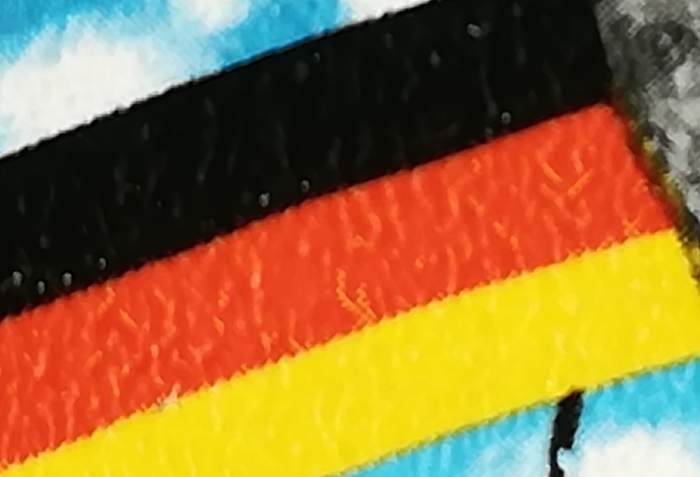
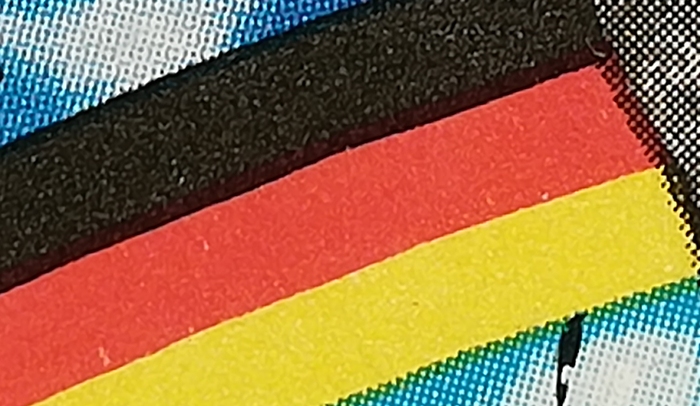
I am interested to gauge what other people think about the printing process used for some Hong Kong stamps.
The famous British Machin has a colourful nephew from Hong Kong.

These stamps exist from counter sheets, booklets, machine-vended coils and souvenir sheets. They were printed by Joh. Enschedé and Leigh-Mardon. The latter only printed booklets. Stanley Gibbons has a basic listing. The Deegam handbook has a more extensive listing. Yang also lists these stamps.
In 2013, a series of articles on the stamps by Daniel Tangri was published in The Bookmark Journal of the Modern British Philatelic Circle, vol. 43, nrs. 4-6 and vol. 44, nr. 1. Vol. 44, nr. 2 had a "catalogue" of the stamps.
Out of the eleven booklets, nine were books of ten stamps of a single denomination intended for sale from 7-Eleven shops. I acquired these stamps, but out-of-booklet.
1A. The first three were printed by Leigh-Mardon. The Deegam Handbook lists these as being printed in lithography. Daniel Tangry thinks it is safe to assume this is true, as the company printed Australian stamp books using the same process. The site that may not be mentioned here also identifies these as lithography stamps. Since these stamps have fluorescent-coated paper and no watermark, it is safe to assign them to the 7-Eleven books printed by Leigh-Mardon. Below is the top left corner of the $1.90 stamp. The other two values are similar.

1B. Leigh-Mardon also printed a prestige book. The stamps I have came from the panes of the book. This too is identified by Deegam and the site unmentioned as a lithography printing. Daniel Tangri uses the same argument to go along with this. Below is the top left corner of the $1.70 stamp. Again, all stamps from the source show similar features.

2. The second set of three 7-Eleven booklets were issued when tariffs changed. The printer is Joh. Enschedé. Enschedé printed the sheet stamps in photogravure and I am quite content the sheet stamps are photogravure stamps. I am also content my stamps are from another source, that must be the 7-Eleven booklets. Deegam and the site-unmentioned list the stamps from the second (Enschedé) batch of 7-Eleven booklets as lithography printings. Daniel Tangri goes along with this. Below is the top left corner of the $1.20 stamp. Some of the edges may confuse, but the inside of the numerals tends to be clean-cut and the serrated appearance seems to result from what looks like an engraved grid and not droplets running in the printing direction.

3. The third batch of 7-Eleven booklets were again printed by Enschedé. If not for the printing process, it might be difficult to distinguish booklet stamps from sheet stamps. The booklet stamps are a little paler, but a little paler is not always obvious. The sheet stamps were, without doubt, printed in photogravure. Deegam and the site unmentioned list the stamps from the 7-Eleven books as printed in lithography. Daniel Tangri also writes they were printed in lithography. But in section E of his catalogue, he lists them as gravure-printed by Enschedé. Below is the top left corner of the $3.10 stamp.

4. And then there is another Enschedé printing for a prestige book and miniature sheet. Deegam and the site list these as lithography stamps. Daniel Tangri never mentions the printing process, but section F of his catalogue again states "gravure" as the printing process. I took these out of the miniature sheets. The booklet panes are larger. Below are the top left corners of the $1.60 and $5 stamps.


Now, if Deegam is correct, I have just posted six top left corners of stamps printed in lithography. If Daniel Tangri's catalogue is correct, four are lithography and two are gravure. If the article is correct, four are lithography stamps, one has an identity crisis and the sixth is an unwanted orphan only explicitly mentioned in the catalogue as being of the gravure persuasion. The full image is doubtlessly a photogravure stamp.
Any thoughts one these?





 Posted 03/07/2021 11:12 am