| Author |
 Replies: 45 / Views: 3,754 Replies: 45 / Views: 3,754 |
|
|
|
Pillar Of The Community
France, Metropolitan
3756 Posts |
|
|
John Becker; One could use infrared spectroscopy to iliminate the real from the fake.all you have to do is get a bunch of stamps on cover with a given overprint.Also a 100 or so single stamps and analyse all of them and I am sure one would arrive at conclusive markers to differentiate the old inks and not so old inks. It is easy to say but in reality a complicated task. A classic analysis on Chile Colon 1st issues stamps: https://repository.si.edu/bitstream...&isAllowed=y |
Send note to Staff 
|
|
|
Bedrock Of The Community
12742 Posts |
|
|
Pillar Of The Community
6363 Posts |
|
|
Bedrock Of The Community
12742 Posts |
|
|
And it is how Chris Ceremuga certifies the consular overprints. He analyzes the ink. The ink of the originals is not the same as the Stolow fakes. It is different ink. It is a common method in expertizing to analyze the ink. Not 100% useful 100% of the time but it frequently provides the answer. If the OP's stamps were overprinted in the same printing facility using the same materials you may not get a definitive answer but if the ink was sourced elsewhere it can likely be determined. If they were my stamps I would have them expertized. As Ceremuga states on his website: Quote:
Advanced technical equipment for expertizing & extensive examination experience built upon my scientific background (BSc-Hons).
Examination equipment ranges from standard magnifiers, light sources, microscopes, scanning/image processing, to advanced scientific equipment that is at forefront of forensic examination techniques in philately,
including:
(a) special Leitz scientific microscope with 630x magnification for transmitted lighting comparison of composition/structure of overprint inks & paper fibers.
(b) Foster & Freeman VSC-4C Video Spectral Comparator for comparison of the optical properties of inks under full range of wavelengths (IR-VIS-UV), and especially for detection of removed cancels & other alterations. |
|
Send note to Staff
|
|
|
Pillar Of The Community
France, Metropolitan
3756 Posts |
|
|
Nice analysis rogdcam. Came up with this comparitive between the op's stamp;a stamp signed Roumet and Brun,and a stamp not expertized where the seller was asking a high price.(In fact he sold a few with this same overprint form). Notice the easy flow and elegance of the arabic characters identical in the Roumet and OP stamps.I checked the normal overprint types and they are identical in the lower value stamps. 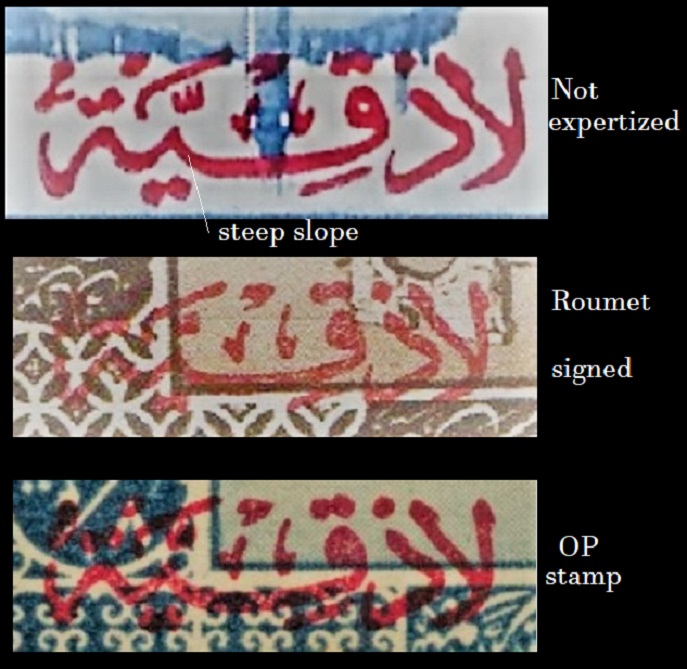 |
|
Send note to Staff
|
|
|
Bedrock Of The Community
12742 Posts |
|
|
Excellent comparison Perf12. IMHO the OP's stamps should go in for examination. |
|
Send note to Staff
|
|
|
Moderator

United States
12330 Posts |
|
|
I really do not understand why more questions are not asked about 'spectral comparators' (like the often-touted VSC devices) in our hobby, we seem to blindly accept that they produce accurate results. At times it feels like we often do not even know what a VSC is or how it works. A VSC is not a piece of equipment that produces an independent analytical result. Instead, a VSC ONLY 'compares'. This obviously, even for a neophyte, begs the question 'compared to what'?
VSC runs spectral analysis by measuring how various ambient light (recall how we often post here color question without ever defining ambient lighting?) bounces off the surface of the stamp or cover. They then 'compare' the measurements taken from the various ambient lighting (both visible lights and near visible lights) with a 'library' of other samples it has in its database.
So the VSC library database is the analytical panacea and the accuracy is 100% dependent upon the quality of the database used in any comparison. Since VSC is designed as a forensic document comparator used primarily to detect bank note forgeries, I assume that it has a well vetted database library of modern inks. But the quality of an existing old stamp overprint, cancel, or cover would be 'custom' addition to the library of any given VSC.
"Garbage in, garbage out" applies ,here and no one should blindly accept a VSC comparison without having a high confidence in the quality of the VSC library database being used. So questions such as these come up;
- If the stamp overprint has a match in the database, where did the original match(s) come from, how were they verified as legitimate, and what was the level of confidence in the existing samples?
- How recent is the database, have the owners of the VSC continued the annual maintenance so that they have received updates and upgrades to the database?
- What is the process used to document previous errors in the database?
- Do organizations that use a VSC share their databases or is there significant deltas between VSC databases in our hobby? If there are deltas (and I think there is) how do we understand which organization has the best database for a stamp/cover in hand?
- Obviously as the library database grows confidence would increase. When an organization gives a result based upon a VSC comparison, are we told how many other samples it was compared against? If not, why not?
- Given that a submission might actually greatly improve the organizations capability and knowledgebase, perhaps they ought to be paying/crediting stamp owners for some of these rarities.
Don
|
|
Send note to Staff
|
|
|
|
Bedrock Of The Community
12742 Posts |
|
|
Don - In Ceremuga's case the baseline data comes from extensive reference material such as the PF has for US material. Material with a traceable history (provenance) as well as documentation contemporary to when the stamps were issued. Chris has issued a great many opinions contrary to PF and Hovest opinions when it comes to consular overprints, as an example. There are nuances to the cliche's that are a part of the puzzle as well as how the overprint was applied and what mechanical affect it had on the paper that go along with analyzing the ink itself.
Garbage in - garbage out is absolutely true. In the end all certificates are opinions but it is better than flying blind if you are going to delve into the dangerous world of overprints which have been forged to death.
Step one for the buyer/seller/owner is to rule out obviously spurious items and if all that can be be done has been done move on to the next step if they feel it is warranted. |
|
Send note to Staff
|
|
|
Moderator
United States
12330 Posts |
|
|
Agreed that it is flying blind when we have no definitive understanding or transparency of the quality of the database, its revision history, or its track record. I guess we can simply buy into someone telling us that it is full of high quality, vetted samples but that is not science or how science works. Science is about transparency and being able to replicate someone else's work which is not possible unless we all use the same library databases in the various VSC's floating around in the hobby (which I am pretty sure are all older, used, second-hand ones).
Don. |
|
Send note to Staff
|
|
|
Bedrock Of The Community
12742 Posts |
|
|
Some of it should be easier than it is. In the case of the consular overprints there are no "cheap" stamps with the same ink and overprint that could be used to establish baselines. The Lattaquie overprints should be easier given that the non-inverted examples and other stamps in a given series are plentiful and inexpensive giving you many sacrificial lambs. But to your point I have my doubts that all expertizing bodies are equal when it comes to utilizing the technology they have at hand given the 180 degree opinions of Ceremuga vs. the PF at times. You have to wonder about methodology, competence and expertise and if some bodies should take a pass on patients outside of their AOR.
To use a car analogy, anybody can buy a device to access their vehicle's computer(s) but actually reprogramming your FORSCAN or equivelant is best left to a certain level of expertise unless you want the horn to blow when you turn on the wipers. |
|
Send note to Staff
|
|
|
Bedrock Of The Community
12742 Posts |
|
|
Pillar Of The Community
France, Metropolitan
3756 Posts |
|
|
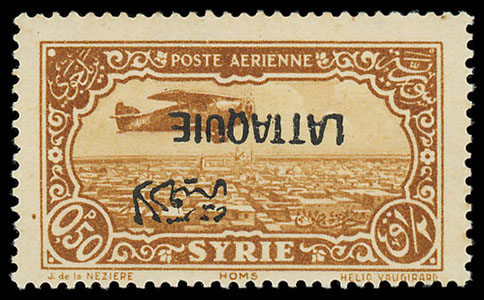
Forgery IMO. The Arab characters are not conform.
As for the latin letters ;they are poorly done. |
|
Send note to Staff
|
|
|
Pillar Of The Community
United States
8599 Posts |
|
|
Pillar Of The Community
United States
8599 Posts |
|
|
In my opinion experts were people who build their own reference library and had studied them for years .They spend thousands of dollars both on reference works and thousands of dollars on stamps . But today we got experts who's claim to fame is by finding other peoples work on the internet and then posting their own opinion so call knowledge on chatroom boards .
On the above stamp from Westpex Rumsey Auction ,the center bar of the "E" is too long ,The style of the "U" is wrong and the two "T's" are different . Then there is all the differences in the Arab script . |
|
Send note to Staff
|
|
|
Bedrock Of The Community
12742 Posts |
|
|
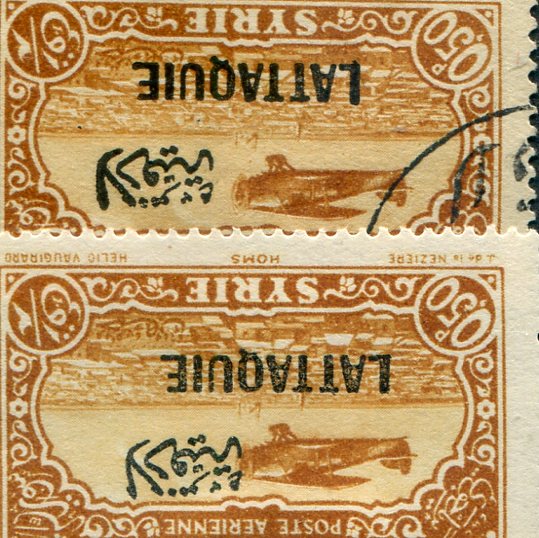
I agree with Floortrader that the overprint is a poor quality forgery. There is a record of one sold at Cherrystone with a Calves cert that looks nothing like the Rumsey stamp.
|
|
Send note to Staff
|
|
|
Replies: 45 / Views: 3,754 |
|



 Posted 12/24/2021 3:36 pm