| Author |
 Replies: 51 / Views: 4,284 Replies: 51 / Views: 4,284 |
|
|
|
Pillar Of The Community
United States
661 Posts |
|
|
Nobody deserves to get screwed, but the simple fact is, it happens. That's just the world that we live in and people need to be responsible enough to recognize the signs and do their due diligence so that they don't get taken. As ridiculous as it is, people still fall for the Nigerian Prince scam. A single Google search would tell them not to hand out their banking details, but apparently, that's too hard for some people to perform. Therefore, it depends on us to not only police the marketplace as much as we can, but to encourage people to know what it is that they're getting into and seek second (or third) opinions before they whip out their credit card. If you're not willing to do that, buy only from respected dealers who will take any bad purchase back, no questions asked. The only reason there are scammers out there is because people keep falling for it. That doesn't make it at all respectable, but the buyer has at least some measure of responsibility too. As with absolutely everything on the planet, buyer beware. |
Send note to Staff 
|
|
|
Bedrock Of The Community
12750 Posts |
|
|
Rule One:
Stop trying to "score" high catalog value fault free material for pennies on the dollar.
Rule Two:
If you insist on purchasing big dollar (you decide your risk tolerance) material that you really know nothing about (be honest) from sellers you have no relationship with require a certificate and CHECK the certificate against a database.
Rule Three:
Ask for help and advice from collectors you trust that know the material you are contemplating purchasing before you pull the trigger. |
|
Send note to Staff
|
|
|
Valued Member
United States
105 Posts |
|
|
good guidelines Rodgcam, as I violated your listed rules 1 & 2. That's what taught me about rule 3.
Getting screwed should never be some type of "rite of passage" for any endeavor, but the reality is if some morally compromised individuals can make easy money they will figure out how.
- Lance |
|
Send note to Staff
|
|
|
Pillar Of The Community
United States
1115 Posts |
|
|
Some good advice and perspectives on this thread.
Love the oracle's reply, and we will never solve capitalism vs. socialism on this board. No matter what the political system, there will always be people trying to dupe others to maximize their profit and others trying to get a bargain and not telling the seller about the deal they have let go through their hands. However I don't think most people are dishonest like this.
So this does NOT mean that all need to go through a "rite of passage" of being screwed.
1. Know who you are buying from.
2. If you don't know who you are buying from or have no prior experience, then no matter what you are buying, gain/have knowledge and be cautious, especially if it seems like a great deal.
3. People are human, they make mistakes. Check the seller's policies, feedback, reviews, etc. I think most sellers are or try to be honest. There are bad apples, but they are in ALL merchandise and places in the world.
4. Bring it to the Stamp Community forum! MUCH great advice is here for free if you are honestly asking for information or advice (not just how valuable...). |
|
Send note to Staff
|
| Edited by orstampman - 03/26/2022 06:45 am |
|
|
Bedrock Of The Community
12750 Posts |
|
|
Good thoughts orstampman.
Another collector I spoke with offline about this topic brought up a great point. People that will endlessly research a $300 appliance prior to purchase from a large well known store will not think twice about spending the same amount on a stamp from an online (Ebay, Hipstamp) seller based upon one or two scans and a few words of description.
Turn your stamp purchasing process into a discipline with set steps that you go through before committing and you will remove a lot of stress from what should be an enjoyable endeavor. |
|
Send note to Staff
|
|
|
Moderator

United States
12330 Posts |
|
|
I assume that making informed buying decisions is something that any reasonable adult would do regardless of the nature of the purchase. In this context, what are the 'forces at work' that might cause someone to not do the proper discovery on both the philatelic material they are purchasing and the seller who is offering that philatelic material? One thing is that is being sucked into ebay's marketing of 'you can safely buy for an unknown seller half way around the world' which is only partly true. But many folks have bought into this completely and are fine with blindly and anonymously sending significant amounts of money to someone half way around the world where they have no legal recourse. Yes, ebay will certainly cover lesser amounts since it costs them more to push back or drag out negotiations. But drop a few thousand with an offshore fraudster and do not be surprised if ebay tells you 'sucks to be you'; I have a number of correspondences with folks who have had this experience. But in short, ebay, HipStamp, and other online selling venues are obfuscating seller information and makes it hard for a buyer to make informed decisions about the venders. But a 'perfect storm' develops when buyers not only cannot do discovery on the seller but are also presented with misleading catalog values. In my opinion we, as hobbyists, do not hold catalog publishers responsible enough for the impact that catalog values have on the hobby. By publishing values that often have little relationship to actual market value they mislead buyers and encourage 'treasure hunting'. It takes special knowledge to understand and even come close to extrapolating a market value from a catalog value. Accounting for quality of the material being offered, condition, ephemeral market demands, is mentioned in the fine print forwards of some catalogs but the truth is they know many folks page to a stamp value and just run with it. There is significant motivation for catalog publishers to use higher than market values but that is for another thread, the take away here is that the higher than market value numbers used in many catalogs works towards people making poor buying decisions. While there are no doubt more factors at play the two things outlined above are, from my chair, damaging our hobby. The internet was in many ways good fit for our independent-centric hobby. But the internet has also opened the door for new opportunities for the hobby to hang itself and in my opinion shrugging off this as 'buyer beware' only serves to make things worse. Anyone with an IQ over room temperature knows that making informed decisions is an important responsibility, but to dismiss or ignore the impact of the internet on our hobby is not wise. Communities like this help, as do other websites that help promote hobbyists in making informed decisions. But having only 5% - 10% of the people in our hobby care about this situation is something much less than ideal. Having people feel that 'hey, I learned the hard way and others should pay the prince for their stupidity too' is also something less than ideal. We should all want to improve the health of the hobby and I wish that this objective was considered much more (which is why I invest time in this community and into Stamp Smarter). Don |
|
Send note to Staff
|
|
|
|
Valued Member
United States
57 Posts |
|
|
I previously owned this well centered 292 hinged. I sold this through a major East coast auction house. Within a year the exact same stamp (I has a photo copy of it) was being offered on ebay as a 292 never hinged stamp. His listing commented of what a great stamp it was by that ebay seller. I had never heard of him before or since. I sent that ebay seller an email informing him that this had been my stamp and defintely had been hinged when I sold it at the dealer's auction. The ebay seller responded to me that "he was a long time dealer and he certainly knew that the copy he was offering was, with his considerable knowledge of gums, indeed it was a never hinged stamp. He refused my suggestion that he add a "buyer be cautious" clause to his listing, and instead sold the stamp as a never hinged, as "one of the finest" for a significant profit. The top row shows a guide line across that row of perfs, as his did also since the ebay stamp was identical to mine. So I have to agree with others here who find that dealing with any auction house needs to proceed with eyes wide open. One can't rely on the stamp publications to call out those dealers who don't have your best interest in mind. 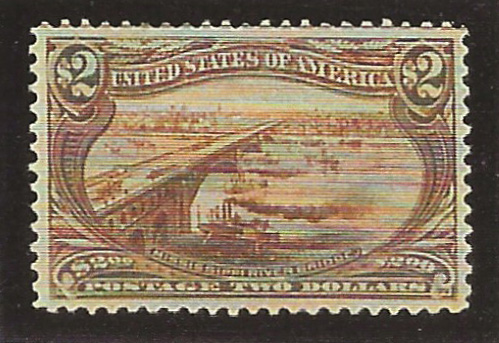 My old hinged 292... |
|
Send note to Staff
|
|
|
Bedrock Of The Community
12750 Posts |
|
|
Pillar Of The Community
United States
8606 Posts |
|
|
Sounds like a lot of crying is going on here......The big problem in the hobby is not even being discussed here ..... I grew up buying stamps from the old time stamp dealers these are the old farts from Chicago and specially New York City . Back in the day they were good they could scam any new collector and they had years of learning how to do it and even built up a relation with those they conn-ed . The customers would come back to spend more money ,yes the old dealers knew their stuff . But ....... these young Turks of today who live on ebay are discussing they couldn't even steal from their Grandmother .....no training and no loyality to those who they rip-off . They just dream up crap and think they are the first ones to figure out how to rip people off .......just poor idiots . They don't know the old time tested methods of making money ,they only know how to grab and run ! No class just street thugs . The old timers sold you a story and showed you the material and then ripped you off ,these damm kids just grab your money ......... The old days you could rip=off 50 or 100 customers around the U.S. and as long as you had your membership society badge on no body complainted but now rip off one customer and they are on a chatboard crying with your name in bold letters. It comes down to learning how the old timers did it .The old timers would say it was made clear in our discussion before the purchase but now everything is in black and white on a screen and can be made into a historical record , years ago when you sold something you told the buyer "I had it checked out with the big time dealer who visited the show yesterday ,he said it was ok,so buy it now before it is gone " there just isn't any of that type of talk anymore ........sad .....the crooks today are amatuers . |
|
Send note to Staff
|
| Edited by floortrader - 03/26/2022 6:20 pm |
|
|
Pillar Of The Community

United States
542 Posts |
|
|
Pillar Of The Community
Australia
3299 Posts |
|
|
I've certainly had my share of interesting experiences over the last 40 odd years. There'll always be someone out there trying to make a quick buck, but, if you're going to spend a decent sum, the more vital it is to know your subject. I've spent good money on ebay from reputable sellers, and there are plenty of them. I've also had less than satisfactory transactions from bricks and mortar sellers/auctions too. If you're confident enough in your knowledge, call out sellers/auctions when you spy an error in a listing. 99% of the time they'll be grateful you did, and more often than not you'll get a thankful reply. |
|
Send note to Staff
|
| Edited by Bobby De La Rue - 03/26/2022 6:51 pm |
|
|
Bedrock Of The Community
Australia
38679 Posts |
|
|
Quote:
but, if you're going to spend a decent sum, the more vital it is to know your subject Agree there Bobby, I was thinking about the recent knowledge, that my Turkey sheet I paid $80 for, was a hoax. I don't consider myself "screwed", I took a punt, I had not seen that item in 10 years of collecting, could not find any printed informatiom on the item, and had 1 chance to secure it, after another collector paid $200. I would do the same again, under that criteria. Had I not purchased it, and it had been a scarcity, I would have felt a whole lot worse. If I recall accurately, I think the reserve was $10, so there was no untowards by my dealer, I think we all were ignorant of what it really was. |
|
Send note to Staff
|
|
|
Valued Member
United States
57 Posts |
|
|
Rogdam....No, no cert on the 293 when I sold it to the auction house. When the different seller listed it, it had no cert either. Can you check with the American Philatelic Society or the Philatelic Foundation, etc. to see if that same stamp is now certified? In my years of collecting I've never had more than a few dozen stamps certified. Yes, I had some surprises on the negative side there.  Rhett...you were correct...I can see that depending on my memory for the correct scott number while typing can be like tossing hand grenades. Luckily the picture is more accurate than my mind. Thanks to you both |
|
Send note to Staff
|
|
|
Valued Member
United Kingdom
439 Posts |
|
|
Certificates aside: Wrong is wrong, no sale or trade should be based on lies, half truths or deceit. Buyers should be aware of things like seller ignorance, malice. greed, likelihood of the description being accurate. These precautions should be taken by the buyer. The Seller must never knowingly lie or set out to deceive. The seller should be aware of there own limitations in identifying stamps. |
|
Send note to Staff
|
|
|
Bedrock Of The Community
12750 Posts |
|
|
Replies: 51 / Views: 4,284 |
|




 Posted 03/25/2022 6:31 pm


