| Author |
 Replies: 24 / Views: 1,705 Replies: 24 / Views: 1,705 |
|
Valued Member
United Kingdom
8 Posts |
|
|
Hi All, I have a stamp from Victoria: SG376, 1901, 1/2d bluish green In SG and in Kellow this stamp is listed as having 12x12.5 perforations. This one is 12.5x12.5. I know that perforations for Victoria are a tricky topic. I've looked at Kellow and searched the web, and no refence to 12.5 on the horizontal. Kellow says only: "Perforations was by the 12 x 12 1/2 comb machine operating on a horizontal pair; the alternate lines completed by a single-line perf. 12 1/2 machine." Sadly the stampsofvictoria.com website appears to have dissappeared. Can anyone shed any light on this? Or is there something really obvious that I have missed. Scanned image below against Instanta perf gauge (Tricky to scan but I think this shows clearly enough not an error on my part in measuring). 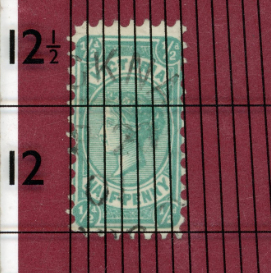 Thanks for any advice |
|
Send note to Staff
|
|
|
|
|
Pillar Of The Community
Australia
3299 Posts |
|
|
Hi Chris,
Hopefully someone with the old Australian Commonwealth Specialists Catalogue (that had the Australian States from the Commonwealth period included) can chime in here.
Gibbons rounds perforations to the nearest half step so maybe it's something like 12.2 x 12.5 |
Send note to Staff 
|
| Edited by Bobby De La Rue - 10/29/2022 4:49 pm |
|
|
Bedrock Of The Community
Australia
38679 Posts |
|
|
Opinion,
I am well aware of the difficulty of scanning stamps on guage,
but I would suggest your image, the teeth are increasingly
out of sequence as you go right.
One must slide the guage, so that the first tooth and the last tooth
match perfectly, then assess the teeth in between to establish correct guage.
Any miss match, one must slide the guage to find the above
I have about 300 of these blighters,
if you think you are correct, I'll dig out my perf guage. (Instanta)
|
|
Send note to Staff
|
| Edited by rod222 - 10/29/2022 6:48 pm |
|
|
Bedrock Of The Community
Australia
38679 Posts |
|
|
Quote:
Hopefully someone with the old Australian Commonwealth Specialists Catalogue (that had the Australian States from the Commonwealth period included) can chime in here. ½d Perforation 12.2 x 12.4 comb across horizontal pairs The vertical line between each pair, completed by a 12.4 Line Machine Brusden White Section 1 Victoria Page 1/236 2004 Early Federal period Being a comb perforator, then top guaging MUST be 12.2 |
|
Send note to Staff
|
| Edited by rod222 - 10/29/2022 6:57 pm |
|
|
Pillar Of The Community
Australia
3299 Posts |
|
|
Bedrock Of The Community
Australia
38679 Posts |
|
|
I learned as well Bobby,  Never would have guessed these were Comb / Line perf ! From that we can postulate, any stamp having a "dent" type perf hole on the left or right hand, would be left or right of the comb pair. Now you would expect the same at the bottom, but that does not seem to fit my examples  Scans arriving soonHow could one guess these were Comb / line There are no giveaway (consistant) "dent" corners In the first image, you can see the straight perfs either side (comb) and the skewed centre punctures (line) Why don't the left and right corners show dents? 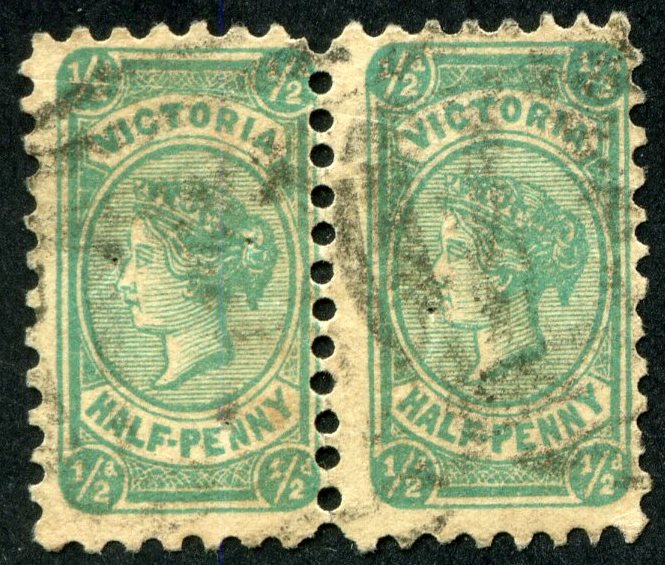 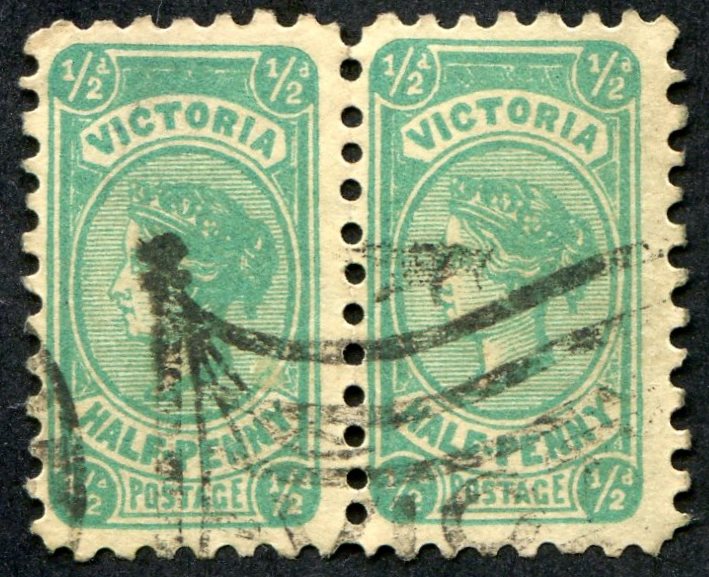 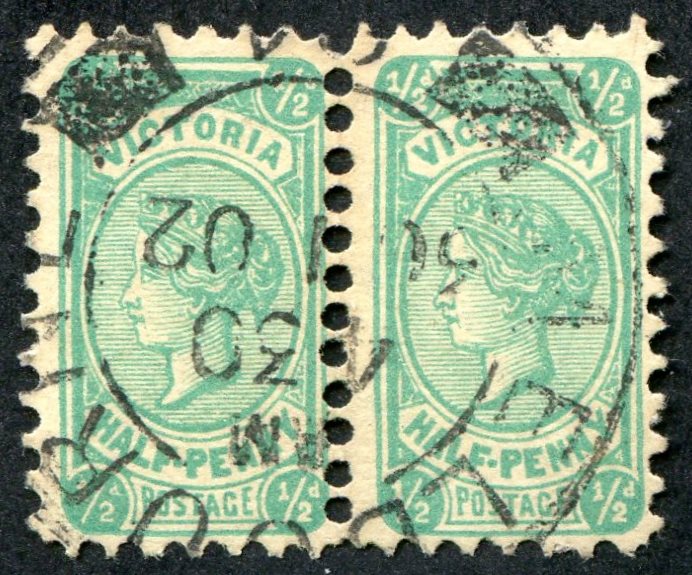 |
|
Send note to Staff
|
| Edited by rod222 - 10/29/2022 10:15 pm |
|
|
Pillar Of The Community
Australia
3299 Posts |
|
|
I must admit that this is the first time I've heard of comb and line perforation occurring on the one sheet.
Very interesting! |
|
Send note to Staff
|
|
|
Valued Member
United Kingdom
8 Posts |
|
|
Thank you both Bobby, Rod, for your interest and answers. Maybe just my dodgy measuring and scanning - gave up after a while on the first attempts yesterday apologies. Tried to do better with these two below. Still seems to be showing approx.12.6-12.7 on the top gauging. I've taken a measurement also against the 12.2 gauge also for comparison with what it should be as per Brusden. Although maybe I am still doing something wrong, I think I got the stamps straight enough, and the points on the gauge lines (for the first one). 12.7 - I think. 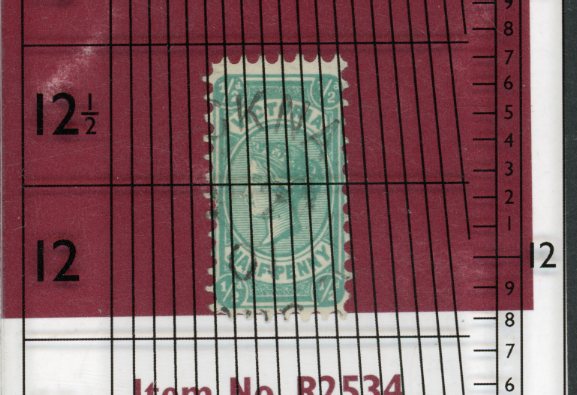 And also photo from my phone - a fraction straighter (eventually gave up on the scanner - too frustrating) 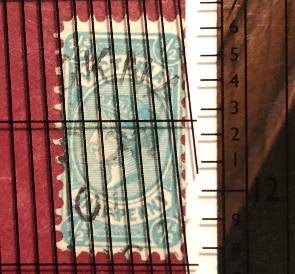 12.2 - Definetely not 12.2 imho, as show the gauge lines on the left of first perf. and the right of last perf. 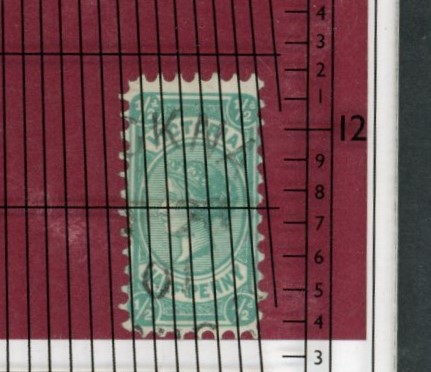 Also on the subject of the comb / line horizontal, here is a block of four on the later 'with postage' type showing the difference quite nicely I think. 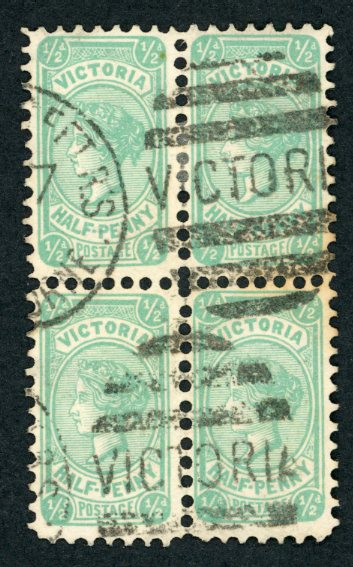 Thanks again, Chris |
|
Send note to Staff
|
| Edited by chris.evans - 10/30/2022 1:24 pm |
|
|
Bedrock Of The Community
Australia
38679 Posts |
|
|
Thanks for the block of 4 Chris  excellent. I am wondering if you guage across the two stamps if the 12.2 comes up? Guaging across 1 may create errors, bent pins etc. Your scan further confuses me, I just cannot see how these were punctured by a comb perforator. Posted in another thread FYI Perforation is an inexact science, it is not meant to be. nor was it intended to be, a scientific response. Unless there is some fine discrepency, between identical issues on different perforators, perf definitions are always approximate, and taken to the closest millimetre. A stamp measuring 11.3 for example, is generally referred to as perf 11 stamp, simply because the finer measurement is not relevant, and probably wrong anyway. (ergo, this does not explain Brusden White's fine definition of guaging here) |
|
Send note to Staff
|
|
|
Bedrock Of The Community
Australia
38679 Posts |
|
|
Block of 4 Postmark (EET.RS)
Railway Station Melbourne
Can be one of 3, from 498 Railway Stations
Burrumbeet RS
Flinders Street RS
Spencer Street RS
|
|
Send note to Staff
|
|
|
Bedrock Of The Community
12767 Posts |
|
|
I have been following this thread with interest and am still confused. Given that the advantage of comb perforating is that paper handling decreases significantly why was this done? Comb perforators perforate three sides at once and then the operator advances the sheet by one row and repeats. Why introduce line perforating into the process which means that you now have to turn the sheet to run the line perforations AND use a second machine. And what was the comb perorating pattern? Comb perf once and then skip a row? A real headscratcher. |
|
Send note to Staff
|
|
|
Bedrock Of The Community
Australia
38679 Posts |
|
|
We are all confused Rog, The use of a comb style perforating jig, was to save time. In this case vast time, and possible damage, by line perforating these tiny "bantams" The Comb punch and die, could come in 3 designs (my rough sketch) 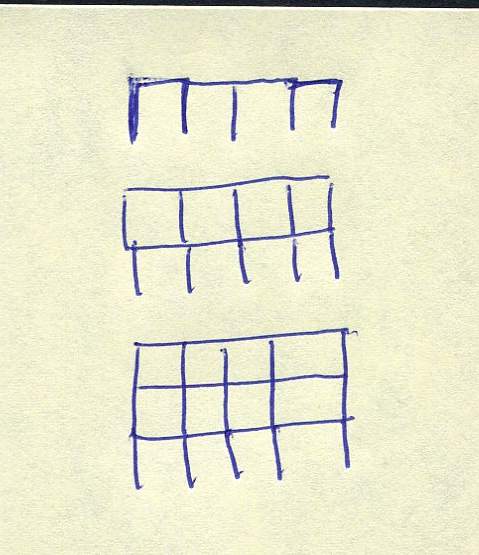 Understandably, the production of each die would be expensive So (I guess) the design of these bantams was to accommodate a presently held comb die. (guess; Employing the Aussie "Grover" perforator. Here is a scan of the Grover pins punch to illustrate. 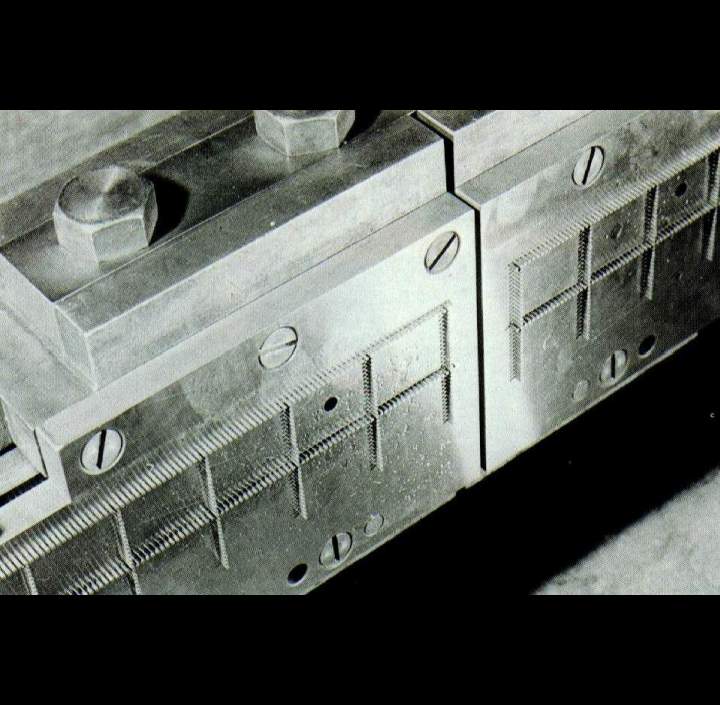 It is, by rationale, identified on postage stamps, by the corner dents made by the perfect symmetry of the comb. See the "dents" in the corners of this King George V stamp this would not occur in line perforating 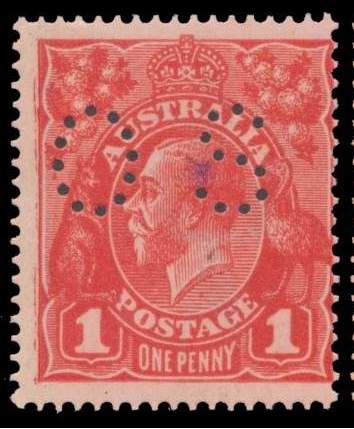 The last problem, is what orientation did the sheet stamps pass through the perforator ? Horiz as shown in the above (bantam) images, or on their side? |
|
Send note to Staff
|
| Edited by rod222 - 10/30/2022 7:42 pm |
|
|
Bedrock Of The Community
12767 Posts |
|
|
Bedrock Of The Community
12767 Posts |
|
|
Here's a thought. They of course already had the comb set up for regular (non-bantam) stamps and ran with it which left the middle, which would have been the center of a regular stamp but was now the space between two bantam stamps unperforated. Of course, this ties into what you said about the expense of a new or modified die. |
|
Send note to Staff
|
|
|
Bedrock Of The Community
Australia
38679 Posts |
|
|
Our resident specialist "FairdinkumStamps" is the "go to"
but may be on holidays at present.
Sheet stamps :
Six electrotype plates were used, each 240 stamps on, in 12 rows of 20
The die exists in three states.
|
|
Send note to Staff
|
|
|
Bedrock Of The Community
Australia
38679 Posts |
|
|
Quote:
Here's a thought. They of course already had the comb set up for regular (non-bantam) stamps and ran with it which left the middle, which would have been the center of a regular stamp but was now the space between two bantam stamps unperforated. Of course, this ties into what you said about the expense of a new or modified die. Yes, that's exactly as I see it. Update : (note to self) always read the catalogue first  Die state 1 (triangles each side of VICTORIA are dark solid colour) exist in single line perf 11 So comb was not used on these ! Sheesh |
|
Send note to Staff
|
|
|
Replies: 24 / Views: 1,705 |
|



 Posted 10/29/2022 08:04 am


