|
This page may contain links that result in small commissions to keep this free site up and running.

Welcome Guest! Registering and/or logging in will remove the anchor (bottom) ads. It's Free!
To participate in the forum you must log in or register.
| Author |
 Replies: 9 / Views: 914 Replies: 9 / Views: 914 |
|
|
Valued Member
United States
6 Posts |
|
|
I was wandering if anyone within this community could help me identify the color shades, and or the Scott number of any of these classic stamps, as I do have color charts, but with certain colors it does not help that much, as the problem with me is more of actually determining what I am actually seeing. Thank you in advance to anyone who replies to my post. 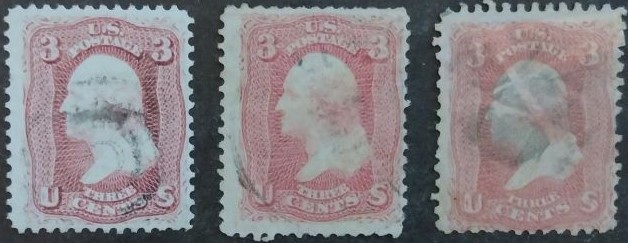 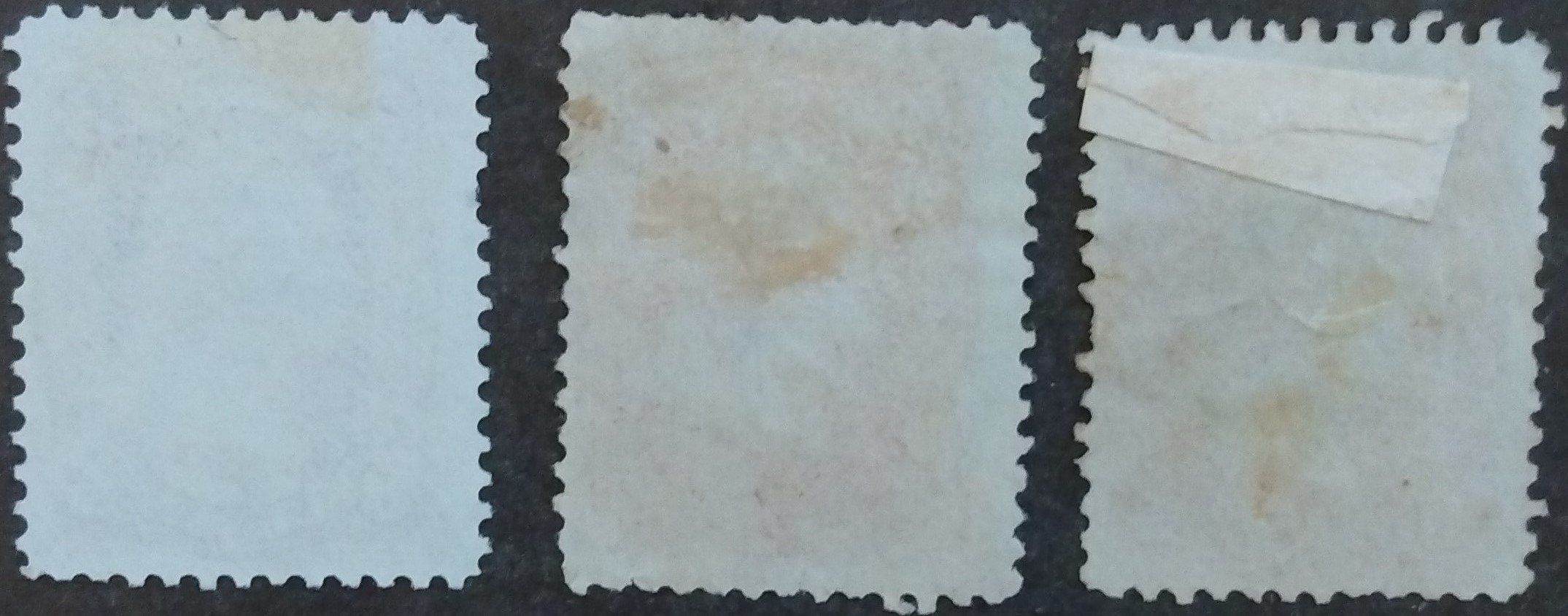 |
|
Send note to Staff
|
|
|
|
|
Moderator

United States
5108 Posts |
|
|
As noted in numerous other posts, it is very, very difficult to determine some colors and shades from scans and how they look on different computer monitors. |
Send note to Staff 
|
|
|
Pillar Of The Community
United States
3224 Posts |
|
|
If your scans show paper as blue for these as I'm seeing, it will not allow for proper color determination. You need to calibrate your scanner at minimum.
May I ask, what color charts do you have?
|
|
Send note to Staff
|
| Edited by hy-brasil - 04/10/2023 3:48 pm |
|
|
Valued Member
United States
6 Posts |
|
|
Thank you for replying to my post, I am using a phone when taking photos, and thanks for the information as I will see if I can find on my camera/phone where to adjust. As far as the color charts, they are not the problem as it is my eyes, as I have trouble seeing certain colors, let alone shades of those colors. Again, thank you. |
|
Send note to Staff
|
|
|
Pillar Of The Community
United States
5471 Posts |
|
|
On top of all the other challenges the color charts also can deteriorate. |
|
Send note to Staff
|
|
|
Moderator

United States
12330 Posts |
|
|
And with a camera, ambient lighting is also critical (its critical with scanned images when people leave the scanner lid open while scanning).
Don
|
|
Send note to Staff
|
|
|
Pillar Of The Community
United States
3224 Posts |
|
|
pastime8469, to be blunt, if your camera image colors look the same as your actual stamps, and it's due to your vision, then according to your stated limitations, determining shades and some colors are perhaps not going to be very useful to you. Quote:
On top of all the other challenges the color charts also can deteriorate. I'd like you to provide proof of this. Under proper conditions, this really doesn't happen very much if at all. Pantone's suggested lifetime of 5 years clearly appears to be a marketing ploy to sell new expensive color charts, especially since they add new shades every year. All six commercial artists I've asked have never replaced their Pantone books, the books up to 20 or more years old. You don't normally leave color charts open out in the sun or under fluorescent lights, nor your stamps, so are you saying inks are inherently unstable? If so, then all our stamps have irreversible color deterioration and so colors, much less shades, cannot be identified with any precision. Certain carefully imaged stamps on SCF are the proof that proper storage over years leads to excellent preservation of colors. Quote:
And with a camera, ambient lighting is also critical (its critical with scanned images when people leave the scanner lid open while scanning). Don, you're certainly in the camp saying that color charts are unreliable due to deterioration. So why advocate scanner calibration and ambient lighting if colors cannot be reproduced or compared accurately? |
|
Send note to Staff
|
| Edited by hy-brasil - 04/12/2023 05:00 am |
|
|
Bedrock Of The Community
Australia
38679 Posts |
|
|
Here is what I use, now I don't employ it for determining scarcities or "rarities" or try to match it to Catalogues (It is Stanley Gibbons and I use Scott) But what it does do, is give newbies like myself, the different hues of the violets the swing between red and scarlet and vermilion. etc It's a general tool for understanding colours and shades I am quite fond of it. I am certainly aware, these are really no good at all for postmarked stamps, as the black ink can visually confuse the colour underneath, shades are always darker. 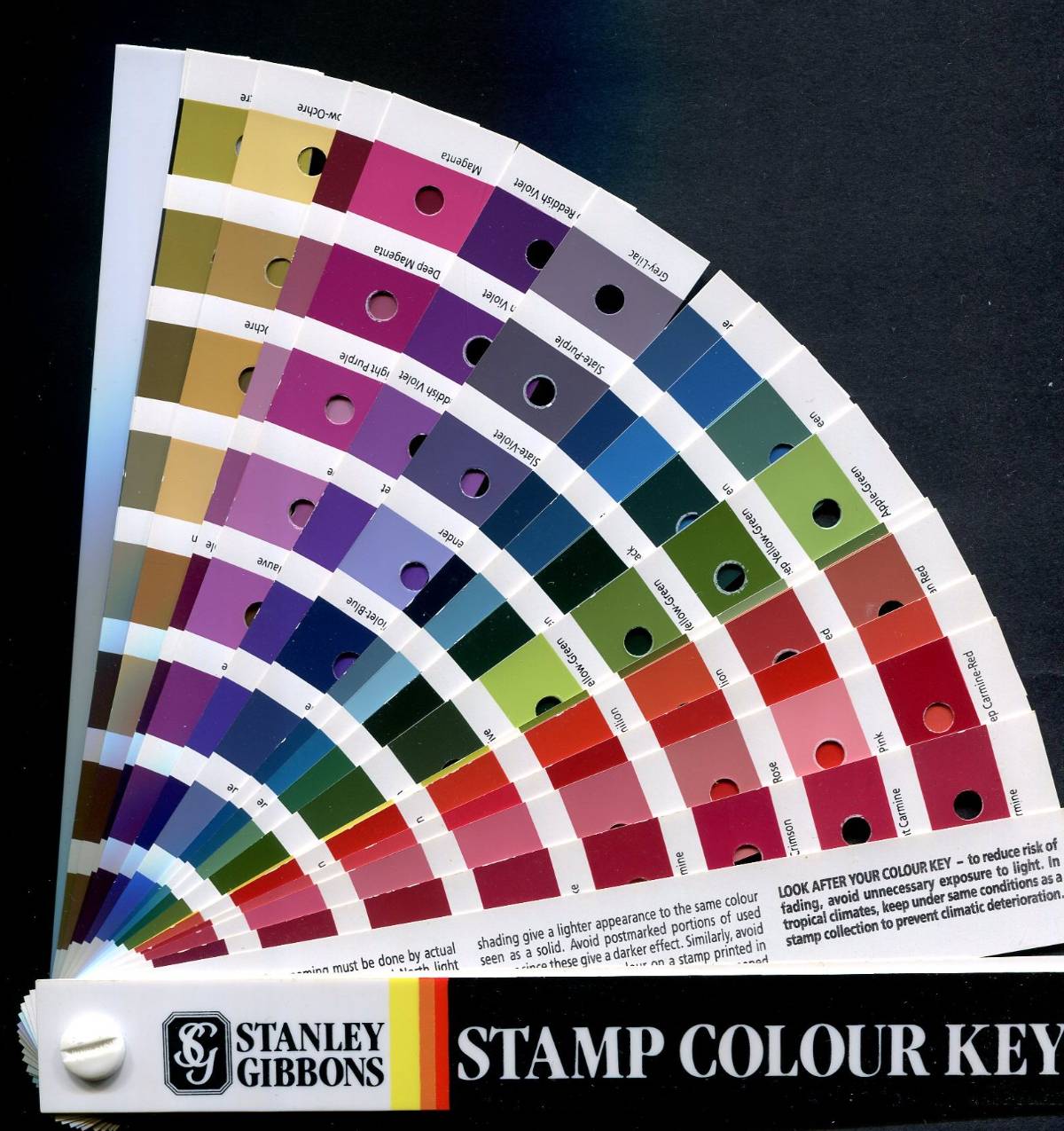 |
|
Send note to Staff
|
| Edited by rod222 - 04/12/2023 05:24 am |
|
|
Moderator
United States
12330 Posts |
|
|
Hi hy-brasil,
The 'camp' I am in includes the business environment where billions of dollars are at stake when trying to match approved colors. The color chart replacement criteria is not just a Pantone suggestion; it is specifically specified in Standards such as ISO and MilSpec.
A typical business color approval process starts by a customer giving a supplier the exact Pantone color or a physical sample to match. These are often the customer's logo or an official company color which has been used for years by the customer. The supplier then develops and produces a sample of their product in that color and sends it back to the customer (a Proof). The customer signs off on it or rejects it. Everyone uses Pantone color charts to perform the color matching during the development approval process and then throughout the entire manufacturing life span of the product (i.e. during incoming receiving for every shipment). The specific Pantone colors are specified and called out for the majority the product's we buy. This is how a company ensured that their colors are consistent across everything that appears with their name on it (i.e Ford blue, Home Depot orange, Coke Cola red, etc.).
This process is the same if you are manufacturing a widget, a sign, a label, a clothing item, a magazine ad, postage stamp etc. Countless law suits have been adjudicated using the Standards and their color matching criteria. When ISO comes into your company for an audit and you have thousands of drawings which call out Pantone colors, you can count on them requesting and reviewing your color charts storage and age. I have confiscated old, retired color charts hidden by engineers and manufacturing employees who do not want to be bothered to go fetch the currently working set from the QA department. While harsh, this could be considered as justification for employee termination.
Are these industry and military Standards (which include requiring color charts to be replaced at least every 5 years) being dictated or controlled by Pantone trying to sell color charts? I doubt it. In business, companies and suppliers spend billions of dollars every year using these standards which rely heavily upon guaranteeing accurate color matching.
And aside of my career experience, I also have experience matching colors in costly car restorations. As anyone who has ever talked to an automotive body shop and car painter will tell you, once a car's paint is more than a year or so old it has changed. You do not just go to a paint book, look up the original color formula and then mix up expensive paint to spray. You match the color, do a spray out (which typically includes using the original formula as a starting point) and them match it to the car you are painting. The majority of time you end up tweaking the spray out color to get the match you need on the actual car.
These are examples of getting a good color match when money is on the line. Yes, there are other situations where 'close enough' could be used when working with color matches. Using an old Pantone chart could be a 'close enough' situations where a lot of money is not on the line or when accuracy does not matter. Pretending that colors do not change over time also works when accuracy does not count.
The cynical 'this is just about profit' theory also works in the opposite direction. For example, I find that many of those who push back on 'color charts have a shelf life' are often those who have an expensive old color chart book sitting on their shelf or purchased an expensive stamp color variety based upon an old color chart. <shrugs>
I would also say that many folks are adamant about their ability to see and identify colors. It is something that the vast majority of us have done since birth and we often feel strong in our abilities. But the truth is that many people have no idea about the science of colors and no experience on matching colors properly. They only know what their eyes and brains are telling them and are willing to make decisions based upon 'close enough'. <shrugs>
RE: ambient light post
I only added this to the litany of reasons why color matching is so challenging. The vast majority of us do not have the experience needed to do accurate color matching but rather fall into the 'close enough' group. An experienced stamp color student understands the impact of ambient lighting on how we all see colors. An experienced stamp color student has a significant reference library of other stamps of the same type. An experienced stamp color student might indeed have old color charts sitting on a shelf by understands that they are not reliable and only uses them in the context of a relative comparison.
The color matching topic has been covered ad nauseam but I am now convinced that there will always be misconceptions and misunderstandings about how we perceive colors. But there are somethings which are factual. Ink/paint colors are ephemeral. Full stop. Colors are 100% dependent upon ambient lighting. Full Stop. Seeing colors are a sensory perception. Full Stop.
Don
Edit: Maybe for many in our hobby 'close enough' works; I have no heartburn with this. But when deciding to go with 'close enough' I hope people would care enough to be educated on basic color theory and color perceptions. If folks have made well informed color decisions and feel that 'close enough' works for them, then that is great. |
|
Send note to Staff
|
|
|
Bedrock Of The Community
12777 Posts |
|
|
The sometimes massive premiums assigned to some color variations by the catalog publishers who in turn were driven to assign them by people with vested interests is in large part responsible for fretting over ink color/shade/hue.
These early stamps were printed in crude, by today's standards, facilities with non-existent uniform lighting utilizing hand mixed materials that could themselves vary considerably. (Thus the varieties)
Almost wish that there were only basic values unless a red stamp was erroneously printed in green, leaving the pursuit of minor varieties in color to the collector to pursue as their prerogative as curiosities or to add depth to a collection.
Perforation and paper varieties are different IMO because they were actually much more controlled components of the process. Mixing inks was more art than science. |
|
Send note to Staff
|
|
| |
Replies: 9 / Views: 914 |
|
|
To participate in the forum you must log in or register. | |
 Scott #498 (1917-1919) Avatar Change Request 2023 Freedem Stamp. Is This Stamp Fake? Transvaal Postal History Help Earliest Stamp With In-Design Date? My First Stamps Help Newbie.help With Stamp Identification (J29) Inherited These Stamps, Are They Genuine? APS Membership Discount Metropex Stamp Show: Roseville, Minnesota October 23-24 Weird Covers, 1885,1886, And 1982 For Users Of Two-Post Blue International Albums What Is Your Experience With Binders. New Member Posting Image Of Avatar, Front And Back Of U2 Cut Square, Market Value Or References? Working On An Offline Collection George Washington 3 Cent 1861 With Print On The Back Hello From The Netherlands - New Member Then And Now, From Old Postcards New Member Wanting To Add An Avatar Sparks Auction Fees? 163 VF Nyfm Vertically Ribbed 163 XF Quartered Cork, Labeled Jumbo 136 VF Quadruple Split H Grill Nashville Philatelic Society-Your Invitation To Our Auction Night Meeting Monday, October 26, 2026 Nashville Philatelic Society-Your Invitation To Our Meeting Monday, October 19, 2026 Christmas Around The World 2026 Scott #498 (1917-1919) Avatar Change Request 2023 Freedem Stamp. Is This Stamp Fake? Transvaal Postal History Help Earliest Stamp With In-Design Date? My First Stamps Help Newbie.help With Stamp Identification (J29) Inherited These Stamps, Are They Genuine? APS Membership Discount Metropex Stamp Show: Roseville, Minnesota October 23-24 Weird Covers, 1885,1886, And 1982 For Users Of Two-Post Blue International Albums What Is Your Experience With Binders. New Member Posting Image Of Avatar, Front And Back Of U2 Cut Square, Market Value Or References? Working On An Offline Collection George Washington 3 Cent 1861 With Print On The Back Hello From The Netherlands - New Member Then And Now, From Old Postcards New Member Wanting To Add An Avatar Sparks Auction Fees? 163 VF Nyfm Vertically Ribbed 163 XF Quartered Cork, Labeled Jumbo 136 VF Quadruple Split H Grill Nashville Philatelic Society-Your Invitation To Our Auction Night Meeting Monday, October 26, 2026 Nashville Philatelic Society-Your Invitation To Our Meeting Monday, October 19, 2026 Christmas Around The World 2026
APS Membership Discount Scott #498 (1917-1919) Women In Our Society: Women's Rights, Empowerment, And Social Progress Help With China Stamps The End Of The Chicago Philatelic Powerhouse . Transvaal Postal History Help 2023 Freedem Stamp. Is This Stamp Fake? Pushing 330,000 All Different Worldwide Stamps In One Collection . Avatar Change Request Inherited These Stamps, Are They Genuine? George Washington 3 Cent 1861 With Print On The Back Scientists Share With US Your Table Tennis Stamps Coat Of Arms Working On An Offline Collection Frogs And Toads On Stamps, Covers And Postmarks. Springback Album..what Is That? Barcelona & Catalonia Cinderellas Stamp Comic - Laugh Of The Day Metropex Stamp Show: Roseville, Minnesota October 23-24 Show Your 1851-61 Era Cancellations And Postal Markings Let's See Your Territorial Covers! Earliest Stamp With In-Design Date? Venues For Art And Culture: Museums, Theatres, Galleries, Concert Halls, Etc. It's Now Cheaper To Use Fedex Ground Than USPS Ground For Some Zip Codes
Disclaimer: While a tremendous amount of effort goes into ensuring the accuracy of the information contained in this site, Stamp Community assumes no liability for errors. Copyright 2005 - 2026 Stamp Community Family - All rights reserved worldwide. Use of any images or content on this website without prior written permission of Stamp Community or the original lender is strictly prohibited.
Privacy Policy / Terms of Use Advertise Here |
| Stamp Community Forum |
© 2007 - 2026 Stamp Community Forums |
| It took 0.19 seconds to lick this stamp. |
 |
|
|
|


 Posted 04/10/2023 12:15 pm


