Stamp Community Family of Web Sites
Thousands of stamps, consistently graded, competitively priced and hundreds of in-depth blog posts to read


Stamp Community Forum
 
Username:
Password:
Save Password
Forgot your Password?

This page may contain links that result in small commissions to keep this free site up and running.

Welcome Guest! Registering and/or logging in will remove the anchor (bottom) ads. It's Free!

Determine Pane Position

 
To participate in the forum you must log in or register.
Author Previous TopicReplies: 14 / Views: 1,215Next Topic  
Valued Member
Learn More...

United States
117 Posts
Posted 05/08/2023   08:58 am  Show Profile Bookmark this topic Add serf_tide to your friends list Get a Link to this Message
I know sheets have been showing the pane position for the past 30 or so years, but how do I tell on sheets prior to that, in say the 1970s? I have a stack of 7 sheets of Scott #1580 for example. How do I look at them and know their position on the original uncut sheet? Related question: I see sometimes Scott says that there were sheets of 4 and sheets of 6 of the same issue, can I only tell which it came from if the perforation is different? If this is as simple as giving me a link to another answer, feel free. I've searched the forum, but can't seem to hit on it. Thanks!
Send note to Staff

Valued Member
Learn More...
United States
117 Posts
Posted 05/08/2023   09:44 am  Show Profile Bookmark this reply Add serf_tide to your friends list  Get a Link to this Reply
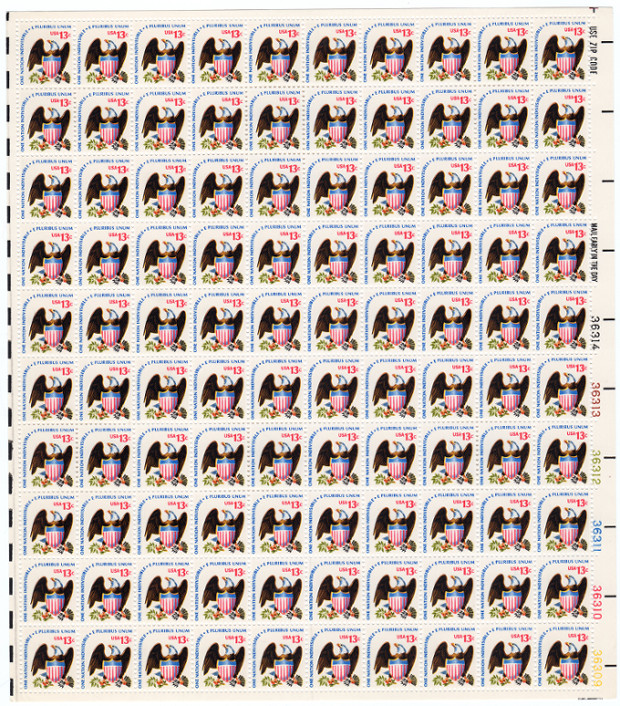
Here is a sheet of 1596 that I just scanned. How do I know the plate position? Thanks.
Send note to Staff  Go to Top of Page
Pillar Of The Community
3859 Posts
Posted 05/08/2023   09:49 am  Show Profile Bookmark this reply Add jogil to your friends list  Get a Link to this Reply
Appears to be a lower right (LR) pane.
Long electric eye lines in middle left.
Plate numbers on bottom outside right.
"+" at top right for cutting sheet into panes.

Look for the corner with the plate number(s).
In this case, it is found at the bottom/lower right side.
Send note to Staff  Go to Top of Page
Edited by jogil - 05/08/2023 10:01 am
Valued Member
276 Posts
Posted 05/08/2023   10:59 am  Show Profile Bookmark this reply Add Perf10 to your friends list  Get a Link to this Reply
judge by the plate numbers because they were put at the four corners of the sheet
Send note to Staff  Go to Top of Page
Valued Member
Learn More...
United States
117 Posts
Posted 05/08/2023   12:02 pm  Show Profile Bookmark this reply Add serf_tide to your friends list  Get a Link to this Reply
So, an UR plate position would have the plate #s running from the UR corner down, in the opposite of the one shown that has them going down to LR corner?
Send note to Staff  Go to Top of Page
Valued Member
Learn More...
United States
117 Posts
Posted 05/08/2023   12:09 pm  Show Profile Bookmark this reply Add serf_tide to your friends list  Get a Link to this Reply
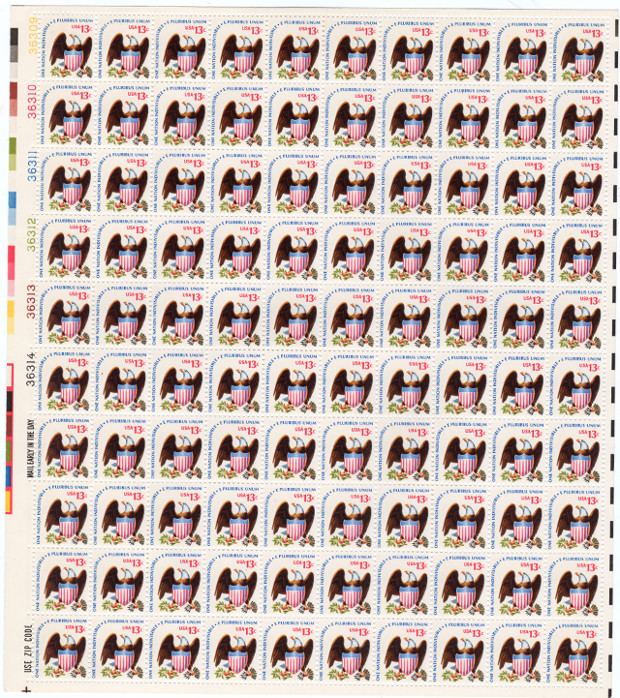
Here is a scan of another that I have. This would be UL? If it had 6 positions, how would the two center ones be lined up?

Send note to Staff  Go to Top of Page
Pillar Of The Community
3859 Posts
Posted 05/08/2023   12:28 pm  Show Profile Bookmark this reply Add jogil to your friends list  Get a Link to this Reply
It would help to have a full intact printed plate proof sheet to compare all sheet markings and their positions to each other. The Smithsonian National Postal Museum might have such a reference plate proof sheet in its collection.
Send note to Staff  Go to Top of Page
Edited by jogil - 05/08/2023 12:36 pm
Pillar Of The Community
Learn More...
United States
1064 Posts
Posted 05/08/2023   1:18 pm  Show Profile Bookmark this reply Add ZebraMan to your friends list  Get a Link to this Reply

Quote:
If it had 6 positions, how would the two center ones be lined up?

I don't know of any 6 position sheets from the 1970s-1980s period that you are looking at. They were all produced as sheets of 4 panes as far as I can recall.

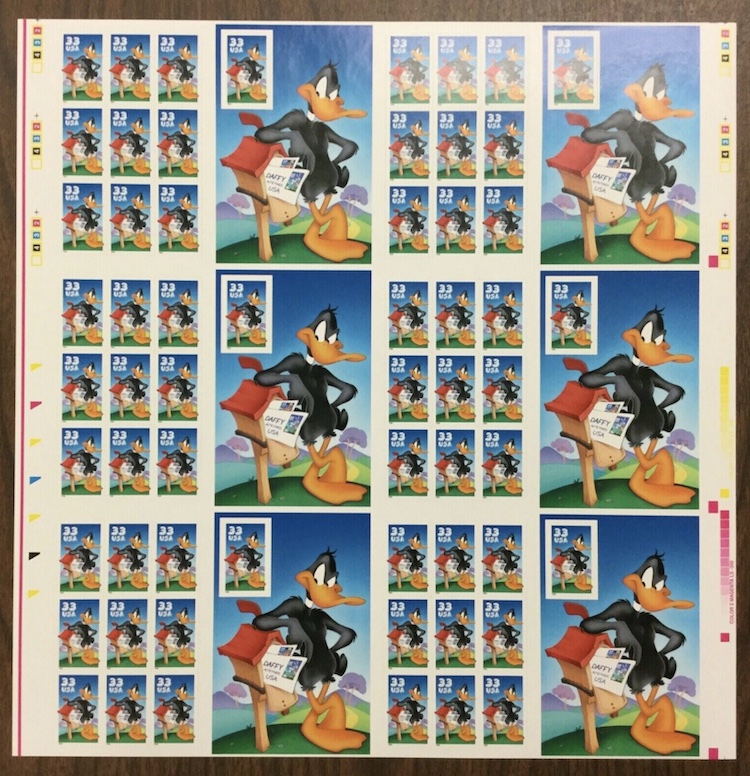
The 6 position sheets are mostly from the modern era of uncut press sheets, like this picture from ebay. Each pane has 4 sets of plate numbers in the 4 corners of each pane. I'm not sure if there is any technical need for this many plate numbers on such a small pane or whether they do it more for tradition or to appease collectors.


Also I don't know if there is any way to tell the plate position from any one of the individual panes once cut down unless they include some of the unique marginal markings seen on some sheets (which you wouldn't get to see when buying single panes from the post office).


Edit: for wording and added a second example photo.
Send note to Staff  Go to Top of Page
Edited by ZebraMan - 05/08/2023 1:28 pm
Pillar Of The Community
United States
8956 Posts
Posted 05/08/2023   2:26 pm  Show Profile Bookmark this reply Add Petert4522 to your friends list  Get a Link to this Reply
The amount of plate numbers do not have a thing to do with the size of the sheet. It indicates how many plates are used to print the different colors on the stamp


Peter
Send note to Staff  Go to Top of Page
Pillar Of The Community
United States
4302 Posts
Posted 05/08/2023   3:42 pm  Show Profile Bookmark this reply Add Parcelpostguy to your friends list  Get a Link to this Reply

Quote:
The amount of plate numbers do not have a thing to do with the size of the sheet. It indicates how many plates are used to print the different colors on the stamp


Interesting for the OP, remember or now understand some multi-color US Stamps were printed from plate and pass due to selective plate inking via ink roller cutouts.

Don't get anyone started on the "Floating Plate Number" issues.


Quote:
The 6 position sheets are mostly from the modern era of uncut press sheets


As press sheets began include more than two or four panes as the per pane image numbers reduced, for collectors plate number(s) and positions were included on the selvage.

However the real push to "plate number every thing" was started with the Transportation Coils where symbolic plate numbers were included in the designs adjacent to the plate lines and continued after plate lines stopped. The single digit number corresponded to a plate used for the color which had a proper plate number but never appeared on the final version of the product for sale. As I predicted in print (carried in Linn's and verified as accurate in Linn's 25 years later) at the time this added number on the coils would spark a huge resurgence in collecting "plate numbers" and cause the Transportation Coils to be hugely popular.

Lastly, understand that plate number were not just used for the stamp designs, but also the gum side printing. As with earlier coils, these number were not visible unless some level of miscutting was present.

Edit:

When you collect stamps, you are just a stamp collector. When you begin to learn about production methods you step over the line into philately. There are many such topic lines which can be crossed into philately--be careful you might enjoy it.
Send note to Staff  Go to Top of Page
Edited by Parcelpostguy - 05/08/2023 3:46 pm
Pillar Of The Community
United States
8956 Posts
Posted 05/08/2023   6:02 pm  Show Profile Bookmark this reply Add Petert4522 to your friends list  Get a Link to this Reply
New one on me: What is "gum side printing" ?

And to be precise, the "plate line" mentioned above was called the "seam line" by the BEP technicians


Peter
Send note to Staff  Go to Top of Page
Valued Member
276 Posts
Posted 05/08/2023   6:09 pm  Show Profile Bookmark this reply Add Perf10 to your friends list  Get a Link to this Reply

Quote:
So, an UR plate position would have the plate #s running from the UR corner down, in the opposite of the one shown that has them going down to LR corner?


yes

for the multi-plate number BEP issues, to make the ID process simpler, reference only the number at the corner
Send note to Staff  Go to Top of Page
Valued Member
276 Posts
Posted 05/08/2023   6:11 pm  Show Profile Bookmark this reply Add Perf10 to your friends list  Get a Link to this Reply
gum side printing was inscriptions on the back (gum) side of the stamps, I think the Postal People issue was the first example
Send note to Staff  Go to Top of Page
Valued Member
248 Posts
Posted 07/01/2023   9:19 pm  Show Profile Bookmark this reply Add chris s to your friends list  Get a Link to this Reply
Thanks Parcelpostguy for the info.

Didn't know gum side printing existed before self-adhesive stamps. But it now makes sense the use of Back number coils on coil strips as it was predated by gum side printing I would think.

I am beginning to slip into being a philatelists as I have discovered the fun of trying to get a SELF-ADHESIVE coil stamp with a plate number on the front AND a back number on the reverse paper. The oddity of collecting these is you can never get one used as the back number is on the paper from which you would peel off the stamp! However, their frequency is usually 1 out of every 270 - 300 coil stamps. This means that out of a run of 100 million stamps only about 3.5 million would have on one coil stamp both a plate number and back number. And consider that this is a subniche of pnc collectors those that are kept is fewer than those just with a plate number. The problem of course is making sure heirs who are non-philatelist do NOT use such a stamp.
Send note to Staff  Go to Top of Page
Valued Member
248 Posts
Posted 07/01/2023   10:43 pm  Show Profile Bookmark this reply Add chris s to your friends list  Get a Link to this Reply
Thanks Parcelpostguy for the info.

Didn't know gum side printing existed before self-adhesive stamps. But it now makes sense the use of Back number coils on coil strips as it was predated by gum side printing I would think.

I am beginning to slip into being a philatelists as I have discovered the fun of trying to get a SELF-ADHESIVE coil stamp with a plate number on the front AND a back number on the reverse paper. The oddity of collecting these is you can never get one used as the back number is on the paper from which you would peel off the stamp for use! However, their frequency is usually 1 out of every 270 - 300 coil stamps. This means that out of a run of 100 million stamps only about 3.5 million would have one coil stamp with both a plate number and back number. And consider that this is a subniche of pnc collectors those that are kept is fewer than those just with a plate number. The problem of course is making sure heirs who are non-philatelist do NOT use such a stamp.
Send note to Staff  Go to Top of Page
  Previous TopicReplies: 14 / Views: 1,215Next Topic  
 
To participate in the forum you must log in or register.

Go to Top of Page

Disclaimer: While a tremendous amount of effort goes into ensuring the accuracy of the information contained in this site, Stamp Community assumes no liability for errors. Copyright 2005 - 2026 Stamp Community Family - All rights reserved worldwide. Use of any images or content on this website without prior written permission of Stamp Community or the original lender is strictly prohibited.
Privacy Policy / Terms of Use    Advertise Here
Stamp Community Forum © 2007 - 2026 Stamp Community Forums
It took 0.31 seconds to lick this stamp. Powered By: Snitz Forums 2000 Version 3.4.05