|
This page may contain links that result in small commissions to keep this free site up and running.

Welcome Guest! Registering and/or logging in will remove the anchor (bottom) ads. It's Free!
To participate in the forum you must log in or register.
| Author |
 Replies: 12 / Views: 1,720 Replies: 12 / Views: 1,720 |
|
|
Valued Member
Canada
35 Posts |
|
|
Hi, it's me again with another strange question! It might be obvious, but I would like to make sure I in the good way... I'm digging on the south african springbuck serie, looking to 2d reduced size yesterday, no big challenge there. But 1 found a 3rd size of the 2d, a bit smaller! 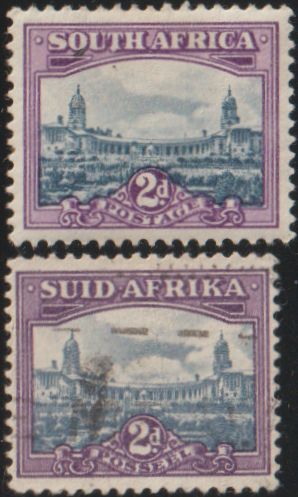 I was reading to "The Springbok" magazine the other day and in first volume, they wrote about narrow perf in South African stamps. " The perforating mechanism forming part of the rotary machine on which the stamps is showing this variety are printed, is of the multiple comb type, which in this case perforates a group of eleven rows at each beat." They said that sometimes, alignment is not perfect, what creates a narrower row in the middle. If I understood, they are talking about 1mm or so as identifiable. We just need to notice that perf is same on 2 stamps, and there is on less perf in the smaller. edited : there are 22 rows in standard size African sheets for that serie counting margins So, is that what they call narrow perforation and what do you think about that smaller sample? I found 1 out of maybe 30, found from different sources. If I got it, I guess that narrow perfs are not exclusive to South Africa... Thanks, I been looking for some kind of answers but people here rocks, I still try to dig as deep as possible before ask! Marc |
|
Send note to Staff
|
| Edited by nar1123 - 08/17/2023 5:05 pm |
|
|
|
|
Valued Member
United States
328 Posts |
|
|
Interesting post.
I assume if you measure the actual width of the printed design it will be the same as the other one. Assuming that is true your lower stamp definitely has a more narrow margin which would indicate that the vertical perfs were cut closer on this one. |
Send note to Staff 
|
|
|
|
Valued Member
Canada
35 Posts |
|
|
I cut another as a gauge for other 22mm frame, there is a tiny difference... It broke my heart to put the cisor on in but it will be usefull to distinguish 22mm frames of this very interesting and affordable serie. I never eard about some printing of this stamp with let say 21.75mm X 17.75mm, that is why I think difference come from one had more ink than the other... 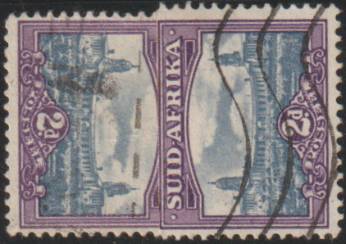 This stamp don't have lot of different issues, and the priting of this size may be on a same grid as for the 1/2d or 1d... so narrow row would be on vertical sides of the small 2d... I need to get some graphic software to elaborate more! 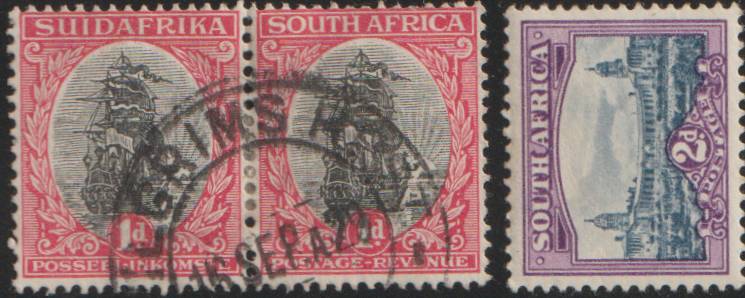 I didn't searched for that one but I have one from Argentina that is bigger than other, maybe it is totally different thing, but still interesting... Some of that time are just a bit different size between issues but I didn't saw listings for that specific one. 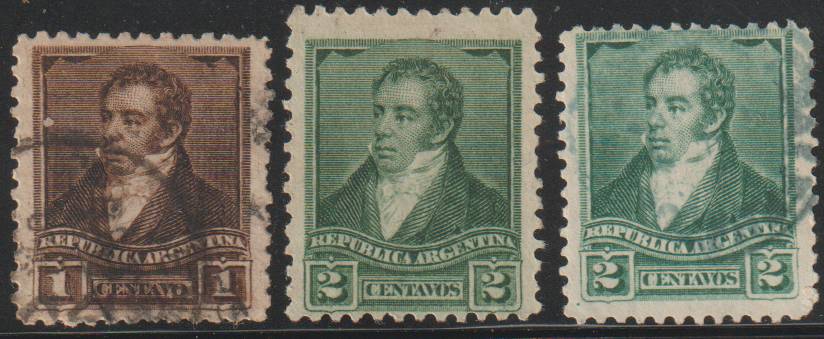 the 1c and the large 2c are wmk. 85, the 2nd 2c is wmk.86. I won't cut to the frame because I don't have a lot of those and not sure if I will study them! But they looks to be same size, one is just cut bigger. I try to find the link to the article I been talking about but I don't remember where I downloaded the PDF, sorry, but it only talks about narrow, I didn't noticed about larger possibility, but I don't see why it wouldn't be physically possible. Thanks for your interest, it helps me to find a solution! Marc. |
|
Send note to Staff
|
|
|
Valued Member
United States
328 Posts |
|
|
There are other examples where the actual printed portion of the stamp varies in size. The Grenada 10/ stamp (see my image) comes in two widths of 24 and 25MM which was caused by printing the stamps on damp paper and later dry paper. The paper actually shrank.
|
|
Send note to Staff
|
|
|
|
Moderator

United States
12330 Posts |
|
|
Stamp design dimension sizes can vary greatly even when printed from the same plate. Consider the US OXF1 Registry Seal  Documented as only ever being printed from a single plate, I have measured the stamp design width as varying from from 70.6 mm to slightly over 72 mm. I believe there several paper variables that can come into play: paper 'grain', paper moisture content at time of printing, paper moisture content at time of measurement. More on this topic in this thread from a few years ago "Chasing Small Physical Stamp Variances" https://goscf.com/t/76973Don |
|
Send note to Staff
|
|
|
|
Pillar Of The Community
Netherlands
6644 Posts |
|
|
The margins on OP's stamps differ in width and the designs do not or hardly so. I would not expect shrinkage to affect the unprinted area much more strongly than the printed area. |
|
Send note to Staff
|
| Edited by NSK - 08/19/2023 11:43 am |
|
|
Valued Member
Canada
440 Posts |
|
|
The Southern Rhodesia 1943 2d Matabeleland Occupation 50th Anniversary stamp was printed by the South African Government Printers in Pretoria. As a result, the stamps in column 8 of the sheet are the narrow variety. 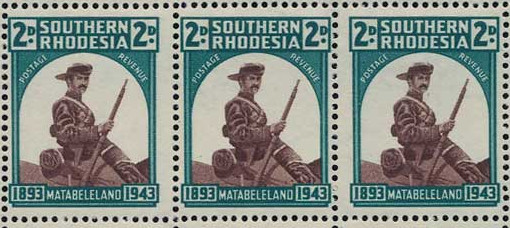 The middle stamp in the image above is the narrow stamp, comparing it to the stamps on either side it can be seen that the left and right margins are almost non-existent although the printed image is the same size. Unfortunately, I am in the middle of a house move with everything packed away, so am unable to actually measure the width of the stamps to compare. Clive |
|
Send note to Staff
|
AlbumEasy - Free software for creating custom stamp album pages ChromaMate - Compare, match, analyse, free colour matching software ImageSleuth - Images, hidden inside images, revealed. A retroReveal alternative PSGSA - The Philatelic Society for Greater Southern Africa |
| Edited by clivel - 08/19/2023 1:05 pm |
|
|
Pillar Of The Community
Israel
1242 Posts |
|
|
If the normal size of the stamp is 24x31, you can calculate with the rule of three the width of the stamps. In stampword they show a scan that is actually very close to the narrow one. |
|
Send note to Staff
|
|
|
Pillar Of The Community
United States
1027 Posts |
|
|
The Argentina aren't good examples of what we are talking about here. They were line perforated, so size is determined by the placement of the sheet as a line is cut, and that placement can vary as much as the operator of the machine wants. From what I understand, a narrow example of a comb perforation happens when the two rows (or columns) overlap by the distance between two perf holes. Since the holes still line up, you don't really see that one hole has been punched out twice, just that there is one less hole on those edges. This happens most often when you use the machine to cut the perforations on one side of the sheet, then turn the sheet to do the other half. A good example of something like that is the '2 perf' pairs from New Zealand during the KGV period. They had two machines to do the comb perforating, with slightly different gauges, and did half of the sheet with one, then the other half with the other. With the NZ examples the two stamps forming the pair often are slightly offset from each other. |
|
Send note to Staff
|
|
|
Pillar Of The Community
Australia
3299 Posts |
|
|
Valued Member
Canada
440 Posts |
|
|
The South African Government Printers in Pretoria used a comb perforator which could perforate a number of perforation rows simultaneously.
As the perforator combs were in a fixed position in relation to each other, in order for the rows of perforations to fall between stamps, the size of the sheets of stamps would of course have to conform exactly to a multiple of the spacing of the rows of the perforator needles.
However, depending on moisture or other factors, the size of a sheet of stamps might vary by a fraction of a millimetre, so, as the rolls of stamps were passed through the perforator, the line of perforations could eventually drift into the design if not corrected.
In order to correct for this, the second strike of the perforator, i.e. the next group of rows, was struck slightly closer to the first, thus causing a "narrow" row of stamps.
As far as I know, this affected all Union of South Africa definitive printed in Pretoria, the Southern Rhodesia 1943 stamps already mentioned, and possibly others that the SA Government Printers may have printed.
Clive
|
|
Send note to Staff
|
AlbumEasy - Free software for creating custom stamp album pages ChromaMate - Compare, match, analyse, free colour matching software ImageSleuth - Images, hidden inside images, revealed. A retroReveal alternative PSGSA - The Philatelic Society for Greater Southern Africa |
| Edited by clivel - 08/21/2023 01:46 am |
|
|
Valued Member
Canada
35 Posts |
|
|
Well, it seems there are many reasons why a stamp can be smaller than his fellows. Sometimes it is meant, sometimes it is a mistake. Argentina is not a good example for that example, just because it is 40 years earlier and different perfortator type. But they are a good example for meant different size on same stamp, as #178 (19mmX25mm) and #196 (18mmX23mm). I agree that South Africa was using a comb perforator perforating many lines at a time. I will refer to an old post on Sweden comb perforator, those were cutting just a row at a time, on 3 sides of the stamps. Again, it is not same thing, the princeps stay similar, the post helped me a lot to figure how it is made and how mistake could happen. There is a picture of a half stamp in it cause by single comb perforator : https://goscf.com/t/61720The small 2d is smaller just on 'width', it is not shrinkage after perforation because 'height' is the same as usual. Also, it is a 1950 printing, South African were getting better and standardized to print stamps. It was at the end of their multiple shades and huge differences between printings. I think it is a mistake of the comb perforator, but I suspect rotogravure printing that shrinked that caused the comb perforation issue, both errors would create the small 2d case :  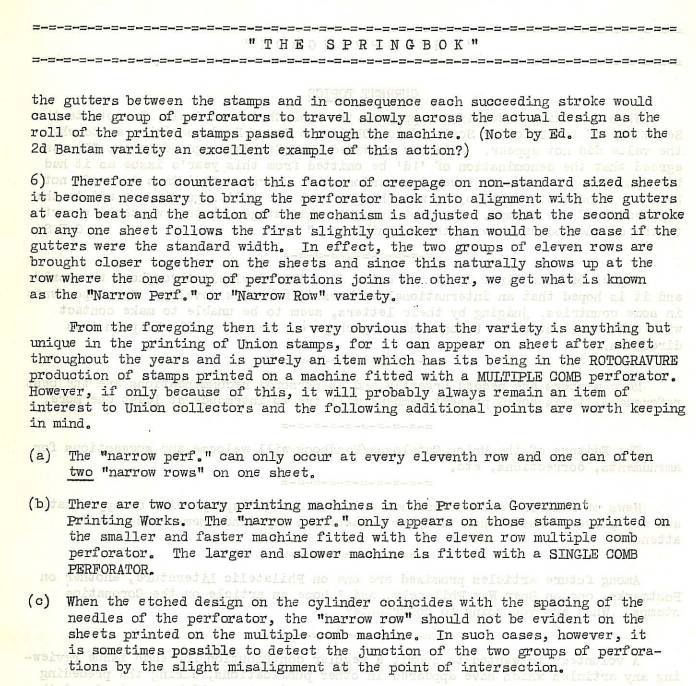 Have a nice day ! Marc |
|
Send note to Staff
|
| Edited by nar1123 - 08/22/2023 08:43 am |
|
|
Valued Member
Canada
35 Posts |
|
|
I already learned something today, just like wood, paper grain can be one one side only. So when wet printed, it would shrink only on one side, so rule of 3 doesn't work to determine shrinkage unless there is no grain sense on the paper. To be clear, the length of a piece of wood practically don't shrink, width of spruce or pine or poplar can can shrink up 10%! As example, the Canadian admiral issue booklets have horizontal grain and supposed to shrink only vertically. I'm not a big fan of Canadian stamps, but admiral serie is interesting for its shades and for its production process. Same height of printing : 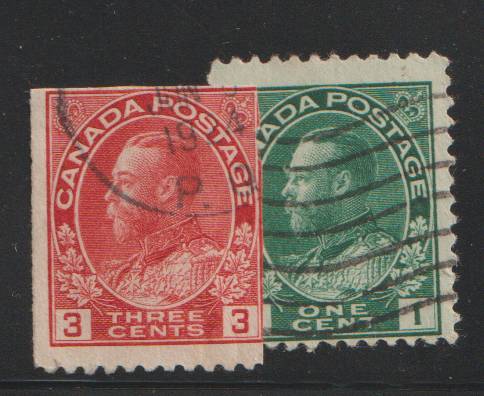 Different width : 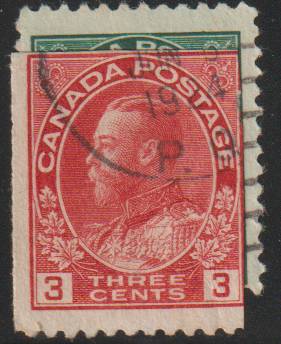 After December 1922, it was dry printing. I used a damaged 3c with 1924 cancel as gauge, scans are not perfect but I think it shows the 3c was really a dry printing, as the 1c was wet printing on vertical grain paper, so it shrink horizontally. I checked the booklet I have and I don't see any difference with usual wet printing, I guess some of them has been printed on horizontal grain paper, not all of them. To link with the main topic, a printing could shrink only on one side. If a multiple comb perforator is used, standard alignment of comb won't be changed, but can request to create a smaller row. If not, the addition of the 0.5mm of each row would make the last row of the sheet badly perforated. With a single comb, adjustment probably can be done to avoid that problem. Source of some of the info : https://www.ottawaphilatelicsociety...e-of-canada/ |
|
Send note to Staff
|
| Edited by nar1123 - 08/24/2023 10:24 am |
|
| |
Replies: 12 / Views: 1,720 |
|
|
To participate in the forum you must log in or register. | |
 Transvaal Postal History Help Earliest Stamp With In-Design Date? My First Stamps Help Newbie.help With Stamp Identification (J29) Inherited These Stamps, Are They Genuine? APS Membership Discount Metropex Stamp Show: Roseville, Minnesota October 23-24 Weird Covers, 1885,1886, And 1982 For Users Of Two-Post Blue International Albums What Is Your Experience With Binders. New Member Posting Image Of Avatar, Front And Back Of U2 Cut Square, Market Value Or References? Working On An Offline Collection George Washington 3 Cent 1861 With Print On The Back Hello From The Netherlands - New Member Then And Now, From Old Postcards New Member Wanting To Add An Avatar Sparks Auction Fees? 163 VF Nyfm Vertically Ribbed 163 XF Quartered Cork, Labeled Jumbo 136 VF Quadruple Split H Grill Nashville Philatelic Society-Your Invitation To Our Auction Night Meeting Monday, October 26, 2026 Nashville Philatelic Society-Your Invitation To Our Meeting Monday, October 19, 2026 Christmas Around The World 2026 C.e. In The Large Queen Cancel A More Condensed Album Page Experiment. US Scott #3 Postmarked Or Fake? Transvaal Postal History Help Earliest Stamp With In-Design Date? My First Stamps Help Newbie.help With Stamp Identification (J29) Inherited These Stamps, Are They Genuine? APS Membership Discount Metropex Stamp Show: Roseville, Minnesota October 23-24 Weird Covers, 1885,1886, And 1982 For Users Of Two-Post Blue International Albums What Is Your Experience With Binders. New Member Posting Image Of Avatar, Front And Back Of U2 Cut Square, Market Value Or References? Working On An Offline Collection George Washington 3 Cent 1861 With Print On The Back Hello From The Netherlands - New Member Then And Now, From Old Postcards New Member Wanting To Add An Avatar Sparks Auction Fees? 163 VF Nyfm Vertically Ribbed 163 XF Quartered Cork, Labeled Jumbo 136 VF Quadruple Split H Grill Nashville Philatelic Society-Your Invitation To Our Auction Night Meeting Monday, October 26, 2026 Nashville Philatelic Society-Your Invitation To Our Meeting Monday, October 19, 2026 Christmas Around The World 2026 C.e. In The Large Queen Cancel A More Condensed Album Page Experiment. US Scott #3 Postmarked Or Fake?
Disclaimer: While a tremendous amount of effort goes into ensuring the accuracy of the information contained in this site, Stamp Community assumes no liability for errors. Copyright 2005 - 2026 Stamp Community Family - All rights reserved worldwide. Use of any images or content on this website without prior written permission of Stamp Community or the original lender is strictly prohibited.
Privacy Policy / Terms of Use Advertise Here |
| Stamp Community Forum |
© 2007 - 2026 Stamp Community Forums |
| It took 0.25 seconds to lick this stamp. |
 |
|
|
|


 Posted 08/17/2023 5:02 pm