| Author |
 Replies: 56 / Views: 8,422 Replies: 56 / Views: 8,422 |
|
Valued Member
South Africa
70 Posts |
|
|
hello to everyone.  its been a while since im here. always nice being back to all you Beautiful people. i ....think I found it finally. I purchased a few Hardings over the months and was having a close look at them this week . i finally found a page that makes it so easy to identify.. quote.. The image above left is a perfect example of the reverse of a flat plate stamp. The flecks of ink on the reverse can be found on flat plate stamps and are rare on rotary press stamps. The cause of the flecks of ink is that during the flat plate process the sheets were placed on top of each other before the ink had a chance to dry properly. Then cut out squares at each corner. As shown in the second image above. Placing the stamp you wish to test under your cut out stamp you can see if the frame lines match. If, as in the last image shown above the frame lines are outside the top stamp in either the top, bottom or sides then you have a rotary stamp. If the lines are in the same place, as shown in the third image, you have a flat plate stamp the above 2 paragraphs are what helped me identify the stamp i may be wrong, and I have been a few times before. now I have no doubt in my mind. my problem was in id in the stamp was the back, until I read the 1st paragraph. and the second paragraph clearly states ( if the stamp is bigger in any direction, Its a ROTERY ) but guys, im no expert, you guys are. this is my hobby. tell me how it is     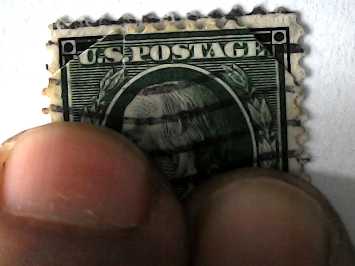   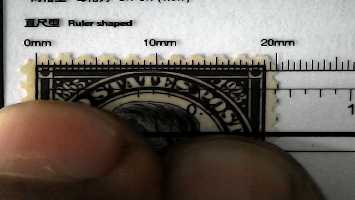 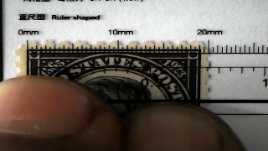 the last 2 photos are the stamps in question .(on the TAPE) the 2 before that are the smaller p11 flat plate |
|
Send note to Staff
|
|
|
|
|
Moderator

United States
12330 Posts |
|
|
Good Day, Have you read through the 20 other SCF threads that specifically cover the #613? It appears you have done discovery. (In the past, you have posted a number of other threads about the possibility of finding a rarity, so I know that you have heard about the odds and likelihood. For example, back in 2021 when you posted about a 613 in a Scott album page.) If not read the other threads, here is the link; https://www.stampcommunity.org/search.aspAnd here is how you setup the search criteria for finding the 20 threads. 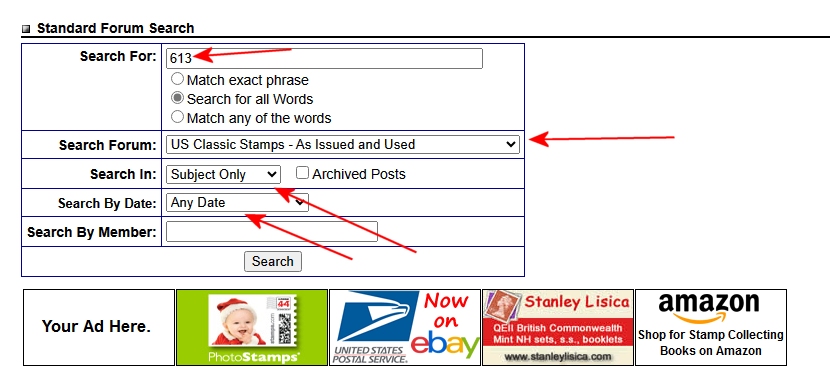 If you have and you have done the identification steps and are convinced that you have a 613, then your next step is to send it off for certification. Without a respected certification, it does not really matter what opinions anyone has. Say I tell you, "yes, that looks like a 613". Now what? To be able to call it a #613 you need a respected cert at the end of the day. |
Send note to Staff 
|
|
|
Pillar Of The Community
6358 Posts |
|
|
rafmal,
Your images do not provide enough visual information to give any meaningful feedback. Specifically useful would be:
1. A full scan of the front (NOT a photograph), with nothing overlapping or distracting.
2. A similar scan of the back side.
3. A scan with an overlay with a known flat or rotary stamp (or both) from the 1923 series, NOT the 1908-23 Washington/Franklin series.
4. It would be good to acquire a pair of tongs rather than using your fingers. |
|
Send note to Staff
|
|
|
Valued Member
United States
22 Posts |
|
|
It's not a 613 unless the Philatelic Foundation, PSE, or PSAG says it's a 613, no matter how much you "measure." |
|
Send note to Staff
|
|
|
Valued Member
South Africa
70 Posts |
|
|
@ 51studebaker..
Hello, my friend. Yes, I've conducted extensive research, and throughout my investigations and the numerous forums I've perused, I've never come across a straightforward method for verifying a stamp's authenticity. Most responses revolve around identifying specific characteristics such as color discrepancies or faint markings on the paper's reverse side. Unfortunately, these nuances have only served to complicate the process of stamp identification.
After years of searching and making mistakes, I've never truly discovered a clear-cut method for identifying a stamp. Each article and forum discussion has only muddied the waters further. The truth, however, is quite simple:
Differentiating between rotary and flatplate stamps primarily hinges on ONE key factor:
The SIZE
Rotary stamps tend to be slightly larger in any dimension.
The back of a stamp, which is rarely inked .
Now, we're left with just two distinct Harding stamps to consider, both with perf 11: 610 and 613. One is rotary, and the other is flat plate, the sole distinguishing feature being their size difference, approximately 0.25 mm.
Additionally, it's important to note that there are usually rare spots on the back of rotary stamps, although this isn't a definitive rule. Therefore, for every certified rotary stamp out there, one can reasonably expect a spot or two on the reverse side.
Furthermore, if you measure a stamp using an old 332 of the Franklin (regardless of the specific version), and it turns out to be Bigger in any dimension, you have a rotary stamp. I bring this up because had I come across these two key points during all my years of searching, I believe stamp identification would have been significantly less challenging. Notably, the color of the stamp doesn't impact its identification, and the primary factor to consider is its size when determining if it's a rotary stamp.
this is my understanding |
|
Send note to Staff
|
|
|
Pillar Of The Community
Netherlands
6639 Posts |
|
|
Rafmal, The text you quoted appears to be from The Swedish Tiger site. https://www.theswedishtiger.com/613-scotts.htmlWhen I follow its instructions, I would be tempted to use a one cent or two cents stamp from what was called "the 1908-23 Washington/Franklin series." It looks like you did this. In his post above, John Becker states: Quote:
3. A scan with an overlay with a known flat or rotary stamp (or both) from the 1923 series, NOT the 1908-23 Washington/Franklin series. Both cannot be correct. You might want to check whether The Swedish Tiger is correct. If not Quote:
if you measure a stamp using an old 332 of the Franklin (regardless of the specific version), and it turns out to be Bigger in any dimension, you have a rotary stamp appears to me not to be the correct way to go about it. |
|
Send note to Staff
|
| Edited by NSK - 10/14/2023 05:41 am |
|
|
Bedrock Of The Community
12705 Posts |
|
|
A couple of quick observations.
While I truly appreciate the effort and love that has gone into creating and building the Swedish Tiger it is frequently cited by posters that have "discovered a rare stamp" as being what led them to their conclusion. The Tiger has an outsize role in these false hopes. I know from firsthand experience there are some egregious errors within the site that when pointed out to people cause a knee jerk angry reaction. It really needs to clean up it's act in some respects.
Humans are interesting creatures. Almost every one of these "discovery" threads follows the same pattern. Discoverer finds "rare" stamp based upon suspect, misapplied and/or often incomplete information/methodology. They come here to present their findings and if not agreed with fight back. So why go public rather than just sending a "sure thing" off to be certified? Even though suffering from terminal confirmation bias there is a part of their brain that knows they are not sure…at all. There would be no need to engage others if it was 100% determined and just needed a certificate.
The percentage of "finds" of rare stamps presented on this forum that end up confirmed is the real rarity. How ironic that is. Maybe two or three come to mind. |
|
Send note to Staff
|
|
|
Valued Member
Switzerland
496 Posts |
|
|
rafml,
"Rotary stamps tend to be slightly larger in any dimension."
That is, unfortunately, the same blunder the Swedish Tiger makes on its web page about Scott 613 when overlaying a flat plate stamp on a rotary plate stamp.
The plate for 613 contained 400 subjects divided into four 10 by 10 panes. The stamps are in upright position. Two plates were vertically joined on the Stickney press by bending them onto the drum. When flat plates are bent, they slightly elongate in one direction, and slightly contract in the other direction. Think of a rubber band that is stretched, It gets longer in the direction you pull but gets narrower in the perpendicular direction. Same thing with flat plates, only the "getting narrower" bit is hardly detectable.
So the Scott 613 rotary stamps are taller than the flat plate printed stamps, but they are a tiny bit narrower. When a flat plate is engraved with the stamps orientated sideways, the curving leads to stamps being wider than flat plate stamps, but slightly less tall. The Swedish Tiger shows a Scott 613 comparison where the rotary plate stamp is wider in both directions. That is impossible.
Now this gets us to another problem. Used stamps that are soaked in (too hot?) water and exessively pressed to dry. These stamps can be slightly wider and taller afterwards as the paper fibres somewhat "relaxed". For example, if you have a (supposed) Scott 613 that is 19.35mm in width, you have to multiply your height measurement by 19.25/19.35 to get the real height value. |
|
Send note to Staff
|
| Edited by drkohler - 10/14/2023 12:05 pm |
|
|
Pillar Of The Community
6358 Posts |
|
|
Quote:
Quote:
3. A scan with an overlay with a known flat or rotary stamp (or both) from the 1923 series, NOT the 1908-23 Washington/Franklin series.
Both cannot be correct. You might want to check whether The Swedish Tiger is correct. If not I sense I may have introduced some confusion, so let me clarify. First, I have taken nothing from the Swedish Tiger site, and never do. The point of any overlay is to know the exact identity of the overlay stamp and what the results will mean. If I had a candidate 613, I would overlay a flat plate example to show the difference and then a rotary plate template to show the match. I would also use stamps from the same series to reduce as many small variables as possible. I have about 10 different templates cut to confirm/refute different stamps. The importance of understanding the tools and their application. But again, without high-resolution scans of both sides of the stamp in question, this will remain a largely useless discussion. |
|
Send note to Staff
|
| Edited by John Becker - 10/14/2023 10:07 am |
|
|
Pillar Of The Community
Netherlands
6639 Posts |
|
|
John,
rafmal posted text from The Swedish Tiger. I do think he did what that site suggested.
Following, as someone who has no knowledge of US stamps, The Swedish Tiger, I ended up with the series you appeared to refer to as the 1908-1923 stamps. From your post, I understood that would not be a good method and using stamps from a later series would be better. I think The Swedish Tiger advises not to use those.
I, actually, tried to point out to OP that he should consider your advice and not blindly follow that of The Swedish Tiger.. I think I remember an earlier post about using incorrect series to identify a stamp with an overlay. |
|
Send note to Staff
|
| Edited by NSK - 10/14/2023 2:17 pm |
|
|
Valued Member
South Africa
70 Posts |
|
|
@ ALL
The message I'm trying to convey is that, regardless of the website I've consulted, it's evident that there are only two distinct types of perforated 11 Harding stamps. The smaller one is the flatplate (P11), while the larger one is the rotary, also perforated 11. I find it perplexing that there seems to be confusion about this simple categorization, as there are only two varieties:
Flatplate: This corresponds to the smaller-sized stamp.
Rotary: This applies to the larger-sized stamp, which may differ in either height or width.
To illustrate, I used a Franklin stamp for measurement, and it perfectly matches the width of the flatplate Harding perforated 11 stamp. However, when I place the same stamp on the other Harding stamp, it becomes apparent that the latter is larger. So, I'm left wondering if there is a belief that the flatplate stamp comes in two different sizes. |
|
Send note to Staff
|
|
|
Pillar Of The Community

United States
1498 Posts |
|
|
I'm not certain that this is germane to the topic at hand, but actually, yes ... the Franklin does come in two sizes. While this is common knowledge for experienced collectors, beginners may often be unaware. Early booklet stamps were printed on paper with the paper grain perpendicular to that of normal stamp paper. These stamps were wet-printed and shrinkage across the grain was about 4 times that of shrinkage with the grain. Consequently, sheet & booklet stamps of the same design do, in fact, have slightly different dimensions. Which is one reason you need to be careful when selecting a stamp to use as a template. Booklet stamps can be poor choices. |
|
Send note to Staff
|
|
|
Pillar Of The Community
6358 Posts |
|
|
(JLLebbert, I agree!)
Until complete scans are shown as I requested above, I suggest we ALL stop replying to this thread. We are being trolled and wasting our time here. It is clear rafmal "knows" more than all of our collective decades of experience. Even if he sent his stamp for a cert, I doubt he will believe the opinion he receives. |
|
Send note to Staff
|
|
|
Bedrock Of The Community
12705 Posts |
|
|
It is not often mentioned but the most effective way of eliminating 610's and identifying potential 613's is by the patina/streakiness of the 613 vs the white clean background of the 610. Every 613 in the Siegel census exhibit the patina. Measuring the design is fools errand IMO and various internet sources harp on that aspect. Top stamp is a 610. Bottom stamp is a 613. 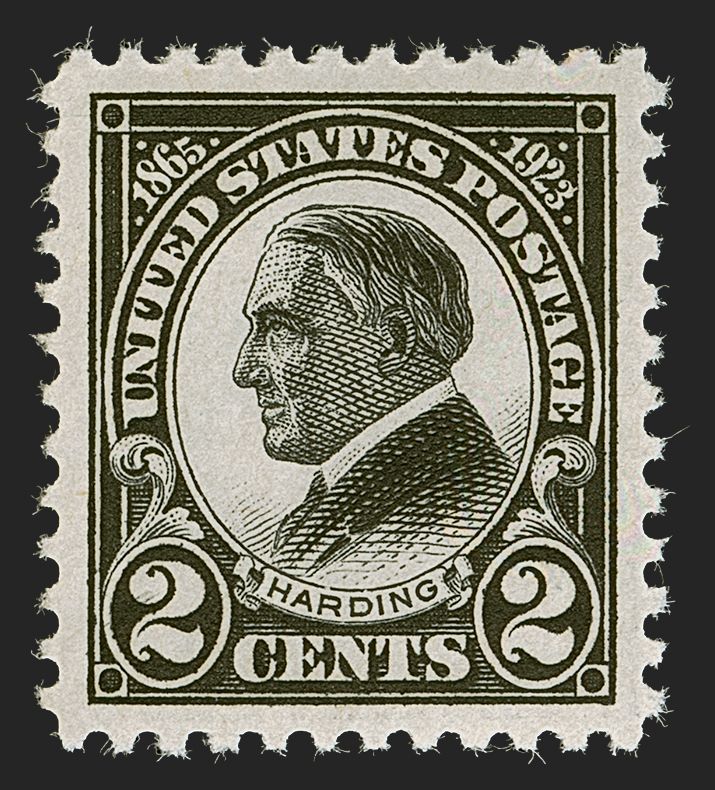 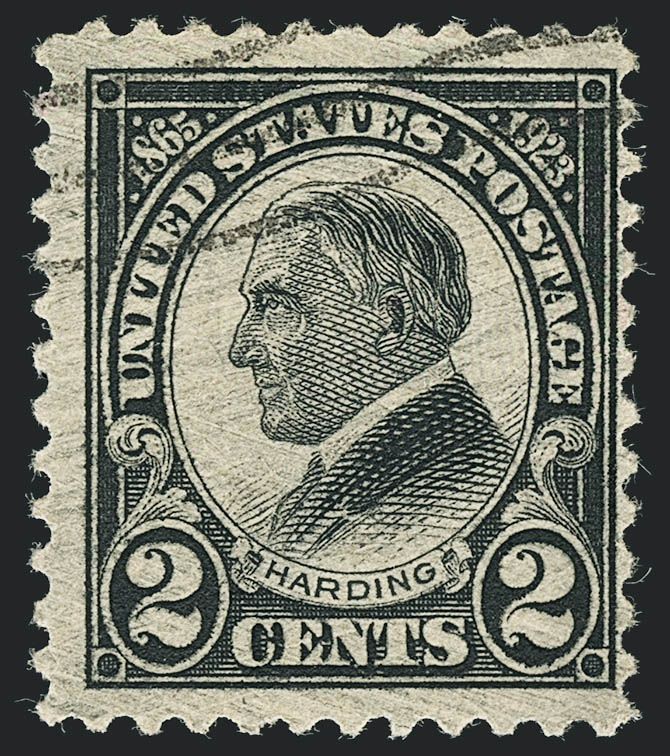 |
|
Send note to Staff
|
|
|
Valued Member
South Africa
70 Posts |
|
|
@jhonbecker.. relax my friend, I dont have a scanner. but give me a few days I will have the stamp scanned and will post during the week. thanks |
|
Send note to Staff
|
|
|
Valued Member
Switzerland
496 Posts |
|
|
"Patina" is a bit of a misnomer (I think of greenish copper when reading patina).
Plate wiping was a two stage process on the four plate power press that produced flat plate stamps. First, a cloth would wipe the inked plate, removing most of the "surplus" ink on the plate. Next the pressman would use the palms of his fists (this proved to be the most efficient method) to remove any of the surplus ink.
On the Stickney Press, the cloth wasn't that big, and no pressman. Hence rotary stamps tend to have a "haze" of the color in unprinted areas. Your 613 example is a particularly gross example of "bad plate wiping". |
|
Send note to Staff
|
| Edited by drkohler - 10/15/2023 9:29 pm |
|
|
Replies: 56 / Views: 8,422 |
|




 Posted 10/13/2023 11:54 am


