| Author |
 Replies: 29 / Views: 2,689 Replies: 29 / Views: 2,689 |
|
Valued Member
10 Posts |
|
|
|
I recently obtained a 1930's era flat plate printed U.S. mint sheet of 100 stamps with full selvage intact, but without a plate number. This issue normally has one plate number along the top or side, but this particular sheet has none. In all other respects the sheet appears genuine. There is no mention of this in Scott or Durland.
I'm admittedly hedging on the specifics, at this point I'm mainly trying to find out if it is a common occurrence for one sheet of 100 out of a press sheet of 400 to have no plate number. I'm a sheet collector, but not an EFO collector
Or, have I hit the mother lode!
Thanks,
ghp413
|
|
Send note to Staff
|
|
|
|
|
Pillar Of The Community
United States
1874 Posts |
|
|
I regard it as unsurprising, because over the years we have seen several examples here where the plate number had to have been trimmed or cut off, given the width of the selvege. A buyer could have done so to fit the sheet in a drawer or a sleeve for storage. |
Send note to Staff 
|
|
|
Valued Member
10 Posts |
|
|
Thanks for that suggestion.
I'll give more specifics, it's a Scott 725, Daniel Webster, upper right sheet with full selvage on top and right side and straight lines at bottom and left. On other sheets of that era (such as the 724 Wm Penn and the 726 Oglethorpe), the top plate number is just above the upper perforations, maybe 1/4" to 5/16" from the top of the upper stamp.
This sheet appears to have full upper selvage, it measures 1 1/32" from the perforations and on my visual inspection does not appear to be trimmed. The sheet has some weak perfs and a couple of minor perf seps, but it otherwise intact.
Still a mystery.
Thanks!
ghp413 |
|
Send note to Staff
|
|
|
Moderator

United States
12330 Posts |
|
|
Pillar Of The Community
United States
4188 Posts |
|
|
It is unlikely they forgot to put the plate number on the plate and more likely it just didn't ink, I've seen more than a few half inked plate #s. |
|
Send note to Staff
|
|
|
Valued Member
10 Posts |
|
|
Pillar Of The Community
6366 Posts |
|
|
I agree with the posts so far that this is an inking freak/oddity. If this were truly a plate number missing from the plate, then Scott/Durland/Hebert would have known about it from the beginning and listed it. And indeed, Durland is clear and lists top-left and top-right numbers for all plates sent to press. The detail of the Durland listing would clinch this an as inking issue. Thus there should be a faint albino imprint of the number if viewed with a strong light raking across the pane as the plate pressed into the paper.
I do not recall seeing (pun intended) a missing plate number before, but the ends of the lines on arrow blocks frequently fade out toward their ends. Underinked or uninked portions of the selvage markings would not change the functionality of the stamps for retail sale/use, so would not be reason to fail quality control. Your pane is likely quite scarce, but nothing to retire on.
As for "hedging the specifics", yes, most participants here like full disclosure with illustrations rather than partial information. Your follow-up posts are appreciated. |
|
Send note to Staff
|
| Edited by John Becker - 11/18/2023 6:52 pm |
|
|
Pillar Of The Community
United States
4465 Posts |
|
|
A striking example. As noted above some level of albino impression should be there. As John notes, inking alway to the very edge of the plate does not always occur leaving short arrows and only partially inked plate numbers. |
|
Send note to Staff
|
|
|
Pillar Of The Community
United States
1170 Posts |
|
|
Valued Member
10 Posts |
|
|
Got some follow up. I was looking to see if the albino impression was visible and flipped the sheet over (probably should have done that originally.) There is faint, but clearly visible reversed plate number in the proper place. See attached. It is plate #21037, which corresponds to the #725 sheet in Durlands. I may ask for some follow-up expertise as to what kind of freak or oddity this might be classified as. Thanks! George  |
|
Send note to Staff
|
|
|
Valued Member
10 Posts |
|
|
I should also say that I did not see any plate number impressions on the front when examined with magnifier and light. But the paper's over 90 years old and not very pristine, so any impressions may have been lost to time.
George |
|
Send note to Staff
|
|
|
Pillar Of The Community
United States
4465 Posts |
|
|
Quote:
what kind of freak or oddity this might be Here in lies the issue, EFOs are about stamps (designs) and not marginal markings normally. However missing and not missing (when the plate number was not intended to appear) are of interest. The plates used to print on the back of a stamp had plate numbers located in the selvage portion which intended to be removed (cutoff) during the production process. That did not always go as planned. FIRST -- As to an albino printing, that is considered a missing color error when all of the color is missing. However that is used for stamp images and postal stationery. EFO Type 9, error, variety. SECOND -- A fully missing plate number when all other design elements are present is known. That is EFO Type 24, error. However the number is missing, as in not there even as an albino impression. It arises frequently with miscut transportation coils where the cut (separation) is shifted up such as the number is not below the stamp design AND it was from the "top' row such that there was no plate number above to capture from a row above. Also the 1957 8¢ Magsaysay Scott 1096 is know with one of the plate numbers missing. At this time, I cannot say if was due to failure to enter it on the printing surface or if arose due to some other process. THIRD -- Improper wetting of the paper prior to printing can prevent proper ink transfer, e.g. underinking. That is EFO type 53, freak, variety. The full list and explanations of the types I referenced can be found for US issued EFOs here: https://www.efocc.org/Resources/Hot...AA_Cover.php If the albino impression is so faint that is only shows on the reverse, that increases the interest. if I owned the item, I would send it in for a certification and see what explanation comes back. The cert maybe adequate to get Scott to list the variety in the catalog. In any case, it does memorialize the existence of what you found. I suggest the APEX of the APS for an item such as this. You may ask them what kind of EFO this would be considered, a question which may get this under the eyes of John Hotchner. I find this extremely interesting and would love to inspect it in person, but that will not be happening. ONE FINAL RULE, if you submit it you need to report back here with the outcome.  |
|
Send note to Staff
|
|
|
Pillar Of The Community
6366 Posts |
|
|
The faint plate number on the back is set-off from being stacked on the press-sheet previously printed and has no relation to the issue you see on the front side. |
|
Send note to Staff
|
|
|
Pillar Of The Community
United States
1159 Posts |
|
|
Except that it is more proof that the plate number did exist during that press run and it wasn't like someone forgot to engrave the plate number on that plate. (Obviously if that had happened, it would have been reported by Durland and elsewhere sometime in the last 100 years. This is just concrete evidence if the fact that the plate number was there).
|
|
Send note to Staff
|
|
|
Valued Member
10 Posts |
|
|
Thanks to all for the great education and resources on EFO's.
Based on this experience and feedback I will be submitting it to APEX (I'm an APS member) for expertization and evaluation. And I will report back on the results.
Thanks!
George |
|
Send note to Staff
|
|
|
Pillar Of The Community
United States
1159 Posts |
|
|
It is possible that it could be an albino, caused by a foldover or some stray paper laying on top of the sheet during printing. But more likely it is just ink starvation at the edge of the sheet. Here are three copies of that stamp from my plate number singles collection, showing one fully inked, and two with various stages of missing ink. 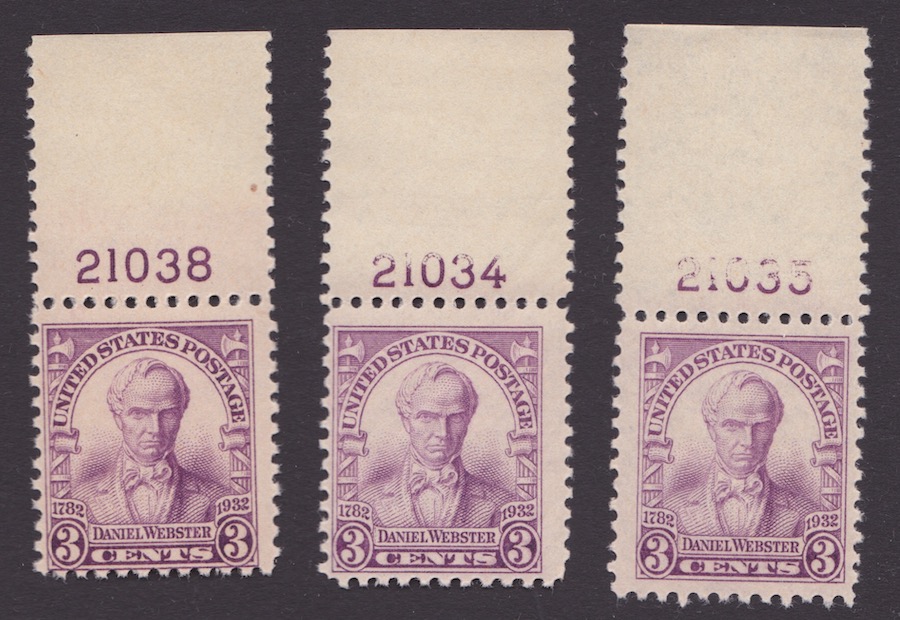 Definitely curious to hear what the experts say. Please post the results when you get it back. |
|
Send note to Staff
|
|
|
Replies: 29 / Views: 2,689 |
|




 Posted 11/18/2023 5:10 pm


