| Author |
 Replies: 13 / Views: 624 Replies: 13 / Views: 624 |
|
|
Valued Member
Bulgaria
398 Posts |
|
|
Does someone has any idea regarding the decorative letter "E" on the back of this intersting old cover Bulgaria, from Ruse to Munich. Can this indicate that this envelope was sent by a diplomat or other foreign official? I have searched for it at Internet but unfortunately I couldn't find any information. [url=https://www.seemystamps.com/image/RSjJ8] 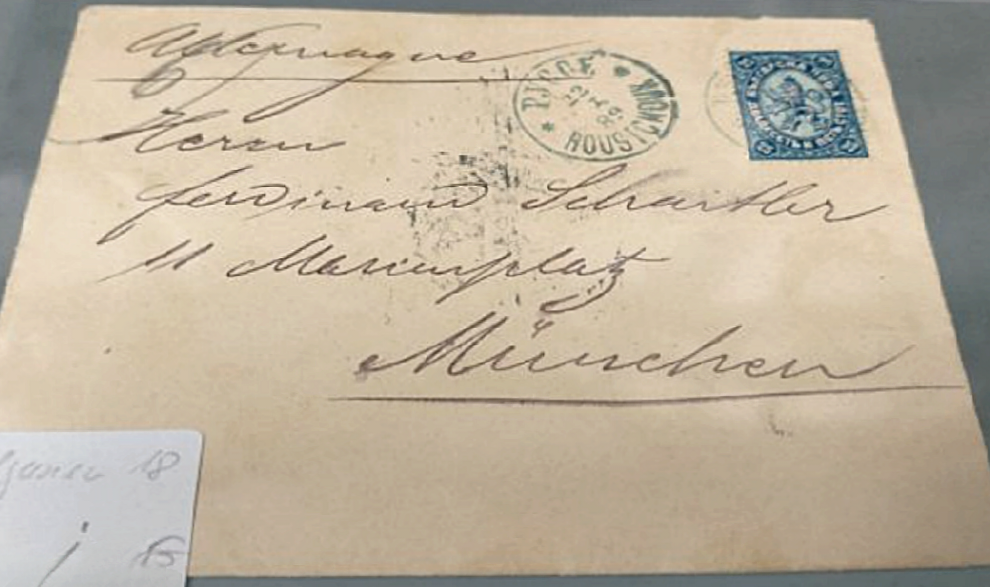 [/url] 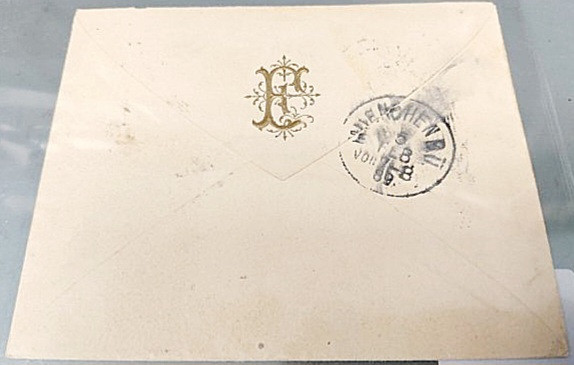 |
|
Send note to Staff
|
|
|
|
|
Pillar Of The Community
Netherlands
6641 Posts |
|
|
Rich people had their own stationery. I would not be surprised if it contained a sheet of paper with the same monogram. It may have been someone from a noble family or even a royal.
I would expect a diplomat to use paper showing the coat-of-arms of the country he represents, not a monogram. |
Send note to Staff 
|
|
|
Valued Member
Bulgaria
398 Posts |
|
|
Been a personal stationary it is logical as you said to had belonged to a nobility . Unfortunately the inner sheet is absent from the cover. We didn't had ower own nobility until and after the Liberation of the country in 1878. All governor's of Bulgaria before 1879 were Russians after that we had two different European royal houses that stayed in Bulgaria in different periods. I have looked the image again and on closer inspection a can tell that I may have been wrong in saying that's the letter "E" , the lavish decoration fulled me at first. I didn't see that the lower part of the is shorter than the upper one,which ends with a nother element. So this should be considered to be "F " not "E " as I first wrote in my post. We don't have this letter in the Cirlic alphabet ,so we should search for a person that was more or less at that period a foreigner ,who can write on German language and doesn't speak well Bulgarian, who has relations with the country to which the cover was send. This guessing, but the only person that fits this description is Ferdinand I ,who was elected by the Second Great Assembly in 1887. As representative of the Saxe - Coburg and Gotha royal house ,he had connections with his homeland and keeping correspondence with it is something normal. The other thing is that it was send from Ruse ( or Ruschuk as it was known before) . It was a important center and port, from which Ferdinand I,made regular trips to Europe. If you had not pointed out that it might have been a personal stationary of dignity it is certain that I most probably would have continued to consider it to be E and not a F and jump to the wrong conclusions. So, I think thath youre post has the main contribution for solving this puzzling question .  |
|
Send note to Staff
|
|
|
Moderator

United States
12330 Posts |
|
|
Occam's razor - the most likely explanation is a monogram from a wealthy person and not nobility.
Don |
|
Send note to Staff
|
|
|
Pillar Of The Community
Netherlands
6641 Posts |
|
|
I agree with Don, the odds are it is a wealthy person.
The thought of a monogram belonging to someone related to the princes of Bulgaria did come to mind and the possibility that the monogram is made up of an initial and the Roman numeral "I" did cross my mind. "Nobility" does not exclude royals. Since Ruse is an important town on the Danube River, I would not discard the possibility of some wealthy person, count, or Austrian prince who brought his own stationery on a journey.
If, indeed, that is a Roman numeral, it, almost certainly, limits the scope. As, in Europe, it is not common to have a non-noble family where dad is Franz Müller I and the son is Franz Müller II.
"Liebe Mutti,
Ich bin Heute in Ruse am Donau eingetroffen. Es ist hier sehr schön.
Die Leute sind ganz nett. Der Schopska-Salat und die Kawarma haben mir auch sehr gefallen.
Viele Bussi,
dein Ferdi der Erste." |
|
Send note to Staff
|
| Edited by NSK - 12/07/2023 07:00 am |
|
|
Pillar Of The Community
Netherlands
6641 Posts |
|
|
Valued Member
Bulgaria
398 Posts |
|
|
Maybe your are both right, I can't say.
I'm probably wrong again ,I should have search for it before jumping to conclusions. I can see that there are many variants of it at the Wikipedia link,only one has a small resemblance with it but it is not enough strong.
At least we know that it belongs to a wealthy person .That is also some starting point. |
|
Send note to Staff
|
|
|
Pillar Of The Community
Netherlands
6641 Posts |
|
|
That of Eleonore has some elements. But placing her in Bulgaria many years before the search for a suitable second wife for Ferdinand I started is somewhat far-fetched.
Google's image search does not show a similar monogram.
Ferdinand Schurtler
Marienplatz 11
München
does not bring up anything.
The address is next to the old town hall (was it at the time?). |
|
Send note to Staff
|
| Edited by NSK - 12/07/2023 08:36 am |
|
|
Moderator
United States
12330 Posts |
|
|
post_pe,
Always start with an open mind and not that you have rare material. If you do not do this, you end up with confirmation bias.
Consider how important this is in other things in life. Imagine if a policeman assumes everyone is a criminal. Imagine if your doctor examines you assuming you have cancer. Imagine if you bring your car to a mechanic and they assume that you will need a new engine. The scientific method typically requires starting with no assumptions, allowing the facts to lead to a conclusion.
If a person is going to start with any philatelic assumption, then start with the assumption that is most likely (which is that we have the most common stamp or cover). Then do the work needed to prove that it is NOT a common item.
Don
|
|
Send note to Staff
|
|
|
Pillar Of The Community
France, Metropolitan
3756 Posts |
|
|
Cover addressed to Ferdinand Schaitler. There is a Ferdinand Kaufmann Schaitler (Marienplatz 11) in the Bavarian directory from 1873.. 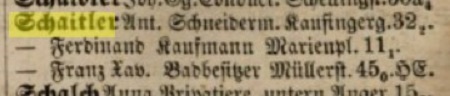 |
|
Send note to Staff
|
| Edited by perf12 - 12/07/2023 11:35 am |
|
|
Pillar Of The Community
Netherlands
6641 Posts |
|
|
Valued Member
Bulgaria
398 Posts |
|
|
Don, I agree that saying this without any strong evidence is not very wise .
I will try to be more objective in my further studies.
I have also tried to find a connection between the E and Queen Eleonore Reuss but she arrived in Bulgaria at 1908, which is 20 yares after the the date on the cover. I admit that It could belong to any foreign citizen,man or woman, who had lived or visited Ruse at that particular time.
I must say that I'm impressed by the precision of which you all have searched for the person who had resived the letter in Munich. The information that he was a merchant maybe can be useful.
The fact that there is no other name except that of the mister in question makes ,the finding of a solution much difficult task. Couldn't the merchant had been corresponding with him before, and as the initial was knowned to the merchant the sender didn't make any effort to write his/her name?
|
|
Send note to Staff
|
| Edited by post_pe - 12/08/2023 02:45 am |
|
|
Pillar Of The Community
Netherlands
6641 Posts |
|
|
Just for having a bit of fun.
Herr Ferdinand Schaitler may have had stationery with this 'F'. His son may have been on a grand tour, or just travelled to Bulgaria to buy merchandise. Daddy gave his son some stationery to write about is progress.
On the other hand, an Austrian countess 'F' residing in Ruse may have wanted to order something from Herrn Schaitler.
The only thing you can be certain of, is that this was not a letter sent by an illiterate pauper living in Ruse.
Marienplatz, at the time, was an important square where markets were held. If it was not renumbered, Herr Schaitler lived across an alley, facing the earliest part of the new town hall built 15 years earlier. (Construction of the second stage that was off the square only started in 1889.) That suggests Herr Schaitler, most likely, was quite wealthy. It is surprising I cannot get hits googling his name. |
|
Send note to Staff
|
|
|
Valued Member
Bulgaria
398 Posts |
|
|
NSK ,maybe you are on the right way.
If the son had bringed with himself, this luxury stationery and didn't want to purchase any from Ruse .That sounds like something which a son of a rich foreigner can do ,this is not impossible . If remember correctly there were also many foreigners traveling by train on the Ruse-Varna railway which was the first one,officially opened in 1866. The British company which built it received the exclusive rights, from the Government of the Sultan for using it, for the next 100 yares,which were interrupted in 1908 when the country became independent.
It was a easy method of reaching other parts of the country ,for buying local goods.
In the first yares after it's Liberation
Bulgaria offered many lucrative opportunities for foreign traders for making good profits. So this may suggest some type of business connection with the country.
I didn't know that the address was at the center of Munich . Being on such location ,as you pointed out this, could be a very important clue regarding the material status of Mr.Schaitler.
I must say that how ever small is the information,it is very interesting.
|
|
Send note to Staff
|
|
| |
Replies: 13 / Views: 624 |
|



 Posted 12/06/2023 06:56 am


