|
This page may contain links that result in small commissions to keep this free site up and running.

Welcome Guest! Registering and/or logging in will remove the anchor (bottom) ads. It's Free!
To participate in the forum you must log in or register.
| Author |
 Replies: 14 / Views: 879 Replies: 14 / Views: 879 |
|
|
Valued Member
Japan
353 Posts |
|
|
Dear experts, I have a rather unusual US Pointing Hand auxiliary marking on a cover dispatched from Okanogan, Washington to "Leese", Washington (hope I'm reading the cancel correctly), where the letter has been returned to sender (= Sheriff of Okanogan County, Okanogan). 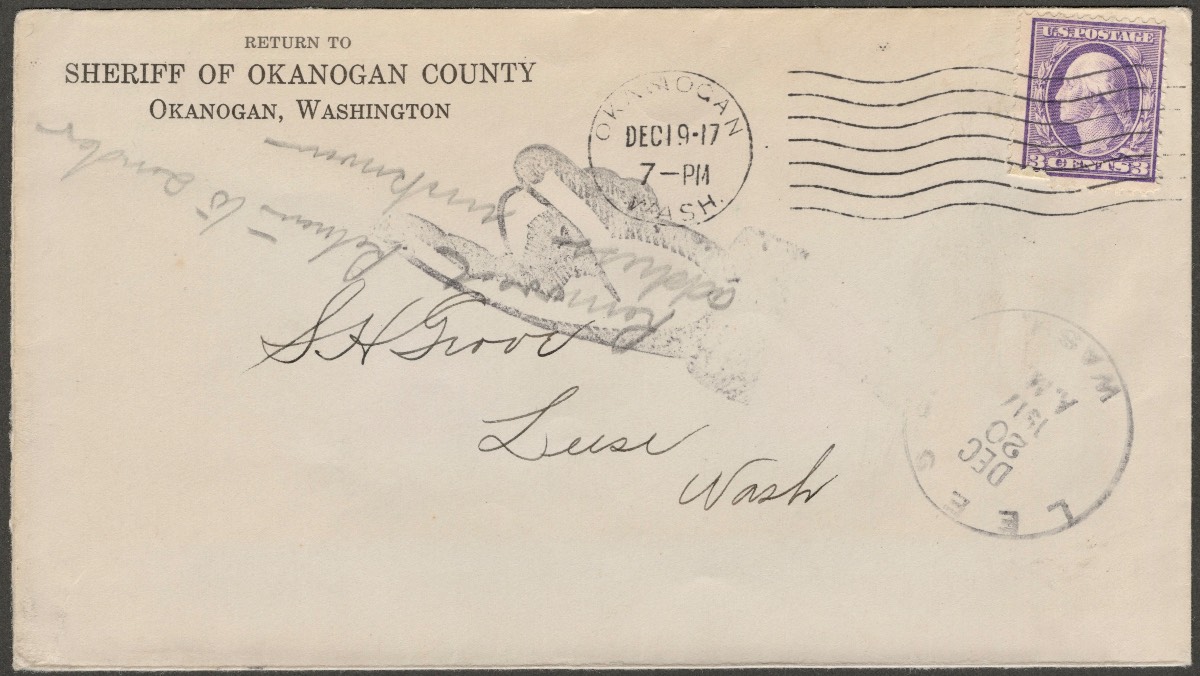 The PH is middle-sized (not that big PH but larger than the small ones), in black ink, Left hand, pointing right (which is also quite unusual) - this is why the PH had to be stamped upside down to point to left (the return address). It has no written clauses (such as "RETURNED TO WRITER" nor endorsements). Instead, "Returned to Sender" and endorsement "Removed", "address unknown" are added in pencil. 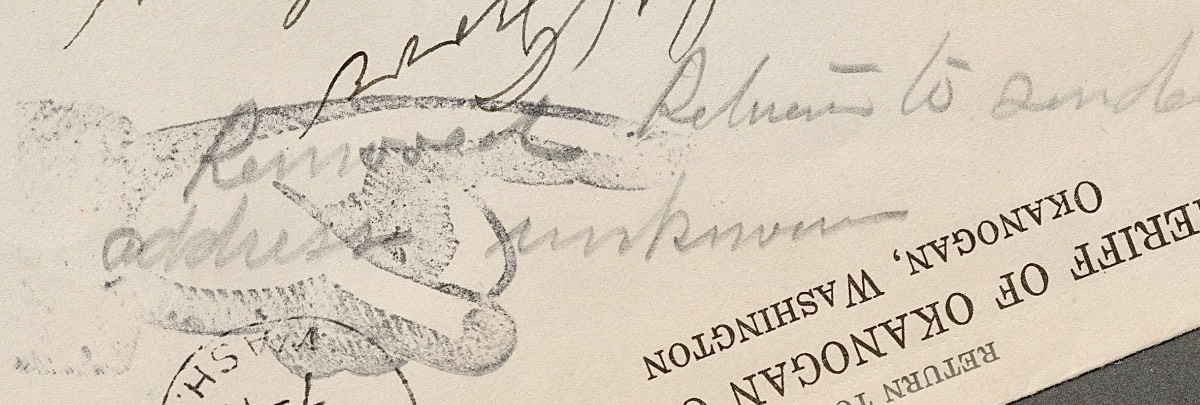 What I believe is that the "Leese" P.O. was a very small P.O. and have used some sort of general use PH hand stamp, which makes this PH a rather odd looking, not fitting in the ordinary types. This cover definitely adds a twist to my US PH marking collection, and to write up the album leaf, I would like to know additional information of the Leese P.O., or the town (village?) itself. This is the close-up of the date stamp. I have searched the Web but without success (Google only shows Leese in Germany...). I've learned that Okanogan itself was a small community, so I reckon that Leese was even a smaller community and thus no detailed information available on Web. 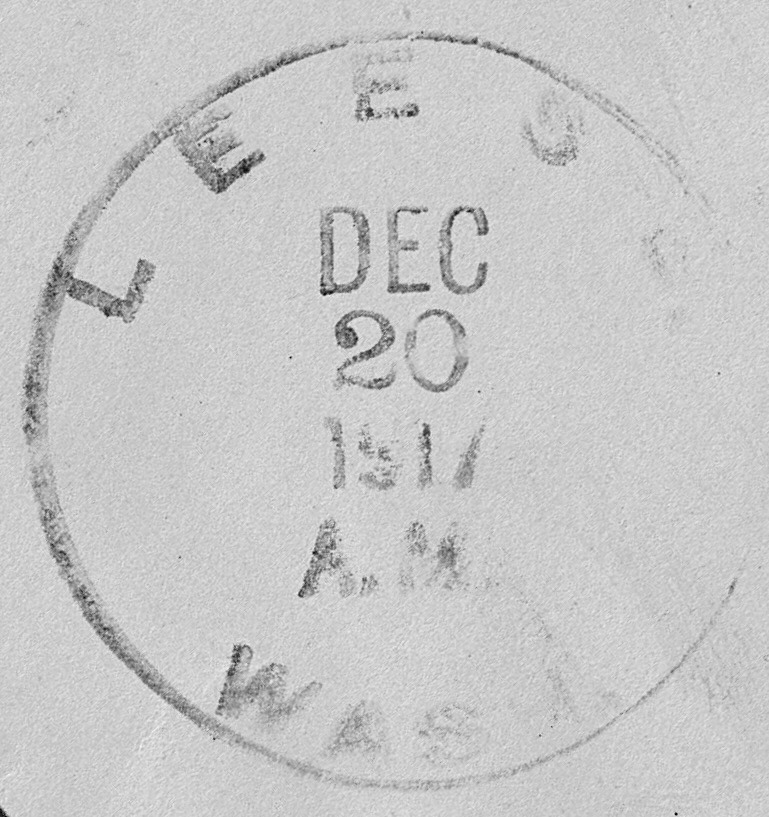 Does anyone have further information on this town/village, and also some information which may associate this cover ? Thank you all in advance ! - Hironobu |
|
Send note to Staff
|
| Edited by unechan - 02/08/2024 10:35 am |
|
|
|
|
Pillar Of The Community
United States
858 Posts |
|
|
The Leese post office operated in Okanagon County 1915-1933. I don't see any quick, easy to find web resources (it may have just been a tiny post office in a corner store or house), but there seems to still be a Leese family in the area. For the deep dive, the National Archives has digitized a large series of microfilmed post office location reports and that may turn up information about a precise location but it will take digging. (the microfilms were organized by state and county, so at least there's that). https://catalog.archives.gov/id/608210 |
Send note to Staff 
|
|
|
Moderator

United States
12330 Posts |
|
|
Hi Hironobu,
Pointing Right hands are less common because they did not point to the return address; turning them upside down to make them point to the return address is common. Each post office purchased these Pointing Hands from 3rd party manufacturers and there were many, many styles to choose from. I am assuming that having fewer 'features' or customizations (reason box, PO name, etc.) on the stamper made them less costly and that smaller POs gravitated towards them.
Don |
|
Send note to Staff
|
|
|
|
Valued Member
Japan
353 Posts |
|
|
Hello paperhistory, I dig into National Archive microfilm data, searched inside the Okanogan, Washington archive - and wow, found it! What a comprehensive database ...thank you so much for your suggestion and instruction. 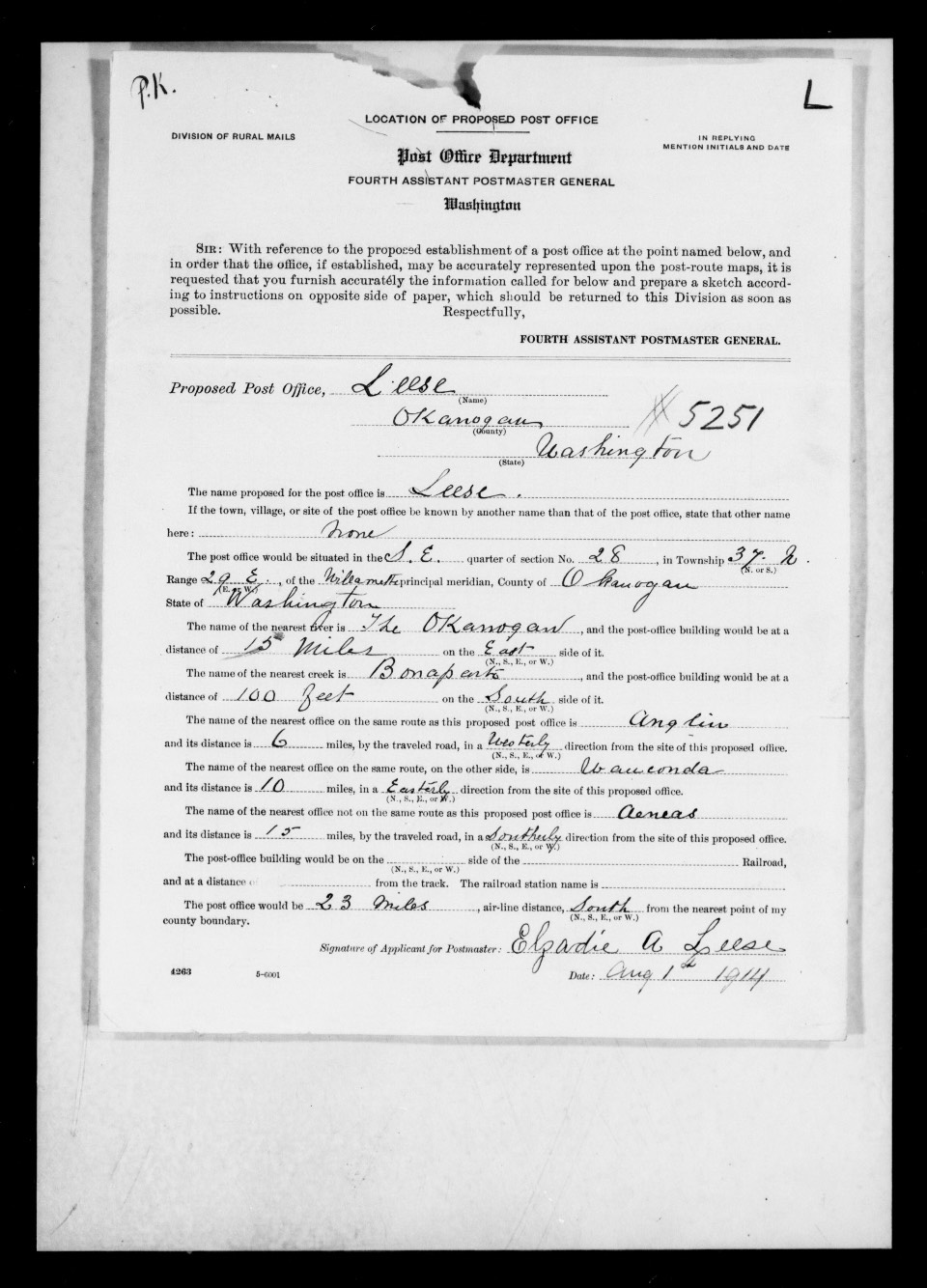 This application to open the P.O. is dated Aug 1, 1914, and submitted by Elgadie A. Leese - yes, there was a family Leese residing in Leese. The 1940 1930 documents shows the detailed location of the P.O.; 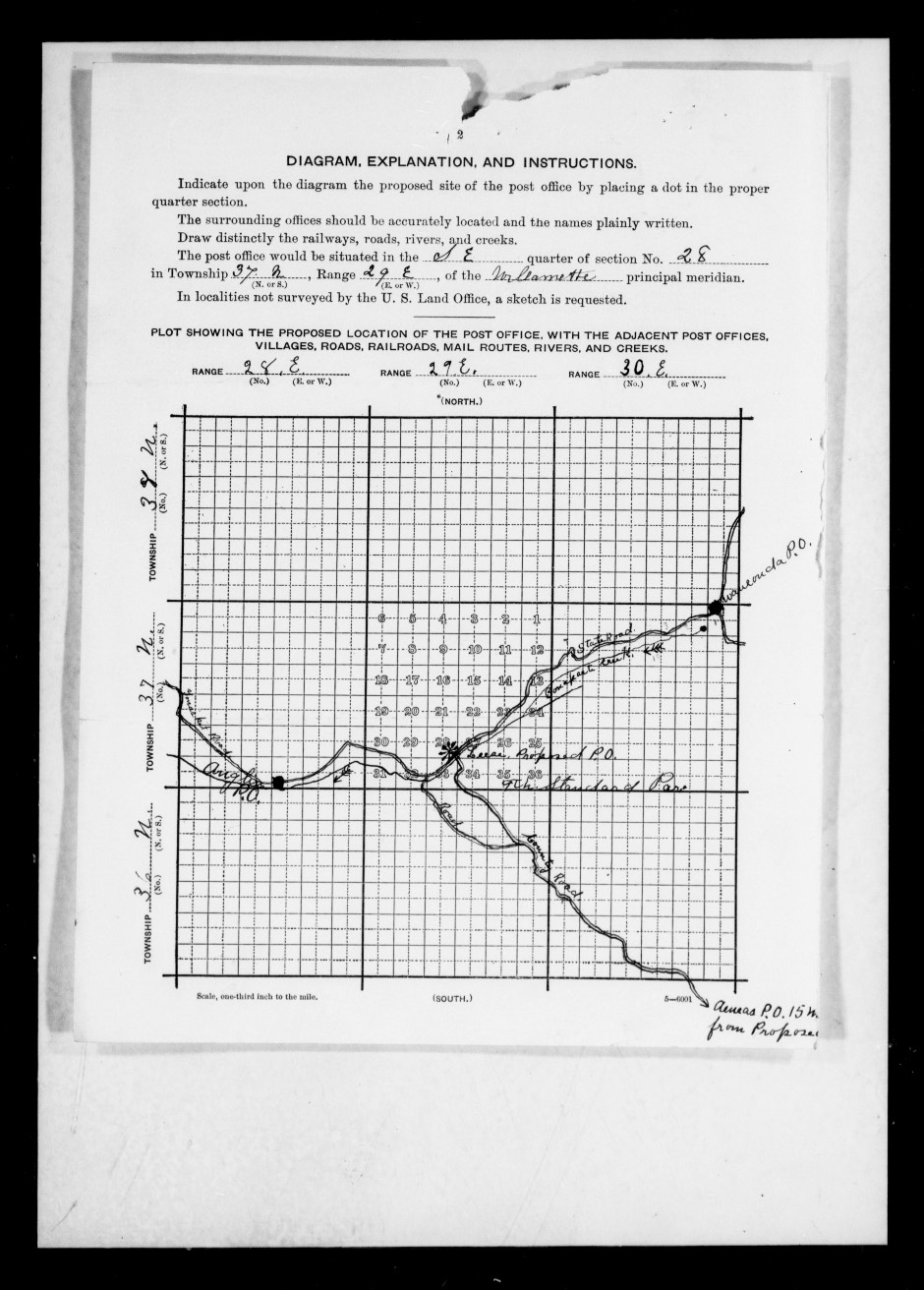 And using Google map, the current location has been identified as follows; 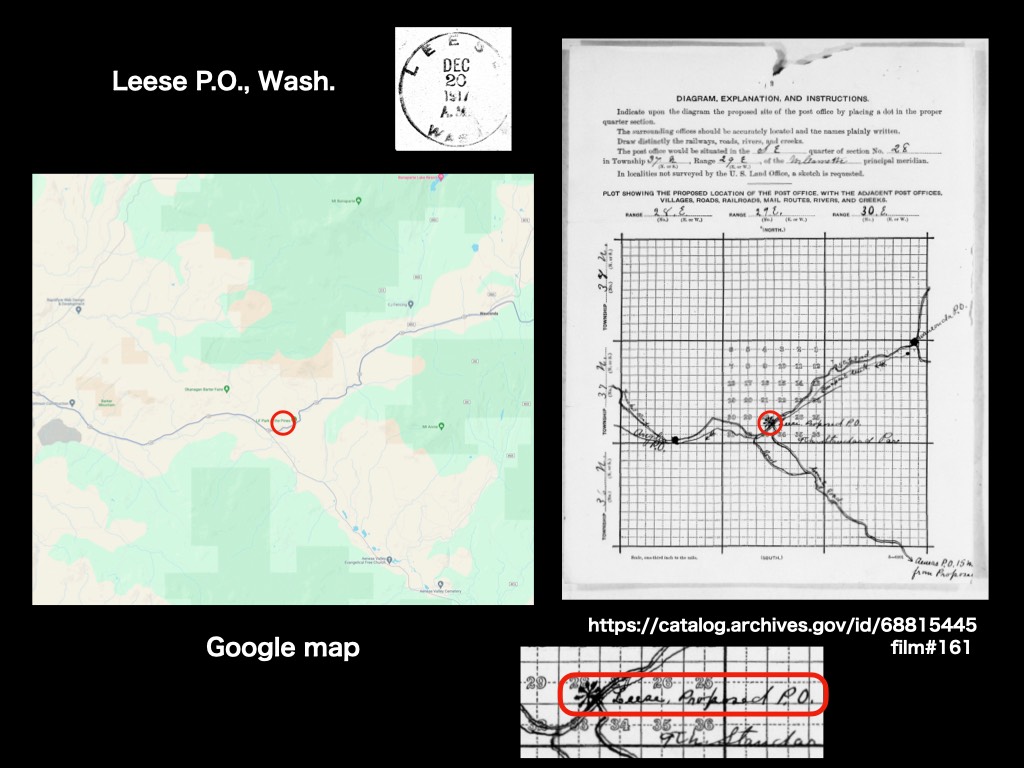 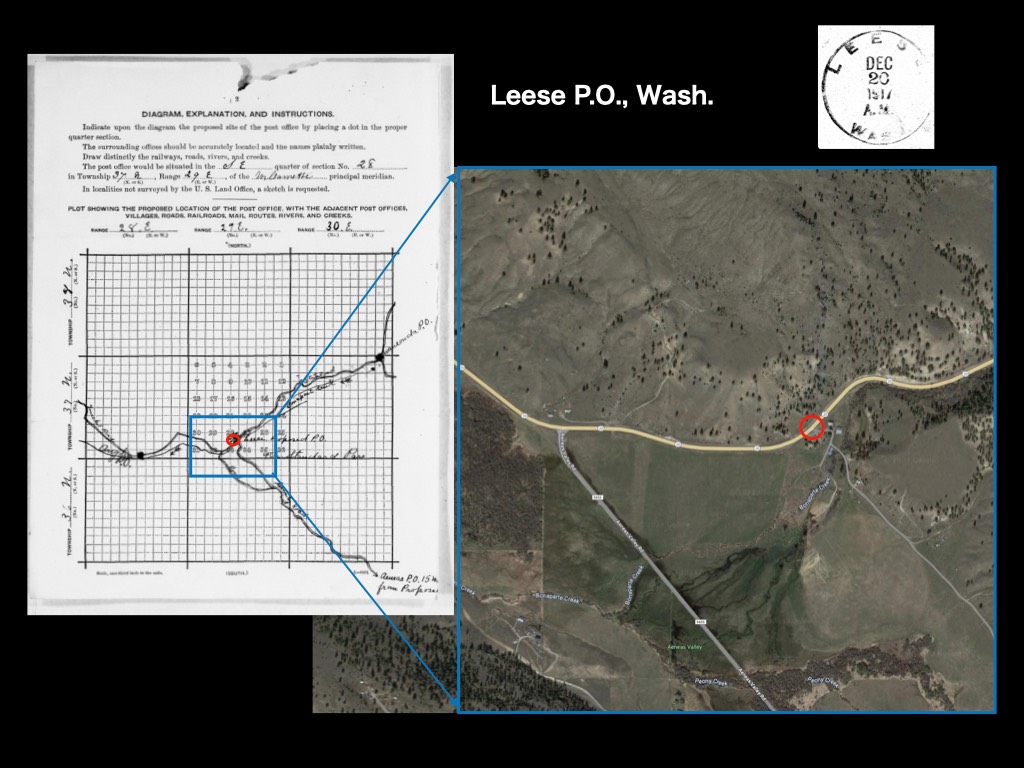 And the possible postal route from Okanogan to Leese and back as this; 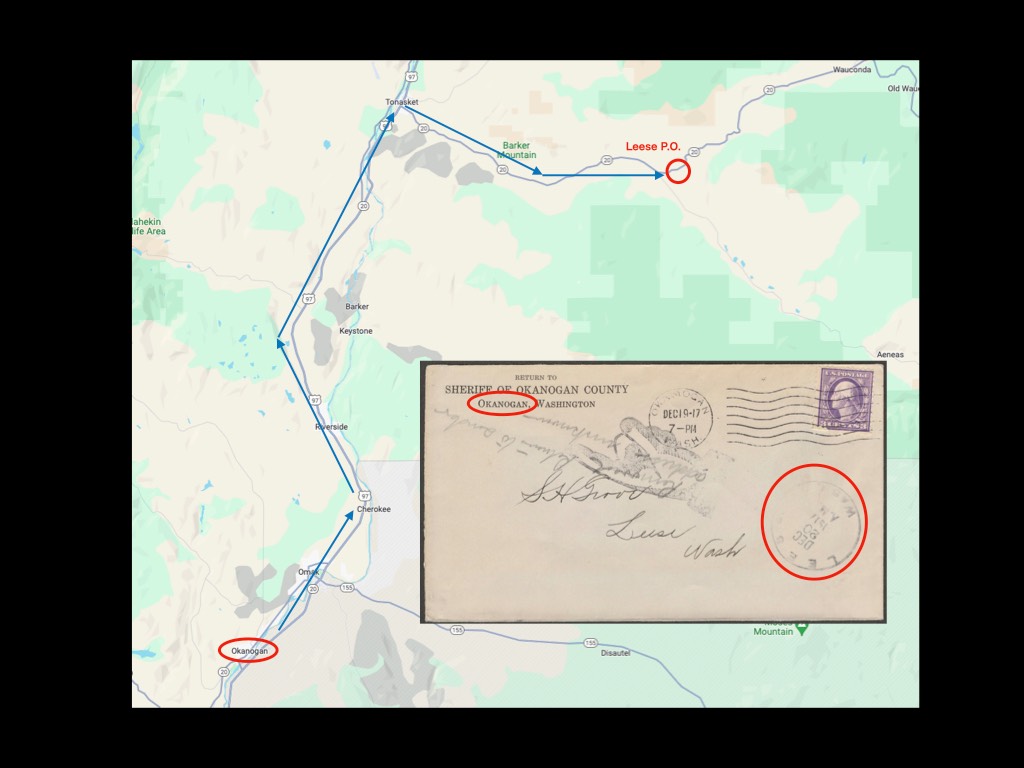 Based on the location and current situation, the Leese P.O. should have been a tiny, almost privately operated one by the Leese family. I reckon that there were not so much postal items being delivered there, and the chance to have it returned to sender should be super small. This is why I collect PH covers, especially when I see some unusual PHs. Lost of things to be written on the leaf - Lovely ! Thank you so much for your instructions, and I do have enjoyed the detective work. - Hironobu - edited for typos |
|
Send note to Staff
|
| Edited by unechan - 02/08/2024 10:38 am |
|
|
Valued Member
Japan
353 Posts |
|
|
Hi Don, thanks for the instructive comment ! Quote:
Pointing Right hands are less common because they did not point to the return address; turning them upside down to make them point to the return address is common. Each post office purchased these Pointing Hands from 3rd party manufacturers and there were many, many styles to choose from. I am assuming that having fewer 'features' or customizations (reason box, PO name, etc.) on the stamper made them less costly and that smaller POs gravitated towards them. Yes I also recognized that right hand PH markings are pretty hard to find so they should be worth noticing and collecting. The link between these rather odd types and the scale/size of the P.O. is very interesting, and would like to further investigate using the digital archive described above. So far, the only few examples that I own are from Dominica and Australia ... need to seek for more US PH ! By recognizing the vast variety of PH, I recently have joined the Auxiliary Markings Club (AMC) and through reading the AM newsletter, I was somehow astonished about the total jungle of PH. But this, at the same time, means that you may have a good chance finding new PHs - very positive news ! I am currently reviewing the systematic categorization being proposed several times on AM newsletter, together with the evolution of various types (form, size, endorsement etc.). For this, I commenced digging into PL&R archive to acquire knowledge on postal rules regarding dead letters and return letters. My final goal is to form a 3- or 5- frame exhibition on US PHs for the forthcoming JAPEX2025 in November. Not sure how the Japanese audience and experts shall judge the exhibit, but at least I will definitely be happy to present the PH to Japanese philatelists (I reckon there's not so many - perhaps nobody - specialized in PH in Japan...) Lots of research and work as well as acquiring interesting covers are required, but I'm really enjoying the fancy "hands". Thanks again ! - Hironobu |
|
Send note to Staff
|
|
|
Moderator
United States
12330 Posts |
|
|
Pillar Of The Community
6366 Posts |
|
|
I see I was writing as you were writing, so some of this may repeat. The method I have found useful for researching a post office is to check Jim Forte's website, particularly the "U.S. Post Offices" link along the left of his main page: https://www.postalhistory.com/Forte lists Leese in Okanogan County, Washington, operating 1915 to 1933, as paperhistory noted. More exact dates can then be found efficiently in the Postal Bulletins website via: http://www.uspostalbulletins.com/ There one finds Postal Bulletin # 10709 dated April 9, 1915 noting the establishment of Leese: 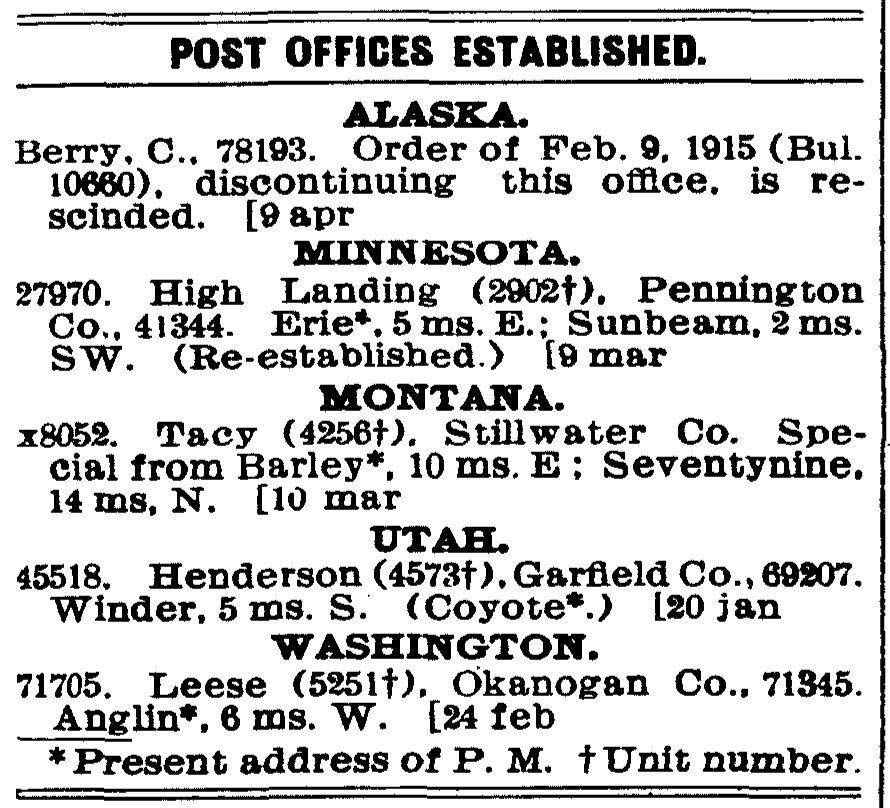 The same issue also notes the commissioning of Elzadie A. Leese as the first postmaster. And Postal Bulletin #16099 dated February 7, 1933 noting the closing: 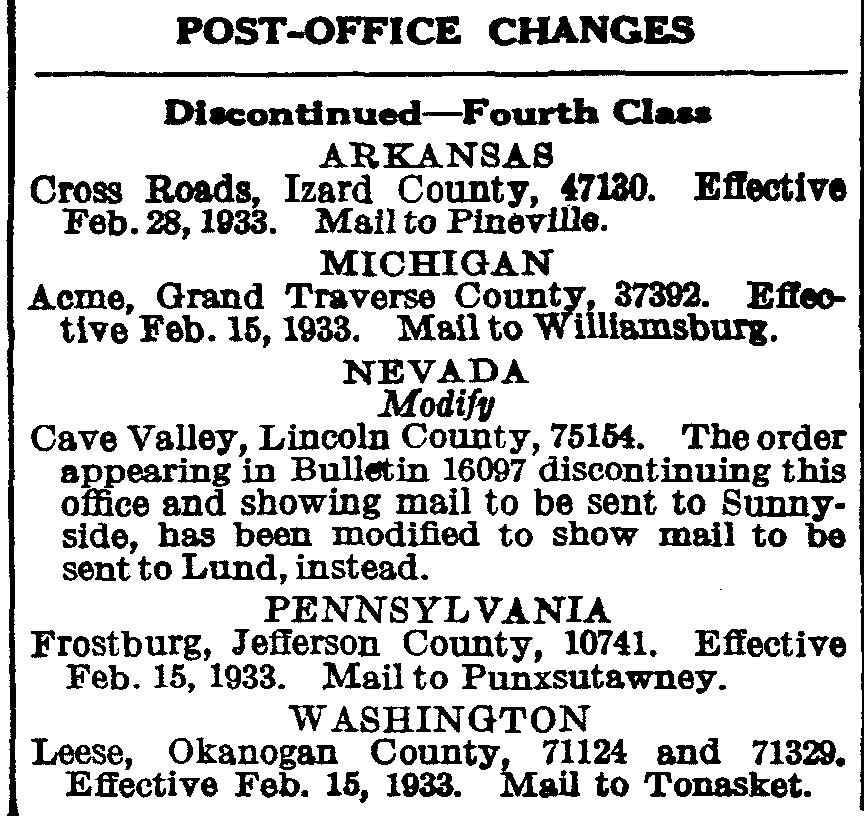 As noted above, and as you found, the Site Map microfilms can be useful to locate an office, although many maps of non-postal origin are digitized and on the internet. The Postmaster Finder site can also be useful in many cases, although Leese does not seem to be listed yet: https://about.usps.com/who/profile/.../welcome.htmIf one wants to dig into the postmasters, the Find A Grave website is often useful and Elzadie Leese is listed: https://www.findagrave.com/memorial...ubiene-leeseOthers may have additional websites and sources, but this is my typical roadmap. On the topic of pointing hands, I have not done any formal census study, but found that pointing hands in the late 1800s and into the mid 1900s are more often left hands (and mostly pointing left). However, I worked in an office 1996-2004 where I had the opportunity to see the returned mass mailings. I found over 90% right hands (and still mostly pointing left). I would add, in my general observation, the larger the office, the more numerous the handstamps and the more specific the messages. For cataloging pointing hands, I see so many individal varieties in the physical illustration as well as the messages to make this one of the most daunting tasks in the realm of auxiiary marks. The typical question to such a listing would be "Is this listed?", |
|
Send note to Staff
|
|
|
Valued Member
Japan
353 Posts |
|
|
Don,
Your database on Stampsmarter is my "go-first" database for the PH - accessing literally every day to seek for information.
I haven't noticed your Advanced DB, which should be also super informative. Lots of things to learn, Thanks !
- Hironobu |
|
Send note to Staff
|
|
|
Valued Member
Japan
353 Posts |
|
|
Hi John, Thank you so much for the additional, informative Web links and your experience in searching the history of post offices. So great to see that those historical documents and records are well preserved - which is not the case here in Japan, where we often struggle to determine even the opening date of smaller, local post offices. I've been using the Postal Bulletins website to search for PL&Rs, but will also dig into the Bulletins as well. Quote:
On the topic of pointing hands, I have not done any formal census study, but found that pointing hands in the late 1800s and into the mid 1900s are more often left hands (and mostly pointing left). Yes, the Large PHs used in larger PO (such as NY and Chicago) are more often Left hand/pointing Left, with some limited exceptions (1899 Chicago Station U; large Right hand / pointing left). Pointing RIGHT should be pretty seldom and might be limited to certain PO or region. The smaller PH, being used from 1880s, are mostly right hand/pointing left, seen from the side. There's another group of left hand/pointing left, seen from the back of the hand (or from above). For both types, pointing RIGHT is not very common. Quote:
However, I worked in an office 1996-2004 where I had the opportunity to see the returned mass mailings. I found over 90% right hands (and still mostly pointing left). I would add, in my general observation, the larger the office, the more numerous the handstamps and the more specific the messages.
This is what I also have observed for the more recent PHs - small in size, right hand / pointing left. These handstamps, with wide variety of messages (endorsements) are available even on Web, for example; https://www.postalproducts.com/grou...r-Stamps.htmSo no wonder there's hundreds and thousands of varieties in the modern-day PH markings ! Thanks again for your instructive post ! - Hironobu |
|
Send note to Staff
|
|
|
Pillar Of The Community
6366 Posts |
|
|
A couple of additional thoughts after getting back from lunch.....
1. "PH" means nothing to the vast majority of the readers here - especially in the thread title. Yes, it will take more typing, but I would avoid this abbreviation since it fails to communicate. "PH" means postal history to many of us.
2. I don't know the intended scope of your exhbit, but the large number of different devices over a century and a half or more would seem to point to some desire for limitations. Do you have a title or scope statement on what you are attempting cover? |
|
Send note to Staff
|
|
|
Valued Member
Japan
353 Posts |
|
|
Dear John, thanks for your kind instructions and suggestions. Yes, I should have written "pointing hand" to be more precise - apologies to all our forum members for confusion if any. As for the exhibit, my first attempt is a one-frame, non-competetive exhibit displaying the varieties (types, or "morphology") of the pointing hand markings - I have submitted the plan and the draft title page to the One-Frame Championship Tokyo 2024 to be held this summer. As this is a non-competitive exhibit, targeting not only the dedicated philatelists but also general public guests to enjoy the world of stamp collecting, I thought it would be more appropriate to make the exhibit more "fun" to watch. To add some more spice, I will be including pointing hand markings from abroad (outside US) - such as Taiwan and Australia - as well. 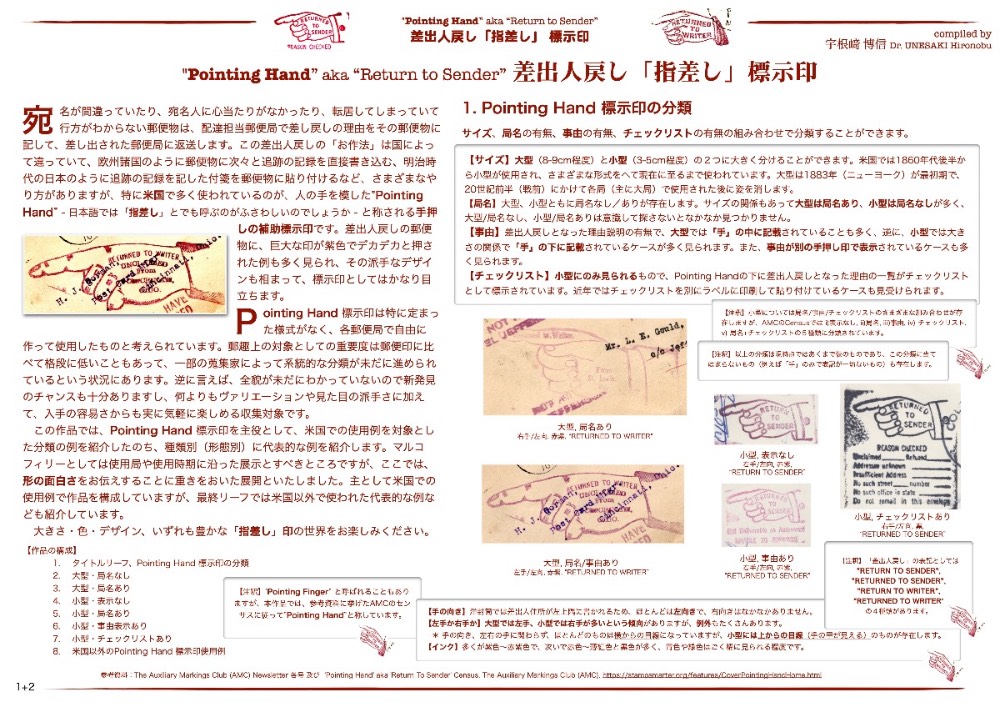 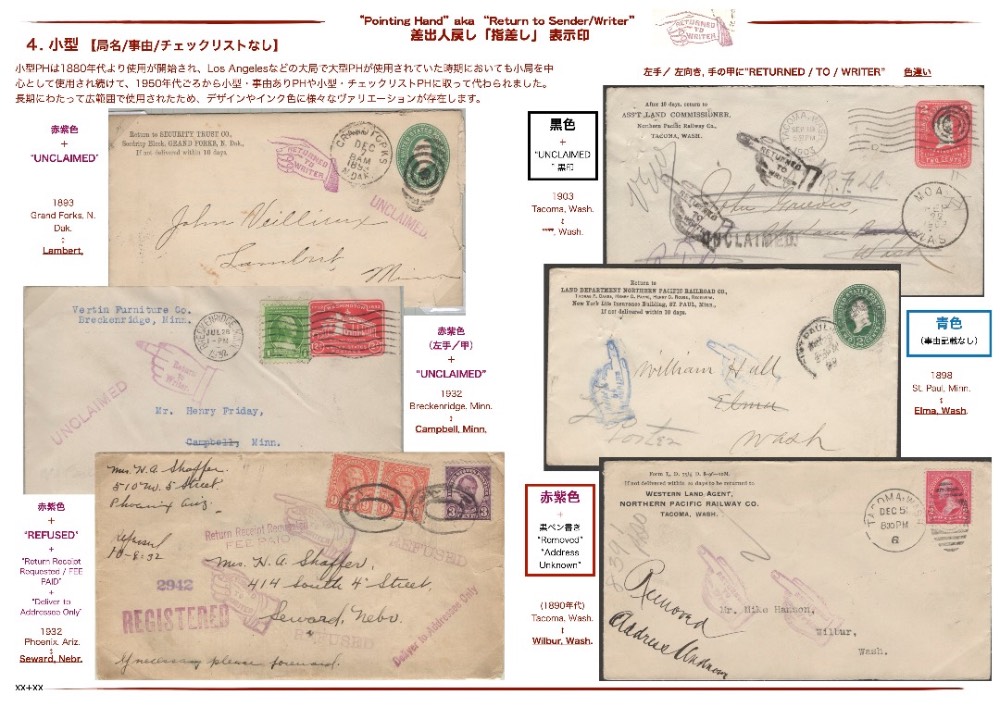 As for the more extended, specialized exhibit targeting JAPEX2024, I am planning to focus on 19th century and early 20th century "Returned to Writer" covers to look for the evolution of different types and early usages. For this, I should add more covers with "Retuned to Writer" markings (not the pointing hands) to show the history. Systematic approach would be definitely necessary as a marcophilatelic exhibit, so I may also be focusing on specific city or area, such as Chicago and New York, and also on specific types (e.g. Large hands). Here's some from my album leafs, which shall be modified and improved to be exhibit leaft - 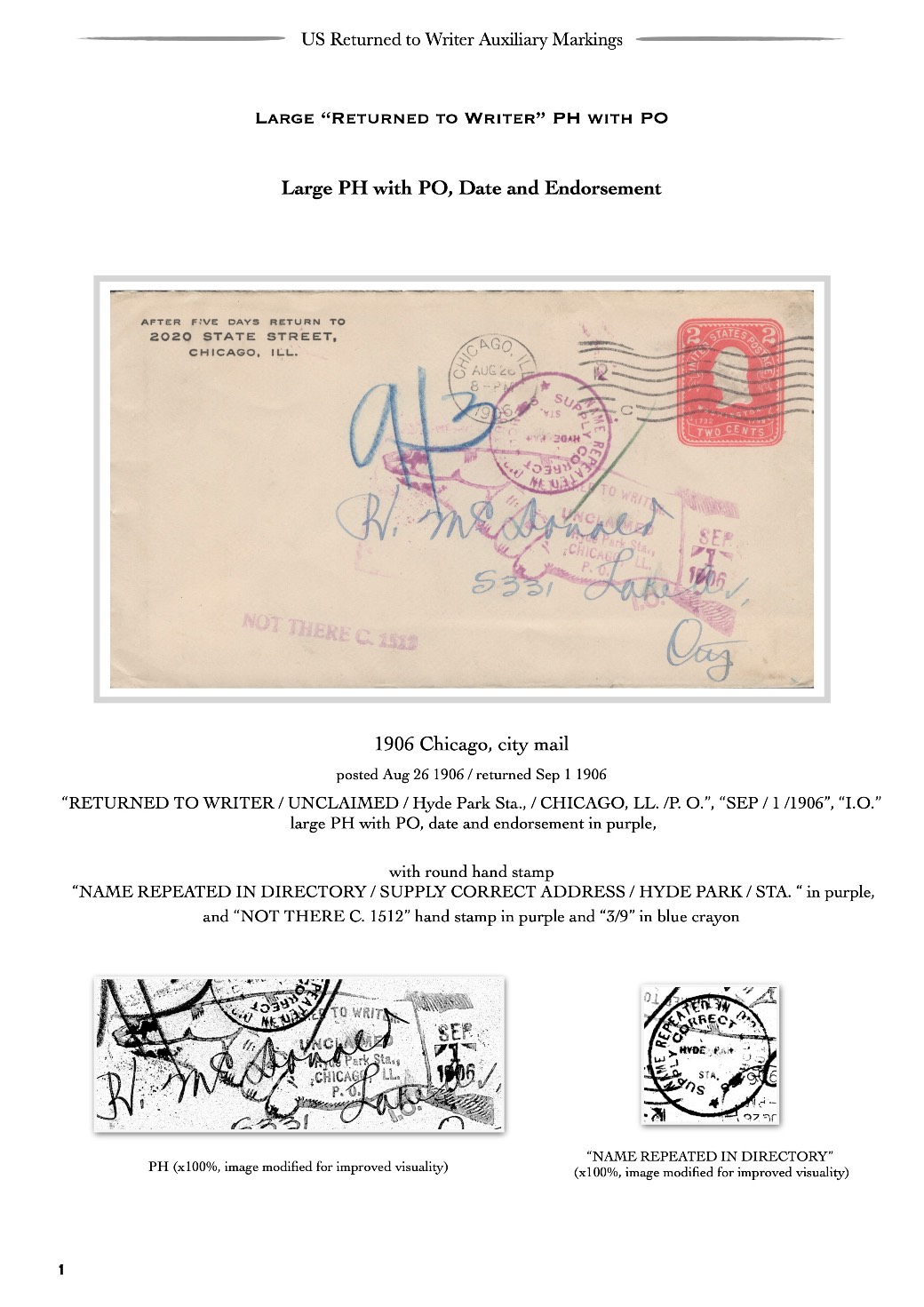 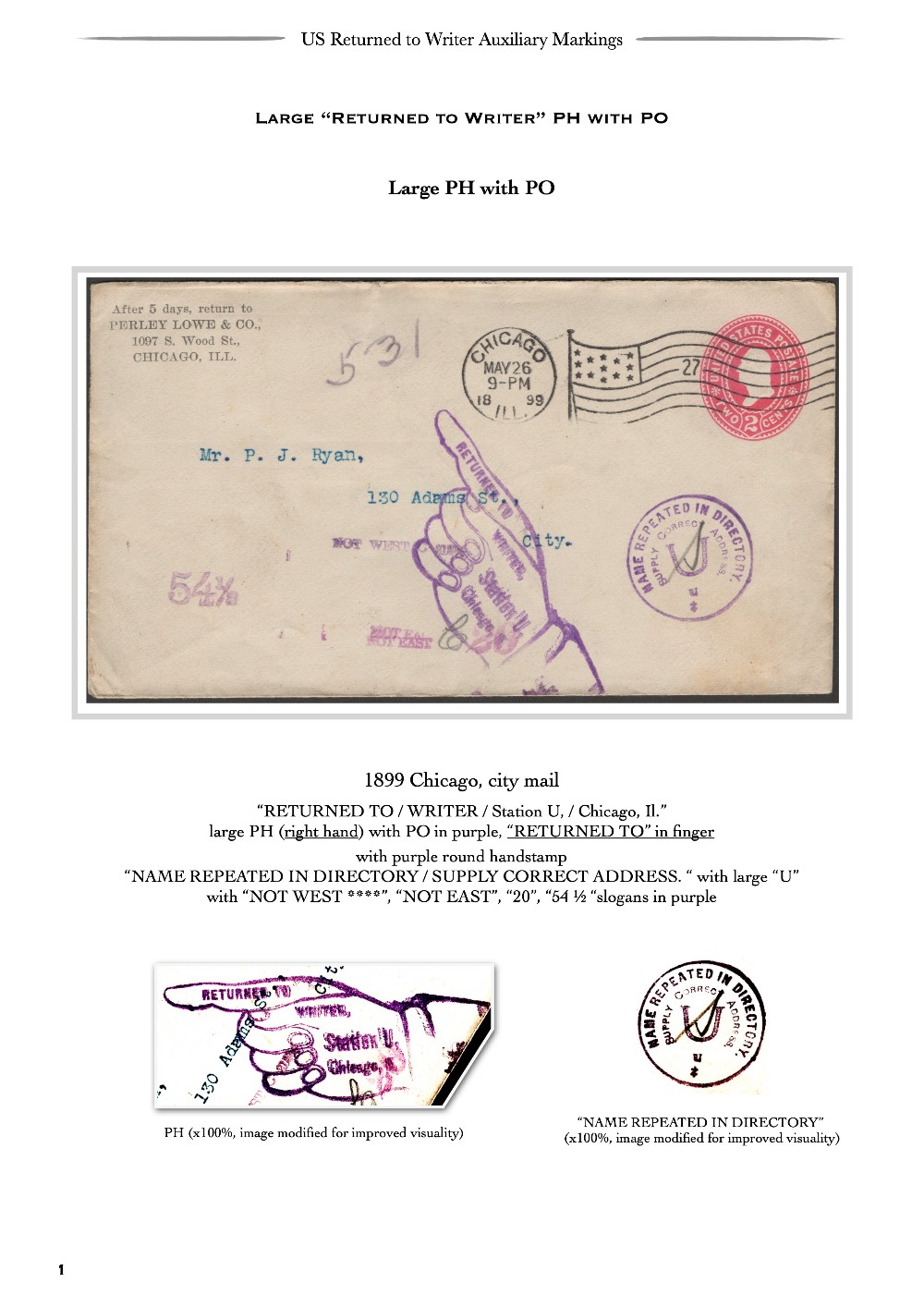 I must admit that I am rather a newbie on pointing hand markings, still on my way gathering information. Most of the information I'm gathering is from Auxiliary Marking Club, especially the Auxiliary Marking Newsletter. Unfortunately I haven't had a chance to see the specialized exhibits on pointing hand markings, so I appreciate any further information on any recommendation for reference materials ! Thanks again. - Hironobu |
|
Send note to Staff
|
|
|
Pillar Of The Community
6366 Posts |
|
|
Yes, I now recall seeing some of these pages in a previous post. A few observations,
1. The first page has an image repeated. Admitedly, I cannot read any of the text, but space being valuable, it would likely be improved by not duplicating pictures.
2. If the last two pages are both used in an exhibit, the difference(s) between the two markings should be obviously pointed out. Perhaps the 2 covers belong on one page.
3. The various numbers 1512, 54 1/2, and 20 are route numbers. I believe you would find it very useful to obtain a copy of Leonard Piszkiewicz's excellent book "Chicago Postal Markings and Postal History", which has chapters on Chicago's "Returned for better direction" and "Returned to writer" totalling 23 pages plus more pointng hands in other chapters incidental to other topics. So much of this book applies directly to other large U.S. cities and U.S. postal history in general, not to mention the footnotes to get you to other valuable references.
4. Overall, much too large of a topic for a 1-frame worldwide survey. And similarly, a multi-frame exhibit on U.S. pointing hands is much too large without a focus to a time period, geography, etc.
One of the challenges to finding much published information about auxiliary markings is that many of them are applied at the destination end of a mail piece's journey and that most postal history collectors tend to collect a geographic area of origin (city, county. state, etc). Dealers often sort by origin state, so finding "pointing hands of state X" requires looking at a dealer's entire stock. Of course, internet sites often allow for more extensive keyword searching but only if the sellers are savvy enough to mention all the features of a cover.
Oops, I've strayed from Leese, Washington a bit. |
|
Send note to Staff
|
|
|
Valued Member
Japan
353 Posts |
|
|
Hi John, thanks for the comprehensive critique and suggestions for improvement - very much appreciated ! Quote:
1. The first page has an image repeated. Admitedly, I cannot read any of the text, but space being valuable, it would likely be improved by not duplicating pictures.
2. If the last two pages are both used in an exhibit, the difference(s) between the two markings should be obviously pointed out. Perhaps the 2 covers belong on one page.
3. The various numbers 1512, 54 1/2, and 20 are route numbers. I believe you would find it very useful to obtain a copy of Leonard Piszkiewicz's excellent book "Chicago Postal Markings and Postal History", which has chapters on Chicago's "Returned for better direction" and "Returned to writer" totalling 23 pages plus more pointng hands in other chapters incidental to other topics. So much of this book applies directly to other large U.S. cities and U.S. postal history in general, not to mention the footnotes to get you to other valuable references.
4. Overall, much too large of a topic for a 1-frame worldwide survey. And similarly, a multi-frame exhibit on U.S. pointing hands is much too large without a focus to a time period, geography, etc. Here's my thoughts; 1. The exhibit leafs are still in draft level, and there should be some inconsistency (such as duplicated images as you have noted). I should have mentioned this. 2. The last two pages are my album leafs for classification and organizing the different types, and I agree that in the exhibit leafs, multiple examples be displayed in a single leaf for presenting the differences (or similarity). 3. Route numbers! This is another thing I need to learn - I have encountered many times whilst reading the Auxiliary Markings Newsletter on the reference book, " Chicago Postal Markings and Postal History", which I thought should be a great reference - found a nice new copy on ebay and awaiting to arrive. Really looking forward to learn lots of things. 4. I totally agree that this is a huge topic to be covered in a one-frame exhibit in a competitive exhibition, as it would also not meet the rules and requirement for a one-frame exhibit. The one in Tokyo that I have mentioned is a non-competitive exhibit and have much freedom, so I am aiming to show the overall sketch of this attractive markings by displaying the representative examples and their variation. As for the multi-frame, competitive exhibit, I am learning that U.S. pointing hand markings are so so diverse and much too large a topic to be covered in, say, 5 frame. Narrowing the scope to focus on early days of specific area (large cities) should be a good approach from both postal history and marcophilately. Another approach might be to focus on the variety of specific type such as large pointing hand, which also narrows the timeframe of the usage. Definitely needs more investigation. Quote:
One of the challenges to finding much published information about auxiliary markings is that many of them are applied at the destination end of a mail piece's journey and that most postal history collectors tend to collect a geographic area of origin (city, county. state, etc). Dealers often sort by origin state, so finding "pointing hands of state X" requires looking at a dealer's entire stock. Of course, internet sites often allow for more extensive keyword searching but only if the sellers are savvy enough to mention all the features of a cover. Thanks, my approach for seeking for pointing hand markings is exactly like what you've mentioned. As it is practically impossible to obtain a cover from the dealers here in Japan, my current resources are ebay, Delcampe and Jim Forte (I appreciate if you can introduce any other recommended dealer sites if any ). I make a search for "pointing hand" or even "returned to writer", and go through all the stock to seek for a desired pointing hand. This takes time but also helps me to understand the postal history of U.S. I am dreaming to visit some of the US stamp shows and dig into the dealer's stocks, which should be a paradise. Thanks again, and I appreciate that my Leese post office question has lead to this invaluable discussion on pointing hand marking collection. - Hironobu |
|
Send note to Staff
|
|
|
Pillar Of The Community
6366 Posts |
|
|
Valued Member
Japan
353 Posts |
|
|
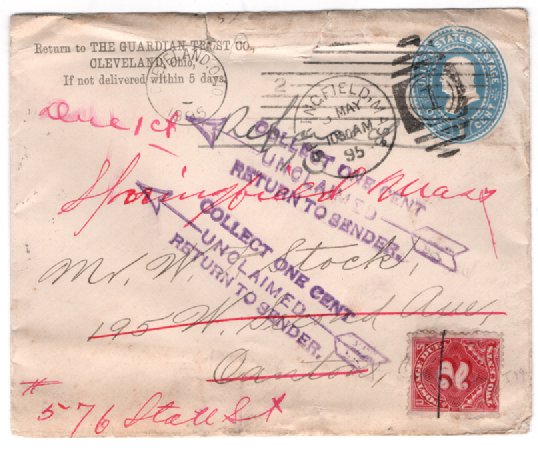
Hi John, this is lovely... postage due & return to sender with arrows !
It's the diversity of Return to Writer/Sender covers which fascinates me, and it's so wonderful to learn something new.
Thanks again!
- Hironobu |
|
Send note to Staff
|
|
| |
Replies: 14 / Views: 879 |
|
|
To participate in the forum you must log in or register. | |
Disclaimer: While a tremendous amount of effort goes into ensuring the accuracy of the information contained in this site, Stamp Community assumes no liability for errors. Copyright 2005 - 2026 Stamp Community Family - All rights reserved worldwide. Use of any images or content on this website without prior written permission of Stamp Community or the original lender is strictly prohibited.
Privacy Policy / Terms of Use Advertise Here |
| Stamp Community Forum |
© 2007 - 2026 Stamp Community Forums |
| It took 0.27 seconds to lick this stamp. |
 |
|
|
|


 Posted 02/08/2024 06:44 am