| Author |
 Replies: 12 / Views: 3,150 Replies: 12 / Views: 3,150 |
|
|
Valued Member
United States
180 Posts |
|
|
|
Another rookie question:
I've spent the past couple of days going through a pile of East German five-year plan stamps and can't find a watermark on many of them.
I have a black tray and Clarity fluid and have even tried the method using a scanner described in another thread.
I had the same problem with the Hindenburg stamps.
Is there something about German stamps that makes seeing the watermark difficult? I've gotten pretty good with everything else - double line watermarks in US, different crown watermarks for GB KGV, etc.
Does everybody end up with a pile of stamps where you just can't find the watermark?
|
|
Send note to Staff
|
|
|
|
|
Pillar Of The Community
United States
775 Posts |
|
|
Daylight works better than artificial light if trying to see the watermark in the tray.
If you are using watermark fluid with the scanner and still cannot see the watermark try running the scan through ImageSleuth or Postmark Reveal.
Unfortunately, a lot of DDR stamps, including the 5 year series, have hard-to-see watermarks. |
Send note to Staff 
|
|
|
Pillar Of The Community
Romania
596 Posts |
|
|
I also struggled with identifying these watermarks until I noticed the indications from Michel (see the red arrow):  Identification is very simple. 1. Place the stamp face up and use a lamp with warm light. 2. If the stamp curves as in the example below:  2 watermark variants remain: 2XI and 2YII 3. If the DDR letters are horizontal = watermark 2XI 4. If the DDR letters are vertical = watermark 2YII The same if the stamp curves in a perpendicular direction |
|
Send note to Staff
|
|
|
Valued Member
United States
50 Posts |
|
|
Yes, particularly difficult are wm"s. #237 (Swastikas) & #292(Flowers) and especially DDR #'s 10N29-10N44 & 122-136. |
|
Send note to Staff
|
|
|
Valued Member
United Kingdom
439 Posts |
|
|
In answer to your Question, does everyone have a pile of stamps they can't identify?-- I certainly have some. I don't think I have ever spotted the watermark on a GB 3d. Lilac, Wilding stamp and don't always see the watermark on some other GB stamps of the era. I put it down to the colour of the ink. I identify those I can, try a few days later with those I can't identify, Eventually I go by the vendors description in the hardest cases. |
|
Send note to Staff
|
|
|
Valued Member
United States
128 Posts |
|
|
Hi cupram, thanks a lot for the tip from Michel. It is interesting that in my book (2016) there is no comment on the bottom about curvature for DDR Wz. 2. What edition of Michel do you have? Also - is there similar curvature comment about DDR Wz. 3 (X and Y) in your book? Thanks |
|
Send note to Staff
|
|
|
Pillar Of The Community
Romania
596 Posts |
|
|
Hi igopp, I'm glad I helped you. I had Michel 2011 and it doesn't appear. This mention appears in Michel 2019. If you look carefully at the watermarks in the catalog, you will also notice some thin white lines that indicate the direction of elongation of the fibers in the paper, so you can know how they will bend - I used the method for Wz.2 Deutsche Reich. For DDR watermark 3X or 3Y does not apply because 3Y is reversed 3X and they will bend the same. I'm looking for a combination of flower and DDR regardless of which side. Since the letters D look like O, I orient myself in identification by the letter R. Flower above and R on the right = 3X The flower above and R on the left = 3Y 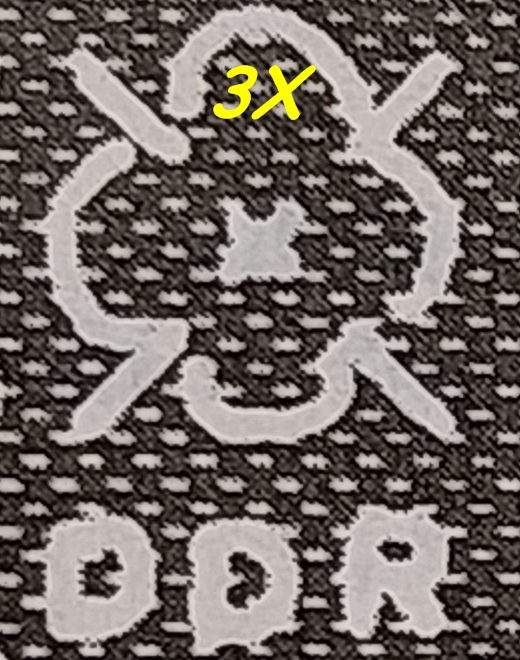 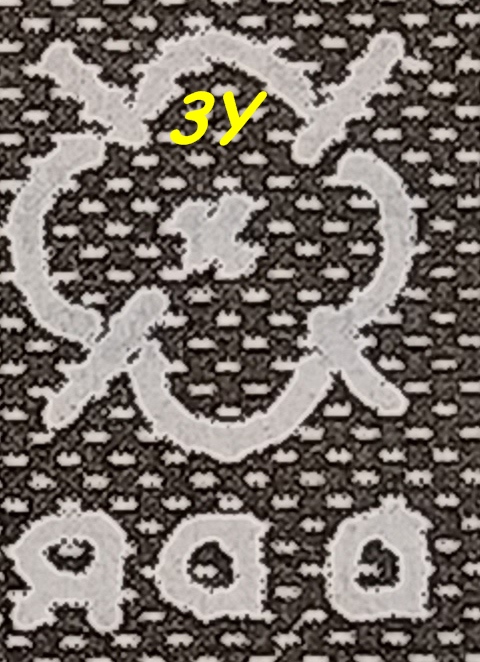 |
|
Send note to Staff
|
| Edited by cupram - 03/28/2024 08:51 am |
|
|
Valued Member
United States
128 Posts |
|
|
Cupram - yes, I also use letter "R" orientation as the main difference between 3X and 3Y. In general it is much easier to determine Wz.3 comparing to Wz.2. |
|
Send note to Staff
|
|
|
Valued Member
United States
128 Posts |
|
|
I found another way to deal with watermarks Michel DDR Wz.2. Warming up is helping to see curvature only for stamps with a gum. However, for used stamps this method is not working. There is another simple way to see the difference between XI and XII (or YII and YI). Simply try to bend stamp slightly (as on pictures) in two different directions. You can easily see that in one direction stamp is bending easily and willingly, but in another direction it will resist slightly. For example, picture 1 shows stamp Mi.#370 XII and it is easily banding in this direction, but it is resisting to bend on picture 2. Now, after some practice, I can accurately and quickly determine watermarks Wz.2 without tray and fluid, and this method works for both mint and used stamps.   |
|
Send note to Staff
|
|
|
Pillar Of The Community
Romania
596 Posts |
|
|
I don't think I have enough sensitivity to apply this method.
@igopp, I suggest you cut some stamps (they are easy to find) so that the height is equal to the width and redo the test.
I am curious if the results coincide with the initial ones. |
|
Send note to Staff
|
|
|
Valued Member
United States
128 Posts |
|
|
cupram, in the last few days I went though my large collection of DDR stamps and double checked many stamps. I also was skeptical first, but many experiments confirmed that using this method I can correctly determine watermark for at least 95% cases. I see your point that it supposed to be easier to bend a stamp against the longer side. However, as you know, the "Five Year Plan" series (like pictured stamp) has both XI and XII orientations, so I do not need to cut stamps for verification of my method as long as I can successfully determine both types of watermark. I am really surprised that you cannot feel the difference. Make sure there is no remaining hinge on a back side - that could mask the difference completely. |
|
Send note to Staff
|
|
|
Pillar Of The Community
Romania
596 Posts |
|
|
@igopp,
For used stamps I use a bowl of water.
They curl immediately. You waste time drying them, but you also clean them. |
|
Send note to Staff
|
|
|
Valued Member
United States
128 Posts |
|
| |
Replies: 12 / Views: 3,150 |
|




 Posted 03/09/2024 10:47 am


