| Author |
 Replies: 10 / Views: 1,132 Replies: 10 / Views: 1,132 |
|
|
Pillar Of The Community
United States
1946 Posts |
|
|
I'm trying to pin down the chronology of some of what seem to be early uses of the bust of Peace (NOT Liberty) vignette on revenue essays. "Foreign exchange" appears in the first issue revenues, but how late did it continue?
 When was the earliest 25 (cent) tax applied and to what? For how long did that last? When was the earliest 25 (cent) tax applied and to what? For how long did that last?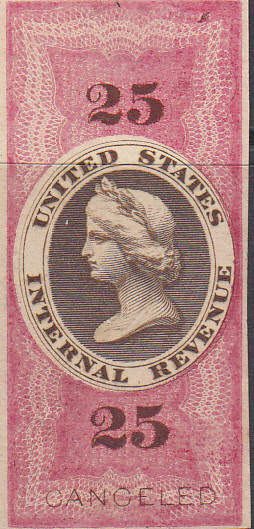 |
|
Send note to Staff
|
|
|
|
|
Bedrock Of The Community
United States
10860 Posts |
|
|
Foreign Exchange tax was rescinded August 1, 1866. There were .25 tax rates in the original Schedule B for Bonds and certificates. |
Send note to Staff 
|
|
|
Pillar Of The Community
United States
1946 Posts |
|
|
Thanks for the reply revcollector.
So might we surmise that:
Stylistically the Foreign Exchange stamp here might fit in the with first issue revenues?
but
The second stamp does not seem to fit with the first series so much as the second or third series?
Or even with the early proprietaries?
I am not willing to lump them all into one early melting pot, but at the same time it is not clear who prepared them.
American from 1868 and later, for sure. But prior to that???
Thoughts? |
|
Send note to Staff
|
|
|
Bedrock Of The Community
United States
10860 Posts |
|
|
Pillar Of The Community
United States
1946 Posts |
|
|
Please don't blow me off. If you find ANY dates in the first six pages of Turner, where these are covered, then you probably wrote them in yourself. Even that would be useful for me.
I have also consulted the Kelleher auction cat for the Morton Dean Joyce collection which was the basis for Turner. Mumble, mumble.
Now I am turning to this list for help filling in the blanks. Some of you guys know quite a bit.
BTW "dialog" implies bidirectional.
If anyone knows what other literature exists for these things, a reference would be appreciated. |
|
Send note to Staff
|
|
|
Bedrock Of The Community
United States
10860 Posts |
|
|
As far as I know, all the banknote companies were producing essays from the beginning, once it was announced that the government was interested in issuing revenue stamps. Unless one can find the specific archives...... |
|
Send note to Staff
|
|
|
Valued Member
United States
81 Posts |
|
|
According to Schedule B of the Act of 1862, an Inland Exchange tax of $1.00 was levied on bills of exchange for amounts over $5000 and up to $7500.
Given the incorporation of reuse-prevention measures in the $1 essay, I'm of the mind that if a competing BNCo was going to expend resources developing a solution and proffer it to the Treasury Department, we're looking at 1867. It was in December of that year that Commissioner of Internal Revenue Rollins issued a call to the public for a solution to reuse (though it should be noted that Butler & Carpenter had been handling reports of revenue stamp reuse as early as 1863.)
Skipping ahead a bit, Commissioner Delano addressed the problem of revenue stamp reuse in his 1869 Annual Report (for FY 1868) and specifically mentioned the potential of printing stamps using fugitive ink. However, by that time, the requirement to inscribe stamps with the name of the instrument to which they were to be affixed had long been rescinded.
I don't think the $1 essay in particular is a candidate for having been submitted in a BNCo bid for the 1862 contract. (If I'm not mistaken, it is not known who the competing BNCos were. They are not mentioned by name in Boutwell's letter recommending Butler & Carpenter.) But if we take a leap and imagine that it was part of an 1862 bid package by a competing firm, the company producing this essay would have to have been unimaginably prescient to anticipate a problem with reuse.
I don't know if any of that helps you at all, but if I had to ascribe an earliest possible year to the development of the $1 design, I'd say 1866, though more likely 1867. Still, I can't account for why the design would have "Foreign Exchange" inscribed in it.
As for the 25¢ essay, the Bust of Peace vignette is quite similar to that used in prototyping the Rosenthal Patent Essay (Turner 2-D). That patent was granted mid-1868. Even if we take into account that patents were often issued after an invention or process was prototyped, 1868 corresponds to the year range mentioned above.
So I think we're looking at a year range of 1866–1868, but with many unanswered questions still on the table. |
|
Send note to Staff
|
|
|
Pillar Of The Community
United States
6469 Posts |
|
|
Pillar Of The Community
United States
1946 Posts |
|
|
And not just the banknote companies. Considering the scarcity of this early material we cannot rule out production by independent inventors, for which patent office records give us some help, but only SOME help. |
|
Send note to Staff
|
|
|
Pillar Of The Community
United States
1946 Posts |
|
|
revenue collector wrote: Quote:
I have a table of all of the Civil War tax rates here: Excellent table. Thank you. Question: WRT the column on the right, if a tax type has no entry, does that mean the tax was never rescinded, or merely that the data are missing? Or something entirely different? |
|
Send note to Staff
|
|
|
Bedrock Of The Community
United States
10860 Posts |
|
|
Not rescinded during the war period. Some were not rescinded until 1883. |
|
Send note to Staff
|
|
| |
Replies: 10 / Views: 1,132 |
|




 Posted 06/01/2024 11:00 am




