| Author |
 Replies: 12 / Views: 1,329 Replies: 12 / Views: 1,329 |
|
|
Pillar Of The Community
United States
1112 Posts |
|
|
*** Moved by Staff to a more appropriate forum. ***In my circa 1947 Scott International, the Scott numbers for the first 6 stamps on page 1 for the United States are old catalog numbers. I am curious what the consensus is as to what they map to in today's catalog. Here's a snippet of the page. Numbers are hard to see, but I will identify them.  1847 1847Listed as (28) - This would be #1 today. 1851-56Listed as (32d) and (33) - I'm guessing these are #9 and #11 today. They could certainly be #7 and #10, but my assumption is that they would be the lesser value (more common) stamps. 1857-60Listed as (42f) (44) and (50) - I'm guessing these are #24, #26, and #35 for the reasons of lesser value (more common) stamps. The year ranges back then are also different than today, likely due to new information, though I suppose it could also just have been an error. Scott #6 today says it was issued in 1857 and Scott #18 says it was issued in 1861. Those are the two stamps that affect the ranges. I have a 1969 catalog, so I'm gonna check that to see what it showed, but I am curious when the changes to the numbering and the date ranges happened.
|
|
Send note to Staff
|
|
|
|
|
Pillar Of The Community
United States
8615 Posts |
|
|
Simple answer ---They had the Postmaster Provisionals as the lower numbers before they change the numbering system . |
Send note to Staff 
|
|
|
Pillar Of The Community
United States
1112 Posts |
|
|
Yeah, I figured that had to be part of what happened. The reason I am asking is that I'm planning to complete this page 1 as part of an idea to recreate the Part I, but with larger frames on better paper. The mapping of the 32d and the 42f interest me most. If I knew Scott's intent back in the day, then I can put the most appropriate stamp on the page. |
|
Send note to Staff
|
|
|
Pillar Of The Community
United States
1112 Posts |
|
|
After some hours poking around other forum topics and big blue blogs, etc. it seems my assumptions as to the mappings are correct. That said, if anyone has images of the 1949 Scott catalog pages that cover these stamps or images of the album pages from the 1969 edition Scott International Part I, that would be wonderful. Note that I read somewhere that US #2 is included in the 1969 edition pages, but I wonder what else was added or changed on the early pages for the regular issues. |
|
Send note to Staff
|
|
|
Pillar Of The Community
United States
1112 Posts |
|
|
I was pointed to this image: 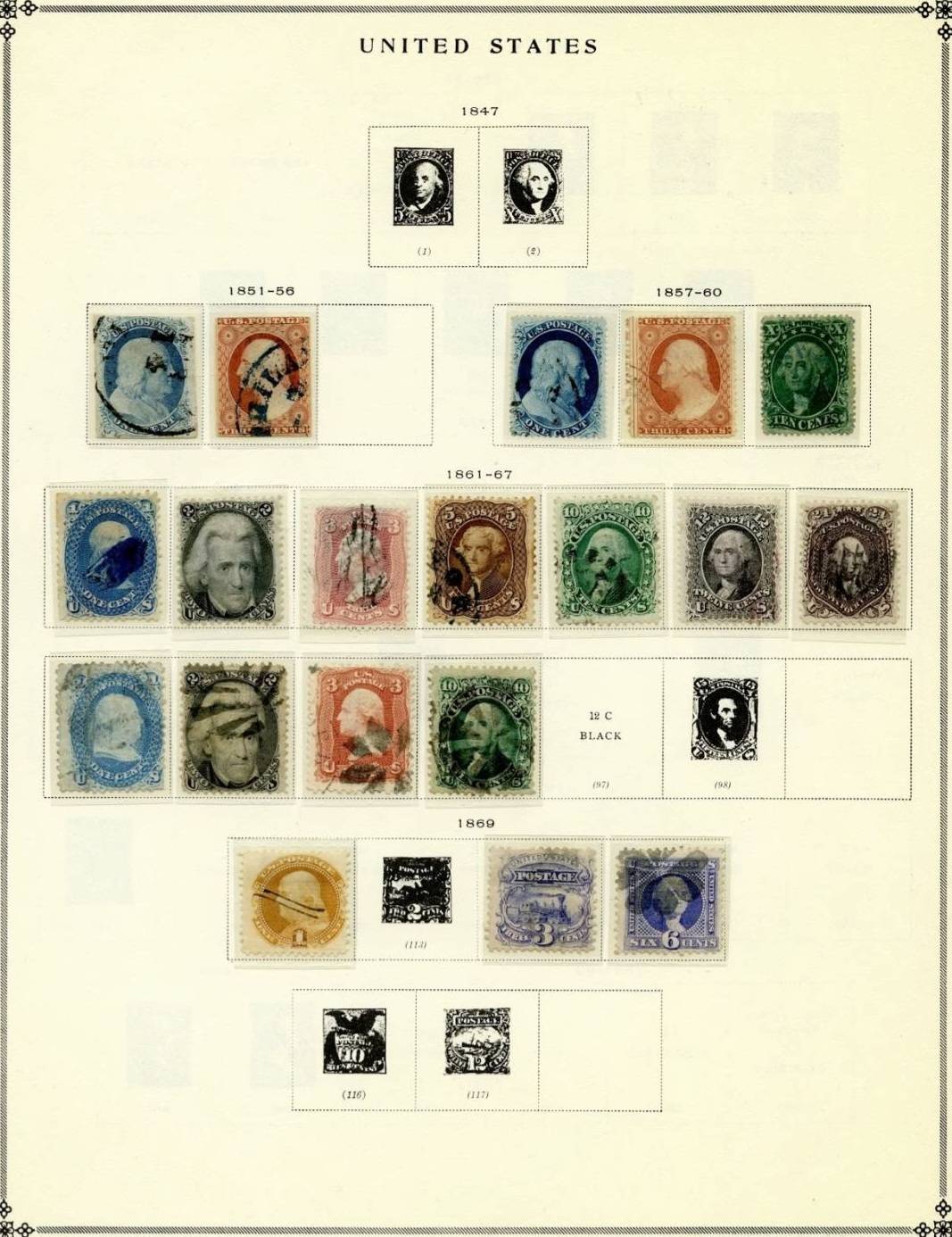 It can be found at: https://bigblue1840-1940.blogspot.c...bum-for.html if you scroll down to the Big Blue section. It is apparently the 1969 (perhaps 1997) edition. It looks like the old catalog numbers were updated and I can see that #2 is added. Also, some previously empty boxes are updated with specific images. Because stamps are mounted, I can't see what else might be blank spaces. Update: The U.S. checklist that is available on the Big Blue blogspot implies that the only blank spaces on the page are the 3rd space under 1851-56, the last space in the grill section of 1861-67, and the last space in the 1869 pictorials section. The suggestion is that #14 or #15 be placed in the first blank space, that #88 be placed in the second, and #119 be placed in the third. I get that #88 is a very inexpensive grill, but it is not the same grill as the others. Maybe I will go for #100. |
|
Send note to Staff
|
| Edited by NicholasC - 09/04/2024 7:00 pm |
|
|
Bedrock Of The Community
United States
10869 Posts |
|
|
Pillar Of The Community
United States
3532 Posts |
|
|
Quote:
The year ranges back then are also different than today, likely due to new information, though I suppose it could also just have been an error. Scott #6 today says it was issued in 1857 and Scott #18 says it was issued in 1861. The year ranges of: 1851-56, and 1857-60 are clearly in error. There were new imperforate Scott #'s in 1857, such as #6, and there were new perforated Scott #'s in 1861 as well, such as #18. 1851-57 and 1857-61 are the correct ranges. |
|
Send note to Staff
|
|
|
Pillar Of The Community
United States
1112 Posts |
|
|
Yes, I found that as well while digging into this. I think perhaps Scott tended to specify the year ranges based on the illustrations / expected stamps to be mounted. Another possibility is the correct year information for #6 and #18 might not have been known at the time of original publishing of these pages. And lastly, just a flat out errors as was common in both the album pages and the catalogs. |
|
Send note to Staff
|
|
|
Pillar Of The Community
United States
1112 Posts |
|
|
I found a copy of the 1926 catalog online (free to read) on Google Books. That was the latest catalog available to read before the catalog numbers changed drastically. From that catalog, I could tell the following:
#28 maps to #1
#32d maps to #9
#33 maps to #11
#42f maps to #24
#44 maps to ? (see below)
#50 maps to #35
We know that in the recent printings of the album, the perforated 3c Washington would be listed as #26 which is dull red type III. In the 1926 catalog, however, there is no mention of a type III. The #44 description is dull red type II. The #43 is rose type I. But, the type II back in 1926 is defined as having outer lines removed, which we know is type III today, so therefore it must be that #44 maps to #26. |
|
Send note to Staff
|
|
|
Bedrock Of The Community
12778 Posts |
|
|
Pillar Of The Community
6366 Posts |
|
|
Nicholas, I think you may be taking jumps which are too long to fully understand the changes to Scott's numbering/mapping. There are several fairly major changes. One of the first is in 1930 with the separation of the last of the BOB stamps to separate groups of higher numbers, which doesn't apply very directly to your album question. Then in 1940 the BOB sections are given their alphabetic prefixes and Postmaster Provisionals are given their new (current) numbering scheme with an internal "X" as part of the ID. Numbers 1-27 then remain unassigned at least through 1945 (I do not have a 1946 or 1947 Specialized), and by the 1948 edition #1 is #1. From the 1945 Scott U.S. Specialized catalog, the old numbers: 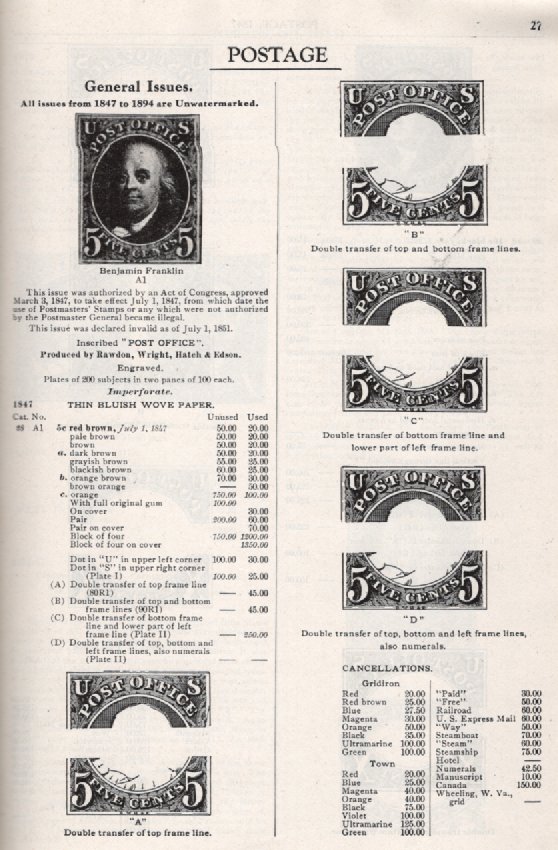 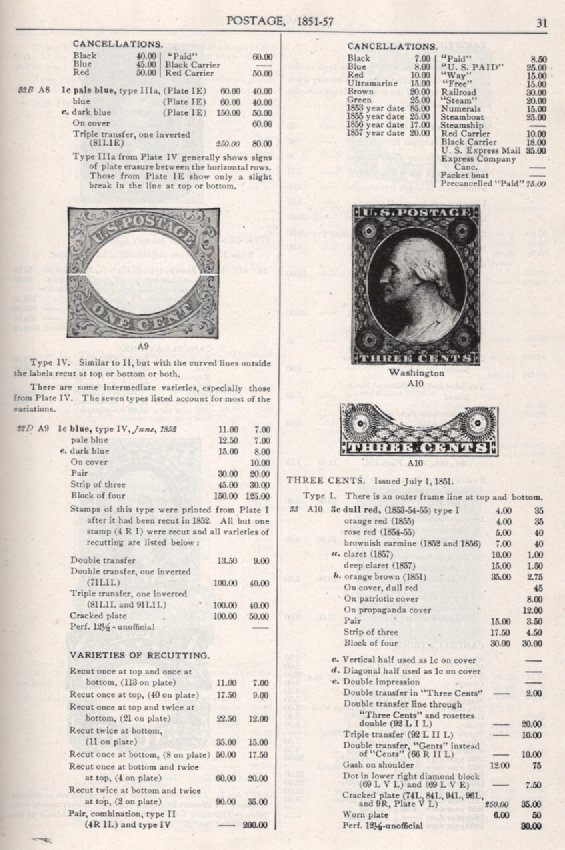 By 1948 #28 has become #1 (and I suspect it happened in the 1946 or 1947 catalog because 1-4 are not among the changes listed in the inttroductory pages in 1948.) 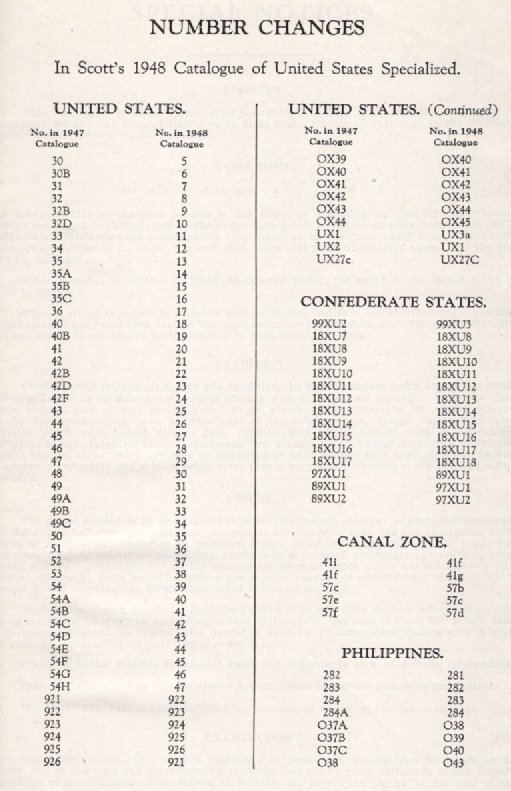 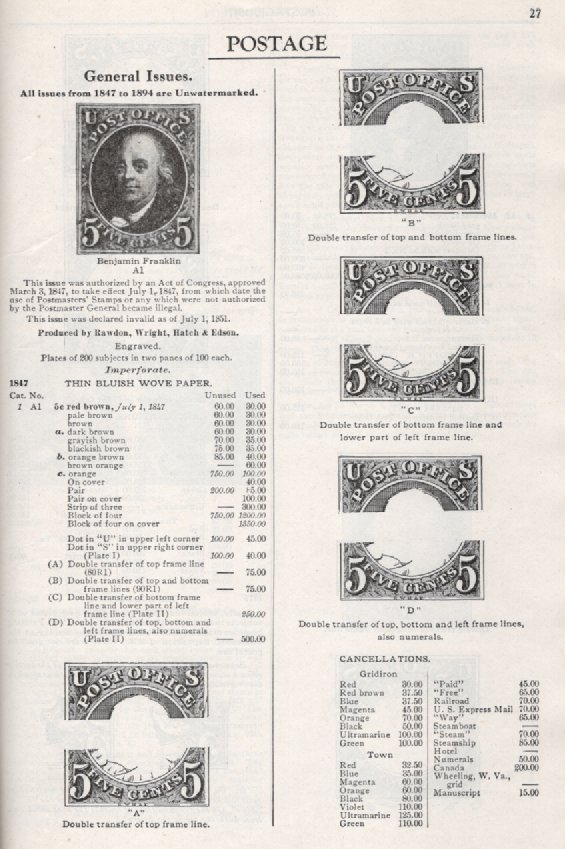 BUT what we now have as 10/10A/11/11A is all under #11, and #10 is occupied by a one cent stamp: 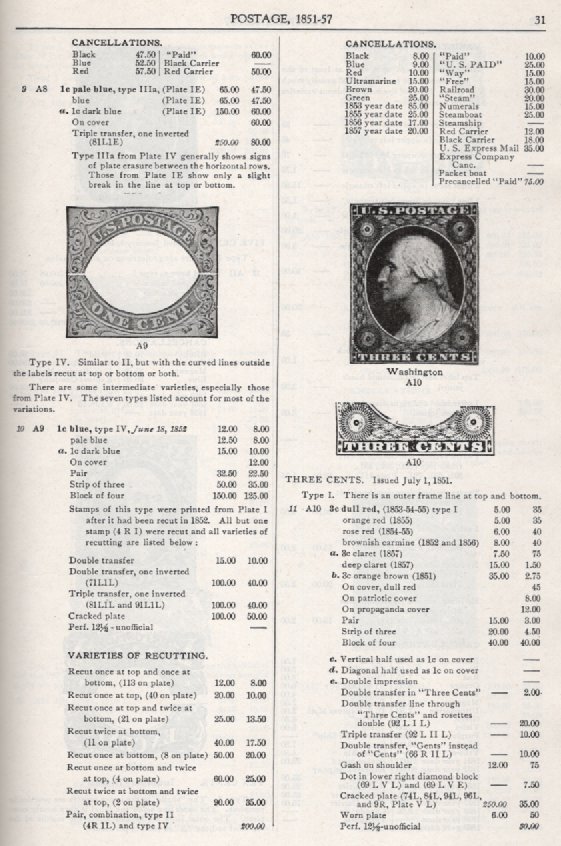 Moving forward in another jump to 1951 and 1952, where the 1951 edition shows listings pretty much the same as from 1948: 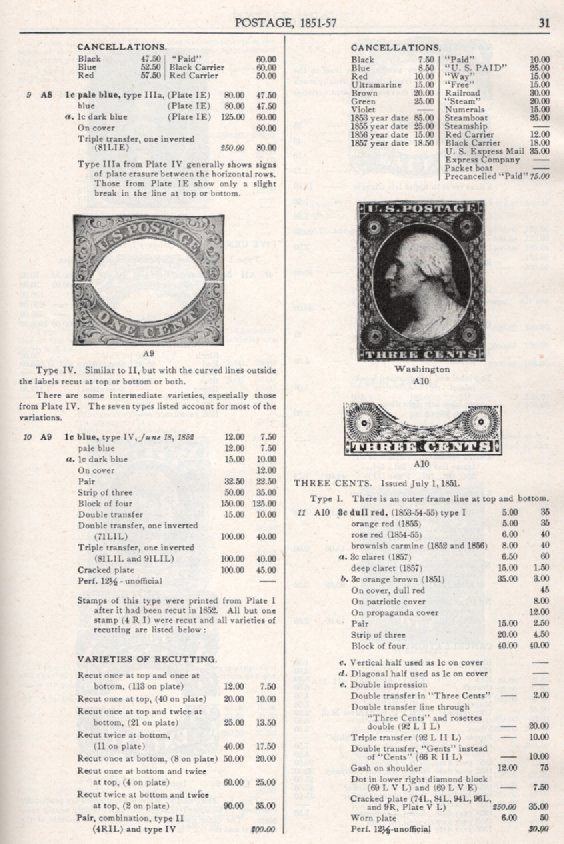 And the changes in 1952 to 8, 9, 10, 11, which pulls 10 back into the preceeding 1 cent issues and splits 11 into 10 and 11. 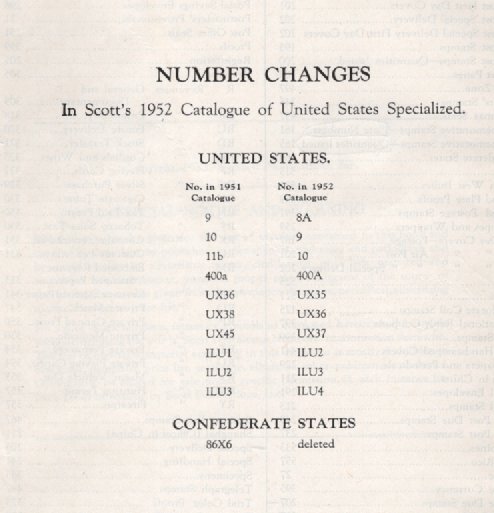 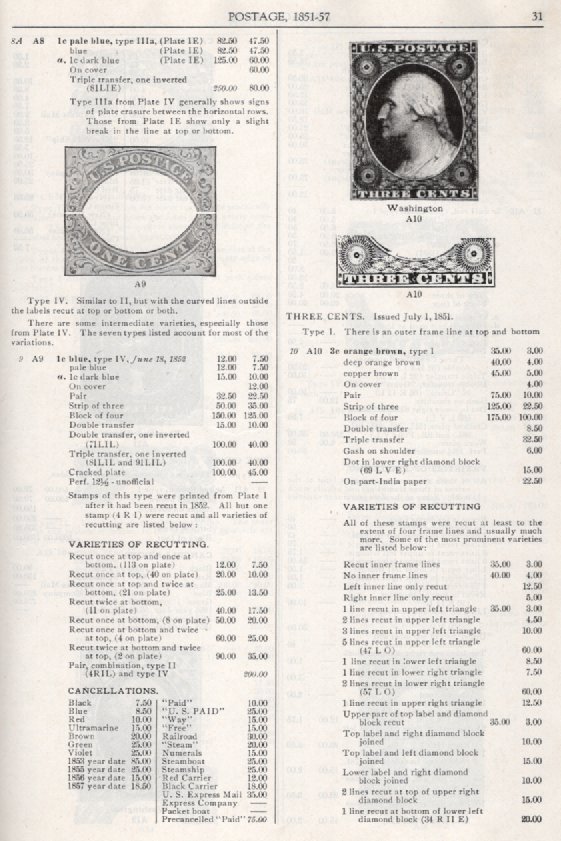 No doubt this may be both more than you want and less than you want, but the mapping is not as simple as comparing one old and one new catalog. Does the old #33 map onto today's 10, 10A, 11, or 11A? |
|
Send note to Staff
|
|
|
Pillar Of The Community
United States
1112 Posts |
|
|
Hi John.
Thank you so much for all of the extra catalog images. I couldn't find anything after 1926 online and my oldest hardcopy catalog is from 1969. I fully understand that changes have happened time and time again. Let me explain what I did and why I reached my conclusion.
When I went searching....
I found a 1904 catalog online. In this catalog, the listing for #28 is clearly the #1 of today. This fact didn't change in any of the old catalogs that I found and it still held true in the 1945 catalog page that you show above. No need to mention this again.
The imperforate 1c Franklin only listed types I, II, and III and they are were defined as numbers #30, #31, and #32.
The imperforate 3c Washington had no types, but the color identified was dull red and this was defined as #33.
The perforated 1c Franklin also had the types I, II, and III and they were defined as numbers #40, #41, and #42.
The perforated 3c Washington had types I and II, taking up numbers #43 and #44.
Note: The type II back then was defined as the top and bottom frame lines being removed. That is type III (and type IV) today.
The perforated 10c Washington had no types listed and was defined as #50.
The 1905 catalog made no changes.
The next catalog I could find was 1914.
Type IV for the 1c Franklin stamps now show in this catalog. Not sure when they were added.
Imperforate 1c Franklin Type IV is shown as #32B.
Imperforate 3c Washington dull red is still #33.
Perforated 1c Franklin Type IV is shown as #42C.
Still no perforated Franklin Type V.
Perforated 3c Washington dull red Type II is still #44.
Type II for the perforated 10c Washington is now shown in this catalog. Not sure when it was added.
Perforated 10c Washington Type II is shown #50A.
The next catalog I could find was 1916.
Imperforate 1c Franklin Type IV is still #32B.
Imperforate 3c Washington dull red is still #33.
Imperforate 3c Washington adds orange brown color as #33b.
Perforated 1c Franklin Type IV is still #42C.
Still no perforated Franklin Type V.
Perforated 3c Washington dull red Type II is still #44.
Perforated 10c Washington Type II is now showing as #50C
The next catalog was 1920.
Type IIIa for the 1c Franklin stamps now show in this catalog. Not sure when they were added.
Type V for the perforated 1c Franklin stamp now shows in this catalog. Not sure when it was added.
The perforated 10c Washington stamps had some numbering changes. Not sure when they happened.
Imperforate 1c Franklin Type IIIa is shown as #32b.
Imperforate 1c Franklin Type IV is now #32d.
Imperforate 3c Washington dull red is still #33.
Perforated 1c Franklin Type IIIa is shown as #42b.
Perforated 1c Franklin Type V is shown as #42f.
Perforated 3c Washington dull red Type II is still #44.
Perforated 10c Washington Type I is shown as #49.
Perforated 10c Washington Type II is shown as #50.
The next catalog was 1926.
The perforated 10c Washington stamps had some additional types added. Not sure when they happened.
Imperforate 1c Franklin Type IV is still #32d.
Imperforate 3c Washington dull red is still #33, but also shows as Type I.
Perforated 1c Franklin Type V is still #42f.
Perforated 3c Washington dull red Type II is still #44.
Perforated 10c Washington Type V is defined as #50.
Note: The Type V description in 1926 matches the Type II description in 1920. This means #50 remained consistent from a description perspective.
Just from following the above changes, I can say the following are true because there weren't any other major colors or types added for these stamps.
#32d maps to #9 because of the Type IV
#33 maps to #11 because of the dull red Type I
#42f maps to #24 because of the Type V
#50 maps to #35 because of the Type V
The remaining stamp to map for certain is the #44. The catalogs that I could find didn't give me the final picture, but knowing that the 1926 Type II description is a direct match for the current Type III description, I think it is safe to say that:
#44 maps to #26 because of the dull red AND knowing that the 1926 Type II description is now the current Type III description |
|
Send note to Staff
|
|
|
Pillar Of The Community
6366 Posts |
|
|
Finding books online newer than c1926 gets into public domain issues. One of the reasons to collect original catalogs. Of course I am always lacking the exact one to fill the gap, as noted in this linked thread, although having the 1957 catalog data will not change the conclusions, but it also relates to catalog number changes. https://goscf.com/t/88300&whichpage=1#816480 |
|
Send note to Staff
|
|
| |
Replies: 12 / Views: 1,329 |
|




 Posted 07/27/2024 1:45 pm


