| Author |
 Replies: 25 / Views: 1,816 Replies: 25 / Views: 1,816 |
|
|
|
Pillar Of The Community
Australia
1692 Posts |
|
|
Moderator

United States
5109 Posts |
|
|
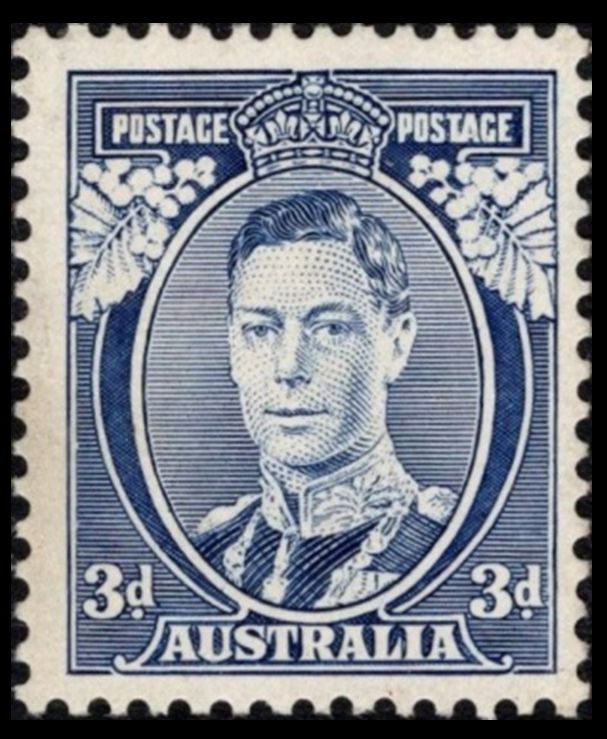
Yes, good scan. The two breaks on the left side are very, very obvious ... even without magnification. The joined TA is also very obvious. Other differences are a little harder to see, but it is 100% obvious that you have a "White Wattle", while my example and the OP's are not. Thanks for showing. |
Send note to Staff 
|
|
|
Valued Member
United States
328 Posts |
|
|
The number of varieties of the Australia 3d value is one of the reasons collecting King George VI stamps is so interesting. In addition to the White Wattles variety, there are several printing variations that can all be identified if you have a good resource like the Stanley Gibbons Catalogue, or the no longer available Commonwealth King George VI Catalogue. Both catalogs illustrate a number of things that might go unnoticed if you use a more general catalog to identify your stamps. Shown below is an ID Chart I put together from the stamps in my collection to show how to identify the various stages of the Australia 3d value. There is a size constraint here so it is much smaller than the original, but hopefully it will help you with your stamps. Please feel free to contact me thru my website - KGVIStamps.com if you would like a larger version. 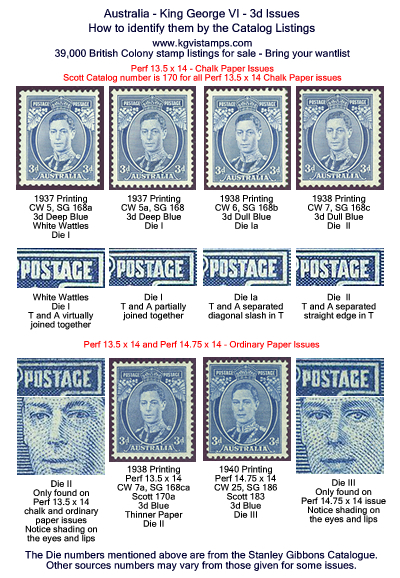 |
|
Send note to Staff
|
|
|
|
Pillar Of The Community
Australia
1692 Posts |
|
|
Glad to show Partime. I have all the main varieties of the 3d blue, in fact I have all the 3d blues printed during the reign of KGVI, including all the shades and varieties as well. |
|
Send note to Staff
|
|
|
Pillar Of The Community
570 Posts |
|
|
The main detail, I think, is in the defective preliminary ink that was only used in the 168a, not whether it is more or less broken...the level of breakage is irrelevant when the importance is in the ink itself that was used... If the 168a is the only one that was used with defective ink, the degree of breakage would be irrelevant, since only that model has the preliminary ink. In fact, Gibbons does not say that the breaks must be major or minor...What is obvious is that there will be more visual copies than others. |
|
Send note to Staff
|
| Edited by Murasama - 08/06/2024 03:21 am |
|
|
Pillar Of The Community
Netherlands
6650 Posts |
|
|
Quote:
If the 168a is the only one that was used with defective ink, the degree of breakage would be irrelevant, since only that model has the preliminary ink. This is not how stamps come into being. Is the break caused by the ink or is this a die flaw that reached a certain state with 168a? The idea that ink problems cause a constant error in all positions of the sheet is questionable. |
|
Send note to Staff
|
| Edited by NSK - 08/06/2024 03:53 am |
|
|
Pillar Of The Community
570 Posts |
|
|
From what I have read the problem in 168a was in the ink not in the die, Gibbons is clear about the unstable experimental ink. In some post I read that the ink came off the die... |
|
Send note to Staff
|
|
|
Pillar Of The Community
Netherlands
6650 Posts |
|
|
The probability that an issue with inking causes breaks in the exact two same spots in every stamp from a plate is ridiculously small. It is not even a plate problem because it would occur only on a limited number (most likely 1) of positions. This can only be caused by a die. The ink can then contribute. |
|
Send note to Staff
|
| Edited by NSK - 08/06/2024 05:51 am |
|
|
Pillar Of The Community
Australia
1692 Posts |
|
|
This is what is said in the ACSC (Australian Commonwealth Specialists' Catalogue). The ACSC is the official catalogue of Australian stamps, this catalogue is titled "King George VI.
Although this information is about Dies 1 (White Wattles", Die 1A (Joined "TA", Die II and Die III. Dies 1 to II also refers to the change of ink to attempting to repair the plate.
Die 1: This is the original state of the die found in the earliest printing. The shallow lines of engraving were exaggerated by the use of an unsatisfactory ink in characteristic Royal blur shade which had the tendency to be stripped from the plate by the wiper, resulting in:
(i) The wattles and white leaves in each corner are very white with little shading
(ii) The King's ear is unshaded and the chin is badly defined.
(iii) "TA" of "POSTAGE" at top right is pronouncedly joined at the foot.
(v) A characteristic of the ink stripping is that it tended to produce two breaks in the inner left frame opposite the lower half of the portrait oval.
The introduction of a new ink formula solved the ink stripping problems. This improved the appearance of the stamps, correcting the defects of (i), (ii) and (iv), although the outline of the chin remained unclear. However, the joined "TA" remained to a lesser degree.
Die IA: the joined "TA" flaw was addressed by retouching the two copper plates. On each unit the letters "T" and "A" were cut apart, producing a characteristic tapering of the lower part of the "T". The hand retouching means there is inevitably some variation between stamps.
Die II: The appearance of Die 1A was still considered unsatisfactory. Die II was the recutting of Die !, performed on a fresh transfer of the original die. Resulting in:
(i) "T" and "A" are separated, and the rest of "POSTAGE" has been re-engraved, making it appear more even.
(ii) The King's chin is outlined by a strong, continuous line.
(iii) No white space over the King's ear, as was seen in Die I.
(iv) Top of cross level with top frame and does not slope.
Die III: When a new master plate was required following the introduction of the 14.75 x 14 (officially referred to as 15 x 14) perforating machine, it was decided to engrave a completely new die.
The "white wattles" was only distributed in Queensland, and all used stamps will show the Queensland cancellation.
I created a detailed display of Dies I, IA and II, when I find this display I will upload it.
|
|
Send note to Staff
|
| Edited by Rob041256 - 08/06/2024 4:06 pm |
|
|
Pillar Of The Community
570 Posts |
|
|
Replies: 25 / Views: 1,816 |
|




 Posted 08/05/2024 6:58 pm