| Author |
 Replies: 22 / Views: 2,157 Replies: 22 / Views: 2,157 |
|
Pillar Of The Community
570 Posts |
|
|
|
I have a question about the Netherlands series SC#34-37 that you might be able to answer. Models 34c, 35b,, and 37d are laid paper. My question is whether this laid paper is like that of Canadian and other similar stamps, where parallel lines are clearly visible. I've identified, against the light, that there are at least three types of paper among my stamps, since when viewed against the light, they are:
a sharp, fine dotted pattern,
a thicker, less distinct mottled pattern,
without any pattern at all.
|
|
Send note to Staff
|
| Edited by Murasama - 05/31/2025 11:47 pm |
|
|
|
|
Bedrock Of The Community
12747 Posts |
|
|
Laid paper is not defined by a Country. That would not make sense now would it. Laid paper is laid paper is laid paper. No parallel lines, not laid paper. Simple. |
Send note to Staff 
|
|
|
Pillar Of The Community
570 Posts |
|
|
I must have expressed myself incorrectly, or I'm misunderstanding the answer... I'll ask a more direct question: How do you distinguish the laid paper stamps from the Netherlands series Sc#34-37 from the non-laid paper ones? |
|
Send note to Staff
|
|
|
Bedrock Of The Community
12747 Posts |
|
|
Valued Member
United Kingdom
379 Posts |
|
|
@Murasama; the term refers to the screen that is used to make the paper. Laid paper's made using a wire screen where the wires are parallel, and hence impress parallel lines into the wet sheet of paper. Wove paper's made using a wire screen with the wires arranged criss-cross. That's probably the mottled pattern you've seen. Presumably there's other patterns, like a kitchen colander would produce. |
|
Send note to Staff
|
|
|
Pillar Of The Community
570 Posts |
|
|
I understand. So the typical parallel lines should be visible against the backlight...does anyone have an image of these models where the lines can be seen? |
|
Send note to Staff
|
|
|
Pillar Of The Community
United States
8601 Posts |
|
|
MURASAMA----- To sell a Laid Paper copy you will need a certificate without that it is just a guess . They are too easy to make .
This set is usually collected for shades ,types I and II , most better collections get into all the perforation variations , never seen one with laid paper . |
|
Send note to Staff
|
|
|
Valued Member
Canada
395 Posts |
|
|
The laid lines on these stamps are horizontal. Here is a poor image of what they look like: 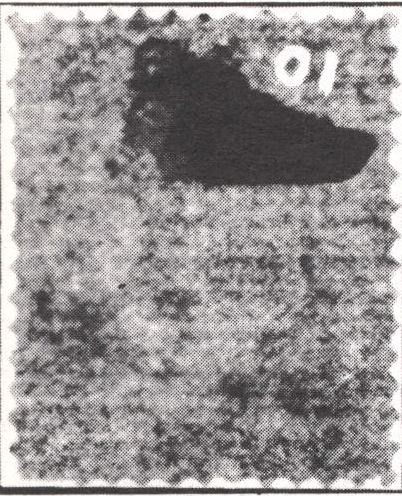 (Image taken from Netherlands Philately, Volume 3 Number 4, page 58) They are relatively scarce. I once looked through 2500 of the one cent value and found only a handful. Jan |
|
Send note to Staff
|
|
|
Bedrock Of The Community
12747 Posts |
|
|
Quote:
does anyone have an image of these models where the lines can be seen? You can look at laid paper stamps from any Country to see what the Netherland's stamps will look like. Russia is a good place to start since there are a LOT of laid paper stamps. There is no secret sauce for these Netherland's stamps.  |
|
Send note to Staff
|
|
|
Valued Member
Canada
395 Posts |
|
|
I found the original source of the image I showed above: October 1976 issue of Philatie. The stamp above is the 2½ cent value. Here is a somewhat better image taken from the same article. (in this case of the one cent value). 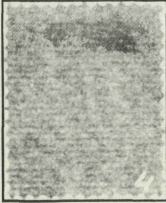 As a hint in looking for an example: All used copies are dated 1893. (Still most dated 1893 are not laid paper.) Jan |
|
Send note to Staff
|
|
|
Pillar Of The Community
570 Posts |
|
|
I have my stamps from this series sorted by color and perforation... but I was wondering what the laid paper would look like for this issue, that is, if the parallel lines are visible to the naked eye, as is the case with some Canadian ones, or if the lines are more or less far apart... 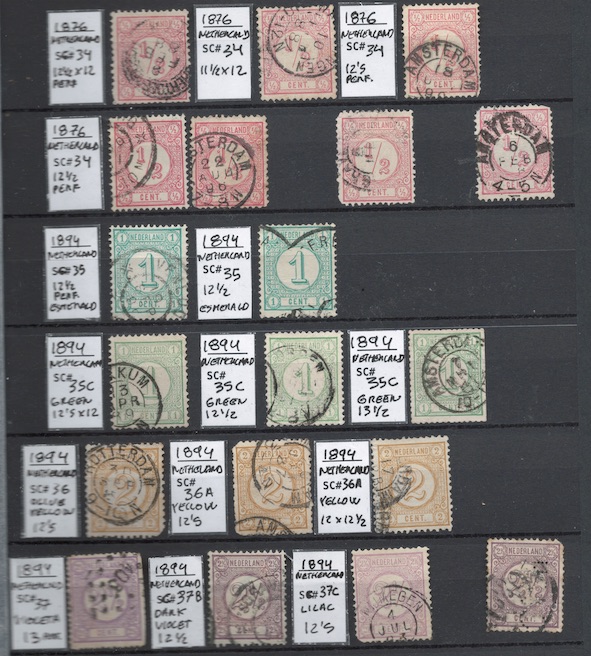 |
|
Send note to Staff
|
|
|
Valued Member
Canada
395 Posts |
|
|
Just for the record, as I realize I wasn't entirely clear in my posts, the two images I posted are Netherlands Scott #37d and #35b respectively.
Jan |
|
Send note to Staff
|
|
|
Valued Member
United Kingdom
379 Posts |
|
|
It may be easier to see the difference in paper type by looking at, say, high-quality note paper. I think the old Basildon Bond was laid paper. You could go to a high-class stationery shop and tell them you want to get laid. |
|
Send note to Staff
|
|
|
Pillar Of The Community
United States
8601 Posts |
|
|
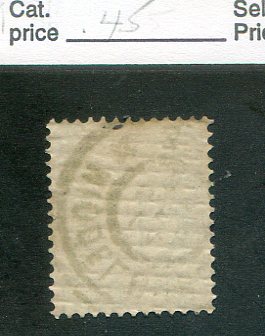 This took me five minutes to create . It doesn't have to be 100% accurate to fool a expert but to fool someone standing in front of a dealer at a stamp show ,who thinks they are getting a bargain for a few dollars but just getting a 5 cent stamp . |
|
Send note to Staff
|
|
|
Pillar Of The Community
570 Posts |
|
|
That's why it's good to know where to step...ask and get information, and having seen the photographs provided by colleague j2186, it helps a lot...since the lines are clearly very close together and possibly only visible against the light, nothing like the plelure "manufactured" in 5 minutes. |
|
Send note to Staff
|
|
|
Bedrock Of The Community
12747 Posts |
|
|
Quote:
You could go to a high-class stationery shop and tell them you want to get laid.  |
|
Send note to Staff
|
|
|
Replies: 22 / Views: 2,157 |
|




 Posted 05/31/2025 11:43 pm


