|
This page may contain links that result in small commissions to keep this free site up and running.

Welcome Guest! Registering and/or logging in will remove the anchor (bottom) ads. It's Free!
To participate in the forum you must log in or register.
| Author |
 Replies: 43 / Views: 2,780 Replies: 43 / Views: 2,780 |
|
Valued Member
United States
46 Posts |
|
|
In Volume III of The United States Postage Stamps of the Twentieth Century, Max Johl wrote that the 14¢ American Indian stamp from the United States Fourth Bureau Issue "served no special purpose except for possible use on packages requiring a fourteen cent fee rather than using two stamps." 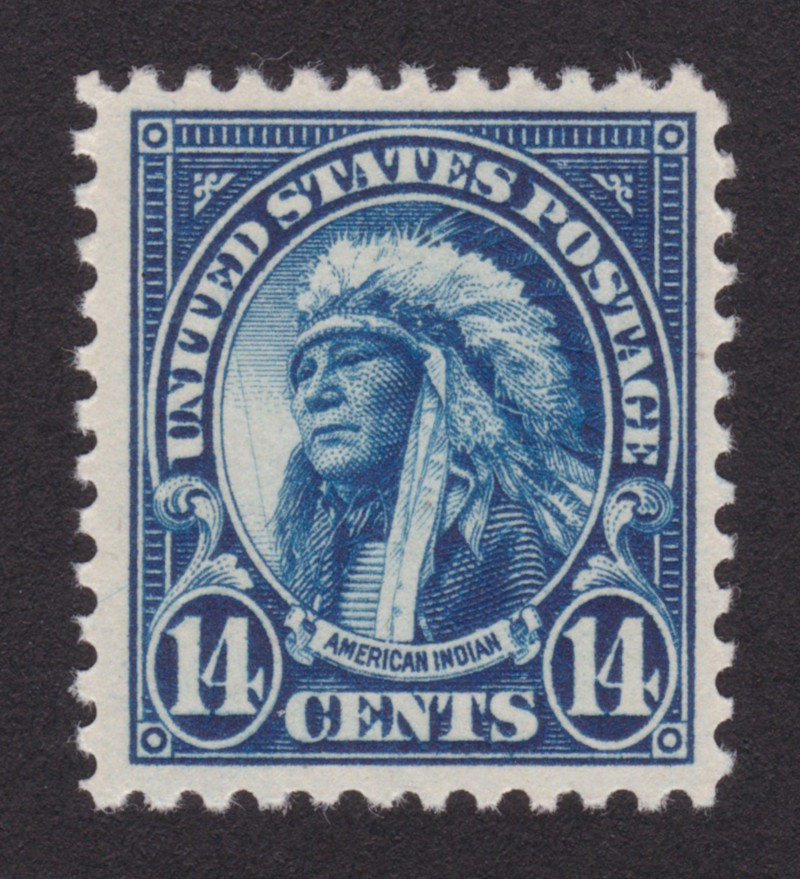 The typical dealer response to my inquiries about whether they happen to have any on-cover solo uses of the 14¢ American Indian in stock is a sideways look accompanied by the response, "I've never seen one". There were, however, a variety of less than common rates in effect during the stamp's period of use (1923–1938) that the stamp did pay exactly, and examples of such uses, although at best uncommon and sometimes exceedingly rare, do exist. As time permits, I plan to share scans of on-cover solo uses from my collection that reflect some of those rates, and I hope other members here may also have examples to share. For the purposes of this thread, I will illustrate only examples where the 14¢ stamp exactly paid a specific postage rate. This will exclude both commercial and philatelic uses where the American Indian stamp overpaid the applicable rate. Philatelic solo uses are interesting as well, but I will save those for a separate thread. Before I begin, I must acknowledge the importance of U.S. Domestic Postal Rates, 1872–2011, and U.S. International Postal Rates, 1872–1996, by Henry Beecher and Anthony Wawrukiewicz. Without the aid of their invaluable works, determining the exact rates paid on certain items I've acquired over the years would be next to impossible. |
|
Send note to Staff
|
|
|
|
|
Valued Member
United States
46 Posts |
|
|
Rate: first-class, two ounces, registeredFrom the 14¢ American Indian's first day of issue on May 1, 1923, through April 14, 1925, the stamp exactly paid postage for an envelope weighing up to two ounces and sent via registered mail: 2¢ per ounce plus 10¢ for registration. The cover illustrated below was mailed from the National Sugar Refining Company of New Jersey to New Haven, Connecticut. Postmarks on the reverse indicate it was both mailed from Wall Street Station in New York City and arrived in New Haven on December 4, 1923. 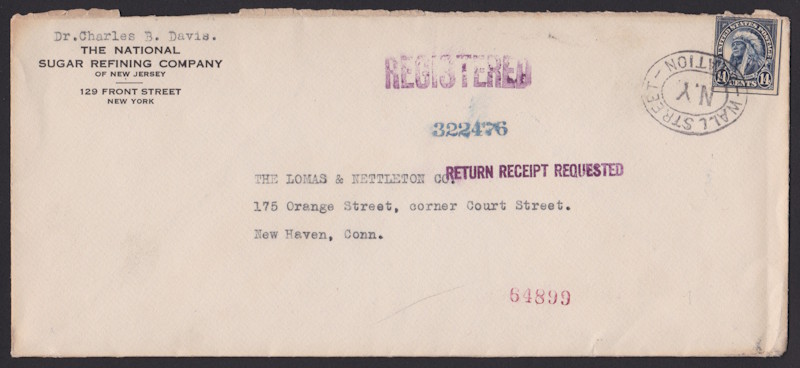 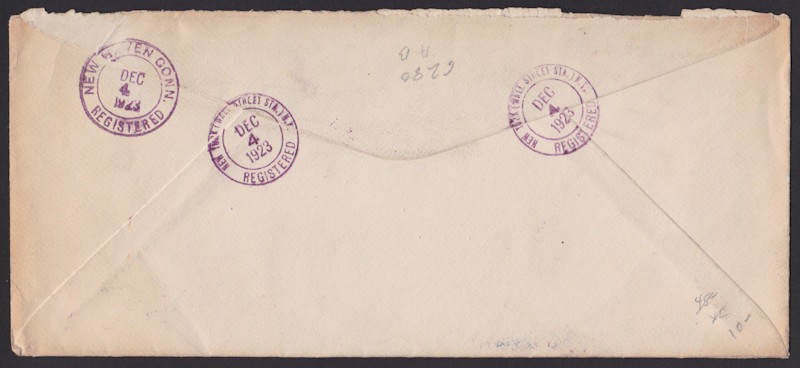 Prior to March 18, 1931, there was no charge for a return receipt for registered mail, so the "Return Receipt Requested" auxiliary marking is not unusual in this case. In my experience, this is the most easily found 14¢ solo rate, though still very difficult to locate. I don't mean to imply that this was the most common way in which the 14¢ stamp was used by itself since Johl's statement suggests the stamp was more likely to have been used on packages, but it is logical to conclude such items would have been less likely to be preserved intact. |
Send note to Staff 
|
| Edited by Philatelius - 12/14/2025 10:16 pm |
|
|
Valued Member
Sweden
134 Posts |
|
|
Here is a 14c solo on parcel to Sweden which was the rate 15 Jun 1925 to 31 July 1953. 14c/lb was then the most common rate for parcels to foreign countries with ocean harbors. I think that about one million foreign parcels with the 14c American Indian have been mailed but very few have been saved 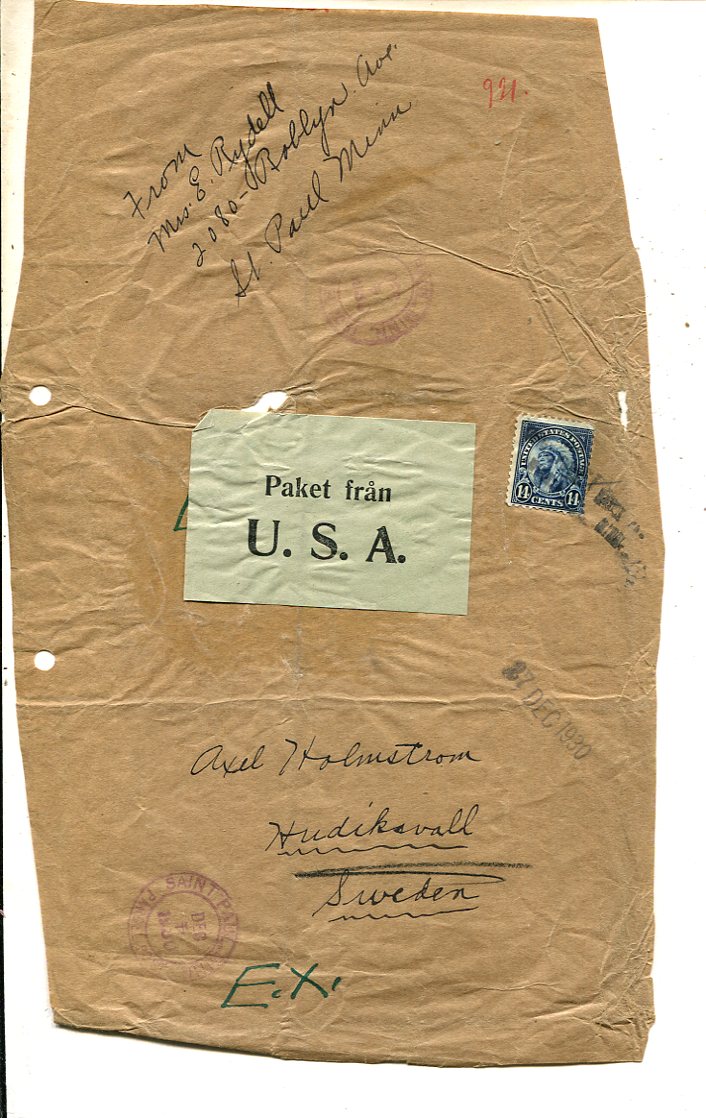 |
|
Send note to Staff
|
| Edited by aolsson - 12/15/2025 04:34 am |
|
|
Valued Member
Sweden
134 Posts |
|
|
The table for Return Receipt fees in Tony W:s book is somewhat hard to understand so I checked with the Postal Bulletins and found that the fee for Return Receipt (3c inland) started already 15 April 1925 |
|
Send note to Staff
|
| Edited by aolsson - 12/15/2025 06:24 am |
|
|
Valued Member
United States
46 Posts |
|
|
I recognize that piece! You sent an image of it to me back in 2012 and granted me permission to share it on my blog. That has to be a remarkably rare surviving use of the American Indian stamp—I don't have an example of that rate in my collection and I've never seen another one like it.
Thank you also for the correction about the date on which the fee for a return receipt was implemented. You're absolutely correct, and I'd have realized that if I'd more closely read the text which clearly states "the first fee for this service was charged beginning April 15, 1925."
Coincidentally, that was also the date on which the registration fee increased from 10¢ to 15¢, so you'll never see a 14¢ solo use on a registered two ounce cover where the return receipt fee applied. |
|
Send note to Staff
|
| Edited by Philatelius - 12/15/2025 09:25 am |
|
|
Valued Member
United States
46 Posts |
|
|
Rate: first-class, two ounces, special deliveryFrom the 14¢ American Indian's first day of issue on May 1, 1923, through July 5, 1932, the stamp exactly paid postage for an envelope weighing up to two ounces and sent special delivery: 2¢ per ounce plus 10¢ for special delivery. The cover illustrated below was mailed to the Kelsey Press Company of Meriden, Connecticut. The stamp is tied to cover by a May 23, 1927, slogan cancellation ("Let's Go! Citizens Military Training Camps") from Madison Square Station in New York City. A handstamped Meriden received postmark on the back is dated May 24, 1927. 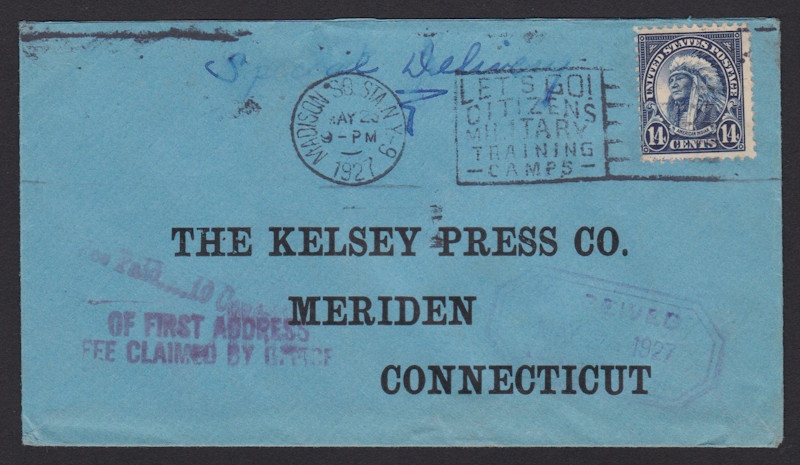 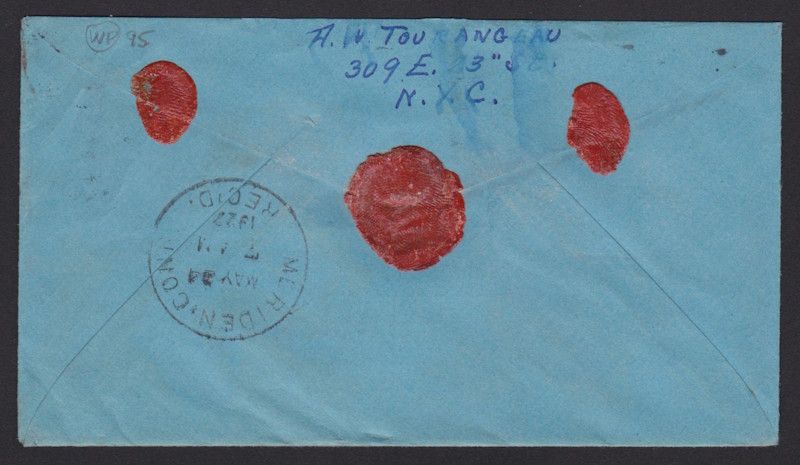 Despite fulfilling the two ounce special delivery rate for the better part of a decade, examples of the 14¢ stamp used in this manner are extremely uncommon. |
|
Send note to Staff
|
|
|
Valued Member
United States
46 Posts |
|
|
Rate: first-class, seven ounces(?) From the 14¢ American Indian's first day of issue on May 1, 1923, through July 5, 1932, the stamp exactly paid postage for an envelope weighing up to seven ounces. The cover illustrated below was mailed from the American Peace Award office to Tenafly, New Jersey. The stamp is tied to cover by a February 14, 1925, duplex cancellation from Grand Central Station in New York City. 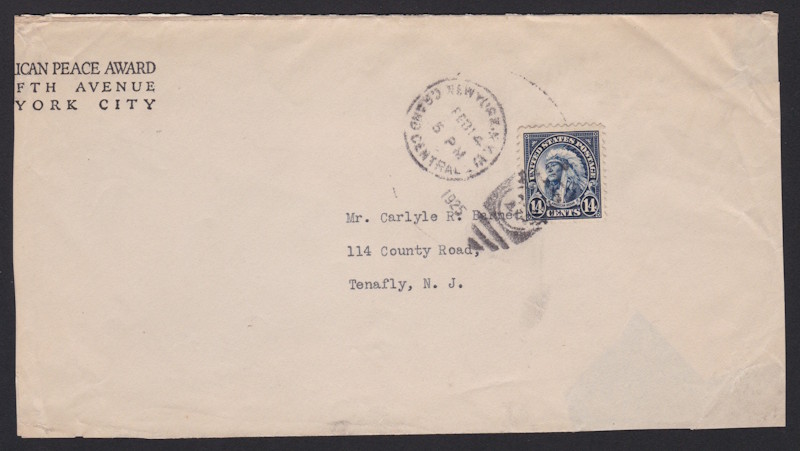 Can I prove beyond doubt that this cover weighed seven ounces? I cannot. It's possible the 14¢ grossly overpaid the required amount of postage, and that this cover thus does not belong in this thread; however, the ring around the duplex cancellation implies the envelope's contents may have been fairly thick, and an original seven ounce weight is at least conceivable. This is the last of the domestic first-class rates represented in my collection. Next, I'll share third- and fourth-class domestic usages before moving on to examples mailed to destinations outside the US. |
|
Send note to Staff
|
|
|
Valued Member
United States
46 Posts |
|
|
Rate: third-class, two or four ounces, collect on delivery From April 15, 1925, through the rest of the 14¢ American Indian's period of use, the stamp almost exactly paid postage for an envelope weighing up to two ounces and containing merchandise sent third-class and collect on delivery: 1½¢ per two ounces plus 12¢ for the lowest-priced COD service. During the same period, the stamp exactly paid postage for an envelope weighing up to two ounces and containing books and catalogs sent third-class and collect on delivery: 1¢ per ounce plus 12¢ for COD service. During the same period, the stamp exactly paid postage for an envelope weighing up to four ounces and containing material for planting: 1¢ per two ounces plus 12¢ for COD service. The cover illustrated below was mailed Gravely and Moore Photographers of Charleston, West Virginia, to Montcoal, West Virginia, and postmarked in Charleston, September 13, 1933. The use of the parcel post postmark initially made me think this piece was sent fourth-class; however, there are no fourth-class rates that fit with the COD service, and use of parcel post postmarks on third-class COD items during this era is well-documented by Wawrukiewicz. It seems most likely the envelope contained merchandise, probably photographs, in which case the American Indian stamp technically overpaid postage by ½¢; we'll call it a rounding error. 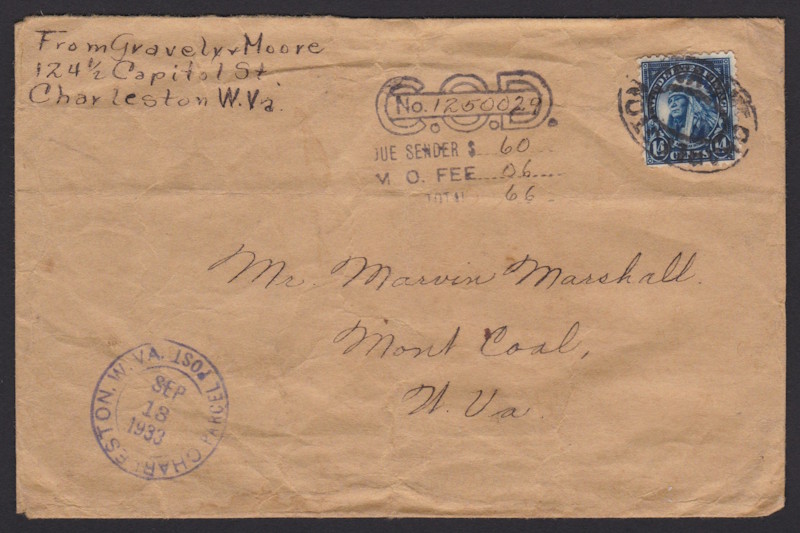 But we can't rule out the possibility that the envelope contained a catalog, or even material for planting. Although I have found no evidence that Ben Gravely, who cofounded the photography studio, conducted such business from that location, he did invent a single-wheel plow and founded the company that eventually developed a tractor with his name on it. The idea of him conducting agricultural business thus seems plausible. |
|
Send note to Staff
|
| Edited by Philatelius - 12/18/2025 10:39 pm |
|
|
Valued Member
United States
46 Posts |
|
|
Rate: third-class, one pound 12 ouncesFrom the 14¢ American Indian's first day of issue on May 1, 1923, through April 14, 1925, the stamp exactly paid postage for a package weighing up to one pound 12 ounces and sent third-class: 1¢ for every two ounces. The parcel label illustrated below was mailed from Miami, Florida, to Oley, Pennsylvania. The "Souvenir Cocoanut" wording on the label suggests it was attached to a small crate or box containing a coconut. 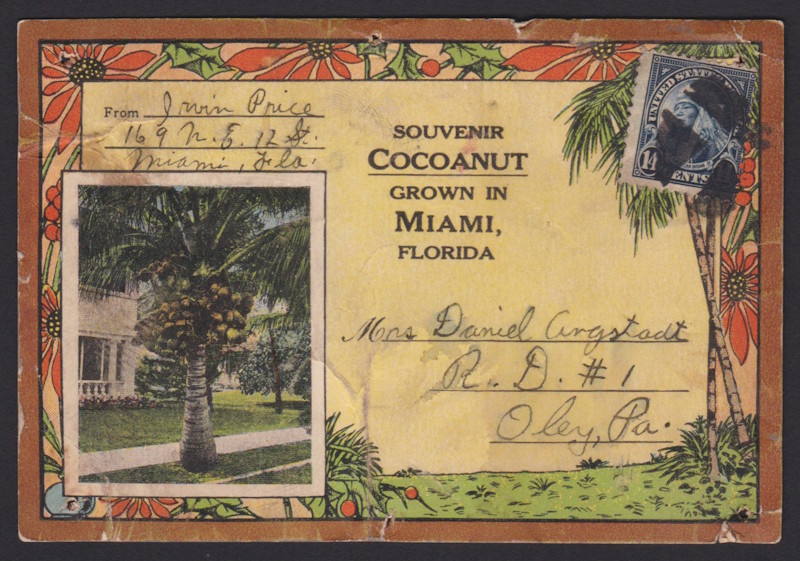 Although I'm unable to state with absolute certainty that this piece was not sent fourth-class, the absence of a dated postmark leads me to think it was most likely sent third-class. I welcome alternative interpretations. |
|
Send note to Staff
|
| Edited by Philatelius - 12/22/2025 10:44 pm |
|
|
Pillar Of The Community
United States
4424 Posts |
|
|
Quote:
From the 14¢ American Indian's first day of issue on May 1, 1923, through April 14, 1925, the stamp exactly paid postage for a package weighing up to one pound 12 ounces and sent third-class: 1¢ for every two ounces. Sorry, Philatelius, not meaning to burst your bubble, but "pop." I enjoy this thread and also chase 14c solos as well as 14c in combination with other stamps in Parcel Post matter. Right now there is a 14c strip of 3 with a 1c WF worth a look on ebay but as it is not a solo I will not clutter this thread. It is a registered bank tag. A "Tag" search should reveal it. (or just message me and I point you at the listing. On 1-1-1913, Parcel Post matter was once cent per ounce up to four ounces, regardless of distance. Any Parcel Post matter over 4 ounces was rated by pound and zone (distance). This carried through 4-13-1925 when the per ounce rate was discontinued. During this same period and regular 3rd class matter over 8 ounces was transferred to Parcel Post and rated by the pound and zone. (there were many 'flavors' of 3rd class. On 4-15-1925 All third class and former Parcel Post matter under 8 ounces was rated at the third class rate and over 8 ounces, again by pound and zone. So I will post this and be back shortly with a rate determination on your item.Edit: "Souvenir Cocoanut" as noted on the mailing label places this firmly as Parcel Post as a "cocoanut" is merchandise and even a sample or gift of such is still Parcel Post merchandise. Miami, FL to Oley, PA just squeaks in as a zone 5 with the 1st lb at 8 cents and each following pound or fraction 6 cents. Thus this is a 2 lb Parcel Post Zone 5 Parcel rated at 14 cents. Now does that sound correct? Under two pounds and over one for a coconut seems factually correct, even with packaging. |
|
Send note to Staff
|
| Edited by Parcelpostguy - 12/23/2025 12:35 am |
|
|
Pillar Of The Community
United States
4424 Posts |
|
|
Now one to your prior envelope, the COD one. It is always best to keep the rating of postal matter simple and with the assumption that the total of stamps applied was correct. Likewise in the period, the heart of the Depression, 1/2 cent was noticeable money and as such, .5 and 1.5 cent stamps where readily available. Additionally a business which is regularly mailing 3rd class matter should have those stamps fractional stamps on hand and available in that time period. 14 cent stamps had a narrow window of need and if a business went to the PO for 14 centers, they can as easily pick up the .5 and 1.5 centers as well.
That said it is not uncommon for a photo company to produce books for customers. With 2 cents postage four ounces could be carried at third class. Looking at other activities the sender engaged in also allows for mailing of specific 1cent/2oz qualifying matter. As such that combined with the 12 cent minimum fee for sending simple COD, you have the correct rate of 14 cents for postage and fees as paid by the attached stamp.
In short I think your envelope is correctly paid,not paid with a 1/2 cent convenience over payment. |
|
Send note to Staff
|
|
|
Pillar Of The Community
United States
4424 Posts |
|
|
FOURTH BUREAU-Sc#565(single frank)-HEMPSTEAD N.Y. FEB/16/1939-TO BELLAIRE: 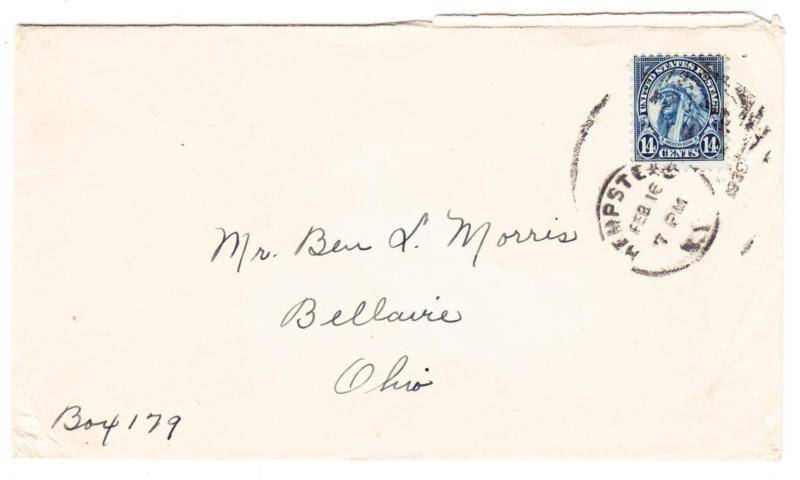 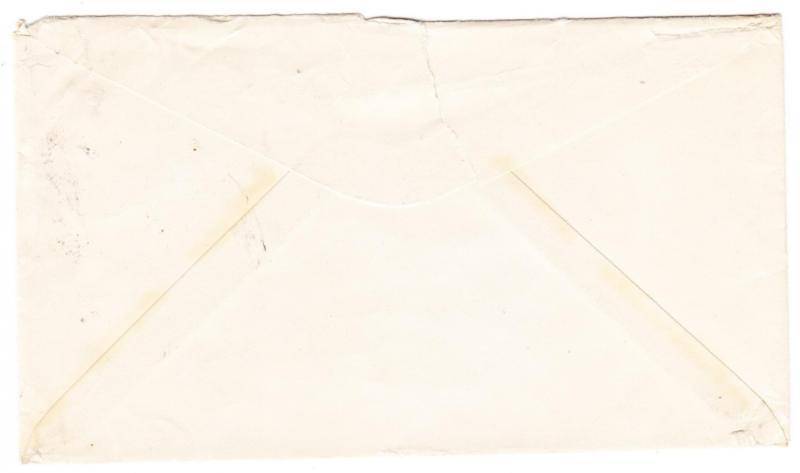 Stamp affixed as intended but failed to register? |
|
Send note to Staff
|
|
|
Valued Member
United States
46 Posts |
|
|
@Parcelpostguy - Thank you for the correction on my most recent posting. Fourth-class, zone 5, up to two pounds it is. I was concerned Miami to Oley was too far to qualify as zone 5.
If I'm reading the charts correctly (always a question), this is still a pre-April 15, 1925, mailing, right?
Regarding the 1939 cover you posted, the lowest registration fee in effect at that time was 15¢; the American Indian stamp wouldn't even have covered that, much less registration plus postage. Doesn't look right for an exact payment of any first-class rate in effect at the time, either.
A Google search reveals the addressee was at the very least a stamp collector. I don't like saying something is a philatelic usage just because a collector sent or received it, but I'm not coming up with a good explanation for that one. Any other ideas? |
|
Send note to Staff
|
| Edited by Philatelius - 12/23/2025 09:12 am |
|
|
Pillar Of The Community
United States
4424 Posts |
|
|
With the size of th envelope I show, it was not stuffed full. But I intended to mean it was a start with a plan to pay the difference at the counter. Postage, 1st Class, was 3c/oz in '39, so clearly other stamps were needed to hit any correct rate. That is why this likely philatelic convenience overpayment has cycled on ebay for a long, long time and remains there. 4-15-1925 saw 2 lbs, zone 5 jump to 16 cents (10 + 6). Quote:
I was concerned Miami to Oley was too far to qualify as zone 5. It is crowfly miles, not road miles and with crowfly miles there is wiggle room as zone is calculated from the middle of the sending towns map quadrant to the closest part of the receiving towns map quadrant. Currently distances are 1214 miles by 2025 roads but only 1042 crowfly miles (be it the 1920s or 2020s). Zone 5 is located between 600 - 1000 miles average radius. With the inexact distances due to use of map quadrants, this 1042 falls within the 1000 mile radius average. [I use https://www.distance-cities.com/ and my maps when dealing with "on the zone edge" post offices.] |
|
Send note to Staff
|
|
|
Pillar Of The Community
United States
4424 Posts |
|
|
Philatelius, here is my deal: You do not have 50 posts yet so you have no access to SCF messaging. So post any question here and I will answer them for you. If you question is not of general interest and neither is my reply, we can delete the posts afterwards. Now my question to you, where the charts to which you refer: Quote:
If I'm reading the charts correctly (always a question), ? If I know I can better direct your use of them. |
|
Send note to Staff
|
|
|
Valued Member
United States
46 Posts |
|
|
I was referring to the fourth-class charts in the U.S. Domestic Postal Rates, 1872–2011 book. Thank you for confirming! |
|
Send note to Staff
|
|
|
Replies: 43 / Views: 2,780 |
|
|
To participate in the forum you must log in or register. | |
 Show Your US 1851-57 Imperforate Stamps Israel Revenue Stamp Catalogue Information Request Help With A 1 Cent Franklin From The Philippines Stamps On Stamps Optical Instruments: Microscopes, Binoculars, Sextans, Theodolits, Hand Scopes Cover Calendar For Month And Day -Pics Pushing 330,000 All Different Worldwide Stamps In One Collection . Postmarks.day By Day Experimenting With A Phone As Attached Scanner Turn On The Light! Candles, Lamps, Torches, Candelights, Bedside Lamps. Fan, Éventail, Abanico, Fächer, Leque Linn's To Return To Printed Issues Minkus Supreme Global Albums (The Big Red Thread) Soviet Union Stamp Engravers Czech Stamp Engravers Collecting By Engraver 1851-57 12c Washington Canada 742 Color Shift Error? Stamps Made Of Cloth, Polymer, Metal, Wood Etc Art & Paintings On Stamps Need Help With Swedish Stamp And Postmark Living Persons Portrayed On Stamps If You Have A Design You Like, Might As Well Stick With It! Newfoundland 82 Imperf Cover Please Identify - USSR Stamps Show Your US 1851-57 Imperforate Stamps Israel Revenue Stamp Catalogue Information Request Help With A 1 Cent Franklin From The Philippines Stamps On Stamps Optical Instruments: Microscopes, Binoculars, Sextans, Theodolits, Hand Scopes Cover Calendar For Month And Day -Pics Pushing 330,000 All Different Worldwide Stamps In One Collection . Postmarks.day By Day Experimenting With A Phone As Attached Scanner Turn On The Light! Candles, Lamps, Torches, Candelights, Bedside Lamps. Fan, Éventail, Abanico, Fächer, Leque Linn's To Return To Printed Issues Minkus Supreme Global Albums (The Big Red Thread) Soviet Union Stamp Engravers Czech Stamp Engravers Collecting By Engraver 1851-57 12c Washington Canada 742 Color Shift Error? Stamps Made Of Cloth, Polymer, Metal, Wood Etc Art & Paintings On Stamps Need Help With Swedish Stamp And Postmark Living Persons Portrayed On Stamps If You Have A Design You Like, Might As Well Stick With It! Newfoundland 82 Imperf Cover Please Identify - USSR Stamps
Disclaimer: While a tremendous amount of effort goes into ensuring the accuracy of the information contained in this site, Stamp Community assumes no liability for errors. Copyright 2005 - 2026 Stamp Community Family - All rights reserved worldwide. Use of any images or content on this website without prior written permission of Stamp Community or the original lender is strictly prohibited.
Privacy Policy / Terms of Use Advertise Here |
| Stamp Community Forum |
© 2007 - 2026 Stamp Community Forums |
| It took 0.23 seconds to lick this stamp. |
 |
|
|
|


 Posted 12/14/2025 10:10 pm


