| Author |
 Replies: 43 / Views: 2,842 Replies: 43 / Views: 2,842 |
|
|
|
Pillar Of The Community
United States
4474 Posts |
|
|
Yes the third edition. Use a ruler, it helps. Also,if you look at the inside back cover, you will see how the USA was divided up in to quadrants. All the cities in the quadrant sending parcels would begin the distance calculation from the center of the quadrant.That introduces an "error" of +/- a certain number of miles depending where the city is in relation to the center of the quadrant and the direction of the city of address. Likewise when the 1000 radius average circle was scribed from the center of the quadrant as long as some small portion fell within the 1000 radius line, the entire quadrant's post offices were with in zone 5. This again adds more +/- miles to the actual crowfly distance between the two post offices. Stampsmarter has the postal guides (as well as another site on the web) which have tables of all zone and weight combinations which looks, in part, like this: 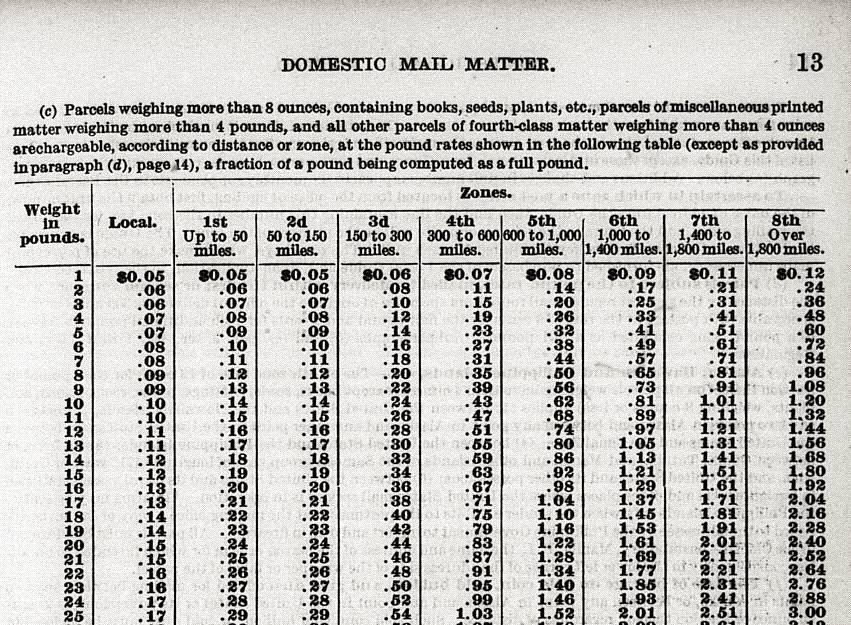 The above is from the 'annual' July 1924 USPOD Postal Guide, page 13. Each July guide had this and certain monthly guide had such as well if the rates changed. No math needed but you still needed a straight edge. As an aside, you mention Max Johl in your OP for this thread. So years later you are still getting information from his family as he is a departed relative of mine. Edited for a missing "s." |
Send note to Staff 
|
| Edited by Parcelpostguy - 12/23/2025 7:36 pm |
|
|
Valued Member
United States
51 Posts |
|
|
Very useful information--thank you once again. And how cool that you're related to one of the noteworthy philatelists of old! Although a grand-uncle who died long before I was born collected at least casually, I'm not aware of anyone else in my family tree who was involved in the hobby. |
|
Send note to Staff
|
|
|
Valued Member
United States
51 Posts |
|
|
Rate: fourth-class, zone 3, four or five poundsFrom the 14¢ American Indian's first day of issue on May 1, 1923, through April 14, 1925, the stamp exactly paid postage for a package weighing up to five pounds and sent fourth-class within zone 3 (150–300 miles): 6¢ for the first pound plus 2¢ per pound for each additional pound. From April 15, 1925, through September 30, 1932, the stamp exactly paid postage for a package weighing up to four pounds and sent fourth-class within zone 3 (150–300 miles): 8¢ for the first pound plus 2¢ per pound for each additional pound. The parcel tag illustrated below was mailed from the James Manufacturing Company of Fort Atkinson, Wisconsin, to Grand Rapids, Michigan. The 14¢ stamp bears a Fort Atkinson precancel; regrettably, there are no dated markings to confirm exactly when the piece was mailed, but the stamp apparently paid one of the two above-listed rates. 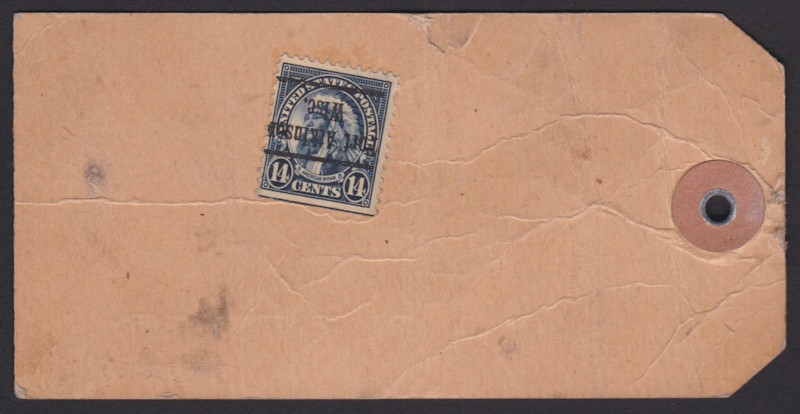 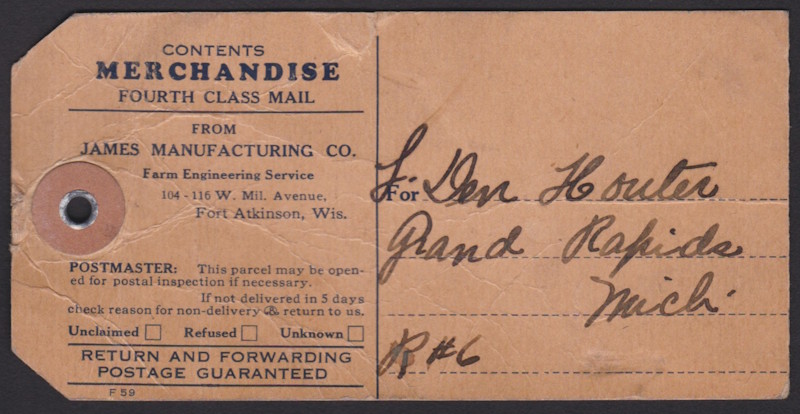 |
|
Send note to Staff
|
| Edited by Philatelius - 12/23/2025 9:35 pm |
|
|
Pillar Of The Community
United States
4474 Posts |
|
|
Be aware of the special circumstance when the rating you mentioned above also applies to zones one and two. It is the one, non-crowfly zone rating adjustment. See footnote 4 on the same table you used.
That said, the crowfly distance between Fort Atkinson,WI and Grand Rapids, MI is only 160 mi. That is within just 10 miles of not qualifying as zone 3 distance 150-300 miles. I would need to get out the maps to confirm if the distance was zone 2 or zone 3. In either case a 5 lb package would cost as noted above, even if zone 2.
Now the pesky reference above to footnote 4. If a zone one or two parcel traveled by post road 300 or more miles, those zone one and two parcels had postage uprated at zone 3. Today and several time previously the was seasonal ferry service between Milwaukee, WI and Muskegon, MI. I do not know at this time if such service ran in 1923-1925. also if such did, it did not operate all year round. Thus in at least once case, winter, the post road route would be over 300 miles, if in fact such a ferry ran at all.
So I agree the 5lb parcel cost 14 cents, but cannot yet agree if it was a zone 2 or zone 3 parcel. If I owned the tag,I would go to the trouble to exactly calculate the zone and determine the floating post roads on Lake Michigan in effect 1923-1925. If you plan to exhibit, you should or need to do so. Such uprated zone one and two parcels are quite scarce.
While you are down reading the footnotes find the one mentioning the mailed on rural route discounts. I bring that up because a rural route, RR#6, was mentioned on the tag. |
|
Send note to Staff
|
|
|
Valued Member
United States
51 Posts |
|
|
You're right once again. I tracked down the 1923 Postal Guide on Google Books to determine the parcel post unit number for Fort Atkinson, and Fort Atkinson to Grand Rapids would have been zone 2.
Do you have any suggestions as to how one might go about determining which "floating post roads" were active on Lake Michigan in the 1920s? I don't mind doing some legwork; I'm just not sure where to even begin with finding that sort of information. |
|
Send note to Staff
|
|
|
Pillar Of The Community
United States
4474 Posts |
|
|
Period maps of the era, usually state or region maps often showed the routes over water. However that is not necessary here. You verified zone 2 distance and zone 3 charges. Also since undated, even if a summer route existed, no such route existed during the rough and frozen lake water months. You are good to go with an item better that you ever though.
Again, stampsmarter.org has the USPOD Postal Guides.
Edit: changed and 'r' to an 'n.' |
|
Send note to Staff
|
| Edited by Parcelpostguy - 12/24/2025 1:44 pm |
|
|
Pillar Of The Community
6366 Posts |
|
|
As a parcel (or most any mail for that matter), Ft Atkinson, WI to Grand Rapids, MI almost certainly went by rail through Chicago at every time of the year. |
|
Send note to Staff
|
| Edited by John Becker - 12/24/2025 3:17 pm |
|
|
Pillar Of The Community

United States
948 Posts |
|
|
The complete set of the USPOD Postal Guides, 1874 - 1953, both the large annual issue and the monthly/quarterly supplements, can be found on Stamp Smarter at this page link. https://stampsmarter.org/learning/Home_USPOD.htmlScroll down to the four row of ICONS which identify the Book Shelf with the 6 series of the Domestic editions. The International editions and some Air Mail routes are on the second row. This is much easier that trying to navigate Google Books to find them.  MikeL |
|
Send note to Staff
|
| Edited by mml1942 - 12/24/2025 2:49 pm |
|
|
Valued Member
United States
51 Posts |
|
|
Quote:
You are good to go with an item better that you ever though. Outstanding! That's a wonderful surprise. I do hope to be able to exhibit one day, but I think I still have a little ways to go in acquiring enough commercial usages of this stamp to fill a frame. Quote:
The complete set of the USPOD Postal Guides, 1874 - 1953, both the large annual issue and the monthly/quarterly supplements, can be found on Stamp Smarter at this page link. I've bookmarked this site. It looks like a great resource. Thanks to everyone who has weighed in on this thread. I'm learning more about my collection as we go. |
|
Send note to Staff
|
|
|
Valued Member
United States
51 Posts |
|
|
Rate: fourth-class, zone 3, one pound, insuredFrom October 1, 1932, through the rest of the 14¢ American Indian's period of use, the stamp exactly paid postage for a package weighing up to one pound and sent fourth-class within zone 3 (150–300 miles) and insured for no more than $5: 9¢ for fourth-class postage plus 5¢ for the insurance fee. The parcel fragment illustrated below was mailed from Summerville, South Carolina, to Jacksonville, Florida. It bears a partial April 24, 1937, Summerville parcel post postmark. 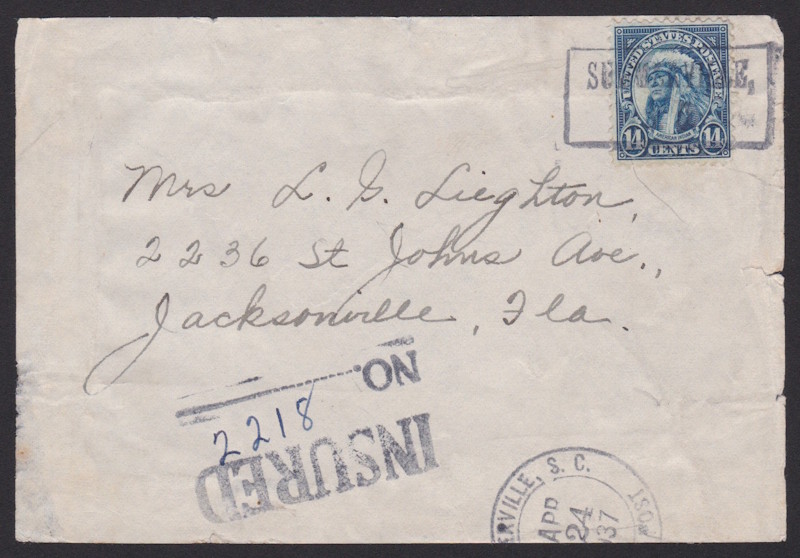 Hopefully I've gotten this one right. This is the last of the domestic rates demonstrated by solo use of the 14¢ American Indian stamp in my collection. I will next move on to examples of the stamp paying exact international rates. |
|
Send note to Staff
|
| Edited by Philatelius - 12/24/2025 9:30 pm |
|
|
Valued Member
United States
51 Posts |
|
|
Rate: first-class, international surface transport, four ouncesFrom the 14¢ American Indian's first day of issue on May 1, 1923, through the rest of its period of use, the stamp exactly paid postage for an envelope weighing up to four ounces and sent first-class by surface mail (not air mail) to many international destinations: 5¢ for the first ounce plus 3¢ per ounce for each additional ounce. My collection contains examples of this rate on covers mailed to two different countries. The cover illustrated below was mailed from the American Baptist Foreign Mission Society in New York City to Swatow (Shantou), China. The stamp is tied to cover by a February 16, 1934, New York duplex cancellation. 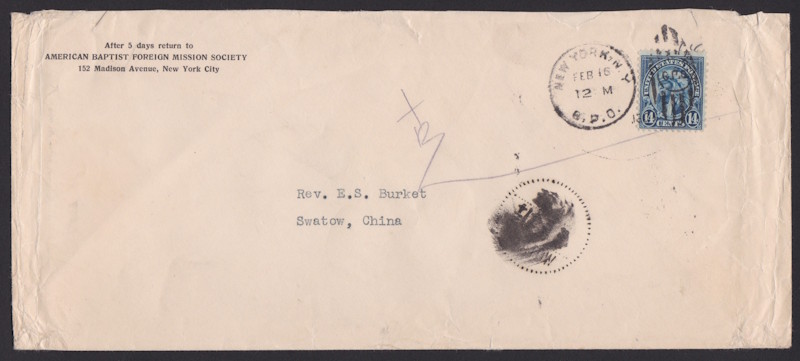 The oversized cover illustrated below was mailed from New York City to Bank Melli Iran in Tehran. The stamp is tied to cover by a December 18, 1935, New York (Hudson Terminal Annex) duplex cancellation, and the reverse bears a Tehran receiving mark. The handstamp near the top center of the cover indicates it was carried on board the S.S. Deutschland, a German ocean liner launched in 1923. 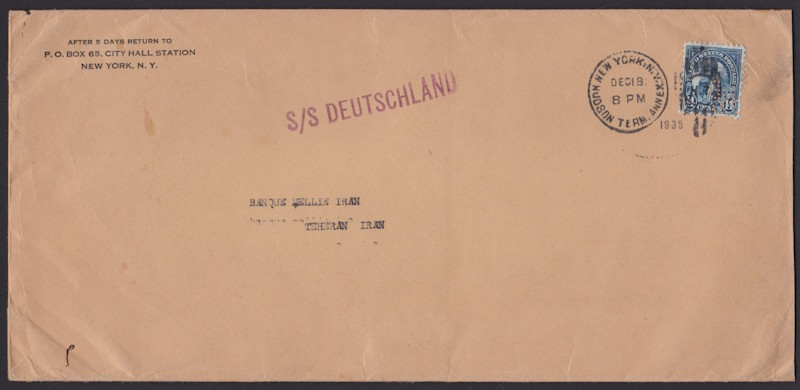 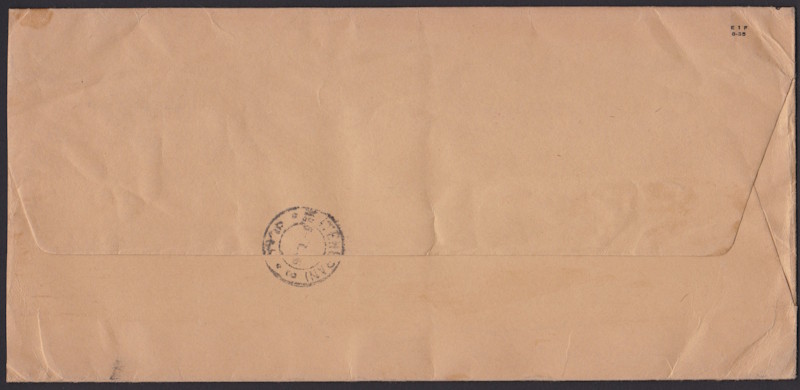 |
|
Send note to Staff
|
| Edited by Philatelius - 12/25/2025 8:40 pm |
|
|
Pillar Of The Community
United States
4474 Posts |
|
|
Quote:
Hopefully I've gotten this one right. Yes you did.  Quote:
first-class, international surface transport UPU uses "letter rate" with "first class" being a USPOD domestic term. [Those two were rate correctly as well.] |
|
Send note to Staff
|
|
|
Pillar Of The Community
United States
4474 Posts |
|
|
Since you have taken a break from posting covers and keeping me busy commenting....Do you own the stamp you showed in your OP?
Do you know what prompted my question? |
|
Send note to Staff
|
|
|
Valued Member
United States
51 Posts |
|
|
Yes, I do own the stamp I shared in my initial post in this thread. I presume the diagonal scratch through the left edge of the vignette is what prompted your question.
I'm no expert on plate flaws in this issue, but I have accumulated a few varieties over the years. Appropriate for a separate thread, perhaps. |
|
Send note to Staff
|
|
|
Bedrock Of The Community
United States
10889 Posts |
|
|
The French book lists 13 different plate flaws for this stamp from unknown positions. Plus many more from known positions. |
|
Send note to Staff
|
|
|
Replies: 43 / Views: 2,842 |
|




 Posted 12/23/2025 7:33 pm


