|
This page may contain links that result in small commissions to keep this free site up and running.

Welcome Guest! Registering and/or logging in will remove the anchor (bottom) ads. It's Free!
To participate in the forum you must log in or register.
| Author |
 Replies: 43 / Views: 2,781 Replies: 43 / Views: 2,781 |
|
|
|
Valued Member
United States
46 Posts |
|
|
So far as I've been able to make out, my example is not one of those listed in the French book, but I still like the variety. The scratch is pretty obvious! |
Send note to Staff 
|
|
|
Valued Member
United States
46 Posts |
|
|
Rate: international surface letter with air mail service between Amsterdam and Aleppo, SyriaFrom October 18, 1929, through February 15, 1931, the 14¢ American Indian stamp exactly paid postage for an envelope weighing up to ½ ounce and sent via surface mail to Amsterdam and via air mail from Amsterdam to Aleppo, Syria. The cover illustrated below was addressed to the care of the US Consul in Aleppo. The stamp is tied to cover by a September 13, 1930, "Register or Insure Valuable Mail" machine cancellation from Varick Street Annex in New York City. The cover also bears a "Via Air Mail" etiquette, a typewritten "First Flight" notation, and an "Inconnu" (unknown) label. 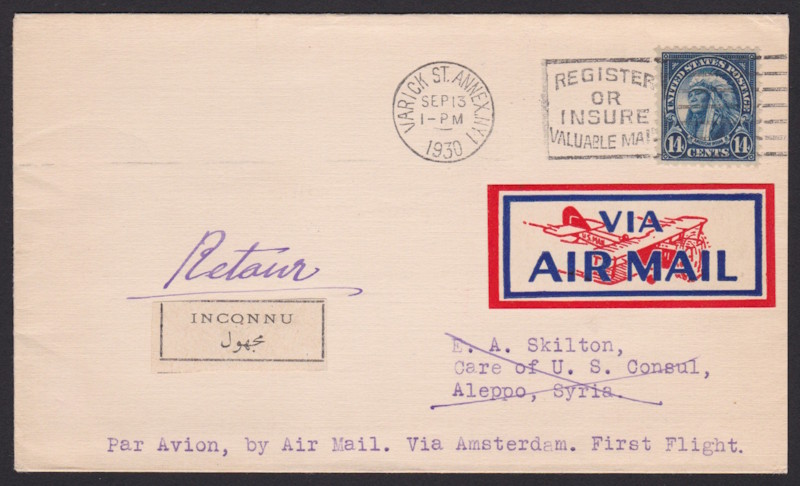 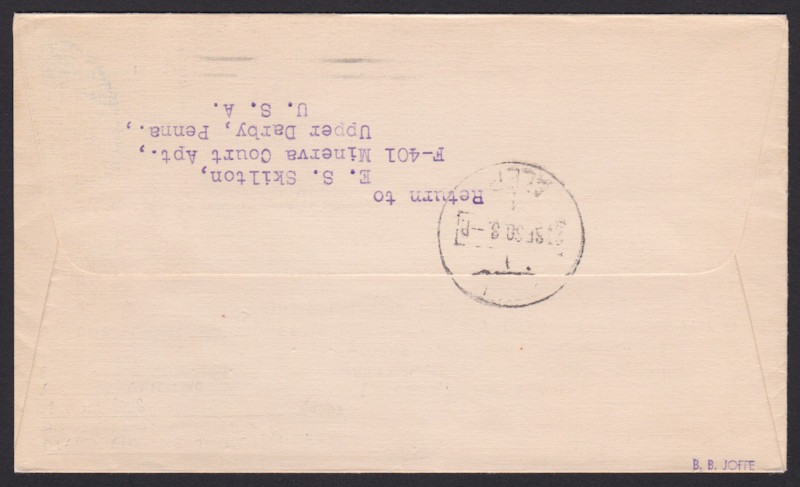 This is obviously a philatelic creation; however, the 14¢ American Indian did pay the appropriate postage due for this route, so I include it here. I hope to one day find a commercial usage of the stamp paying this particular rate. |
|
Send note to Staff
|
|
|
Pillar Of The Community
United States
4424 Posts |
|
|
Quote:
So far as I've been able to make out, my example is not one of those listed in the French book, but I still like the variety. The scratch is pretty obvious! French's book is an outstanding work, but to say it is incomplete is to state the truth, not to put it down. Quote:
This is obviously a philatelic creation; however, the 14¢ American Indian did pay the appropriate postage due for this route FDI (FDCs), First Flight, FD Of operation, last day of operation and the like are all philatelic creations to mark one event. On must look beyond that. Here the rate was 14 cents with surface/air transit as described. It was paid by a current and highest denomination stamp to make the rate, doing so perfectly. Here the routing was spelled out. On a commercial cover, the details of routing would not likely appear. It is like short hop helicopter mail, where without the "philatelic markings" of the first or last flight, it would be impossible to verify helicopter carriage. |
|
Send note to Staff
|
|
|
Bedrock Of The Community
United States
10812 Posts |
|
|
The French book is now 48 years old, of course it's not a complete listing. It could not possibly be so. |
|
Send note to Staff
|
|
|
Valued Member
United States
46 Posts |
|
|
Rate: international air mail letter with surface transport between United States and Europe and air mail service within US and EuropeIf my reading of U.S. International Postal Rates, 1872–1996 is correct, from November 23, 1934, through June 20, 1938, the 14¢ American Indian stamp exactly paid postage for an envelope weighing more than ½ ounce and no more than one ounce and sent via surface mail between the United States and Europe with air mail service within the US and Europe: 8¢ for air mail service within the US and surface transport from the US to Europe, and 3¢ per half ounce for air mail service within Europe. The cover illustrated below was mailed from Honolulu to Berlin, and the stamp is tied to cover by an April 16, 1935, Honolulu machine cancellation. The front of the cover also bears the appropriate Form 2978 "Par Avion / By Air Mail" label and "Via Air Mail" and "Via Air Mail in U.S.A." handstamps. 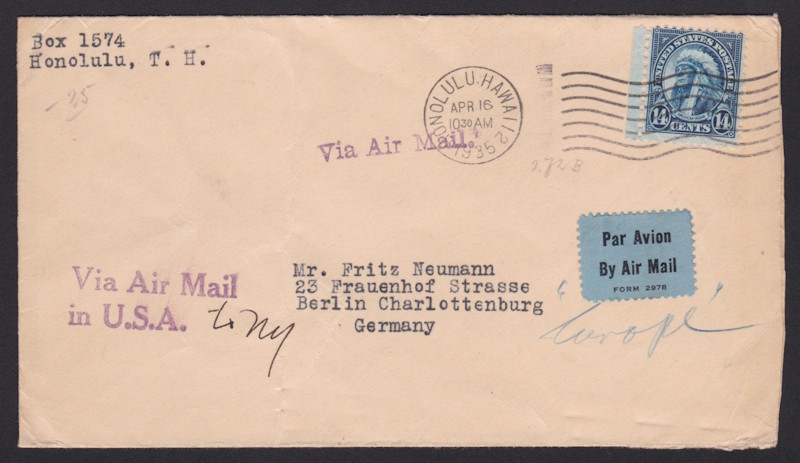 |
|
Send note to Staff
|
|
|
Pillar Of The Community
United States
4424 Posts |
|
|
Valued Member
United States
46 Posts |
|
|
No, nothing significant on the reverse of this cover--just some ink smudges transferred from the machine cancellation on another piece of mail. No way to determine exactly when it arrived in Germany. |
|
Send note to Staff
|
|
|
Valued Member
United States
46 Posts |
|
|
Rate: international air mail letter with surface transport between United States and Europe and air mail service within US and EuropeFrom June 21, 1938, through the rest of the 14¢ American Indian's period of use, the stamp exactly paid postage for an envelope weighing more than ½ ounce and no more than one ounce and sent via surface mail between the United States and Europe with air mail service within the US and Europe: 3¢ per ounce for air mail service within the US, 5¢ for surface transport from the US to Europe, and 3¢ per half ounce for air mail service within Europe. Although the total price was the same as that demonstrated by the previous cover I shared, this was technically a different rate since the charges for international surface transport and air mail service within the US were calculated separately. I have two covers showing this rate. The first was mailed from Chillicothe, Ohio, to Copenhagen, Denmark. The American Indian stamp is tied to cover by an August 17, 1938, Chillicothe duplex cancellation. The envelope is reduced at left. 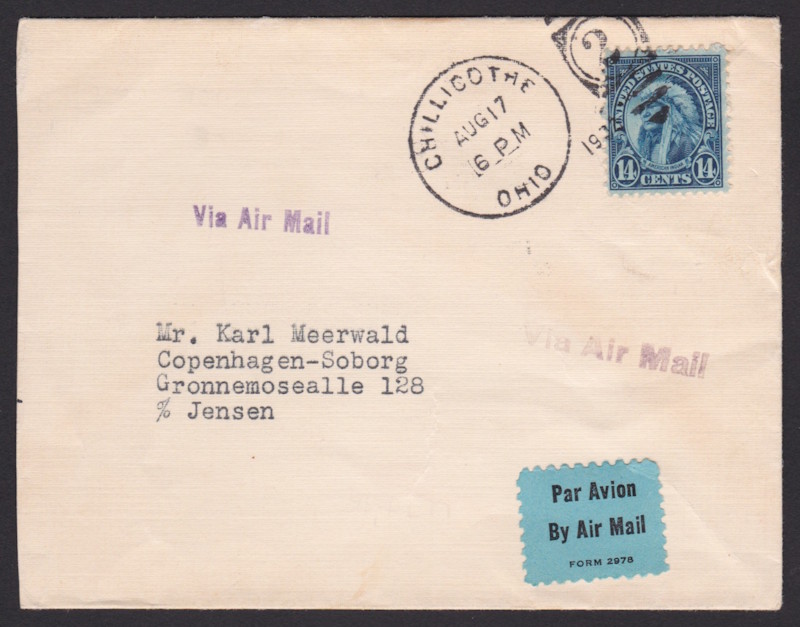 The second was mailed from Los Angeles to Vienna, Austria. The front of the cover bears an October 1 Los Angeles Arcade Annex Air Mail duplex cancellation, and both the American Indian stamp and the "Par Avion / By Air Mail" label are tied to cover by a separate October 1, 1938, "Air Mail Saves Time" slogan machine cancellation from Los Angeles. As indicated by the address, Austria had by this point been annexed by Germany. 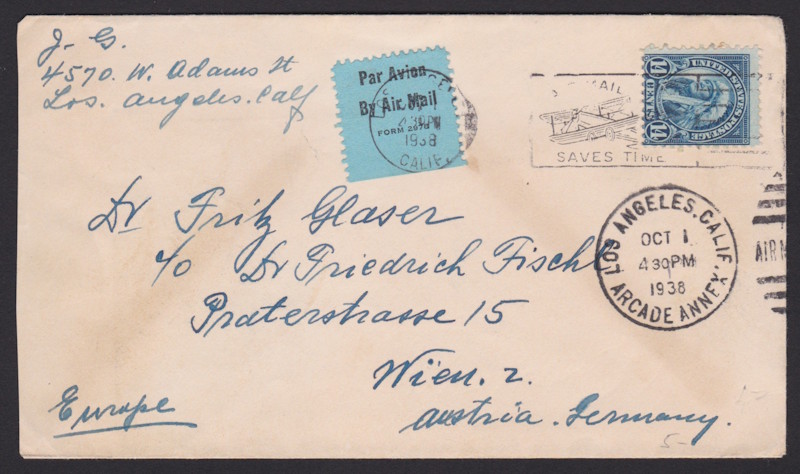 Interestingly, despite being used within a two month period, the Form 2978 "Par Avion / By Air Mail" labels on these two covers show the use of different perforation gauges, neither of which matches the perforation gauge used on the 1935 cover I previously showed. It would seem these labels were perforated with whatever happened to be handy! These are the latest exact rate solo uses of the 14¢ American Indian in my collection. The American Indian stamp's successor, the 14¢ Franklin Pierce "Prexie," was issued October 6, 1938, just five days after my final cover was mailed. I hope you've enjoyed seeing these items from my collection. I would love to see additional examples showing payment of the same or other 14¢ rates paid by the American Indian stamp. |
|
Send note to Staff
|
| Edited by Philatelius - 12/29/2025 9:57 pm |
|
|
Pillar Of The Community

United States
1120 Posts |
|
|
Neat covers. I wonder what would come of the first one if that address were mailed today - with no country name, just a city name that one could guess was Denmark, but I wonder if the systems today are smart enough to decipher that or if it would be returned for a better address.
You mentioned the rates are for air mail service within the US and Europe, and surface mail between the US and Europe; how does one identify (as collectors and/or as the postal service) that this is what was intended, and what was actually performed? Are there backstamps with dates that could help identify the duration of the Atlantic passage? Or was surface transport across the ocean simply the default method during this period unless a much higher airmail-all-the-way fee was paid?
|
|
Send note to Staff
|
|
|
Valued Member
United States
46 Posts |
|
|
None of the "air mail to Europe" covers I've shown have any markings on the reverse, so we don't get any help there. My understanding--and I hope someone with greater knowledge will chime in if I'm mistaken here--is that unless sent by a specific FAM route, international air mail letters went by surface transport by default during this time period. A quick flip through the "International Airmail Letter Rates" chapter of U.S. International Postal Rates, 1872–1996 gives me the impression there was a (sometimes significant) premium charged for mail carried on FAM routes. In any case, during the 14¢ American Indian's normal period of use, it seems there were no airmail-all-the-way routes directly from the US to Europe. Quoting from "Airmail: A Brief History" on the USPS website: Quote:
Transatlantic airmail routes connected the United States with Europe beginning May 20, 1939, with the 29-hour flight of Pan American Airways' Yankee Clipper from New York to Marseilles, France, via Bermuda, the Azores, and Portugal. That same year, on June 24, a route was inaugurated between New York and Great Britain by way of Newfoundland, Greenland, and Iceland. |
|
Send note to Staff
|
|
|
Valued Member
United States
154 Posts |
|
|
What an interesting focus to specialize in uses, the 4th Bureau series' 14c. I enjoyed presentation and discussion very much. One point not raised yet, regarding the "seven ounce" letter example and the ring around the circular date stamp (barrel) handstamp: Doesn't the presence of the ring indicate a FLAT surface? Rather, a bulky one would mean less contact across such a circumference, right?
(For completeness, whenever a 'reduced' cover is shown, it is best to show us the reverse also, so we can see for ourselves how the "envelope flap" looks -- this tells us the relative Size of the "lost portion" of historical artifact like this. Then we can wonder if some Auxiliary marking is missing that might add clue to actual weight (or a fee for some service included in the 14c, thus reducing the postage portion). Otherwise, we have to ask you if assumption is correct that only a "sliver" is missing at (front) left edge, and "no" markings on reverse since you did not show it.) |
|
Send note to Staff
|
|
|
Valued Member
United States
46 Posts |
|
|
Here's the reverse of the cover I tentatively identified as showing the 14¢ stamp paying the first-class seven ounce rate. 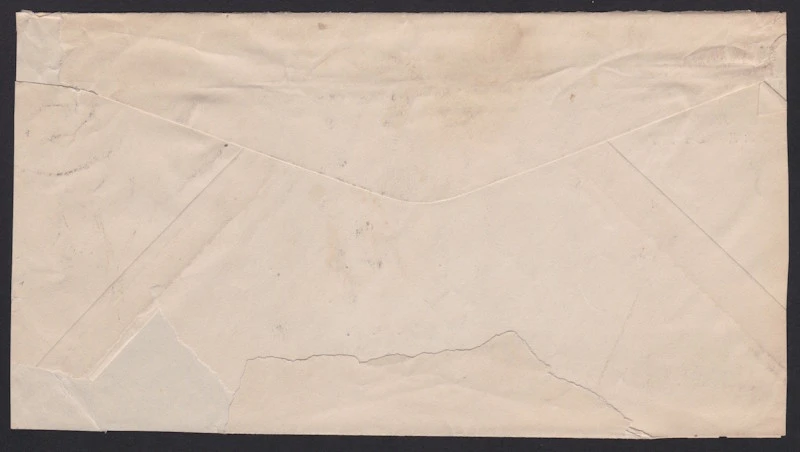 Assuming each end of the top flap continued at approximately the same angles and ended roughly at the top corners of the envelope, I estimate approximately 1¼" was trimmed from each end of the envelope. This would make the full envelope roughly 10"×4½" in size, or slightly larger than a modern #10 (business size) envelope. 1¼" wide strips at either end of the envelope would provide relatively little room for any auxiliary markings. Such markings if they existed likely would have had to have been applied vertically instead of in the more typical horizontal orientation. Most covers I've seen with duplex cancellations do not show a surrounding "ring." My speculation that the cover may have contained relatively thick contents is based on the idea that a thick sheaf of papers might "give" enough to the pressure at the center of the device to allow the surrounding envelope to make contact with the outer rim of the cancellation device. This is admittedly conjecture. I welcome alternative explanations for the use of the 14¢ stamp on this cover. |
|
Send note to Staff
|
|
|
Pillar Of The Community
United States
4424 Posts |
|
|
Philatelius, in your 7oz solo 14c trimmed cover, I do not see a cover which carried 7oz inside. I see a cover likely attached to a larger envelope containing the weight.
Trimmed ends also allows for using the envelope as a wrapper but I have two reasons against that idea, first the envelope does not appear with use marking consistent with such wrapper use and secondly the organization was against rolled material being submitted (rules prohibited such) and likely would do the same with material sent. |
|
Send note to Staff
|
|
|
Replies: 43 / Views: 2,781 |
|
|
To participate in the forum you must log in or register. | |
 Show Your US 1851-57 Imperforate Stamps Israel Revenue Stamp Catalogue Information Request Help With A 1 Cent Franklin From The Philippines Stamps On Stamps Optical Instruments: Microscopes, Binoculars, Sextans, Theodolits, Hand Scopes Cover Calendar For Month And Day -Pics Pushing 330,000 All Different Worldwide Stamps In One Collection . Postmarks.day By Day Experimenting With A Phone As Attached Scanner Turn On The Light! Candles, Lamps, Torches, Candelights, Bedside Lamps. Fan, Éventail, Abanico, Fächer, Leque Linn's To Return To Printed Issues Minkus Supreme Global Albums (The Big Red Thread) Soviet Union Stamp Engravers Czech Stamp Engravers Collecting By Engraver 1851-57 12c Washington Canada 742 Color Shift Error? Stamps Made Of Cloth, Polymer, Metal, Wood Etc Art & Paintings On Stamps Need Help With Swedish Stamp And Postmark Living Persons Portrayed On Stamps If You Have A Design You Like, Might As Well Stick With It! Newfoundland 82 Imperf Cover Please Identify - USSR Stamps Show Your US 1851-57 Imperforate Stamps Israel Revenue Stamp Catalogue Information Request Help With A 1 Cent Franklin From The Philippines Stamps On Stamps Optical Instruments: Microscopes, Binoculars, Sextans, Theodolits, Hand Scopes Cover Calendar For Month And Day -Pics Pushing 330,000 All Different Worldwide Stamps In One Collection . Postmarks.day By Day Experimenting With A Phone As Attached Scanner Turn On The Light! Candles, Lamps, Torches, Candelights, Bedside Lamps. Fan, Éventail, Abanico, Fächer, Leque Linn's To Return To Printed Issues Minkus Supreme Global Albums (The Big Red Thread) Soviet Union Stamp Engravers Czech Stamp Engravers Collecting By Engraver 1851-57 12c Washington Canada 742 Color Shift Error? Stamps Made Of Cloth, Polymer, Metal, Wood Etc Art & Paintings On Stamps Need Help With Swedish Stamp And Postmark Living Persons Portrayed On Stamps If You Have A Design You Like, Might As Well Stick With It! Newfoundland 82 Imperf Cover Please Identify - USSR Stamps
Disclaimer: While a tremendous amount of effort goes into ensuring the accuracy of the information contained in this site, Stamp Community assumes no liability for errors. Copyright 2005 - 2026 Stamp Community Family - All rights reserved worldwide. Use of any images or content on this website without prior written permission of Stamp Community or the original lender is strictly prohibited.
Privacy Policy / Terms of Use Advertise Here |
| Stamp Community Forum |
© 2007 - 2026 Stamp Community Forums |
| It took 0.21 seconds to lick this stamp. |
 |
|
|
|


 Posted 12/27/2025 9:33 pm


