| Author |
 Replies: 59 / Views: 48,060 Replies: 59 / Views: 48,060 |
|
Pillar Of The Community
Australia
2156 Posts |
|
|
I've spent most of the day going through my vintage American stamps. In the course of the day, I discovered that the design of the stamp shown below was VERY slightly longer than the others I own of the same issue, whihc consistently measure 19 1/4 mm by 22 1/4 mm. Lo and behold, it turns out that it's the very rare #596, which according to one source (a contribution to the forum made by user 'Jim' in 2008) measures 19 1/4 mm by 22 1/2 mm. I think it would be little short of a miracle if it were really so that I owned a copy of a stamp of which there are apparently only 13 in existence. So the first question I would ask concerning this issue is this: what other ways are there to tell the difference between rotary printings and flat plate printings than the size of the area of the design? I find it hard to believe that the difference between the valueless #552 and the incredibly valuable #569 comes down to just a quarter of a millimetre's difference in the length of the design. Since a different printing method was used, there must be other indications of difference. Does anyone know anything about this subject? A second question: is it possible, for instance, that the extra 1/4 mm. would be due to accident, say, something that might have stretched the area of the stamp slightly??? Anyway, here's the stamp in question:  I look forward to hearing what people have to say about this, and hopefully we can all learn something about this very rare issue. |
|
Send note to Staff
|
|
|
|
|
Pillar Of The Community
United States
2547 Posts |
|
|
jimjam, first step is to verify the vertical perforations. I suspect that they are 10.5 not 11. If they are 10.5 then the stamp is 632. |
Send note to Staff 
|
|
|
Pillar Of The Community
Australia
2156 Posts |
|
|
Hi Russ,
Earlier in the day compared the stamp to scans of #632 and I found that they have different numbers of perf holes on all sides.
I just checked the perfs for this one again (since it always pays to check!), and they are 11 at top and bottom and indeed 10.5 on the sides.
I'm therefore confused as to why the scans of #632 do not look the same as my stamp.
Is the design area 22 1/2 mm. on #632???
Do the sizes of the design areas vary for the 1c green Franklins and only matter when it comes to deciding if yours is a #594 or a #596???
|
|
Send note to Staff
|
| Edited by jimjamtwo - 05/14/2011 10:58 am |
|
|
Pillar Of The Community
United States
2547 Posts |
|
|
The 632 is 19.25x22.5. The biggest indicator that the stamp was a 632 is the color. The 596 was sheet waste from the rotary press (perf 10x10) Scott 581 and was printed in green as opposed to the yellow green of the 632. The 594 would measure 19.75x22.25 and was coil waste from the rotary press (perf 10 vert) Scott 597 coil.
The 581/596 were printed on the Bureau of Engraving and Printing's new large Stickney rotary presses. These machines did the printing gumming and perforation in a continuous operation. Evidently a small amount of printed and gummed web was removed in the early set-up and run of this stamp. Rather than destroying it, it was cut into sheets and perforated on the perf 11 flat plate perforators. The total quanity produced is unknown but was probably just a few thousand. |
|
Send note to Staff
|
|
|
Pillar Of The Community
United States
3568 Posts |
|
|
I am with Russ on this. Color which I am amazingly crappy at gives this away, but the yellowish hue to this stamp screams 632. Sorry - Jeff |
|
Send note to Staff
|
|
|
Pillar Of The Community
Australia
2156 Posts |
|
|
Thanks for the info! It's most interesting.
Given that the rotary press operation was very different, do you know if there are any guidelines as to how to tell the difference between flat plate and rotary printings (generally, I mean)? |
|
Send note to Staff
|
|
|
Pillar Of The Community
Australia
2156 Posts |
|
|
Russ, jhlovell, yes, I always thought the colour was a red flag, so to speak.
All the versions of both #596 and #596 I could find online were dark green, so I didn't really think for a minute that I had either of them.
I'm really just using this subject as an entree into the complexities of US philately.
I won't even go into the subject of 'bluish paper,' which is, apparently nearly always gray rather than blue!
|
|
Send note to Staff
|
| Edited by jimjamtwo - 05/14/2011 11:30 am |
|
|
Pillar Of The Community
United States
3568 Posts |
|
|
Most of the time it all boils down to size of the frame, you need a good measuring tool and the Precision U.S. Specialty Multi-Gauge that Russ touts is the best I know of to check perfs, grills, and measurements. Gotta have one if you are working with 19th or early 20th century U.S. stamps. - Jeff |
|
Send note to Staff
|
|
|
Pillar Of The Community
United States
2547 Posts |
|
|
There are 2 distinctions. The size is the first. After the laydown the rotary plates were curved to a semi-circular shape. This operation caused them to stretch in one direction accounting for the diffence in size.
The second distinction is in the quality of immpression. The flat plate impressions are normally very sharp while the rotary press impression is not as sharp and crisp. |
|
Send note to Staff
|
|
|
Pillar Of The Community
United States
3568 Posts |
|
|
Soooooooo Russ are you saying you are flat plate and I am rotary press?????  |
|
Send note to Staff
|
| Edited by jhlovell - 05/14/2011 12:19 pm |
|
|
Pillar Of The Community
Canada
6525 Posts |
|
|
Pillar Of The Community
United States
3568 Posts |
|
|
I don't know I wasn't feeling very sharp or crisp this morning so I figured I must be rotary press and I am 6' 2". |
|
Send note to Staff
|
|
|
Pillar Of The Community
Australia
2156 Posts |
|
|
Russ wrote, 'The second distinction is in the quality of immpression. The flat plate impressions are normally very sharp while the rotary press impression is not as sharp and crisp.'
Thanks for the info, Russ. I had a feeling there would be some kind of difference in the overall result.
Next question: wwhile checking the design areas on my 1c Washingtons I didn't find a single one with a design that was 19 mm X 22 mm - all were a little bit smaller. Two were 18.5 mm X 21.75 mm. Is this considered a significant difference? And if so, what would be responsible for this? |
|
Send note to Staff
|
| Edited by jimjamtwo - 05/14/2011 9:57 pm |
|
|
Pillar Of The Community
United States
2547 Posts |
|
|
Let me give a little background on the rotary press. The BEP was looking for a more effective method of producing coil stamp. the method used for flat plate was to perforate the sheets in one direction, split the sheet, trim the ends, paste-up the end-to-end splice, strip and wind. Benjamin Stickney was the chief machine designer for BEP and developed the rotary press which was able to print from a continuous web (paper roll) rather than from single sheets. The first presses were the small rotaries that used 2 plates per drum. The plates were either 170 (10x17) subject for vertically perforated coils or 150 (15x10) subject for horizontally perforated coils. The first rotary press coil was the 2 cent Scott 453 issued July 3, 1914 followed by the 1 cent Scott 452 on Nov 11, 1914. Both are vertically perforated. The BEP continued to use the flat plate for the 3, 4 and 5 cent vertically perforated coils and all horizontally perforated coils. As the BEP increased the number of presses they moved all coil stamp production to the rotary presses. The horizontally perforated coils, along with the 4 cent vertical coil, were moved to the rotary press in 1915. The 3 and 5 cent vertically perforated coils were moved in 1916. No flat plate coils were produce after 1916. Since the original rotary press was designed for coil production it was not suitable for sheet stamps. A larger rotary press was designed and place in operation in 1920 for the production of sheet stamps. The first rotary sheet stamp was the 1 cent Scott 542 which was released on May 25, 1920. This larger press used a drum consisting of 2 plates of 400 subjects each. Below is a drawing of the original small Stickney press for the original patent 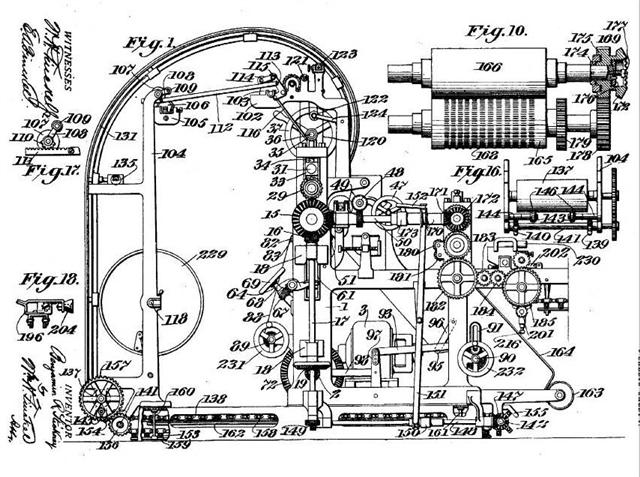 I hope this helps |
|
Send note to Staff
|
|
|
Pillar Of The Community
United States
2547 Posts |
|
|
Since you referenced a 1 cent Washington, I am assuming that you are talking about the 3rd Bureau issues (1908-1921). The flat plate issues for this series are 18.5-19X22. |
|
Send note to Staff
|
|
|
Pillar Of The Community
Australia
2156 Posts |
|
|
Replies: 59 / Views: 48,060 |
|




 Posted 05/14/2011 10:22 am


