| Author |
 Replies: 9 / Views: 8,890 Replies: 9 / Views: 8,890 |
|
|
Valued Member
United States
166 Posts |
|
|
I came across six of these Orange 3 cent stamps. I can't find them anywhere. 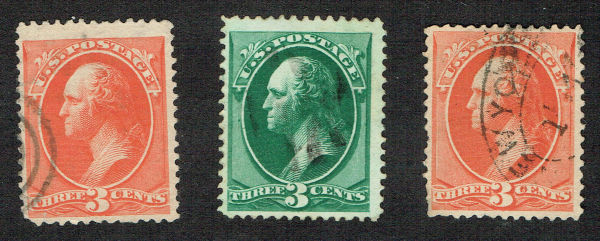 |
|
Send note to Staff
|
|
|
|
|
Pillar Of The Community
United States
2963 Posts |
|
|
Scott 214 - far more valuable than the more common green variety :)
Brian |
Send note to Staff 
|
|
|
Bedrock Of The Community
United States
12128 Posts |
|
|
Pillar Of The Community
1849 Posts |
|
|
Pillar Of The Community
United States
1624 Posts |
|
|
Pillar Of The Community
United States
1946 Posts |
|
|
tazzmann30
In 1881 the three cent stamp design was given a bit of a 'facelift," so to speak. If you look at the vignette frame of the green stamp in your pic, you will see that the bottom half has a bit of an "apron" of color below it. Look at that same apron on the stamps in vermilion and you will see it is much narrower. That is one of the characteristics of the redesign. In green it is a #207 and in vermilion a #214.
You might want to make note of that, because these redesigned varieties only occur on what is commonly called "soft paper." When you start to tackle the Bank Note issues, you can use these redesigns as touchstones for soft paper, as opposed to the hard paper most commonly found on the earlier design. Why is that important? Because the original three cent design occurs on both hard and soft paper, and bedevils lots of collectors who try to distinguish the different catalog varieties, not only for the three cent, but for all the denominations.
So if you remember that the vermilion is only on soft paper it may help you distinguish the paper types. |
|
Send note to Staff
|
|
|
Valued Member
United States
166 Posts |
|
|
essayk
I assume that you tell the difference of hard and soft paper by touch. I can feel the difference when I touch the Green and VERMILLION (Thank you)stamps.
I have another question though....If you have stamps with complete gum intact how do you tell the difference as I am sure the gum would make it feel more rigid and not as soft. |
|
Send note to Staff
|
|
|
Pillar Of The Community
United States
1946 Posts |
|
|
Actually, touch is not the way the distinction is made. If the stamps have no gum, the snap test is commonly used. Holding the stamp near your ear with the tongs gripping it near the center, bend the stamp slightly and release it listening for the tone of the snap as it returns to form. Train your ear with known examples of hard and soft paper first. (E.g. anything the National Bank Note Company printed from 1861-1873 was on hard paper. Soft paper started a little before 1879, but was standard for the American Bank Note Company by 1881. So anything after that is soft.)
The snap test also works with gummed stamps, but is a bit tricky to learn. And regummed stamps can mess it up even more. So you also want to get familiar with the differences in "paper mesh" between the hard and soft papers. When you know that a paper is hard, hold it to the light and note how tight the weave of the fibers is, and how bright the white of the paper is. Do this for examples with and without original gum. Then do the same with stamps you know are on soft paper and much of the time you will see some rather stark differences, since soft paper is not at tightly woven nor as bright white.
Once you have gotten familiar with these two tests, you will be able to distinguish the paper most of the time, say 85% of the time. The 15% failure is due to the existence of paper sub-varieties that are intermediate, or complicated by adhesions or other hindrances. Stamp color, paper thicknesses, pulp additives and other technical points will get you through those, but at first you may wish to send those out for another opinion.
|
|
Send note to Staff
|
|
|
Rest in Peace
United States
763 Posts |
|
|
HARD Vs SOFT PAPER
******************
Here is a short portion of an instructional handout I will be giving to next year's APS Summer Seminar Hands-On Expertizing Class which may help;
"(Tip- The ability to identify hard and soft paper is important, so a few words on that subject;
HARD PAPER – Stiff, whiter than soft paper, not translucent when held to light (the paper weave appears more "solid" than soft, which has a distinct mesh) , appears whiter under UV long wave light (because it is less dense than soft paper), perf tips appear more solid when viewed with good (recommend 10-15X) magnification than soft paper (which will display more paper fibers on the perf tips). Detect hard paper by observing the traits already noted. Some people can also ID hard paper by "flicking" the edges and feeling the stiffness of the paper versus the softness of soft paper).
SOFT PAPER – A looser-weave paper than hard, so feels softer, displays a weave when held to light, looks grayer under UV light than hard, and shows lots of perf tip fibers with good magnification".
This is part of a much bigger article on the 1870-1890 Banknote Issues which will be distributed there to the class.
I agree with the poster who recommends using a #214 as a perfect example of soft paper. Actually, any stamp between Scott #206-218 and even 219-245 will work too. For hard, I recommend the 3c 1861 and/or 3c 1869 as good examples, but any 1861-73 stamp will work as well.
|
|
Send note to Staff
|
|
|
Rest in Peace
United States
7097 Posts |
|
|
Thank you Bill. Looks to be a great class and I hope to attend. The Banknotes are among my favorites to work with. Cheers. -Jeff |
|
Send note to Staff
|
|
| |
Replies: 9 / Views: 8,890 |
|



 Posted 12/31/2013 07:14 am


