| Author |
 Replies: 74 / Views: 14,334 Replies: 74 / Views: 14,334 |
|
|
|
Pillar Of The Community
United States
770 Posts |
|
|
Pillar Of The Community
United States
770 Posts |
|
|
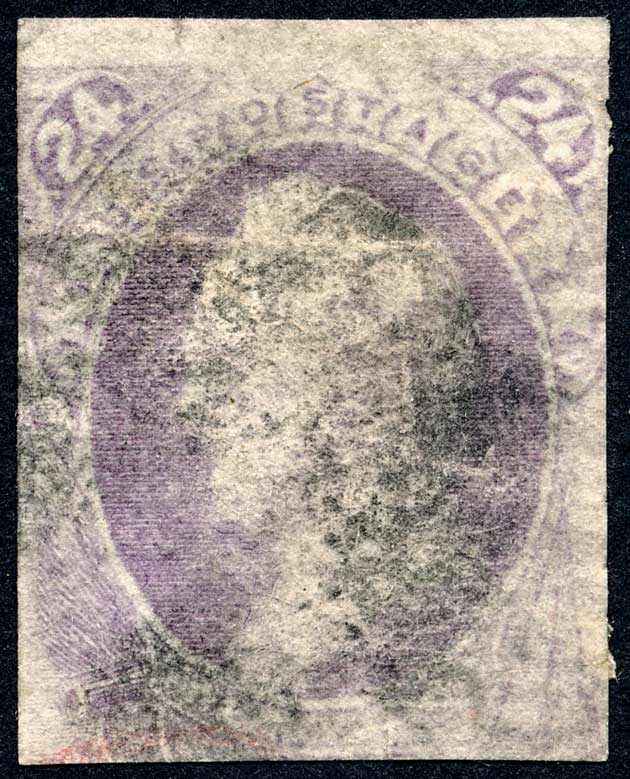
it is on a very hard translucent paper. Like vellum... can anybody help? |
Send note to Staff 
|
|
|
Pillar Of The Community
United States
1946 Posts |
|
|
Unless you see lines of ribbing or a grill, it can only be a #153. Trimmed to beat all Hades, but a 153 nonetheless. As for the paper, it sounds like it may still be affixed to something that was trimmed with it. If it is attached with a water soluble gum you might try soaking it. Have you? |
|
Send note to Staff
|
|
|
Pillar Of The Community
United States
770 Posts |
|
|
It doesn't look like it has any backing paper at all. I can't remember if I tried soaking it, and I'd rather not as it is quite thin already. It does not look like any kind of ribbed paper. I put it in my collection over a decade ago and really haven't given it a thought since! |
|
Send note to Staff
|
|
|
Pillar Of The Community
United States
1946 Posts |
|
|
Perhaps I misunderstood your reference to vellum. I have several book pages from the 12th to 15th centuries on vellum, from lamb/sheep skin, and it is a rather thick material except where it has been hammered thin enough (inadvertently, I suspect) to be translucent. Mostly it is not translucent. That's what came to mind when I first read your reference to it before. But now I realize that you may have been referring to a modern grade of paper called "vellum" and not to real vellum. That would be my mistake, and I apologize. Let's forget the vellum reference for a moment. You were saying that the paper for this is hard, thin, translucent paper.
Are you familiar with the paper variety from the grilled issues of 1867 called, "very thin paper?" I was recently informed that the National Bank Note Co. had a residual supply of this paper still in 1870-72, and that some of their Bank Note Issues were printed on it and issued. It may be possible that National printed this 24c on this special grade of paper. You might try to track down an example of the earlier paper variety and compare it with your stamp. Do you have access to a paper micrometer? |
|
Send note to Staff
|
|
|
Valued Member
Ireland
169 Posts |
|
|
Well I posted my worse stamp here because mainly I collect only MNH and this one posted is fake, perfs are fake, backed up on stamp paper with brown gum, tear some one mentioned. Badly faked proof, but may be backed up real one? Only if lifted of the backing I could find out. Looks that some perfs are different on original, looks like backed up and then re-perforated, may be a tear because paper is thin and fragile? May be it was backed up to preserve it as it was so fragile? Who knows? Whoever you need to have some CSI skills to separate backing paper from original and its going to remain for me a mystery. * * * * *  |
|
Send note to Staff
|
| Edited by Gladiators001 - 12/08/2014 6:25 pm |
|
|
Pillar Of The Community
United States
770 Posts |
|
|
yes sorry - I'm a designer and we used to use Bienfang translucent vellum paper for marker comps way back when. It has a very hard surface and we used it because we were able to work on both sides of the paper and even scrape details into our designs with an xacto blade. The stamp paper is similar but thinner. I figured part of the reason the print is so poor is because of the type of paper. Using a machinist's micrometer the thickness appears to be .0025" |
|
Send note to Staff
|
|
|
Pillar Of The Community
United States
770 Posts |
|
|
and the Bienfang wasn't a real vellum paper like you are familiar with so sorry to confuse you. Thanks for all the help by the way! |
|
Send note to Staff
|
|
|
Pillar Of The Community
United States
770 Posts |
|
|
Pillar Of The Community
United States
1946 Posts |
|
|
Okay, using a machinists micrometer on paper is a bit tricky, because it is easy to overcrank the thing and get a false reading because the micrometer mashed down the paper to something thinner than is normal thickness. Assuming you anticipated that and figured out a way to keep a light touch, the reading of .0025 puts your paper on the thin side, especialy if the measurement included some of the inked portion of the paper. If you can get a reading off an edge that misses the printing, that is better. John Barwis of the USPCS published a study of paper thicknesses for the BankNotes in the August 2014 Chronicle pp246-257. http://chronicle.uspcs.org/PDF/Chro..._243/243.pdf (You may need to copy and paste that into your browser locater bar). His numbers came from measuring the uninked portions of stamps. By his numbers, your reading is characteristic of a gelatin sized, high permeability paper that is known for clear images (rarely blurry as you reported). But in my experience, when measured with the ink, the thickness number is normally a bit thicker, up to .0030 inch. If you are seeing .0025 with the ink, then your stamp paper is a bit on the thin side, but within a reasonable range. Ha -- after I posted that I saw the link you had posted to the original version of John's article. I spoke to him on the phone about his measurement technique, since I have run into that problem before. I.e. that research is published but I can't replicate the data because of an unexplained difference in measurement technique. Believe me, it matters. Anyway, you have the substance of it from the article he originally published for the Symposium on Analytical Methods in Philately. Same substance as the Chronicle article, but with more detail. |
|
Send note to Staff
|
| Edited by essayk - 12/08/2014 4:36 pm |
|
|
Pillar Of The Community
United States
770 Posts |
|
|
To get a measurement its a bit easier with the calipers but its not quite as accurate obviously. I just rechecked with the micrometer at the very top of the stamp at the largest margin. I still get .0025. Thanks! |
|
Send note to Staff
|
|
|
Pillar Of The Community
United States
937 Posts |
|
|
I am very happy for this detour of thread topic. I finally understand 1870–1881 paper types in an analytical manner. Also, I am now aware of the Institute for Analytical Philately, Inc. http://analyticalphilately.org/ Thank you guys!! Concerning the measurement of stamp paper, can someone link or provide a summary of measuring methods and caveats? i.e. calipers, machinist micrometer, specialized paper measuring devices. |
|
Send note to Staff
|
|
|
Pillar Of The Community
United States
937 Posts |
|
|
Well, southpaw and essayk already mentioned the major caveats about measuring stamp paper thickness. Here's a summary and a few notes: -The stamp must be measured on an area without ink. That includes original design, postmark, and cancellation ink. -Specialized paper measuring devices are the easiest. Just make sure that it can measure a small area like an uncanceled portion of the margin. -Dial and Vernier Calipers can be used but typically only have a resolution of 0.001" so are not well suited. Few have a higher resolution, 0.0001" is required. -Micrometers can often be found with resolutions to 0.0001". -To get an accurate measurement, you'll need to use a pressure of about 7 psi. This is not easily done but could be learned by practicing with paper of known thickness where the contact surface area stays consistent. In summary, most people should just spend the additional money for a specialized paper thickness measuring device. It also appears that the Institute for Analytical Philately, Inc. website is being hugged to death by too many people trying to view it at a time. The server is overloaded. Here's a screenshot of the home page:  |
|
Send note to Staff
|
Ryan = HDNAC = DNA = HDC = Hysterical DNA Collector = Historical DNA Collector = me who just loves stamps :) |
|
|
Pillar Of The Community
1849 Posts |
|
|
Gladiators001....
I would not jump to the conclusion that this is FAKE.
What do you think it is???
I have my thoughts....but want to hear your first
|
|
Send note to Staff
|
|
|
Valued Member
Ireland
169 Posts |
|
|
@Historical DNA Collector: Looks to me 69-E6b or 69-E6d with fake perfs added and not 69-E6e till its proven other wise |
|
Send note to Staff
|
|
|
Replies: 74 / Views: 14,334 |
|




 Posted 12/08/2014 10:31 am