| Author |
 Replies: 8 / Views: 2,584 Replies: 8 / Views: 2,584 |
|
|
Pillar Of The Community
United States
670 Posts |
|
|
I've been looking at the 1851 and 57 stamps on the Seigel site to get a better feel for the various types and subtle differences. This sale jumped out at me because the stamp doesn't have the typical characteristics of a 24, specifically the bottom frame line. Are there examples of Va's that have a virtually complete bottom line? Did pse get this one wrong? http://www.siegelauctions.com/lot_g...lledfrom=lkpJust when I start to feel confident, a stamp throws me a curve ball. Edit: maybe a 22? |
|
Send note to Staff
|
| Edited by raymodj - 04/06/2015 11:14 pm |
|
|
|
|
Pillar Of The Community
United States
1360 Posts |
|
|
Absolutely correct, Ray.....can't see the top very well, but that's a complete bottom curve, so it's either a 22 or a 20....looks like a 22 to me.....
Ray |
Send note to Staff 
|
|
|
Pillar Of The Community
United States
2555 Posts |
|
|
That is a #22 from Plate 11. I think it is an A relief showing more bottom right plume than you would normally see. |
|
Send note to Staff
|
|
|
Pillar Of The Community
United States
670 Posts |
|
|
Thanks Ray and Winston. I thought this stamp was a Type IIIa rather than Va. Although people here have talked about it, I've never found a misidentified cert and didn't expect to see one in a Siegel auction. At first I trusted the cert more than my own knowledge of the types. |
|
Send note to Staff
|
|
|
Pillar Of The Community
United States
1820 Posts |
|
|
The dot in the medallion oval (see arrow) is a sure indicator of Plate 11 or 12. Even if the side and/or bottom ornaments were cut into you could definitely tell that this is not a Scott #24 (which only came from Plates 5, 7, 8, 9 and 10). 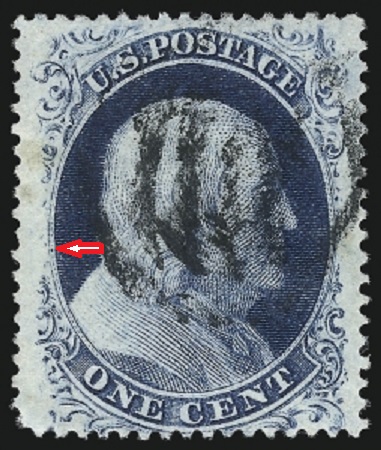 |
|
Send note to Staff
|
| Edited by dudley - 04/07/2015 9:58 pm |
|
|
Pillar Of The Community
United States
1820 Posts |
|
|
Apropos of this topic, here's one that I just let slip through my fingers on ebay. It was misidentified as the higher-valued Scott #23, but is another example of a Plate 11, A relief, Scott #22. It appears that it may have been canceled as a remainder after demonetization in August 1861 (though Neinken only mentions such pen-ruled cancellations having been made in red ink). 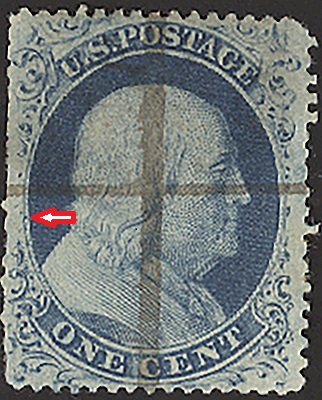 |
|
Send note to Staff
|
|
|
Pillar Of The Community
United States
670 Posts |
|
|
Thanks Dudley, very interesting. I was curious how all the stamps from plates 11 and 12 could have this dot, since there are different reliefs. Neinkin calls it a "secret mark" on all the stamps on 11 and 12 regardless of relief. He also says it's on the die proofs. I looked at some examples from plate 12 on the Franklin Plating Archive. They haven't documented any position from plate 11. |
|
Send note to Staff
|
|
|
Rest in Peace
United States
763 Posts |
|
|
Quote:
It appears that it may have been canceled as a remainder after demonetization in August 1861 (though Neinken only mentions such pen-ruled cancellations having been made in red ink).
Dudley, It is more likely just a precancel, as these "cross" type precancels in the 1850s-1870s was not uncommon. I've seen a decent amount of them in my career, and I would not think of them as being a "remainder after demonitization". Just my opinion (no pun intended!). |
|
Send note to Staff
|
|
|
Pillar Of The Community
United States
1820 Posts |
|
| |
Replies: 8 / Views: 2,584 |
|




 Posted 04/06/2015 10:38 pm


