| Author |
 Replies: 20 / Views: 5,130 Replies: 20 / Views: 5,130 |
|
Valued Member
United States
189 Posts |
|
|
Is there a color chart, and is it worth getting one if a person is NOT working with pristine, protected and unused stamps? Guesses for the colors on these three, please. I didn't put up the 88 because it is the same color as one of these. Input greatly appreciated. 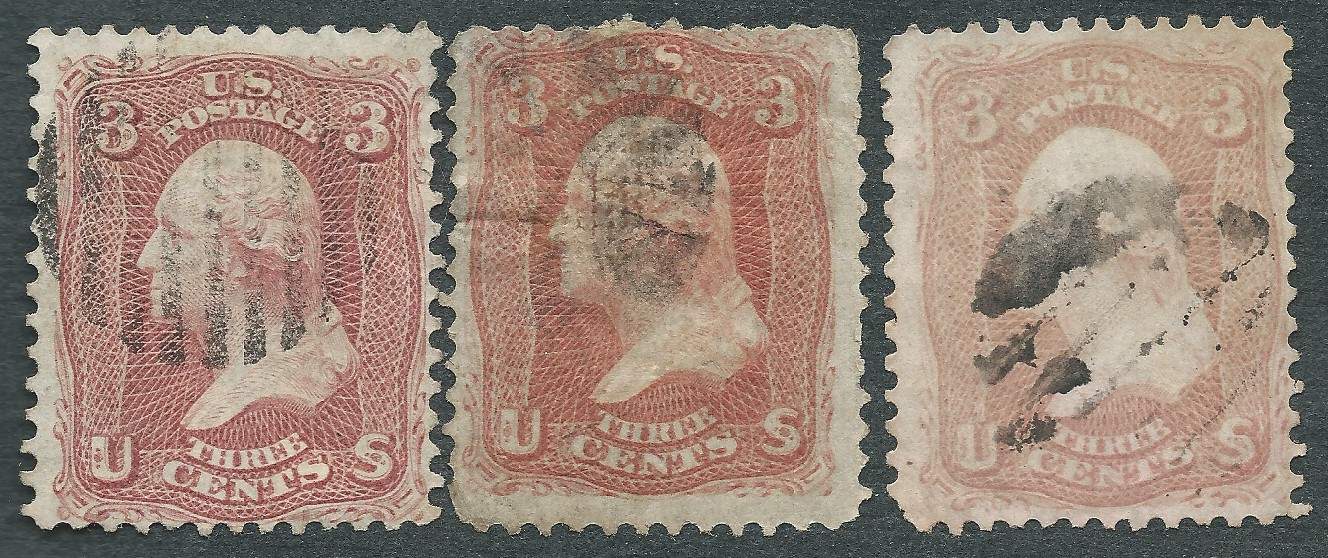 |
|
Send note to Staff
|
| Edited by walkabout - 04/09/2015 1:35 pm |
|
|
|
|
Pillar Of The Community
United States
845 Posts |
|
|
Valued Member
United States
189 Posts |
|
|
HungaryForStamps - Thank you for the reply and the link. I'm not sure that I would have that much use for it since working with this collection is a one time thing and I'm finding that my eyes aren't distinguishing the subtle differences that well. It seems that the early stamps are the most problematic (what the heck is 'Lake Red' anyway), however, it is good to know there is a good one out there. |
Send note to Staff 
|
|
|
Pillar Of The Community
United States
1756 Posts |
|
|
I see the price has been cut to $43.99... not sure if that's
even a good price for what's included in this guide...
Any opinions? |
|
Send note to Staff
|
|
|
Pillar Of The Community
1515 Posts |
|
|
I bought this color guide years ago (when it was published under the name of Pittsboro Philatelics) as I thought it would be useful when I decide to tackle this issue. Here's part of the page for #64 and #65 to give you an idea of what it looks like: 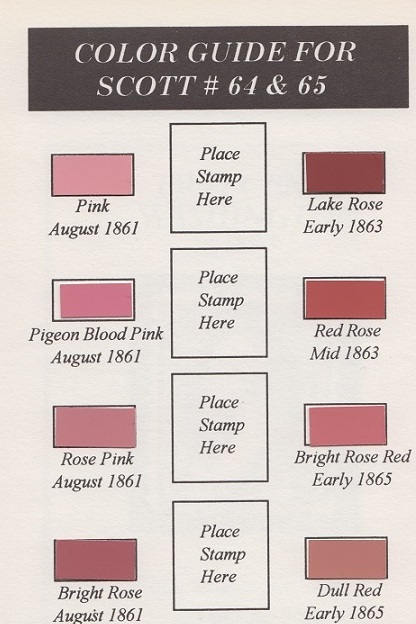 Instructions for use: 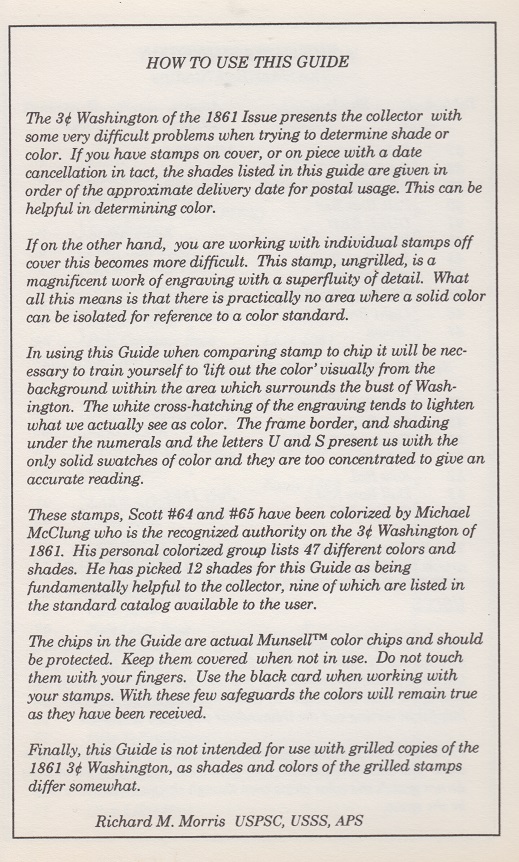 This is the "special tool (aka black card) which is included to allow you to focus solely on the color without being distracted by the design": 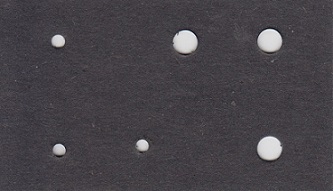 |
|
Send note to Staff
|
| Edited by Jenny2U - 04/09/2015 3:30 pm |
|
|
Valued Member
United States
189 Posts |
|
|
Hello disi123 - I'm not sure, after seeing Jenny2U's color guide, that any of the color guides would be useful to me. Old age with eyesight deteriorating - details, not too bad, colors, well ....
Jenny2U - Thank you very much. This will help on the more obvious color differences. I appreciate your time and trouble. Thank you for sharing. |
|
Send note to Staff
|
|
|
Pillar Of The Community
United States
1756 Posts |
|
|
Hello, Jenny... indeed... thank you kindly for sharing...
The page you displayed appears to be the one that I'd need...
I supposed beyond this point, I would wonder if Scott is
maintaining a high level of quality control on their own
inks for consistency from one guide to another...
Randall |
|
Send note to Staff
|
|
|
Pillar Of The Community
United States
578 Posts |
|
|
BTW, the chips in the guide that Jenny2U posted are IMO more accurate than the (expensive) White color reference. FWIW, I haven't seen one of the sets produced by Amos/Scott (my set is the old Pittsboro brand,) but suspect the quality is still good (and still more accurate than White.)
Of course, nothing beats actual stamps, but with the CV's of 64a's, 64's, etc., even certified fillers can get pricey. These chips are the next best thing and definitely worthwhile to pick up.
If you do get the chips (or any other color reference for that matter,) just make sure you're comparing stamps under "full spectrum" (e.g. Ott) light, not incandescent, etc... It makes a huge difference with these 3c shades. |
|
Send note to Staff
|
|
|
Valued Member
United States
189 Posts |
|
|
srailkb - Thank you for your comments and information. Finding an effective full spectrum light may be more difficult than getting a good color chip. As full spectrum seems to be more of a marketing than technical term and the actual requirement is equal distribution of light through the spectrum, it may not be cost effective when one can use natural light when available. Living on the central coast of California, we seem to have an abundance of that, considering we are in a long drought and it isn't cloudy all that often lately. Thank you for the suggestion and recommendation, though. |
|
Send note to Staff
|
|
|
Rest in Peace
United States
763 Posts |
|
|
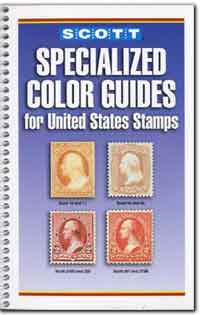
Has any reader actually seen that Scott color guide (the one shown on Subway's website)? I have not. Anyone? |
|
Send note to Staff
|
|
|
Valued Member
USA
29 Posts |
|
|
One of my first classic stamps is a 65. Still not sure of the color. But since then I have always wondered about the color of pigeon blood. We're any pigeons harmed to verify its shade?
Just wondering. |
|
Send note to Staff
|
|
|
Pillar Of The Community
1515 Posts |
|
|
Pillar Of The Community
United States
1756 Posts |
|
|
Bill... in your professional opinion, would you say
the Scott guide is worth the $43.99 asking price?
Randall |
|
Send note to Staff
|
|
|
Pillar Of The Community
United States
578 Posts |
|
|
Jenny2U, that's the question. I don't think anyone here knows. Pittsboro (Morris) was obviously buying the color chips somewhere (I doubt directly from Munsell,) but whether Amos/Scott is using that same company, with the same quality control standards, is unknown.
Having said that, I'd expect Amos/Scott to be using a quality supplier & have a quality product (comparable to the Pittsboro version.) I just didn't want to say that in my first post though, as I haven't actually seen the chips sold by them (nor has Bill Weiss...that probably says volumes about their sales to date, LOL.)
I wonder if someone like Jim Lee (who sold the Pittsboro chips for many years) has seen the Amos/Scott version & compared them. |
|
Send note to Staff
|
|
|
Pillar Of The Community
United States
578 Posts |
|
|
BTW, I should mention that I do have multiple "editions" of the Pittsboro color chips in my reference library. Although the chips got smaller in size over the years (LOL,) the color reproducibility/consistency is excellent between the earliest version and the 2004 "revised edition" (the most recent set I have.) |
|
Send note to Staff
|
|
|
Moderator

United States
12330 Posts |
|
|
How does the color standard define an light sources? Obviously colors are greatly affected by the ambient light. Un many color specifications that I have seen in QA manuals and manufacturing guides they are usually defined with something like, 'sample to be viewed under office lighting and at arm's length'.
The ambient light source may be any one of hundreds of wave lengths. I would say that it would be possible to "match" a color as a rare type by simply changing he ambient light source wave length. If so, what good is a color guide as a definitive method for identifying a stamp?
Again, my opinion is that unless the ambient light source is defined and consistently applied across every sample environment, color matching is not a reliable method for identifying a stamp.
Don
|
|
Send note to Staff
|
|
|
Replies: 20 / Views: 5,130 |
|



 Posted 04/09/2015 1:31 pm