Stamp Community Family of Web Sites
Thousands of stamps, consistently graded, competitively priced and hundreds of in-depth blog posts to read


Stamp Community Forum
 
Username:
Password:
Save Password
Forgot your Password?

This page may contain links that result in small commissions to keep this free site up and running.

Welcome Guest! Registering and/or logging in will remove the anchor (bottom) ads. It's Free!

US Classic Stamps: Inverted Grills Study?

 
To participate in the forum you must log in or register.
Author Previous TopicReplies: 4 / Views: 1,571Next Topic  
Pillar Of The Community
United States
2953 Posts
Posted 04/20/2015   2:00 pm  Show Profile Check Rileysan's eBay Listings Bookmark this topic Add Rileysan to your friends list Get a Link to this Message
By no means have I read all there is to read on the subject of grills. For example, I have read things by students of the topic that are not published anywhere else but SCF and I feel privileged to have the opportunity to read the notes of those who continue that study!

Last week, while researching a related topic, I came across this auction from Siegel (Sale 1054, lot 457). It is for a block of four US 114s with irregular perfs and grills with both points up and down on one of the stamps. My presumption is that this happened to the sheet being folded over after printing and before being fed through the perforating and grilling machines.
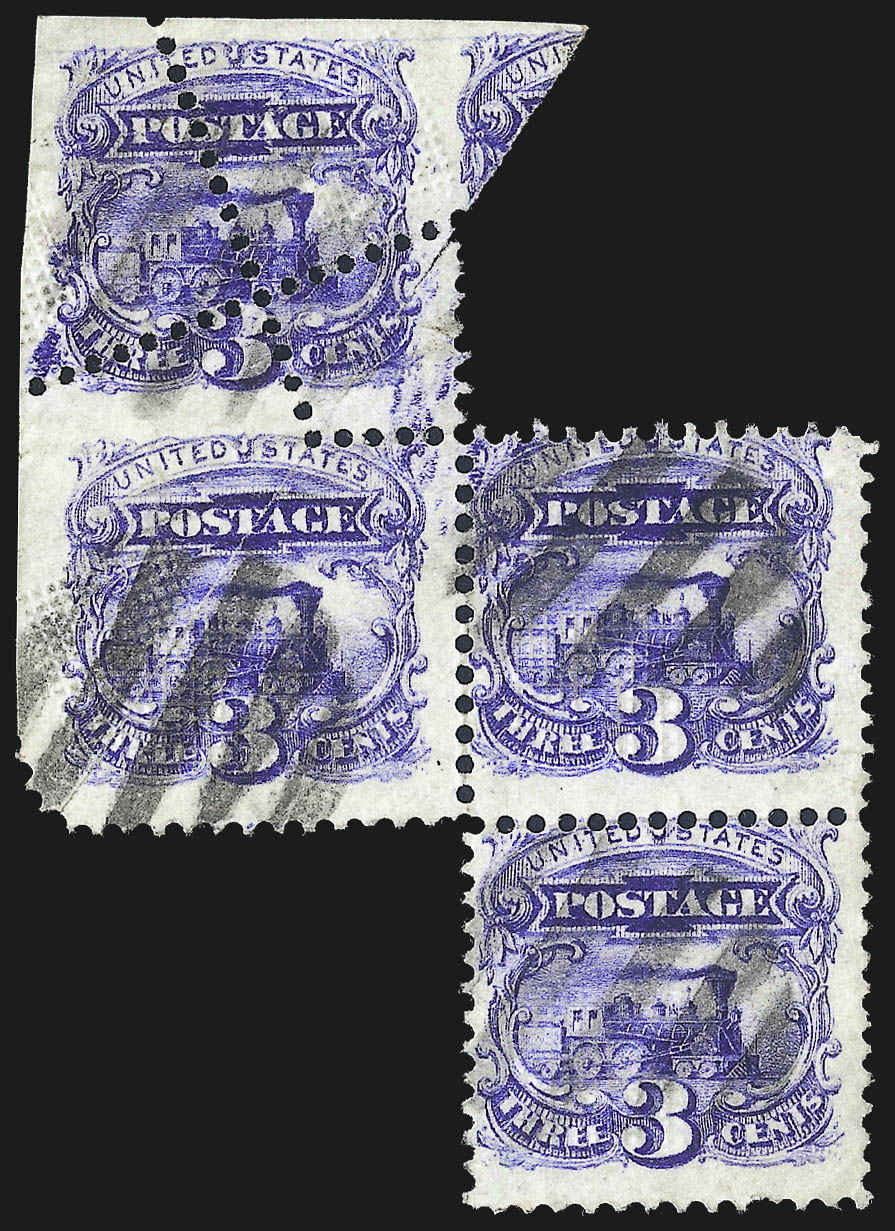


This leads me to a number of questions:


1) Does the fact that a folded sheet was fed into both the perforating and grilling machines without being noticed lend credence to the hypothesis that multiple sheets were fed (stacked) into said machines?

2) If a folded sheet can be fed into these machines un-noticed, could a sheet be fed upside-down, thus creating a "points up" or "points down" error?

3) Are there other recorded examples of blocks with this type of error?

4) If the answers to these questions are 'yes', is it possible that these types of errors exist and have been simply rejected as "fakes" because they don't exibit the correct points up/down characteristics?

5) Are there any articles that talk about this subject? If so, I'd love to read them!

Brian
Send note to Staff
Brian Riley
APS 223349
Edited by Rileysan - 04/20/2015 3:28 pm

Pillar Of The Community
United States
1942 Posts
Posted 04/20/2015   3:06 pm  Show Profile Bookmark this reply Add essayk to your friends list  Get a Link to this Reply
Good topic, Brian. (But then, I WOULD say that, wouldn't I?)

If I may try my hand at your questions. The topic, btw, is referred to as "inverted grills."


1 I don't see that the two topics are intrinsically related.

2. How much do we know about the apparatus into which the sheets were fed? Could not a corner of the sheet have caught and folded over AS IT WAS BEING FED IN? The few who have written on this topic do not leave open much hope that whole sheets were done at a time. Usually they are attributed to foldovers. Brookman did raise a question about an example that had been in his posession, based on the fact that the grill edges squared up with the stamp edges, which is not typical of foldover inverted grills

3. yes.

4. Given the fact that many collectors own material they don't entirely understand, we certainly have to allow for the possibility you suggest.

5. The subject of "inverted grills" is touched upon by Stevenson in his handbook #16 on grills from the Severn-Wylie-Jewett second series. Brookman in his special study on grills (vol 2 in the set) also touches on the topic in the section on grill varieties. Beyond these most references to the phenomenon in my experience come from auction catalogs where they sometimes appear. I am sure there are other references, but probably embedded within larger studies. The topic is not widespread enough or understood enough for a separate treatise, or so it would seem. But I confess that I have not yet done anything like an exhaustive search on the topic, so there may be something out there buried in time.
Send note to Staff  Go to Top of Page
Pillar Of The Community
United States
2953 Posts
Posted 04/20/2015   3:27 pm  Show Profile Check Rileysan's eBay Listings Bookmark this reply Add Rileysan to your friends list  Get a Link to this Reply
I was hoping you would chime in!


Quote:
1 I don't see that the two topics are intrinsically related.


My thought is this: I can understand a mistake happening at one machine. However, unless the employee was lazy, blind, or unaware of the folded sheet, how could it be fed into two different machines without notice unless the folded sheet was somehow hidden?

I don't have an opinion one way or another on whether sheets were stacked before being grilled or perforated, but this example makes a good argument in favor of such a theory!

I love a good mystery ...
Send note to Staff  Go to Top of Page
Brian Riley
APS 223349
Edited by Rileysan - 04/20/2015 3:44 pm
Pillar Of The Community
United States
2953 Posts
Posted 04/20/2015   3:53 pm  Show Profile Check Rileysan's eBay Listings Bookmark this reply Add Rileysan to your friends list  Get a Link to this Reply
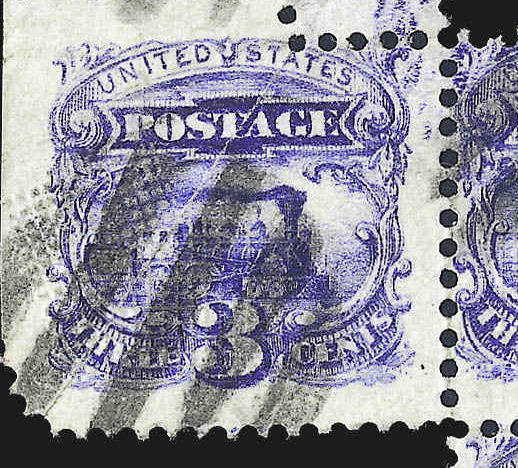
I cropped this image from the block as I think it would make for a great study.

I believe than if you were to fold this stamp back along the crease, you would find that the grill from both halves line up perfectly - that is, the grill impression was made to both halves at the same time (that is akin to having two sheets of stamps grilled simultaneously). From the picture alone, it appears that the grill is clearly impressed on both halves. If two sheets could be impressed simultaneously, how much time would it save during manufacturing? What about three sheets or more? There's clearly a limit to the number of sheets, but where that is?!?

Brian


Send note to Staff  Go to Top of Page
Brian Riley
APS 223349
Pillar Of The Community
United States
1942 Posts
Posted 04/21/2015   10:27 am  Show Profile Bookmark this reply Add essayk to your friends list  Get a Link to this Reply
Brian, no offense but you have retreated from the set of questions you asked and now are trying to build on a speculation. Don't get me wrong. I'm tickled that you are excited about this. But speculations are bunkum, in the words of Elliot Perry, whose battle cry was always, "More facts and less bunkum."

Could you return to the facts? What evidence do you have that links this foldover to anything having to do with multiple sheet grilling? You spoke of two layers in a single pass. Okay.

Brookman, following Wylie, presents a speculation about the shapes of the grill points on sheets "below" the first one in a stack. Based on what you are seeing in this foldover, how well does that vision hold up?

Send note to Staff  Go to Top of Page
Edited by essayk - 04/21/2015 10:31 am
  Previous TopicReplies: 4 / Views: 1,571Next Topic  
 
To participate in the forum you must log in or register.

Go to Top of Page

Disclaimer: While a tremendous amount of effort goes into ensuring the accuracy of the information contained in this site, Stamp Community assumes no liability for errors. Copyright 2005 - 2026 Stamp Community Family - All rights reserved worldwide. Use of any images or content on this website without prior written permission of Stamp Community or the original lender is strictly prohibited.
Privacy Policy / Terms of Use    Advertise Here
Stamp Community Forum © 2007 - 2026 Stamp Community Forums
It took 0.31 seconds to lick this stamp. Powered By: Snitz Forums 2000 Version 3.4.05