| Author |
 Replies: 9 / Views: 2,623 Replies: 9 / Views: 2,623 |
|
|
Valued Member
7 Posts |
|
|
Frederick Remington painting "The Gold Bug" was used for the design of the 50-cent stamp of the Trans-Mississippi Exposition Issue. What is the history of the depicted painting? For whom and why did Remington create "The Gold Bug", was it an illustration to a literary work or simply an independent project? Also, what did he mean by "gold bug" - is it a term for a prospector? These questions have been raised on Russian philatelic forum  and any help in solving these mysteries will be appreciated. Thank you! |
|
Send note to Staff
|
|
|
|
|
Pillar Of The Community
United States
3304 Posts |
|
|
Just a guess, but since prospectors were said to have "gold fever" perhaps Mr Remington supposed they got that fever from a bite from the Gold Bug??  |
Send note to Staff 
|
|
|
Pillar Of The Community
Australia
1251 Posts |
|
|
Or perhaps it is a reference to the famous story by Edgar Allen Poe "The Gold Bug"
Horamakhet. |
|
Send note to Staff
|
|
|
Pillar Of The Community
United Kingdom
895 Posts |
|
|
Surely the Gold Bug just means a keenness or obsession with finding gold as if it were a bodily condition - as in, "He's got the gold bug". Compare with, say Beatlemania or World Cup Fever. |
|
Send note to Staff
|
|
|
Pillar Of The Community
United States
526 Posts |
|
|
See http://www.etymonline.com/index.php?term=bugfor the etymology. "Bug" was not yet being used to mean microorganism in 1898 or when Remington painted the picture. It was being used to mean a defect in a machine but the first use of that was only 1889. The most likely meaning is obsession, which was also relatively new (1841) but long enough in the past to be the best explanation for "the gold bug" |
|
Send note to Staff
|
|
|
Pillar Of The Community
United States
2963 Posts |
|
|
Pillar Of The Community
United States
3304 Posts |
|
|
According to the United States Postal Service booklet 1898--1989 Trans Mississippi Issue that came with the 1998 Trans-Miss Collectable, page 26; 50 cent Western Mining Prospector, paragraph 2 states that; "Remington's wash drawing "the Gold Bug" was the inspiration for the stamp. The picture was taken from the book Drawings by Frederic Remington, published by Robert Howard Russell." I also have the set of Fleetwood First day covers released for the re-issue of the Trans-Mississippi issue, and there is nothing mentioned on the back of the 50 cent Westren Mining Prospector. 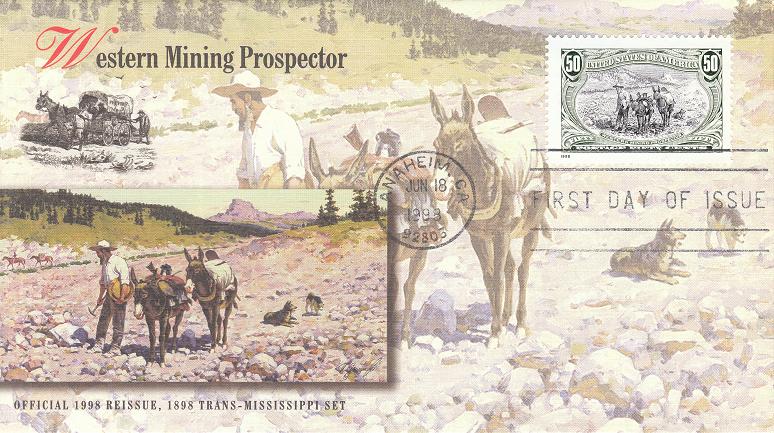 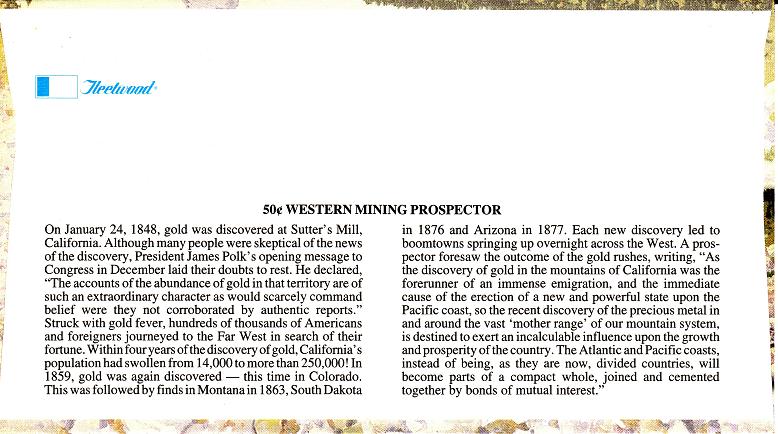 |
|
Send note to Staff
|
| Edited by littleriverphil - 05/11/2015 1:21 pm |
|
|
Valued Member
7 Posts |
|
|
I would like to thank everybody for doing research and finding the information, especially Littleriverphil for FDC reissue image. "The Gold Bug" was included in the book Drawings and was most likely drawn by Remington for no reason besides his artistic aspiration. On Russian forum, it was speculated that Remington possibly drew "The Gold Bug" as an illustration to a book describing life of prospectors. Cheers. |
|
Send note to Staff
|
|
|
Pillar Of The Community
United States
2963 Posts |
|
|
I finally got the chance to sit down and read the section on the 50c issue in the aforementioned book on the Trans-Mississippi issue.
As was stated previously, the vignette was taken from a drawing by Frederic Remington published by Robert Howard Russell in New York, 1897. Remington is credited with other drawings depicting prospecting and other Western themes. The 8c stamp from this series also uses a Remington drawing.
"Frederic Remington, whose works before his untimely death in 1909 at the age of 48, included more than 2000 pictures of the American West."
And
"It is important, at this point, to note Remington's participation in this series. Two of his works are actually depicted in this set, with one of his works considered for the four-cent value. As most historians and art collectors realize, there is no artist, with more devotion to the West in his subject matter, who is more inalterably tied to this facet of our history. The sheer bulk, not to mention quality, of his output in his brief life is unmatched. His expertise on the subject transcended works of art, for he wrote no fewer than 13 books and illustrated a total of 73 books in all."
According to the author, the picture had been considered for the $2 denomination, and "such an experimental essay exists".
Brian |
|
Send note to Staff
|
Brian Riley
APS 223349 |
| Edited by Rileysan - 05/13/2015 10:53 pm |
|
|
Valued Member
7 Posts |
|
| |
Replies: 9 / Views: 2,623 |
|



 Posted 05/10/2015 3:01 pm


