| Author |
 Replies: 16 / Views: 3,720 Replies: 16 / Views: 3,720 |
|
Valued Member
United States
11 Posts |
|
|
I feel I'm finally old enough to start trying to identify some of my classic stamps. I bought what I believe to be a #98, (12 points on the grill).out of Germany. The seller is liquidating his grandfather collection and only posts pictures on ebay. It is stamped very lightly in red on the back M.L. I seem to remember from years ago that this was some sort of certification. And the placement of the stamp indicated different things. Can anyone refresh my memory on this? 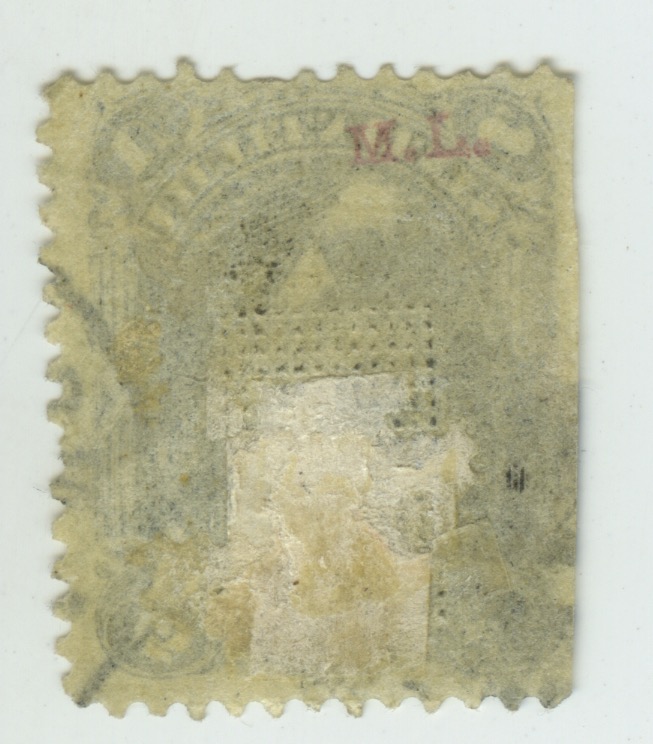 |
|
Send note to Staff
|
|
|
|
|
Pillar Of The Community
United States
1414 Posts |
|
|
Pillar Of The Community
United States
2423 Posts |
|
|
Valued Member
United States
11 Posts |
|
|
Clark, Most of the stamps I've gotten out of this collection have heavy hinge remnants. Some were glued in. But until I learn better techniques on cleaning stamps than what I did as a kid and soaking them, I'm leaving them in the original conditions. I put to many hinges on mint stamps and soaked off original gum as a kid and young man to make the same mistakes again. Mounts like Showgard didn't exist when I started collecting in 1955. |
Send note to Staff 
|
|
|
Pillar Of The Community
United States
526 Posts |
|
|
There's such a thing as overreacting to correct previous errors.
This one has no gum, right? A bath would not hurt it and would permit the grill to be evaluated. Simple lukewarm water, give it all the time in the world so as not to damage it by prematurely removing the hinge/paper, care with the tongs while it's still wet but soak it, nonetheless. |
|
Send note to Staff
|
|
|
Valued Member
United States
11 Posts |
|
|
Hieronymus, A bath might wash the M.L. stamp off. A scan shows me the grill is 12 across thus verifying the F grill. The link KGB gave was good but the only expert I saw that might fit would be Mortimer L. Neinken, https://en.wikipedia.org/wiki/Morti...ic_activity. I need to know more before making any kind of alterations to the original condition I received it in. The manuscript marks are interesting but most experts appear not to have used them but stamps instead. I would like to see some known examples of these expertizing stamps. |
|
Send note to Staff
|
|
|
Pillar Of The Community
United States
526 Posts |
|
|
the M.L. won't wash off. It may well be a European dealer's mark. But suit yourself. |
|
Send note to Staff
|
|
|
Valued Member
United States
11 Posts |
|
|
Hieronymus, this is the first U.S. stamp that I have found in 50+ years of collecting with an expertizing mark, I may never find another. So I would rather err on the side of caution until someone like Weiss chimes in and can give me knowledgeable information or where to find it. |
|
Send note to Staff
|
|
|
Pillar Of The Community
United States
1115 Posts |
|
|
The initials are not necessarily from an expert nor indicating an expert opinion. The initials may be simply the collector's/owner's initials. |
|
Send note to Staff
|
|
|
Valued Member
United States
11 Posts |
|
|
I found another early one today with the same stamp from this seller. So I've written him and asked for the original collectors name. |
|
Send note to Staff
|
|
|
Pillar Of The Community
United States
1179 Posts |
|
|
I tend to agree with the conclusion of ORSTAMPMAN -- the initials most likely belonged to a collector. It seemed the fashion in the late 19h century to early 20th to place one initials on the back of a stamp; I seen as many as four different sets on one stamp on many early foreign stamps of that period. |
|
Send note to Staff
|
|
|
Pillar Of The Community
United States
1946 Posts |
|
|
Until you have satisfied yourself that you know the identity of the initials, or that you never will, it is probably best not to alter them. But authentication was not their only function. Identifying marks were also intended as testimony to provenance, and some came to be as much exploited as fakes and fantasies as were the stamps themselves. Not only initials but ciphers and symbols were sometimes used.
As for the removal of the paper hinge remnants, which were doubtless glued on and may require some careful effort to remove, be careful about what you uncover. One of the reasons hinge remnants have such a strong negative effect on value is due to the fact that they can be used to mask thins, tears, holes, and repairs. Or you can create one of these in the act of removing the hinges, or make a minor defect more prominent.
It is possible to become TOO cautious and cause the same trouble, but a bit of caution with these seems prudent. You have to decide what you can handle and stay with it. |
|
Send note to Staff
|
| Edited by essayk - 07/27/2015 09:32 am |
|
|
Valued Member
United States
11 Posts |
|
|
I contacted the seller and the initials were not those of the collector. I will ask another question on hinge repentant removal.
|
|
Send note to Staff
|
|
|
Pillar Of The Community
United States
8956 Posts |
|
|
I too agree with Ortstampman. Ages ago, when I lived in the Netherlands ( in the 40's, 50's, 60's ) I was a member of a local stamp club. There were of course no safeguards for stamp circuits yet, like we have nowadays in the way of microfilm or even scanning! A lot of collectors would put a small stamp somewhere on the back of their stamps so they would be easy to identify. Sort of the same idea of a precancel or perfin.
Peter |
|
Send note to Staff
|
|
|
Pillar Of The Community
United States
1946 Posts |
|
|
Quote:
I contacted the seller and the initials were not those of the collector. Which collector? The last one, the first one, or someone in between? Understand? Chances are the seller can't tell you any more than you already know. |
|
Send note to Staff
|
|
|
Pillar Of The Community
United States
1179 Posts |
|
|
And just how do you propose MAYER "remove" the ink on the back without the possibility of damaging the stamp? If a solvent is used, there is a chance the "red" will bleed through the front and ruin the stamp. If too much solvent would make the ink bleed on the front. It's the back, best to leave well enough alone. MAYER, there is nothing wrong with soaking the old hinge remains off the back in a little warm water (which will also help clean remove dirt). However, if you don't know what you're doing when attempting to clean "ink off paper," I strongly suggest leave it alone, it's not hurting ANYTING!
Good luck!
Hal
|
|
Send note to Staff
|
|
|
Replies: 16 / Views: 3,720 |
|




 Posted 07/26/2015 01:21 am


