My thanks to all of you who have responded so far. I am particularly intrigued that even though I constructed the poll to give reasons why people would NOT wish to collect E&P material, some of the respondents took it to a different place by giving reasons why they DO collect them.
Obviously with the user name and avatar I have selected for use on this list, my own bias is well known (or certainly not a difficult secret to figure out). I first fell in love with E&P material, especially die items, back in 1968, because of a display the Post Office Department then had up at the Wisconsin Federation of Stamp Clubs Show that year. I didn't buy my first one until five years later, but I was smitten. That first purchase was a large die proof of #300 that has turned out to be an unlisted essay - which I still have. But it illustrates a point I want to make.
With most stamps, when you have gone through the steps necessary for identification, and can give it a catalog number, you are done. But with stamp essays, and to a lesser extent certain proofs, the catalog itself is a work in progress, and what you have may actually be a new discovery. Let me illustrate with a couple of items I just purchased at that same auction to which Glenn referred.
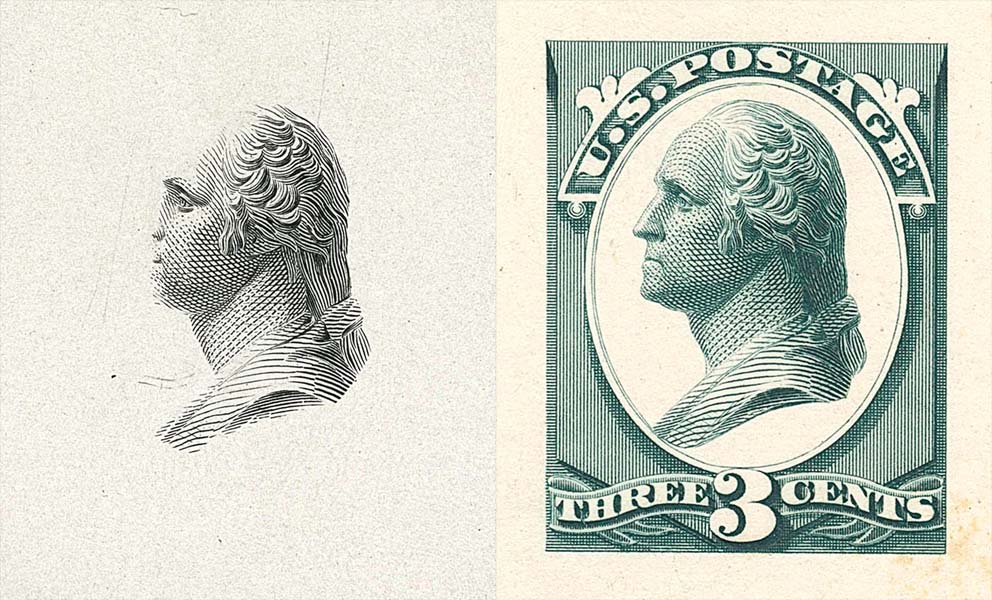
In the Scott Specialized the item on the left is listed as 147-E8, a progress essay of the National Bank Note Co on its way to becoming the first 3c Bank Note Issue. The item on the right is a first stage essay of the Continental Bank Note Co. for a redesign proposal they submitted in 1877; Scott listed as 184-E9 in the colors of green and black.
Ron Burns, an advanced student of these 3c stamps, has an example of the former and the example of the latter in black. So far as is known, I have the only other of the former and the only example in green of the latter. That's nice I suppose, but here is the fun part: In an exhibit in 2006 Ron suggested that the progress essay on the left is actually a stage in the development of the essay on the right, and not the work of the National Bank Note Co. In a preliminary study using overlay scans, I think I can demonstrate that he is right. Now that I have the material I am sure the case will be made, and the catalog will have to be rewritten on the identity of the essay on the left. It gets more complicated than that, but you get the idea I am sure. These are significant pieces, and truly rare, yet in terms of cost the sum of the two came to less than $1000.
My point is that there is real opportunity for new discovery in the study of essays and proofs, which are not ancillary to the stamps that grew out of them but rather are fundamental. If you have a bent for story telling with the material you collect, these are an unending source of stories that even the general public finds captivating when they see the behind-the-scenes material for the first time.
Something to think about.





 Posted 12/10/2015 12:30 pm