| Author |
 Replies: 20 / Views: 3,516 Replies: 20 / Views: 3,516 |
|
Pillar Of The Community
793 Posts |
|
|
|
|
Pillar Of The Community
United States
2555 Posts |
|
|
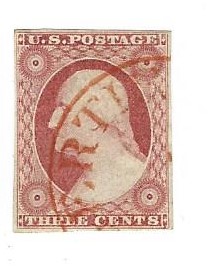
Looks like an 11A but your image is also very poor. Chances of me changing my mind with a better image? Slim to none. |
Send note to Staff 
|
|
|
Pillar Of The Community
United States
2230 Posts |
|
|
A higher-quality image would probably allow us to identify the plate or plate group that it was printed from, and that would help confirm whether it is 10A or 11A. From the small image you posted, it is almost certainly a #11A. |
|
Send note to Staff
|
|
|
Pillar Of The Community
793 Posts |
|
|
Would this pic be of sufficient quality to assist with the ID? Thank you again. 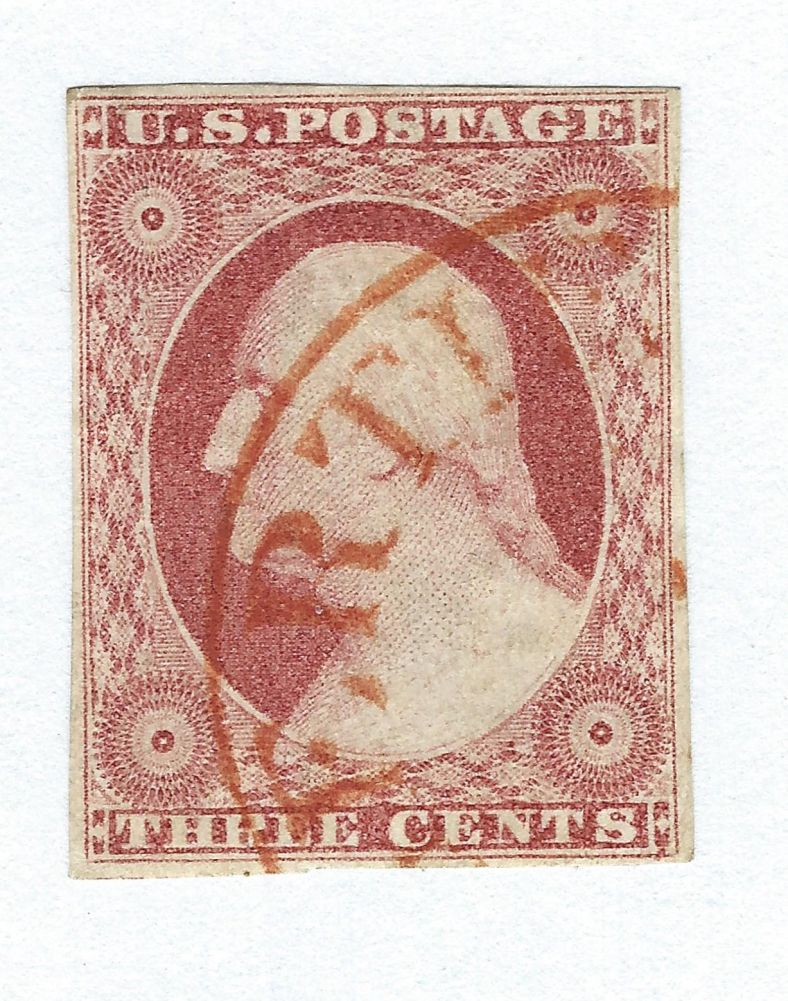 |
|
Send note to Staff
|
| Edited by Oracle of Delphi - 01/22/2016 10:44 pm |
|
|
Pillar Of The Community
United States
2555 Posts |
|
|
Definitely an 11A from Plate 2L or 3. Easy one to plate if anybody wanted to. I wish I could figure out the cancel but I can't right off quick. |
|
Send note to Staff
|
|
|
Pillar Of The Community
6366 Posts |
|
|
Pillar Of The Community
United States
1360 Posts |
|
|
Winston, this is a good example of why I never proceeded with the 3c plating-- I really struggled with understanding how to ID the plate.
I can understand 2L or 3 on this one-- can't be 1L, and I guess that 5L would be lighter frame lines.
But if you were going to plate this one, and didn't have the Chase prints, how would you go about eliminating either Plate 2L or 3?
Similarly, with the no-inner lines plates 6 and 7, how would you go about trying to know which?
Would love any tips you can provide here....thanks!
Ray |
|
Send note to Staff
|
|
|
Pillar Of The Community
United States
2555 Posts |
|
|
I would start with Plate 3 because the inner lines are pretty much equal weight. Plate 2L will frequently have one inner line that is more faint than the other due to reentry. It still could be from Plate 2L. Plates 6 and 7 are so similar that it is not possible on most stamps to easily eliminate one plate. |
|
Send note to Staff
|
|
|
Valued Member
United States
293 Posts |
|
|
Pillar Of The Community
United States
2948 Posts |
|
|
Oracle, If I may... Now that Sinclair2010 has narrowed down the possibilities, here are things I look for. 1-Guide dot. That cuts the horizontal row possibilities by more than half. 2-Triangle recut lines. Always take a good look at all four triangles. Your stamp shows a fairly prominent single recut line in the upper left triangle. 3-The lower right rosette. Some look like yours, some have dots protruding outside the outer frame line. Some do not touch the frame line. 4-Look at all four corners to see how the frame lines meet. Sometimes they don't meet, sometimes they continue past each other etc. 5-This one I've made a mess of with my doodling. But you can see the darker, upper edge of the label and diamond block. This is a recut to look for. These are just some of the things that can help plate a stamp. 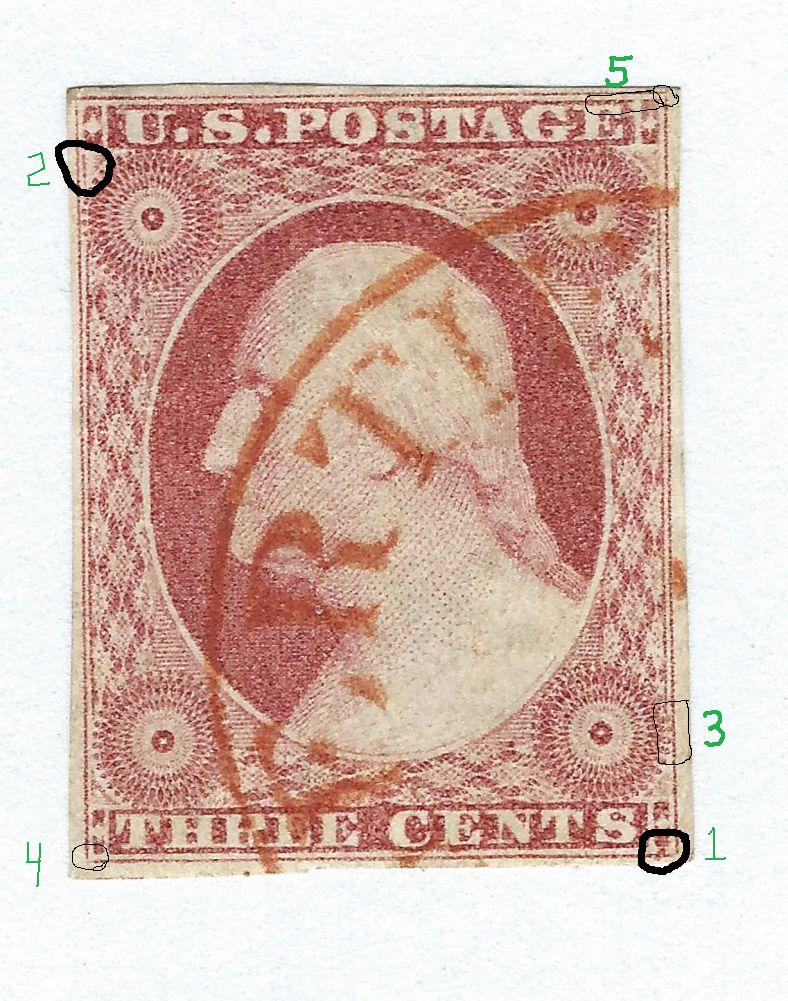 |
|
Send note to Staff
|
|
|
Pillar Of The Community
793 Posts |
|
|
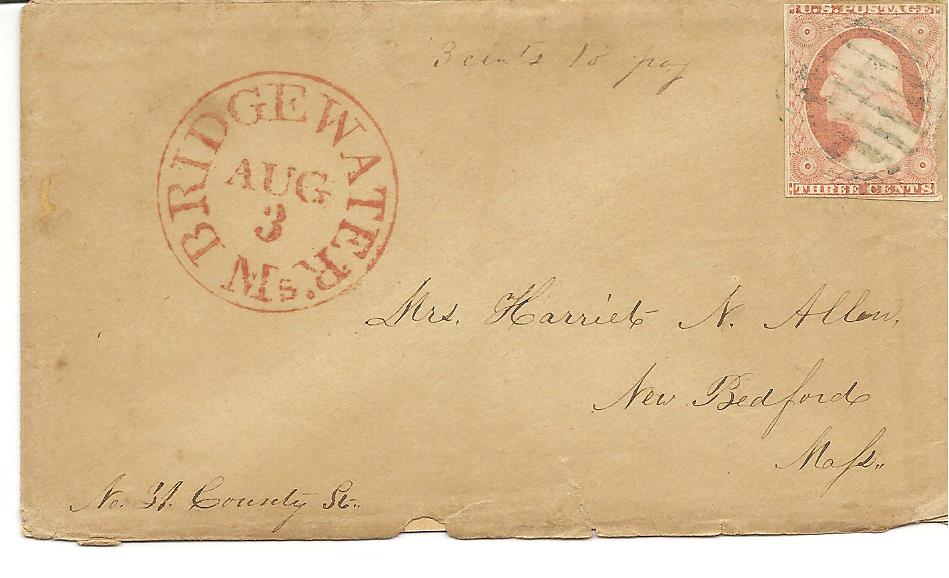
Stampcrow - many thanks for the tutorial and thanks also to others helping me out with their comments. As someone who's newly returned to collecting, I am obviously still low on the learning curve and apparently can't tell the difference between 10s and 11s, never mind the nuances regarding whether it's an 11 or 11A and how to plate the stamp. What makes it even more confusing for folks like me with less than perfect eyesight and color recognition is the shades that these similar stamps come in. Below I'm showing the previous stamp, along with another stamp that has been certified as an 11A and a third stamp that is a 10A. Yet the color of the top stamp looks a lot more similar to (but still somewhat different than) the bottom than the middle stamp. Just to compound the confusion, the middle stamp was certified by the PF an as 11 while the PSE calls it an 11A. Did the 11A classification not exist at the time of the PF cert (1992) or would this be a genuine disagreement as to what Scott # it is? 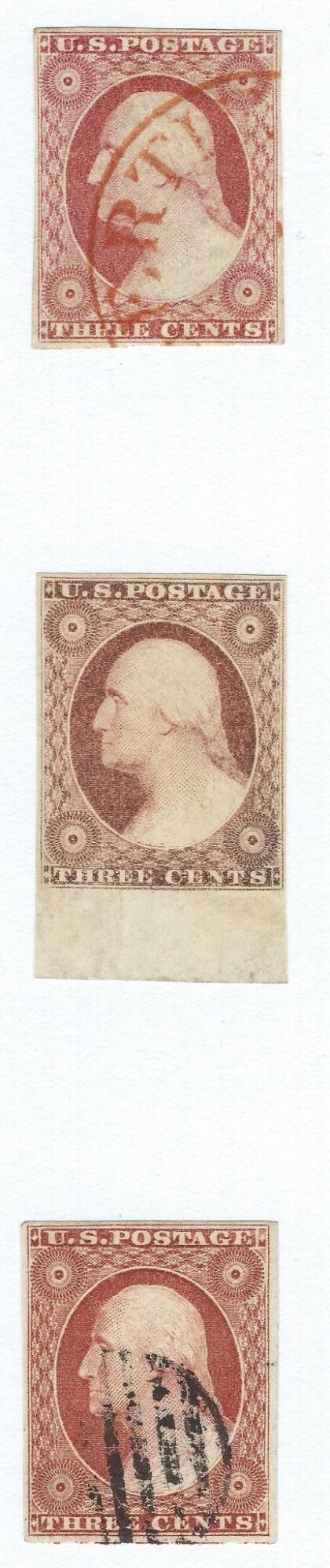 |
|
Send note to Staff
|
|
|
Pillar Of The Community
United States
2948 Posts |
|
|
Quote:
Did the 11A classification not exist at the time of the PF cert (1992) or would this be a genuine disagreement as to what Scott # it is? That is somewhat correct. The 'A' classification was first listed in 2008 Scott catalogs. So 10A and 11A were both created, so to speak. The A being stamps of the Type II variety. That being stamps with inner frame lines left and/or right sides. I like the site linked below for a decent overview. http://rosenstamps.com/the-3-cent-stamp-of-1851/ |
|
Send note to Staff
|
| Edited by stampcrow - 01/23/2016 6:41 pm |
|
|
Pillar Of The Community
United States
2230 Posts |
|
|
Oracle,
I'm 99.2 percent certain the first stamp you showed (red CDS) is plate position 45R3. |
|
Send note to Staff
|
|
|
Pillar Of The Community
1545 Posts |
|
|
Quote:
many thanks for the tutorial stampcrow, thanks too from me. I'm going to bookmark it. But once you have your five pieces of information, what do you reference it to? -IBFS |
|
Send note to Staff
|
All science is either Physics or Stamp Collecting. -- Ernest Rutherford |
|
|
Pillar Of The Community
United States
2948 Posts |
|
|
IBFS, first I would add, there are other clues to look for also. This particular stamp, those are ones that jumped out at me. Right now there are a combination of sites I use. I like the Rosenstamps site for overview. The USCPS site has a table with recut varieties http://www.uspcs.org/the-1851-1860-...amp-plating/ and the Steven Ruecker site http://www.stamps4collectors.com/in...cphotos.html has plated stamp photos. Then of course there's the Chase book. The Chase plating prints are also available for purchase from the Smithsonian. So you piece things together and hope you find a match. When that fails, I post here hoping for a response from our expert members... There's work going on right now, building a site that brings all this type of info to one place. |
|
Send note to Staff
|
| Edited by stampcrow - 01/24/2016 7:22 pm |
|
|
Pillar Of The Community
1545 Posts |
|
|
Thanks stampcrow. Just what is the title of that there "Chase book"?
-IBFS |
|
Send note to Staff
|
All science is either Physics or Stamp Collecting. -- Ernest Rutherford |
|
|
Replies: 20 / Views: 3,516 |
|




 Posted 01/22/2016 2:17 pm