Stamp Community Family of Web Sites
Thousands of stamps, consistently graded, competitively priced and hundreds of in-depth blog posts to read


Stamp Community Forum
 
Username:
Password:
Save Password
Forgot your Password?

This page may contain links that result in small commissions to keep this free site up and running.

Welcome Guest! Registering and/or logging in will remove the anchor (bottom) ads. It's Free!

Help Identifying 43-P4?

 
To participate in the forum you must log in or register.
Author Previous TopicReplies: 9 / Views: 2,051Next Topic  
Valued Member

United States
67 Posts
Posted 12/12/2015   9:20 pm  Show Profile Bookmark this topic Add HarryG to your friends list Get a Link to this Message
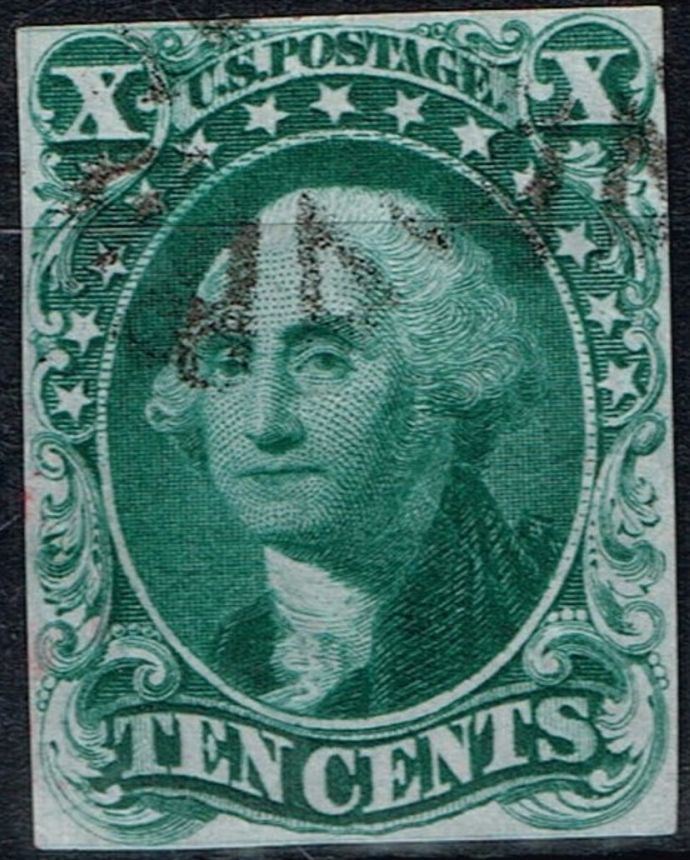
I was going through some stamps this evening and came across this. It was identified in the stockbook as a #13 - which it clearly is not.

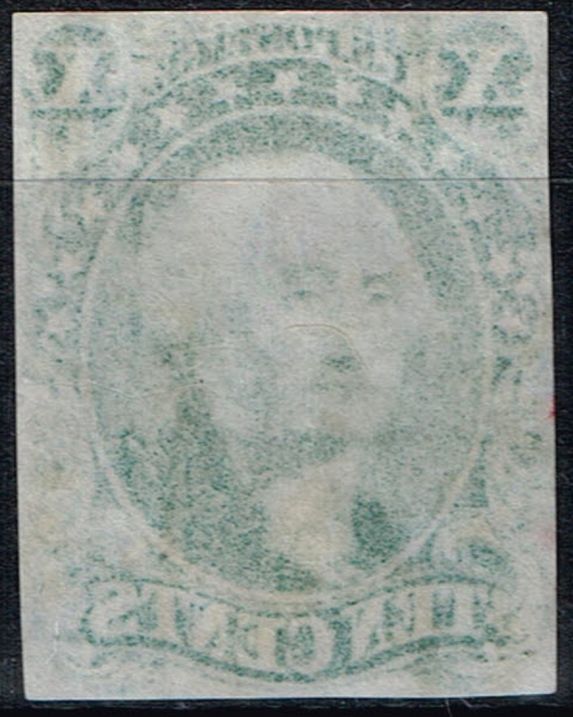
I suspect it is a 43-P4 with cancel added. The paper is VERY thin however, not card stock. Where any of these proofs printed on thin paper?
Any thoughts or insight is much appreciated.
Harry


Send note to Staff

Valued Member
324 Posts
Posted 12/12/2015   11:14 pm  Show Profile Bookmark this reply Add lukusw to your friends list  Get a Link to this Reply
I agree that the design impression looks like a proof. I am far from experienced in the realm of Proofs, but I know multiple sources comment that the Plate Proofs (Proofs made from a plate ready to start printing stamps) on Card were of "varying thickness". The late Bill Weiss had an excellent description of paper types, including those used for Proofs and Essays. It is still available at:

http://www.stampexpertizing.com/pdf...s_ver1.0.pdf

The Proof section is toward the bottom of the article. Of note, he states that for Card Plate Proofs (which to my inexperienced eye is what your specimen looks like):

"Fake stamps are also made by shaving down the backs of card proofs to try to
attain the thickness of wove paper, then adding gum and perfs and sometimes
rebacking paper. These fakes can usually be detected in watermark fluid because of the
varying thickness which shows up as patterns of light and dark while in the fluid or by
holding it to the light and looking through the stamp which again, will reveal big
patterns of light and dark area."

Perhaps someone was hoping to pass it off as a very clear #13 and altered the thickness??? Hope this helps.

p.s. nice etched guidelines in the upper right
Send note to Staff  Go to Top of Page
Moderator
Learn More...
United States
12330 Posts
Posted 12/13/2015   08:08 am  Show Profile Bookmark this reply Add 51studebaker to your friends list  Get a Link to this Reply
I did Bill's site for him a few years back but it is hosted on another friend of Bill's account. I have not talked to Lori (Bill's daughter) about the status of the site and am unsure how long it will remain up. I talked to Bill in August and he agreed that the site's content should be saved for others to use by moving it to Stamp Smarter.

So Stamp Smarter now has all of Bill's articles and should be available for many years to come. http://www.stampsmarter.com/

There is also some good additional paper type info in the 1847usa content at the same link.
Don
Send note to Staff  Go to Top of Page
Edited by 51studebaker - 12/13/2015 08:09 am
Bedrock Of The Community
United States
10629 Posts
Posted 12/13/2015   08:31 am  Show Profile Bookmark this reply Add revcollector to your friends list  Get a Link to this Reply
This is a proof on India.
Send note to Staff  Go to Top of Page
Pillar Of The Community
United States
1942 Posts
Posted 12/13/2015   08:46 am  Show Profile Bookmark this reply Add essayk to your friends list  Get a Link to this Reply
HarryG, I'm curious about how you came to think of it as an altered P4, when the US Specialized offers a more likely alternative. Your stamp has the appearance and, from your comments, the characteristics of stamp paper.

Did you consider 43P5, the reprint proof on stamp paper?

Shaved proofs on card are always stiffer than stamp paper of the same thickness. Bill's description of them is merely a quick summary, and focuses on proofs shaved down to less than the thickness of stamp paper, which makes them vulnerable to tearing, and then rebacking them. If rebacked, or only shaved down to "normal" stamp thickness, you do not see as much of the design from the reverse as your stamp is showing.

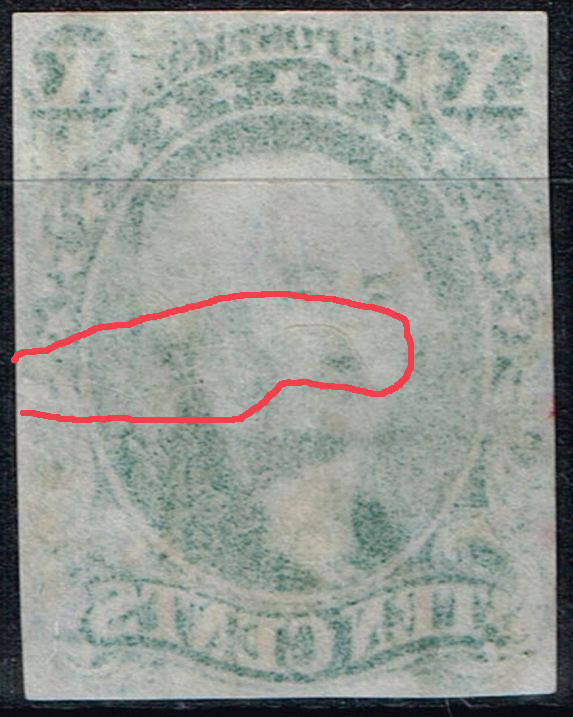
However, I am seeing something on the reverse that raises a question for me about that. Starting at the center and moving left, I am seeing what appear to be long paper fibers embedded in the fabric of the paper. However, I cannot be sure that those are not pencil marks or the residual marks of a bit of creasing. Nonetheless, if those are fibers then I would consider the possibility that the paper is India paper which has been treated with a gelatin based sizing agent to stiffen it. That is another well known approach to altering proofs to represent them as issued stamps. India paper is normally a very white, very thin, paper that often shows long bamboo fibers. It is nearly unsized and so soft as to be fragile. A tinted sizing agent could produce a passable facsimile of stamp paper, but the tone of the paper is usually a giveaway. How does this paper stand up against other examples of the reprint?

If you can rule out the possibility of bamboo fibers, then you are probably looking at what is often referred to in the catalogs as "stamp paper." Plate proofs on stamp paper gave the truest sense of the appearance of the printed stamp, since it was usually done on the same stock used for regular printing. Normally these proofs were not released to the public, but examples leaked out. More examples of stamp paper proofs are available today than the actual reprints sold in 1875. And one example of the reprint is known used, and it has a big price tag. My hunch is that your stamp was an attempt to emulate a used reprint.

None of the three types of proof has much catalog value, so getting a cert for a P5 as a P5 should not be costly. If it is something else, the PF would tell you in the cert. That is the surest way for you to lay the questions about this stamp to rest.
Send note to Staff  Go to Top of Page
Valued Member
United States
67 Posts
Posted 12/13/2015   12:27 pm  Show Profile Bookmark this reply Add HarryG to your friends list  Get a Link to this Reply
Thanks everyone for sharing your knowledge!

I think Revcollector is probably correct - Proof on India paper - even though I am unable to see any bamboo fibers in the paper (which I could easily be missing)
Essayk - My 2012 Scott Specialized does not list a 43P5, it does list a 43P4a (greenish black on stamp paper) though and I am not going to rule that out.

I am fortunate enough to have a great stamp dealer about an hour away from me. And I have some time off over the holidays! Ill bring this stamp into him to get his opinion while I peruse his inventory and maybe buy myself something for Christmas.

Harry
Send note to Staff  Go to Top of Page
Bedrock Of The Community
United States
10629 Posts
Posted 12/13/2015   12:34 pm  Show Profile Bookmark this reply Add revcollector to your friends list  Get a Link to this Reply
This paper is much too thin to be "stamp paper", practically the complete design is visible from the reverse. This is a 43P3, type I on India from a new plate. With a fake cancel to make the less experienced collector think it is a 13.
Send note to Staff  Go to Top of Page
Pillar Of The Community
United States
1942 Posts
Posted 12/13/2015   1:40 pm  Show Profile Bookmark this reply Add essayk to your friends list  Get a Link to this Reply
What I am seeing as possible fibers are inside this range.


revcollector says: "it's India." I say, probably, but check it out to be sure its India (the fibers).

Regular stamp paper can be made to look this way. This stamp has just enough residual staining visible on the reverse to make me suspicious. Handling the stamp with the fingers while eating could do this. I have seen dealers at shows ruin material in just that way. I have also inadvertently used solvents in the past that left the stamp partially translucent even after they had dried. So for someone not well familiar with papers, I hedge and advise that you check it out rather than assume you know.

But if the "fibers" thing checks out, then I am solidly in the India camp.
Send note to Staff  Go to Top of Page
Bedrock Of The Community
United States
10629 Posts
Posted 12/13/2015   4:06 pm  Show Profile Bookmark this reply Add revcollector to your friends list  Get a Link to this Reply
Chemically caused translucency would almost certainly be uneven and would very likely show major staining.
Send note to Staff  Go to Top of Page
Pillar Of The Community
United States
4106 Posts
Posted 12/17/2015   5:48 pm  Show Profile Bookmark this reply Add stampvirgin to your friends list  Get a Link to this Reply
WOW, I have been out of stamp collecting so long I didn't know Bill Weiss had passed.
He was one of the best in the business.
Send note to Staff  Go to Top of Page
  Previous TopicReplies: 9 / Views: 2,051Next Topic  
 
To participate in the forum you must log in or register.

Go to Top of Page

Disclaimer: While a tremendous amount of effort goes into ensuring the accuracy of the information contained in this site, Stamp Community assumes no liability for errors. Copyright 2005 - 2026 Stamp Community Family - All rights reserved worldwide. Use of any images or content on this website without prior written permission of Stamp Community or the original lender is strictly prohibited.
Privacy Policy / Terms of Use    Advertise Here
Stamp Community Forum © 2007 - 2026 Stamp Community Forums
It took 0.32 seconds to lick this stamp. Powered By: Snitz Forums 2000 Version 3.4.05