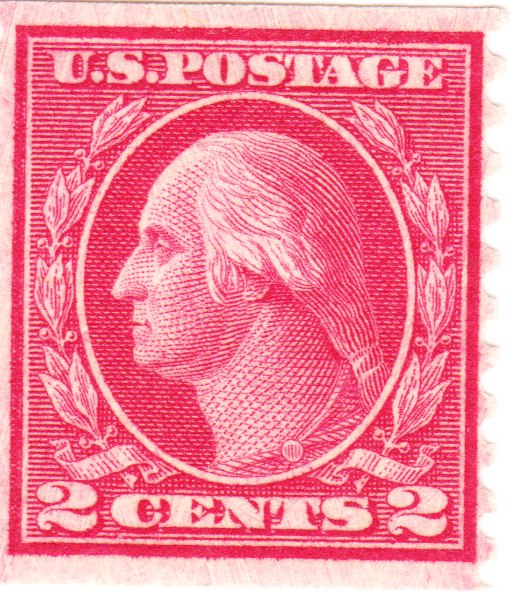
I personally find the dilemma of finding genuine W/f coils (especially p12) interesting. I have bought a few on
ebay, some that still look possibly real, and others that fail when I gain new knowledge about how to test for genuineness. But I balk at only purchasing certified because
1) I genuinely like the hunt (my favorite stamp right now was a #31 that was sold as a misidentified #33 on
ebay that I picked up for <$90) ... this is part of my enjoyment of stamps.
2) The cost is prohibitive right now (e.g. I grabbed a possible #350 on
ebay for a mere $22--yes, I know the likelihood is low it is genuine even though it passes the tests I know to put it through right now, but if nothing else I plan to use it for a reference; a certified #350 typical runs >10x that much)
I've done some digging for info on the W/F coils (applying primarily to Flat Plate coils) and this is a list of what I have found so far as "tests":
1. Size: ideal is 25mm tall or 21.5mm wide (straight edge to straight edge). This is ideal. I don't know if there is any census that includes the sizes of certified coils, but I've read in multiple sources that there are many genuine coils that do not meet this criteria. I would love to know if there is a "minimum size" requirement to certify a p12 W/F coil (that has no known history as part of a multiple or cover)?
2. Edges: Straight edges should be perfectly or nearly so parallel (outliers are past-up coils if they were the early flat plate variety done by hand)
3. Edges: cut with scissors (i.e. trimmed perfs) will be very sharp and clean. Real edges will be slightly rough on magnification (maybe sometimes seen to naked eye?). Caveat would be if the "rough" spots march out with the spacing of perfs, suggesting remnants of trimmed perfs.
4. Perfs: Round perf holes are fake, oblong or ovoid are real (it took me a long time to understand this. To me, it looks like the base of half perfs are slightly flat...I find it hard to explain)
5. Perfs: Clean perfs suggest fake. Perfs with tufts and fibers on the ends of perf holes with tufts and fibers consistently on THE SAME SIDE suggest real.
6. Perfs: Spacing must be regular, not varied between perfs.
7. Watermark: Must be appropriate to the issue in question. Also, for lower denomination (e.g. 1c-2c) flat plate coils, the WM should read horizontally (i.e. the letters are oriented with orientation of the stamp); vertical WMs suggest it is an altered booklet stamp.
8. Guideline: Must be same color as remainder of the stamp.
I'm sure there are things I'm missing and have not yet learned. I've only been seriously looking at W/F coils for about 1-2 years, so I would consider myself a novice. In regards to the coils I have, two are certified (#348 guideline pair and #386) that I caught for cheap as
ebay auctions, and I have 4 more that pass the above tests. I'm getting the Specialty Gauge for Christmas (thanks, wife!), so they will be double checked soon. At some point, I will have to bite the bullet on a couple to get them certified (one is a possible #349 guideline pair and also the #350 mentioned above).
p.s. Clark, I love the info you drop in your comments. Now I'm going to have to get one of these "Peak loupe" magnifiers. Please keep it coming.





 Posted 12/19/2015 2:53 pm