| Author |
 Replies: 15 / Views: 3,353 Replies: 15 / Views: 3,353 |
|
|
New Member
1 Posts |
|
|
I recently found this stamp which I am assuming is a 1869 3 cent stamp. Where can I take it to learn more about it? I know absolutely nothing about stamps. 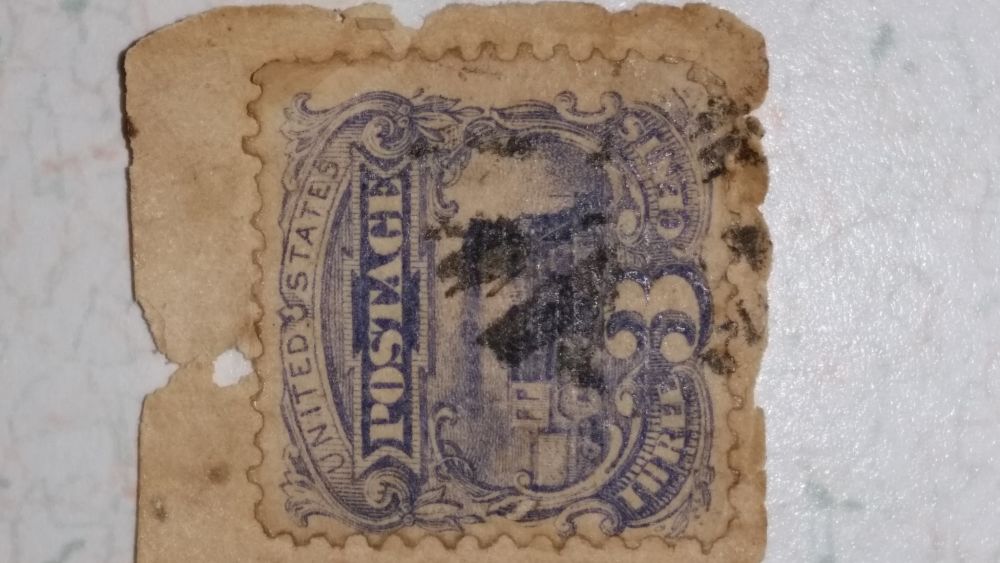 |
|
Send note to Staff
|
|
|
|
|
Pillar Of The Community
United States
2230 Posts |
|
|
 That's Scott catalog #114. You can search for 1869 pictorial issue, and look at the USPCS and Wikipedia sites. And of course ebay by catalog number to get value estimates. |
Send note to Staff 
|
| Edited by Classic Coins - 12/20/2015 9:01 pm |
|
|
Moderator

United States
12330 Posts |
|
|
Pillar Of The Community
United States
1946 Posts |
|
|
Others have pointed you to philatelic sites for various technical details about your stamp as a collectible. Since you are not (yet) a collector, your interest may be more historical than philatelic. If the question is, "Why a locomotive?" it helps to remember that the stamp was issued in 1869. What happened at Promontory Summit, UT in May of that year? That event was anticipated, and it changed history in a big way for the nation. To the designers at the National Bank Note company and the Post Office Department in 1868 it seemed fitting that a stamp should bear an icon of all that effort and achievement. Here is a set of plate proofs showing the designs of all the stamps in the series for that year. Your stamp is in the top row: 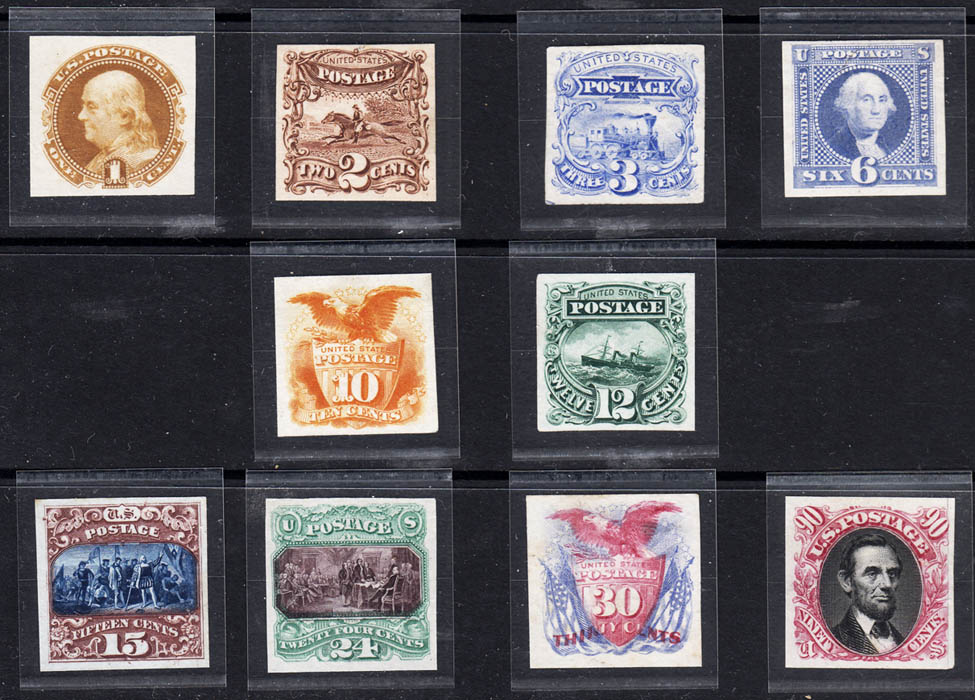 Not sure if you want more info about the design of your stamp or its history, but you can let us know. |
|
Send note to Staff
|
| Edited by essayk - 12/21/2015 12:22 pm |
|
|
Valued Member
United States
211 Posts |
|
|
dodgemason,
Welcome to the boards. That's a cool stamp. Where did you find a stamp this old? |
|
Send note to Staff
|
|
|
Moderator

United States
5108 Posts |
|
|
Essayk ... beautiful proofs ...thanks for posting to help in this discussion. Please keep up the good work! |
|
Send note to Staff
|
|
|
Pillar Of The Community
United States
1946 Posts |
|
|
Quote:
Where can I take it to learn more about it? I know absolutely nothing about stamps. One post and out. Dyed-in-the wool non-collector methinks, with but a passing curiosity about a "find." Perhaps they wanted a local referral? I don't think they were much impressed by what they found out from us. |
|
Send note to Staff
|
|
|
Valued Member
United States
211 Posts |
|
|
essayk,
Ok, I'll ask a question. I'm a younger person exploring the possibility of getting into this hobby. I really like the look of early stamps. Could you explain what are 'plate proofs?' and how the public originally obtained them? |
|
Send note to Staff
|
|
|
Pillar Of The Community
United States
1946 Posts |
|
|
Those are astute questions, dsmith. Let's see if I can do them justice in a serviceable way.
Within the realm of the philately of US material, any impression from a plate normally used for the production of postage stamps that resulted in the printing of an officially approved stamp design, on any medium, that was NOT intended for normal distribution to the public through sale by the Post Office Department or USPS is classified by philatelists as a "proof impression." Since this kind of printing could take place at any time the stamp was current or later, it should not be assumed that all proofs were intended to test the condition of the designs or plates, though such prints are included.
The critical characteristic of stamp proofs is that the design is in all respects identical to the officially approved design. Such proofs which are printed in colors not as issued to the public are called by philatelists "trial color proofs" but here again it is not to be assumed in all cases that their production preceded the printing of the finally approved color(s). Similar types of prints from the officially sanctioned stamp producers in which the design differs in some respect from the finally approved and issued version are referred to by the term "essay" rather than "proof."
Delving into the question of why proofs were printed is beyond the scope of a simple definition/explanation. Before I take up the other half of your question I would like to make sure this much is clear. The field can be confusing since not all countries use the same nomenclature in referring to material from the various phases of stamp production. These are the three principle terms for US material: essay, proof, trial color proof. Other derivatives exist, such as specimens and experimentals. But this is enough for now. |
|
Send note to Staff
|
|
|
Valued Member
United States
211 Posts |
|
|
essayk, It's not clear to me what you mean by.. "that was NOT intended for normal distribution to the public through sale by the Post Office Department or USPS" My first read of this made me think that it wasn't available to then public for purchase. My second read of this made me think that is was available to the public but not from your local post office. My third reading I started to redefine what normal distribution really means and also how is it tied to the public or if 'the public' isn't important in your definition. So please clarify what is meant in the quotation. And of course new questions pop up, but I only have part of the answer to the original question(s) so far. Not sure if I should hold off now and ask later or ask now since you wanted clarification on my understanding so far. Here are the questions either way: (1) if proofs are printed from sheets (a) are proofs ubiquitous in the marketplace? (b) do people collect them by the sheet or blocks like normal stamps? (2) Since they are printed from plates at anytime does that mean there are proofs from worn out and/or damaged plates? (3) Are/Were proofs and trial color proofs valid for postage use? (4) Is there any way for someone to know when a proof was printed? (5) What is more valuable to a collector(s) a proof or a trial color proof (6) A scenario question: for a set of trial color proofs (which we know these specific ones are for a fact are actual ones produced prior to the choice of color) is the one which is the same color of the printed stamps automatically change the status of that specific 'trial color proof' to a 'proof' or does it stay a 'trial color proof' as it was born that way (ie. the defining moment is fixed to the time of printing only) Thank you My 100th post   |
|
Send note to Staff
|
| Edited by dsmith426 - 01/03/2016 3:27 pm |
|
|
Pillar Of The Community
1545 Posts |
|
|
Welcome Dodgemason! It is U.S. Scott No. 114 of the 1869 pictorial issues. So named, because they were the first U.S. stamps to show something other than a President's bust. We look at them today and take them for granted. Though at the time of their release they must have been regarded as shockingly beautiful sudden departures from the design norm of the era. Normally in "very fine" condition, a used 3 cent Locomotive would go for $18.00 or so. An unused one, in the area of $250.00. Yours unfortunately is not in very good condition. It's a shame it wasn't taken better care of. Looks like someone used it as a coaster for a coffee cup. But I'd definitely hang on to it. Here you can read more about the history of the issues of that set... https://en.wikipedia.org/wiki/1869_Pictorial_IssueWhat is a Scott Number? The Scott's Specialized Catalog of United States Stamps is the annually released pricing bible for United States Stamps. It not only has prices, but in depth info on the stamps themselves, more or less, depending on the stamp. Congrats on your milestone, dsmith426! -IBFS |
|
Send note to Staff
|
All science is either Physics or Stamp Collecting. -- Ernest Rutherford |
|
|
Pillar Of The Community
United States
1946 Posts |
|
|
Quote:
My 100th post Congrats on the milestone dsmith426! I am going to respond to your inquiry in a separate thread so as not to hijack the original intent of this thread. I should have done that in the first place, and my apologies to those offended that I did not. Thank you to IBFS for steering it back to where it belongs. |
|
Send note to Staff
|
|
|
Pillar Of The Community
1849 Posts |
|
|
When we see a OP ask a question about a stamp....
(and this is the first post by them)
Mostly they are looking for value....$$$
When they do not get the answer in the 1st few posts
they give up.
They think because it is over 100 years old it
is going to get them to retire.... |
|
Send note to Staff
|
|
|
Bedrock Of The Community
United States
10867 Posts |
|
|
My two cents:
"(1) if proofs are printed from sheets
(a) are proofs ubiquitous in the marketplace?
(b) do people collect them by the sheet or blocks like normal stamps?"
I don't know about ubiquitous, but many 19th century proofs are fairly common. However a large part of this is because they are not nearly as widely collected as issued stamps are, so the demand is much smaller.
Yes they are usually collected in the much same way that stamps are collected.
"(2) Since they are printed from plates at anytime does that mean there are proofs from worn out and/or damaged plates?"
No, they were printed from new plates which is why proofs are very sharp impressions that show every line clearly.
"(3) Are/Were proofs and trial color proofs valid for postage use?"
No, although a few might well have been used that way.
"(4) Is there any way for someone to know when a proof was printed?"
Depends on the proof. Often it was shortly before the stamps were issued, but there were a number printed later (sometimes much later)for various reasons.
"(5) What is more valuable to a collector(s) a proof or a trial color proof"
Depends on what you mean by valuable. Normally there were fewer examples of trial color proofs made, so they tend to catalog more. From a collecting standpoint it depends on how one is trying to collect.
(6) A scenario question: for a set of trial color proofs (which we know these specific ones are for a fact are actual ones produced prior to the choice of color) is the one which is the same color of the printed stamps automatically change the status of that specific 'trial color proof' to a 'proof' or does it stay a 'trial color proof' as it was born that way (ie. the defining moment is fixed to the time of printing only)"
To my knowledge there is no way to tell a trial color in the issued color from a later proof unless they were dated or marked at the time, so it would just be considered a proof in the issued color.
|
|
Send note to Staff
|
|
|
Valued Member
United States
211 Posts |
|
|
essayk,
Could you provide the link to your post which finishes the answer to the question? I don't seem to be able to find it. Also if the original poster comes back they might want to click the link too as you posted the proof for the stamp he/she has but never explained what a proof was in your original response to him.
revcollector,
What I meant by valuable was which is viewed more desirable to collectors in general. And please realize this is coming from someone who isn't a stamp collector today so don't have the background or experience of everyone else here on the boards. But I'm making serious effort exploring the hobby and what I might collect. At the moment one of the leading areas of interest is 19th Century USA stamps as they are so old, have a different look, and I'm amazed they exist outside of museums.
|
|
Send note to Staff
|
| Edited by dsmith426 - 01/05/2016 8:18 pm |
|
|
Pillar Of The Community
United States
1946 Posts |
|
|
Quote:
Could you provide the link to your post which finishes the answer to the question? This link is to the new thread I created in this forum on the subject of proofs. You should feel right at home there.  https://goscf.com/t/47271 https://goscf.com/t/47271 |
|
Send note to Staff
|
|
| |
Replies: 15 / Views: 3,353 |
|



 Posted 12/20/2015 8:45 pm


