| Author |
 Replies: 20 / Views: 3,197 Replies: 20 / Views: 3,197 |
|
Pillar Of The Community
United States
1518 Posts |
|
|
|
|
Pillar Of The Community
United States
4106 Posts |
|
|
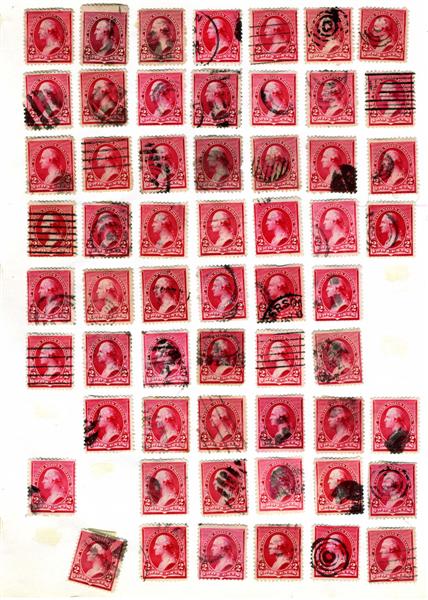
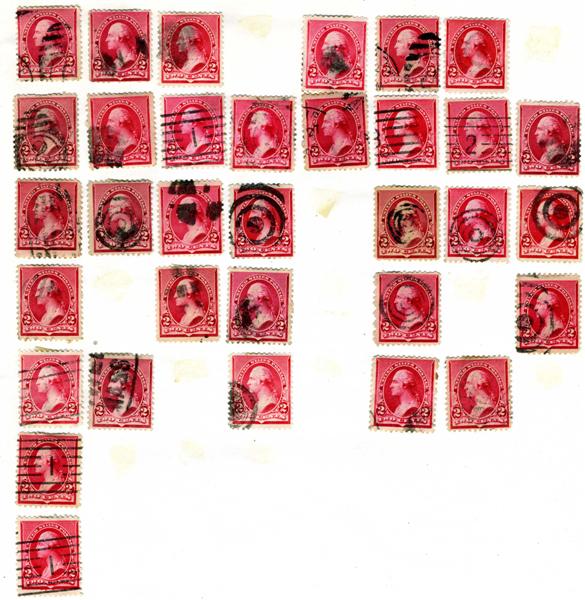
from first glance, you have several different stamps and types
could be from the 1890, 1893 or later top sheets
to 1894 on up...
it all depends on what type, color etc..
considering what you have found so far, I would take very good care to examine them carefully, before giving or selling them.
you could have some really nice gems in there...
You should look at the links posted in the thread I started and carefully review each stamp according to the guidelines.
Like I said based on what you have already shown us I would not discount anything. Just the tax stamps were wonderful to see.. and I can't think of anyone who wouldn't love to own them... but, I can't say this enough.. be careful and study them well.
|
Send note to Staff 
|
|
|
Pillar Of The Community
United States
1518 Posts |
|
|
Good advice, tho don't know, yet, how much time I have to give to each ... just trying to put some order to the chaos. :)
|
|
Send note to Staff
|
|
|
Pillar Of The Community
United States
1947 Posts |
|
|
The first two groupings all appear to be the small banknotes (no triangles in the upper corners.)
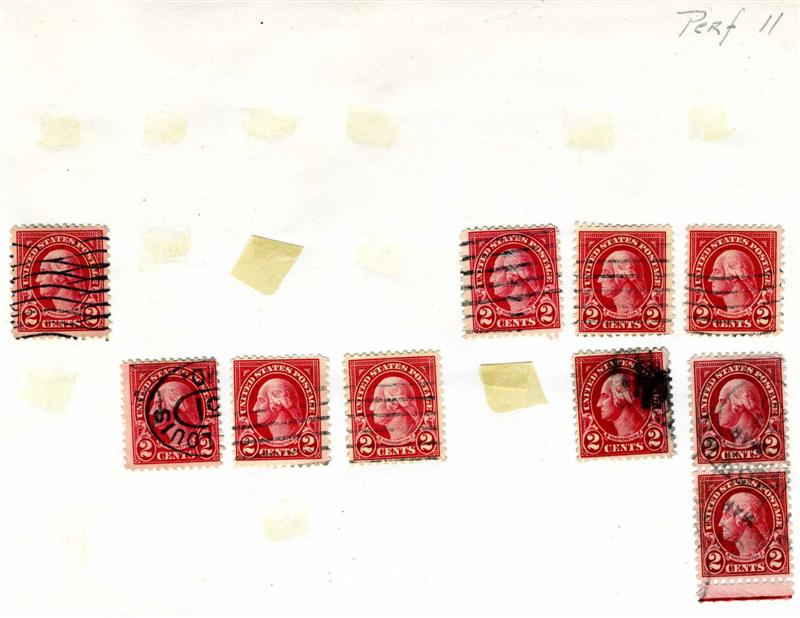
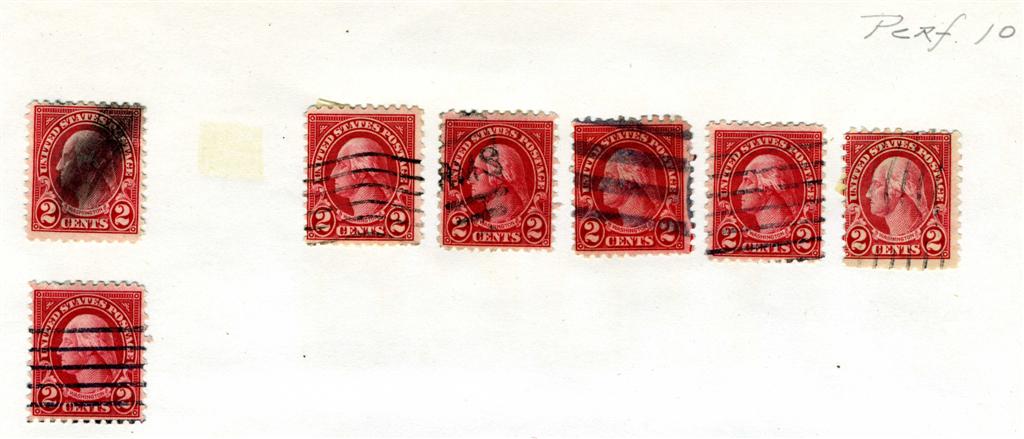
The latter two groups are from the 1920's. If, and this is a big if, in the perf 11's there is a rotary press stamp, then you have a real gem. Odds are tremendously against this, but you will never know unless you check. |
|
Send note to Staff
|
|
|
Pillar Of The Community
United States
4106 Posts |
|
|
You are talking about SC 554? for the perf 11's?
the perf. 10's is that perfed top or bottom? or ary any of the perf 11's perfed 10 top or bottom.. if os.. wow.
the top ones do look like the bank note series from 1890-93 look at sc# 220.depending on which variety will classify it better.
you have a lot of fun ahead of you.
|
|
Send note to Staff
|
|
|
Pillar Of The Community
United States
1518 Posts |
|
|
So how do we tell Rotary Press... is it double paper in addition to the perf vertically or horizontally? Or is it something else? |
|
Send note to Staff
|
|
|
Pillar Of The Community
United States
4106 Posts |
|
|
In stamp collecting, rotary-press-printed stamps are sometimes a different size than stamps printed with a flat plate. This happens because the stamp images are further apart on a rotary press, which makes the individual stamps larger (typically 1/2 mm to 1 mm).
edit: Courtesy of Google and Wikipedia |
|
Send note to Staff
|
| Edited by stampvirgin - 07/14/2010 09:56 am |
|
|
Pillar Of The Community
United States
6756 Posts |
|
|
Quote:
In stamp collecting, rotary-press-printed stamps are sometimes a different size than stamps printed with a flat plate. This happens because the stamp images are further apart on a rotary press, which makes the individual stamps larger (typically 1/2 mm to 1 mm).
edit: Courtesy of Google and Wikipedia Wikipedia is incorrect. When the rotary press stamp is a different size from the same stamp design flat plate press, it is only a different design in ONE direction. This size difference is NOT caused by different spacing between the stamps (that does not affect the design size, only the space between the stamps). The size difference is caused by "stretching" in one direction when the flat plate is curved to make it cylindrical (or semi-cylindrical) for the rotary press plate. We had a thread on this somewhere... |
|
Send note to Staff
|
|
|
Pillar Of The Community
United States
4106 Posts |
|
|
Kim, that makes perfect sense...
So the height of the stamp would be taller? or can it be width or height |
|
Send note to Staff
|
|
|
Pillar Of The Community
United States
6756 Posts |
|
|
Which dimension gets changed during the production of the rotary press depends on which way the plate was "curved". It varies from different stamps. There is unfortunately, no simple rule of thumb -- you have to check the catalogs. |
|
Send note to Staff
|
|
|
Pillar Of The Community
United States
4106 Posts |
|
|
Valued Member
United States
428 Posts |
|
|
Quote:
So how do we tell Rotary Press Rotary or Flat Plate? This used to be very difficult for me until it was solved. I recently took the Washington-Franklin course at the NPM in DC and the instructor distributed two templates which I have scans attached here- 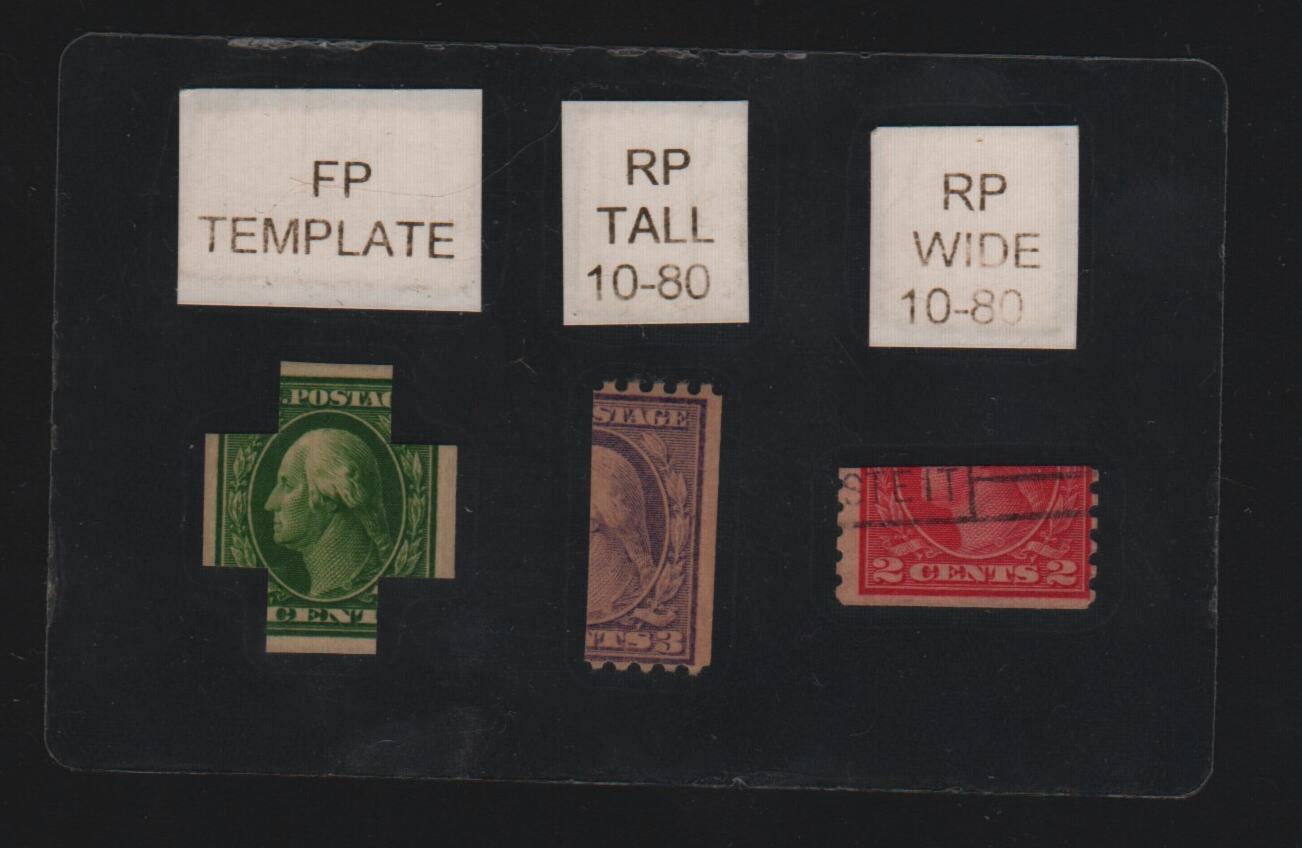 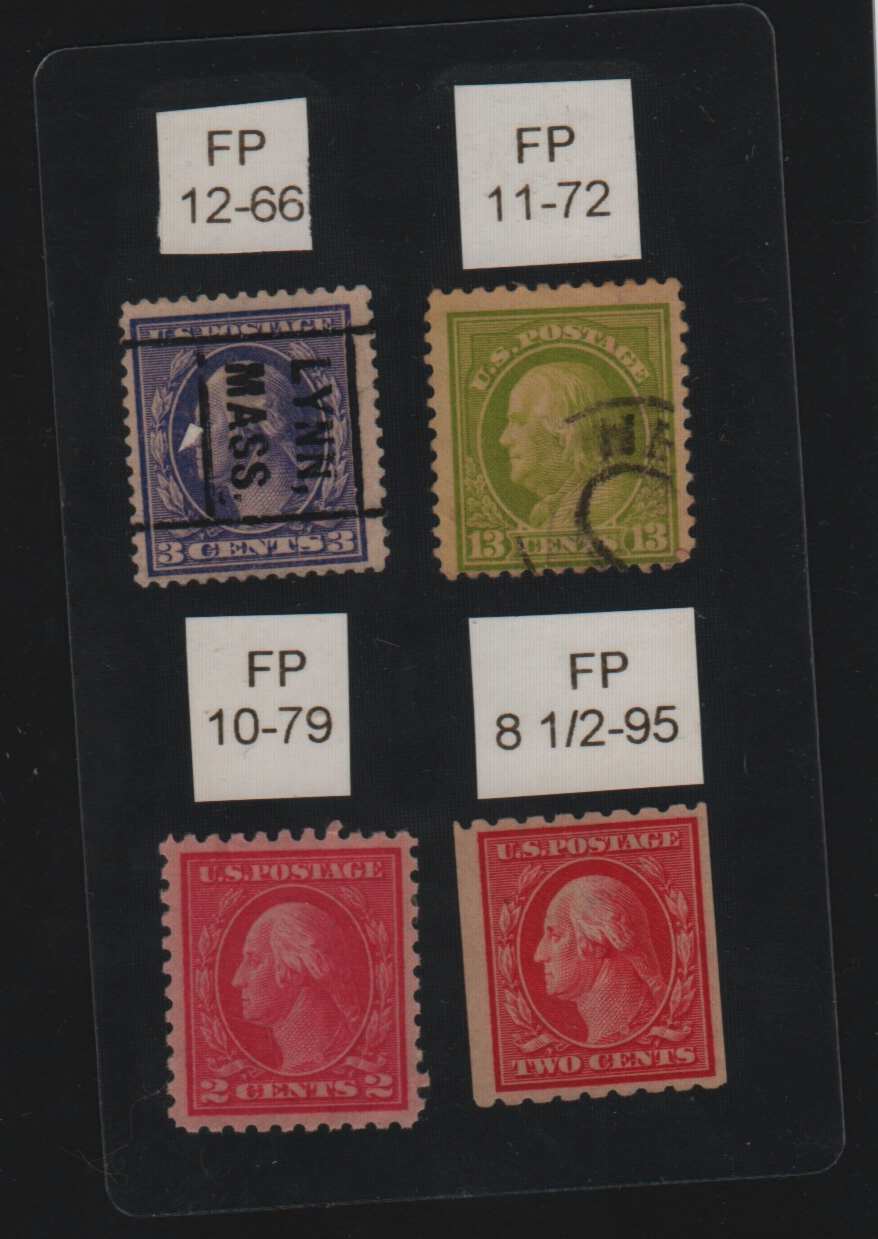 In the first one, the corners have been cut off of a FP stamp. You simply guide the template over a stamp, try to align the edges and if it fits- its FP. Next there are two Rotary Press templates, one long and one wide. If a stamp has "failed" the FP test, try the RP template wide and then tall and see if you have a fit. It is all very very easy. Just be careful about Offset press. You will also see that some of the stamps in the first scan and all the stamps in the second have numbers, like FP 10-79. Translation: Flat Plate and perforation of 10 or more properly 79 on the Kiusalas scale. Again, makes perf checking a breeze, very easy and nothing is better than checking against a real stamps rather than something not, imho. These templates are easily made. At Walmart you get plastic stock to coat cards, easily available and easy to make. Yes, it means destroying some stamps and you do need a known exemplar, but it made check several hundred W-F a snap for me. (Now truth be known, after a while you can eyeball RP or FP and an 8.5 perf sticks out to me, but first you have to learn.) -Larry |
|
Send note to Staff
|
|
|
Pillar Of The Community
United States
4106 Posts |
|
|
hey can you scan this in life size format? I have access to a tekstronic color printer. |
|
Send note to Staff
|
|
|
Pillar Of The Community
United States
6756 Posts |
|
|
Yes, the actual stamp template is very nice and convenient. I actually prefer to compare stamps overlaid as well, rather than trying to measure. Keep in mind, however, that because these stamps were printed by the old wet printing process, there will be some shrinkage in time. So make sure you actually measure the stamps you use as a comparison first. How do you know it's shrinkage? It affects both dimensions.
Also, when printing out templates, also measure again. Many printers weren't designed to reproduce accurately in both dimensions down to 1/4mm. Resolution and accuracy are not the same thing.
There are also a few perforation gauges that have incorporated the template, such as the Precision US Specialty Multi Gauge by Sonic Imagery Labs. It's a bit pricey, but it's got everything I need for measure US and world-wide stamps. I was surprised to find out it's a wonderful tool for measure total overprint sizes on those irregular multi-lined overprints. |
|
Send note to Staff
|
| Edited by khj - 07/14/2010 2:17 pm |
|
|
Valued Member
United States
428 Posts |
|
|
Quote:
hey can you scan this in life size format? I have access to a tekstronic color printer. Sure, give it a try, but I suspect it is harder than it might sound. In any event, its beyond me. Any given the tolerances here, not sure I'd use do it. And, Kim is absolutely right. There are gauges (like the Multi gauge) out there that can do this. It is just that I personally found these template very easy to use. |
|
Send note to Staff
|
|
|
Pillar Of The Community
United States
6756 Posts |
|
|
Quote:
It is just that I personally found these template very easy to use. That is an important factor. Thanks for mentioning it. The Sonic Imagery Labs gauge is quite bulky, and not convenient to use sometimes if the stamp is already mounted in an album. That's why I usually use the stamp overlay method. Just remember the wet-printing shrinkage possibility, so you don't end up mis-IDing some stamps. |
|
Send note to Staff
|
|
|
Replies: 20 / Views: 3,197 |
|




 Posted 07/13/2010 5:02 pm