| Author |
 Replies: 12 / Views: 5,417 Replies: 12 / Views: 5,417 |
|
|
Valued Member
71 Posts |
|
|
|
I noticed some of the us stamp in fact are having same design but have different type of printing, such as engrv. plate and rotary.
Is the someone who can teach me how to differentiate them ? or any photo can upload ?
Thanks
|
|
Send note to Staff
|
|
|
|
|
Bedrock Of The Community
United States
12128 Posts |
|
|
Moderator

United States
4788 Posts |
|
|
Pillar Of The Community
United States
2547 Posts |
|
|
Ken, the printing presses were differnt designs. The flat plate press used 4 flat plates on a moving pallet. The rotary press used 2 semi-circular plates witha continuous web of paper. Below is a Hoe & Co. flat plate press 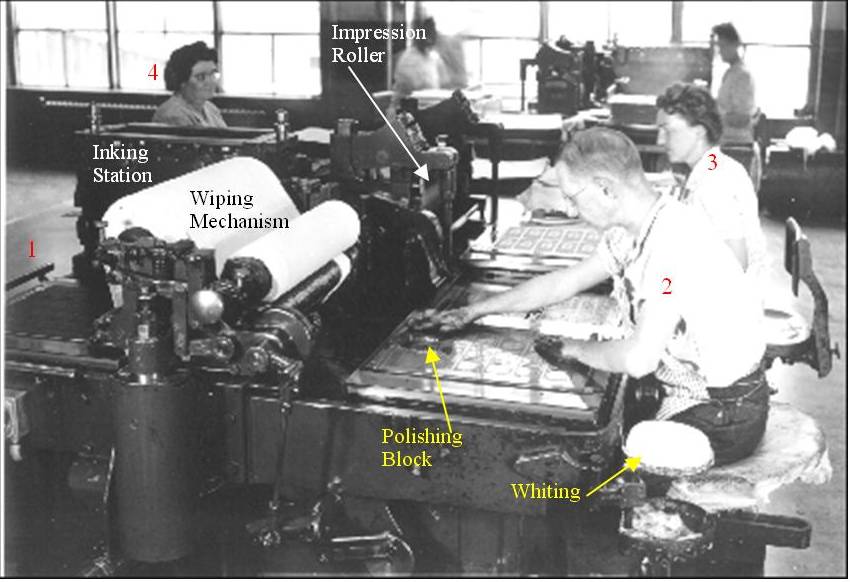 Below is a Stickney rotary press 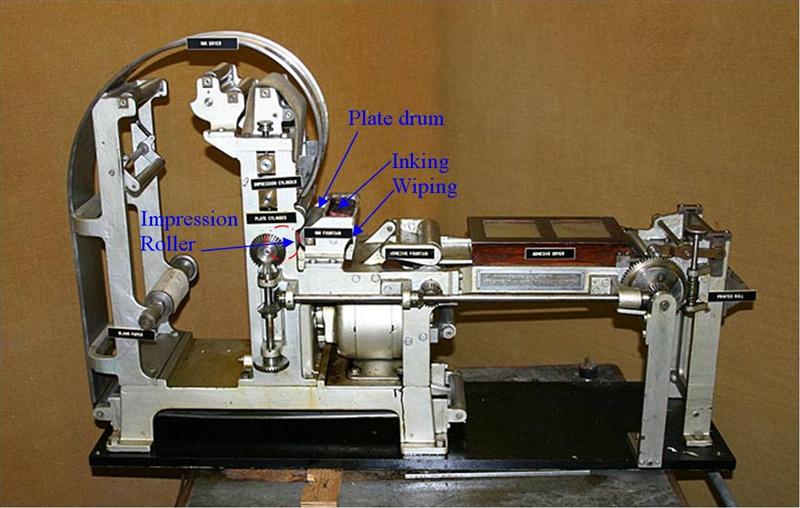 |
Send note to Staff 
|
| Edited by Russ - 10/25/2011 7:47 pm |
|
|
Valued Member
71 Posts |
|
|
Wow ! those are informative !
Dear All , Thanks You very much for time & effort to answer my question. |
|
Send note to Staff
|
|
|
Rest in Peace
Netherlands
963 Posts |
|
|
The rotary refers to the cylindrical plate or curved plates! The plate turns around, rotates, instead of being flat!
It does not necessary mean the press is reel-fed or web-fed! It may just as well be a sheet-fed press... |
|
Send note to Staff
|
|
|
Pillar Of The Community
3865 Posts |
|
|
The Stickney rotary press was a paper web fed press that wet printed postage stamps.
The Hoe rotary press was a paper sheet fed press that dry printed postage stamps. |
|
Send note to Staff
|
| Edited by jogil - 04/15/2014 8:17 pm |
|
|
Pillar Of The Community
Canada
5821 Posts |
|
|
Quote:
The rotary refers to the cylindrical plate or curved plates! What printing presses and by which manufacturer were these curved
plates used ? If they were only curved then would they then only be partially rotated in the press ? Like rocking back and forth? |
|
Send note to Staff
|
|
|
Pillar Of The Community
3865 Posts |
|
|
Two curved plates (of half a circle each) to put on and cover a circular cylinder drum so that it could continuously rotate 360 degrees. The Stickney rotary press appeared to have been made by The Universal Telegraphic Company, Baltimore, MD. ("The History of the Bureau of Engraving and Printing 1862-1962", Michael Plant, U.S. Treasury Department, 1962, page 80, reprinted by Quarterman Publications, 1979) |
|
Send note to Staff
|
| Edited by jogil - 04/15/2014 10:18 pm |
|
|
Pillar Of The Community
Canada
5821 Posts |
|
|
Valued Member
United States
82 Posts |
|
|
great thread people, excellent work. I may be mistaken but has anyone told the poster the difference between the two presses when looking at a stamp. Flat plate stamps can usually be identified even when in a pile and from the back by the drops of ink left on the back from stacking sheets. On rotary press this "Rarely" occurs, rotary press is easily identified by the stretching of the stamp design either vertically or horizonally. If you have done a lot of stamps in a row the two are easily distinguished by eye but to be safe the design should be measured vert. & hort. this is a very simplified way to quickly ID. guy please don't pick this apart, just trying to help. |
|
Send note to Staff
|
|
|
Valued Member
United States
95 Posts |
|
|
Now I can't remember rightly, but with flat plate is the inked design also more raised than with rotary which I think is "smoother" to the touch? |
|
Send note to Staff
|
|
|
Pillar Of The Community
3865 Posts |
|
|
The Hoe flat plate press was a paper sheet fed flat plate press that wet printed stamps.
Perforations for the flat plates are 11 (10.95) x 11 (10.95) while for the rotary press are 11 (11.25) x 10.50 (10.50) or 10.50 (10.50) x 11 (11.25). [Also, some rotary press were 10 (9.85) x 10 (9.85).] |
|
Send note to Staff
|
| Edited by jogil - 04/29/2014 07:11 am |
|
| |
Replies: 12 / Views: 5,417 |
|




 Posted 10/25/2011 10:39 am


