Early Tunisia postage dues were created by adding a large perforated T to regular postage stamps.
According to Scott Classic, for the lower values, the sheets of stamps were folded in half and then run through the perforator, creating relatively equal chances of obtaining a regular or an inverted T.
For the higher values, the stamps were created as needed, so that there is an imbalance between normal and inverted. They are priced separately.
I've had a few of these but never paid much attention to them. I just picked up a card of eleven of them, and seeing them all together makes me wonder a bit about them.
Here is the row with the higher values:
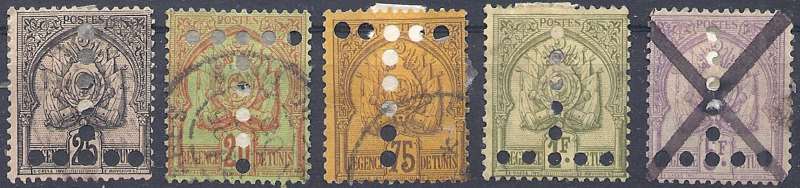
(I haven't yet removed the hinges...I'm guessing the perfs might have weakened the stamps a bit, so I'm not in a rush to remove them.)
There appear to be two different sizes of holes. Here are closeups of the 1f and the 5f:
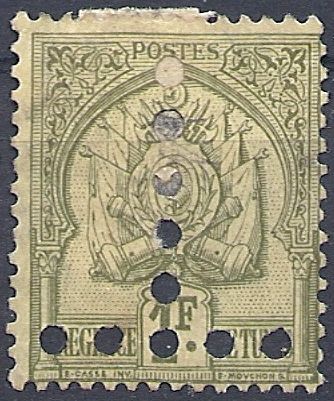
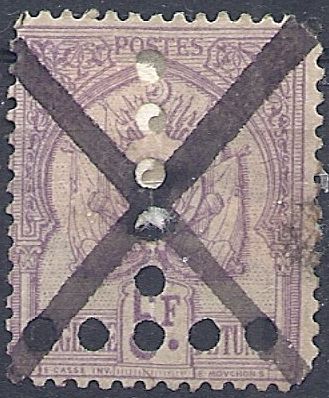
Any ideas about variations in perfs?
Second, the 5f is the high value, and I'm wondering about the large X. An early example of the marker monkey? Or a remainder cancel?
Thanks for looking.





 Posted 09/16/2012 10:42 am


 .
.
 Since the original perforating equipment was used, it is a little tricky to ID original T perforations. Especially, genuine 5fr T perforations are quite uncommon. Some of your stamp T perforation varieties are not listed in Ceres, so you should treat them with caution. However, my Ceres is old (2001), so some new varieties may now be listed/confirmed.
