Stamp Community Family of Web Sites
Thousands of stamps, consistently graded, competitively priced and hundreds of in-depth blog posts to read


Stamp Community Forum
 
Username:
Password:
Save Password
Forgot your Password?

This page may contain links that result in small commissions to keep this free site up and running.

Welcome Guest! Registering and/or logging in will remove the anchor (bottom) ads. It's Free!

Early Switzerland, Silk Thread Color?

Previous Page
 
To participate in the forum you must log in or register.
Author Previous TopicReplies: 28 / Views: 10,432Next Topic
Page: of 2
Moderator
Learn More...
United States
5094 Posts
Posted 10/09/2012   12:19 am  Show Profile Bookmark this reply Add Partime to your friends list  Get a Link to this Reply
Philimpex. Also, want to add my thanks for your contribution to this topic. As you very correctly note, the native catalogs are much more apt to have detailed (and correct) information for the specific countries.
Send note to Staff  Go to Top of Page
Valued Member
United States
296 Posts
Posted 10/09/2012   12:29 am  Show Profile Bookmark this reply Add Art Strohmeier to your friends list  Get a Link to this Reply
Partime:
Can you translate Philimpex's response for me?
Send note to Staff  Go to Top of Page
Moderator
Learn More...
United States
5094 Posts
Posted 10/09/2012   01:20 am  Show Profile Bookmark this reply Add Partime to your friends list  Get a Link to this Reply
Art. Having only the US Scott's, it is difficult to translate to the Zumstein system correctly. However, Philimpex is pointing out that the later year stamps have very thin (small) margins. As I said, your stamp appears to have (4) clear margins, but it is difficult to see the exact margin size unless you happen to catch part of a bordering stamp in the same cut. Philimpex is also pointing out that the color of the silk thread is sometimes discolored or missing completely due to the soaking technique. So the best guess is that you probably have a Scott 37 which is the 1858 to 1862 issue, which is supposed to have a Green Silk Thread. 2012 Scott Classic Specialized value is $26.00.

If you were able to show a better scan so that we could catch the cancellation, it would help. If you can show a date that is before 1858, then you would have something more valuable ($55 to 130 in the same Scotts).

Still, a great stamp and a keeper.
Send note to Staff  Go to Top of Page
Valued Member
United States
296 Posts
Posted 10/09/2012   6:35 pm  Show Profile Bookmark this reply Add Art Strohmeier to your friends list  Get a Link to this Reply
Replaced by the following
Send note to Staff  Go to Top of Page
Edited by Art Strohmeier - 10/09/2012 7:05 pm
Valued Member
United States
296 Posts
Posted 10/09/2012   6:35 pm  Show Profile Bookmark this reply Add Art Strohmeier to your friends list  Get a Link to this Reply
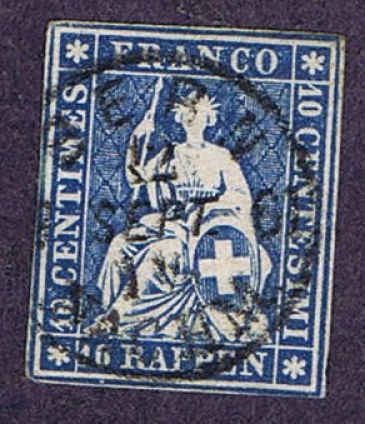
Revisiting the subject of the Swiss A17 illustration, based on suggestions from Philimpex and Partime, as you have noted from earlier discussions, I have been examining the subject to determine
a final conclusion, as much as is possible. My initial assumption, based on color and impressions leaned towards #21. Upon examination by SCO based on examination and expertise, leaned to #27. Additional examination leaned towards the assumption that it was likely #37.

Criteria for review included higher magnification of the thread on the back and the postmark on the front. Questions also existed on the color; #37 is dark blue, whereas the subject's color, although it appeared blue, had not been specifically identified.
The postmark, at the magnification level of the original posting, indicated source as Bern, but the date was not identified.
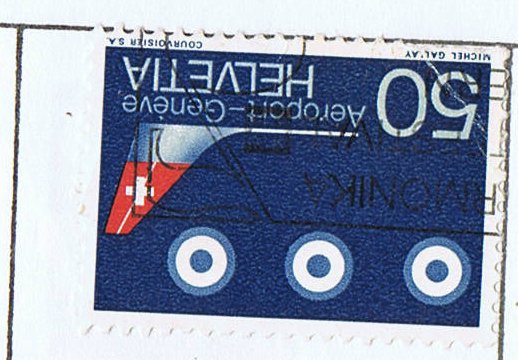
As to color, here is the subject followed by #277 and #490, both dark blue,



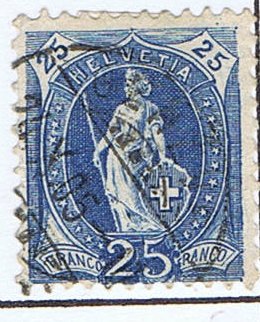
Here are two subjects identified as 'blue,' # 94 and #120.


Magnification of the back revealed no color identification. As previously reported, the color of the thread on the subject may have dissipated during the paper removal process. Magnification of 130x revealed no further identification.

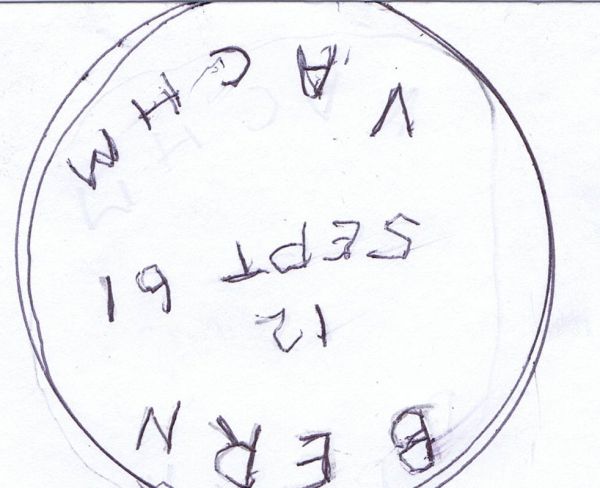
High magnification of the postmark, however, appears to be the following, which, if correct, identifies the stamp, as previously assumed, to be a #37, postmarked in 1861, regardless of the color difference.


Final conclusion was that "still a great stamp, and a keeper." I'll settle for that.
Send note to Staff  Go to Top of Page
Edited by Art Strohmeier - 10/09/2012 7:18 pm
New Member
United States
3 Posts
Posted 10/18/2012   7:08 pm  Show Profile Bookmark this reply Add Roger Heath to your friends list  Get a Link to this Reply
Hi,
Interesting thread about strubels. One easy method of separating the printings is the fact that with very few early exceptions, all Strubels were cancelled with a grill canceler prior to May 23 1857. All strubels after that date were CDS.

Thin paper stamps were pulled from the earlier Bern printings as substandard, then released when shortages occurred during the change to multiple colored threads. So there was not real "thin printing". Most of the thin stamps were used up as the multiple color thread issues were distributed, and they are rearly seen after the last printings were started.

For example the last blue stamp you illustrate:
Must be a Scott 37 because the date stamp is 12 Sept 1861. It does no good to compare the color with stamps printed 100 years later.

Your 1 FR stamp is an extremely nice Sc31. Four margin copies are to be treated kindly.

The 5 centimes brown stamp is most likely a SC 15. The print quality is fine and the grill cancel confirms it as an early printing. Notice the broken frame line lower left corner and top left corner. Again, a very nice example with the added feature of having two threads. The only drawback is the thin top center.

One need not worry about the difference between emerald thread or green thread. "Emerald" was from the Munich made paper, so all examples will have grill cancels. "Green" thread stamps all come from Bern printings on Zürich made paper, and have CDS cancels.

Don't get caught up in trying to identify these stamps by color shade except for those special shades such as the orange brown Munich print (Sc14), the pale yellow green Sc 18, or the milky blue with red thread Sc 26.
Send note to Staff  Go to Top of Page
Pillar Of The Community
United States
8429 Posts
Posted 10/18/2012   7:41 pm  Show Profile Bookmark this reply Add floortrader to your friends list  Get a Link to this Reply
Welcome ----ROGER ,understand you will be having a SWISS exhibit at the Chicago stamp show next month ....are you coming also .
Send note to Staff  Go to Top of Page
Pillar Of The Community
United States
8956 Posts
Posted 10/18/2012   7:48 pm  Show Profile Bookmark this reply Add Petert4522 to your friends list  Get a Link to this Reply
Art, great job of drawing the cancel above, but just one little item. The 'V' in the word 'Vachm' is a 'N'! That makes the word 'Nachm' which is German, and an abbreviation for 'Nachmittag' ( afternoon or PM ).

Peter
Send note to Staff  Go to Top of Page
Moderator
Learn More...
United States
5094 Posts
Posted 10/18/2012   9:58 pm  Show Profile Bookmark this reply Add Partime to your friends list  Get a Link to this Reply
Roger. Glad to have you on board. I was curious to see if you have more information or explanation about "rough" versus "fine" impression. I was looking at the crown of Helvetia to make my assumption, but does it have to do with the background or just a general look of the stamp?

And thanks for helping to clarify my Sc15. You pretty much quadrupled the value of that item.
Send note to Staff  Go to Top of Page
Valued Member
United States
296 Posts
Posted 10/19/2012   01:03 am  Show Profile Bookmark this reply Add Art Strohmeier to your friends list  Get a Link to this Reply
Peter
Danke
Art Strohmeier
Send note to Staff  Go to Top of Page
New Member
United States
3 Posts
Posted 10/19/2012   4:40 pm  Show Profile Bookmark this reply Add Roger Heath to your friends list  Get a Link to this Reply
Hi Floortrader - Yes , I'll have a couple of exhibits in Chicago. My nine frame de Coppet razor cancel exhibit, and a new single framer (which I've never shown before) titled "Swiss Made Cancelers Used in Latin America". If anyone has the opportunity to view them and give comments, I'm all eyes. I enjoy and consider comments of viewers in addition to the judges critiques. Sadly I won't be attending, so must wait until after the show to see how they do.

Partime - Glad to be of help. A little history of the printing of these stamps. They were first printed in Munich by the Bavarian printing office in the same manner of Bavarian stamps of the period using the embedded silk thread and having the paper embossed. The paper went through a first press to emboss the paper. The design was "engraved" into a gutta percha type material and when the paper was pressed onto the "form" the embossing was complete. Then the sheets were placed into a printing press and the ink added. These were hand presses, so different pressures were possible. If the hand made paper was too thin the ink didn't transfer well so the stamps have a faded look. These for many years were called the thin paper printing, except they were actually individual sheets pulled of the line by quality control, then stored in the vaults together. Eventually they were released during shortages in 1856-57.

Stamp use increased in huge amounts leaving the printing department continually on the edge of not being able to deliver the necessary amount of stamps to the post offices. Speed became the demon.

It was realized that the embossing really was unnecessary, the paper made in Switzerland was thicker, and the gutta percha "plates were worn. Therefore, the late stamps have little or no embossing, and the print quality deteriorated. These are the rough stamps.

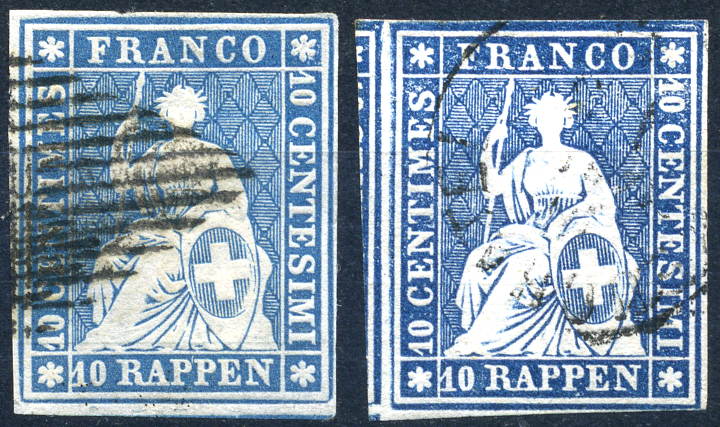
Here are examples of what Scott calls fine and rough. The stamp on the left is a Munich print Sc 16, Zu 23A. Right - Sc 37, Zu 23G. Note the fineness of the background lines and the "smoothness" of the ink in the solid areas of the first printing. Quite often the dark colored line on the shoulders and up the neck are very thick and filled in on the late "rough" printing. Finally looking on the back, the early prints have excellent embossing, the late print, none.

BTW - The left stamp has an emerald thread, and the right a green, which has nothing to do with the identification of the stamp.

Send note to Staff  Go to Top of Page
New Member
United States
3 Posts
Posted 10/19/2012   9:30 pm  Show Profile Bookmark this reply Add Roger Heath to your friends list  Get a Link to this Reply
Partime - I reread my post.

Switzerland asked that the plates and paper be sent from Munich after the first stamps were delivered to Bern. The Swiss decided to print them. The first Bern printings are slightly different shades of ink, and it is from these printings that the thin paper examples originate. So thin paper stamps must be faded shades of the Bern printing. Bern also decided to have a Swiss paper manufacturer make the paper, so the the paper is also different.
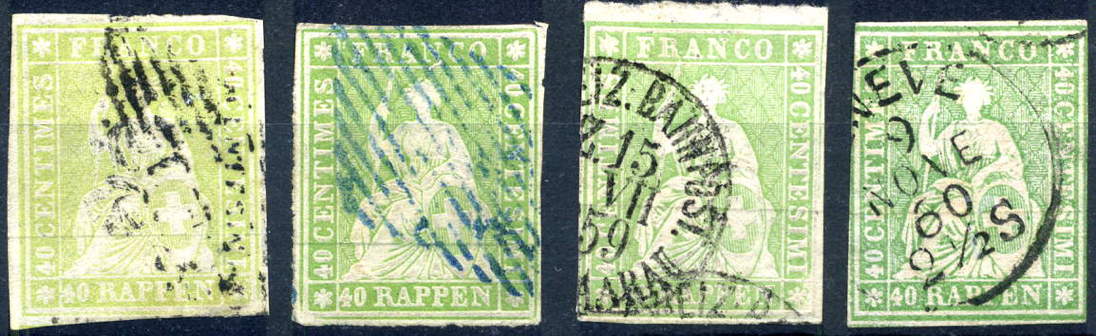
These are from left to right:
Munich Sc18, Zu 26Aa; Bern Sc19, Zu 26A; Bern w/maroon thread Sc 29, Zu 26 C; Bern Sc40, Zu 26G.

The yellow green is almost impossible to detect the image (one reason Bern decided to print the stamps).
The first Bern is probably the best printing.
The colored thread stamps can be found both with fine print and coarser print. There was too much of this paper manufactured so the paper was used as the printing plates wore down over time.
Finally the last printing has no embossing and the dark ink line on the neck and shoulder of Helvetia.

Send note to Staff  Go to Top of Page
Moderator
Learn More...
United States
5094 Posts
Posted 10/19/2012   11:01 pm  Show Profile Bookmark this reply Add Partime to your friends list  Get a Link to this Reply
Roger,

Thanks for adding so much more information to the conversation and for posting the lovely copies of the 40 rappen variety. I am always learning more things from SCF and am thankful for everyone's participation. It is always interesting to find that one country allowed their stamps -- essentially currency -- to be printed in another country for a period of time. This would seem a great opportunity to make some money on the side for the ambitious person. Your story also helps to understand how a "fine" impression eventually becomes "rough" and then replaced by later issues.

Most of the remainder of my Switzerland are in too poor shape to post, but I do enjoy the Semi-Postals and have quite a few used copies of the earlier time periods.

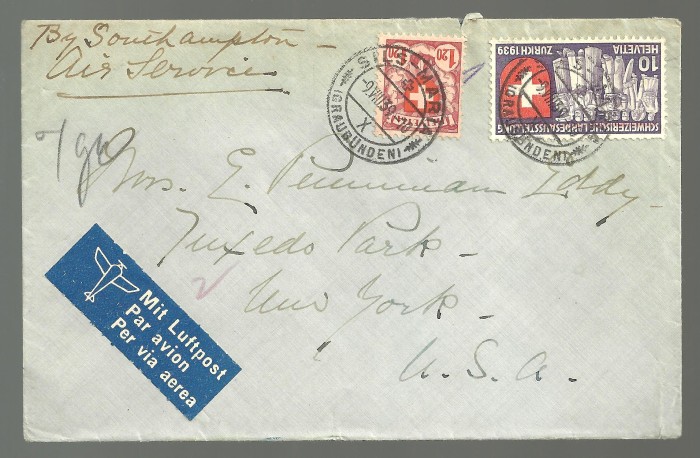
Only one cover of any consequence in my collection. It appears that the sender couldn't quite figure out up from down, but at least they put them in the right place.

Send note to Staff  Go to Top of Page
Page: of 2 Previous TopicReplies: 28 / Views: 10,432Next Topic  
Previous Page
 
To participate in the forum you must log in or register.

Go to Top of Page

Disclaimer: While a tremendous amount of effort goes into ensuring the accuracy of the information contained in this site, Stamp Community assumes no liability for errors. Copyright 2005 - 2026 Stamp Community Family - All rights reserved worldwide. Use of any images or content on this website without prior written permission of Stamp Community or the original lender is strictly prohibited.
Privacy Policy / Terms of Use    Advertise Here
Stamp Community Forum © 2007 - 2026 Stamp Community Forums
It took 0.18 seconds to lick this stamp. Powered By: Snitz Forums 2000 Version 3.4.05