| Author |
 Replies: 11 / Views: 3,032 Replies: 11 / Views: 3,032 |
|
|
Valued Member
Canada
107 Posts |
|
|
|
There must be an obvious answer to this: I have several copies of Canada 459 6 cent orange, perf 10, with a smooth edge along the top only. Where do these come from? I can't find a listing for these. They are the same size as other stamps so have not been clipped. Looks like they're maybe from a mini pane but I haven't found it.
|
|
Send note to Staff
|
|
|
|
|
Rest in Peace
Canada
544 Posts |
|
|
The 459 sheets had straight edges on 3 sides.
The left side was perforated. |
Send note to Staff 
|
|
|
Pillar Of The Community
2361 Posts |
|
|
Valued Member
Canada
107 Posts |
|
|
Thanks alanl for the explanation. I assume it also applies for the straight edges on perf 12.5x12 copies. Can you tell me how this allows for plate blocks? |
|
Send note to Staff
|
|
|
Valued Member
Canada
107 Posts |
|
|
Rest in Peace
Canada
544 Posts |
|
|
Well that`s interesting. I don`t have any plates.
I guess the post office added the perfs to the sheets
just for the plate blocks but not on the right edge.
All the 6 cent stamps (orange & black) printed by
British American Bank Note had straight edges on
three sides.
|
|
Send note to Staff
|
| Edited by alanl - 12/01/2012 01:33 am |
|
|
Valued Member
Canada
450 Posts |
|
|
The BABN 6c orange and 6c black Centennial stamps were printed on a continuous web. The cylinder was comprised of 6 panes of 100 subjects each (2 rows by 3 columns). The three panes in the top row had 3 imperf. sides with the left side only having selvedge. 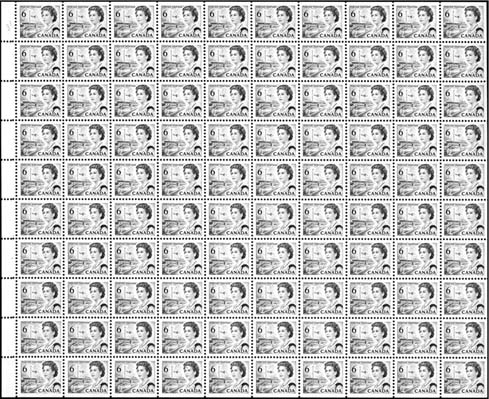 The three panes in the bottom row had 1 imperf side at the right; the other three sides had selvedge. Inscription blocks came from these panes. 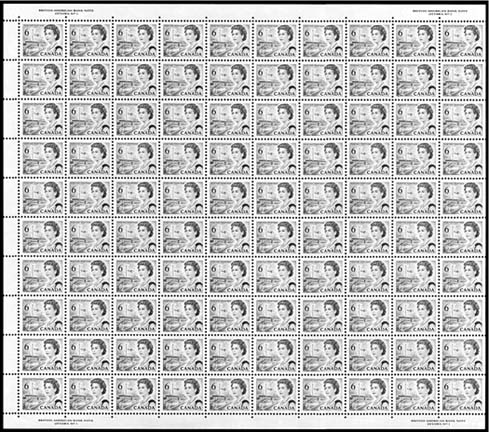 The 7c and 8c BABN Centennial stamps were a bit different, with each pane having selvedge on all four sides (half of the panes had inscriptions, the other half did not). More details on the full printing process are available in Harris' Centennial Definitive Series 1967-1973 book ( http://www.adminware.ca/phil_bk.htm) |
|
Send note to Staff
|
|
|
Valued Member
Canada
107 Posts |
|
|
Thanks studystamps - always a good day when you learn something new. It would be helpful for less-experienced collectors if the specialty catalogues explained this at least enough to acknowledge the existence of the stamps with straight top edges, and that the stamps with straight sides are not all from small booklet panes. It looks as if the edge stamps from sheet panes have narrower white borders than those from booklet panes - can you say if this is a useful way to separate them? |
|
Send note to Staff
|
|
|
Valued Member
Canada
450 Posts |
|
|
You cannot use the size of the stamp, or the amount of white border, as a guide to identify the stamps.
Perforating and pane cutting are an inaccurate science. Every stamp issue can have different sizes of panes (albeit extremely small differences). |
|
Send note to Staff
|
|
|
Valued Member
Canada
450 Posts |
|
|
Re: straight edges on panes. See the note at the lower left corner of page 170 of the Unitrade catalogue, which says: Quote:
BABN Printings (1968–1970)
The BABN "experimented" with their stamp printing during this time period. One part of this was the introduction of "perf 10" commemorative stamps (Sc. 482, 483, 484, and 490). This is a very coarse perforation. Specimens of these stamps, with sound perforations all around, will command a premium.
Most of the BABN issues in this time period will result in a stamp that can have one or two straight edges. Panes produced with inscriptions (philatelic stock) will have one side of the pane without selvedge (i.e. a straight edged stamp); panes produced without inscriptions (field stock) will have a straight edge on three sides of the pane. |
|
Send note to Staff
|
|
|
Valued Member
Canada
107 Posts |
|
|
Thanks for setting me straight - that's the explanation I was looking for in the catalogue, but in the wrong places, apparently! |
|
Send note to Staff
|
|
|
Valued Member
392 Posts |
|
| |
Replies: 11 / Views: 3,032 |
|



 Posted 12/01/2012 12:37 am


