| Author |
 Replies: 21 / Views: 9,103 Replies: 21 / Views: 9,103 |
|
Valued Member
United States
30 Posts |
|
|
Hi All, I am interested in the four copies of the Edifil #1 displayed below. I have been using the Guia tort and Manual de Sello, but I can't seem to be confident about the authenticity of these stamps. I am very suspicious of the two middle stamps as the Queen outline appears to be too rough. In addition, the first stamp is missing the two white dots typically found below the upper left floret.  I would really appreciate another persons opinion. Regards, Robert |
|
Send note to Staff
|
|
|
|
|
Pillar Of The Community
United States
1121 Posts |
|
|
At first glance they all look genuine to me. There are enough identifying marks on each to accurately plate each copy. With the scan available, I would tentatively identify them as (in order in the scan): First stamp - Plate II, type 12 (plate position) Second - Plate II, type 24 Third - Plate II, type 21 Fourth - Plate II, type 23 I'm pretty sure about the second, third and fourth, however the first one may be another type. It's had to say because 2 of the main identifying marks are obscured by the cancel. There are 2, that I know of, philatelic forgeries that often pop up on places like ebay, which might be mistaken for genuine copies. However, once seen and compared they stick out like a sore thumb. When I have some time tomorrow I will post scans of those to compare. My advice would be to make yourself familiar with plating these. It shouldn't be that hard as there are only 24 types for plate I and 40 for plate II. What I do just for practice is go through ebay and find the #1's for sale that have nice large scans and see if I can plate them using the Tort guide. Generally speaking, if you can accurately attribute a #1 to a particular plate position, it's probably genuine. The forgeries of #1 I've seen cannot be plated. |
Send note to Staff 
|
|
|
Pillar Of The Community
United States
1121 Posts |
|
|
Ok, here are a few of the more common forgeries I've found. 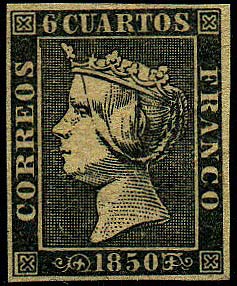 This forgery is mostly found uncancelled and sold as unused or reprint. If you compare this to any of your genuine #1's above you can see there is a stiffer, more stout feel to it. The outline of the Queen is more or less a solid line. All the imperfections you see in the originals is actually a good thing, because they do not exist on these. All the lines are thicker on this forgery and look too perfect and clean, almost as if the forger just copied a genuine copy and cleaned up the imperfections. I believe these were made by Miguel Segui. They are commonly found in blocks like this: 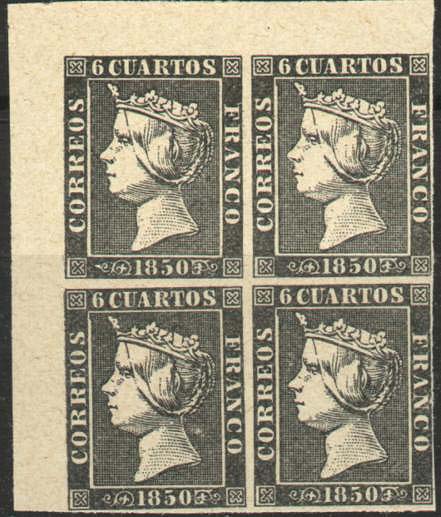 Genuine unused copies of the first Spanish stamp are rather hard to find and shouldn't be bought without a certificate. This next forgery is attributed to Peter Winter: 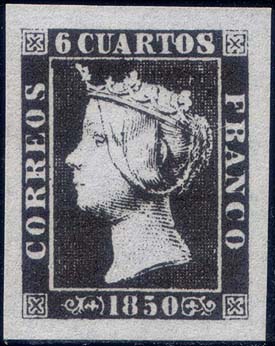 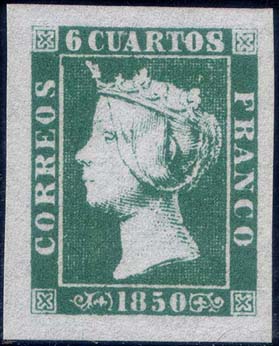 They are commonly found in various colors and sold as color proofs. Color proofs of this stamp do not exist, so don't be fooled. It's apparent they were created by photographing a genuine stamp, but lacks depth. There are imperfections visible, but the extra large margins give it away rather quickly. The paper is thin and very white. Most of the ones I've seen are uncancelled, but I have seen some with fake, rubber stamp-type cancels. |
|
Send note to Staff
|
|
|
Valued Member
United States
30 Posts |
|
|
spain_1850 - thank you for your help. There is a pretty steep learning curve in terms of seeing the real and fake 1850-1 6 Cuartos and it does make sense what you say about accurately attribute them to a particular plate position. Still, I feel it's difficult to identify them to a plate position, because the the variation are similar, but not always the same. I am sure with time I will develop a better eye.
Regards,
Robert
|
|
Send note to Staff
|
|
|
Pillar Of The Community
United States
1121 Posts |
|
|
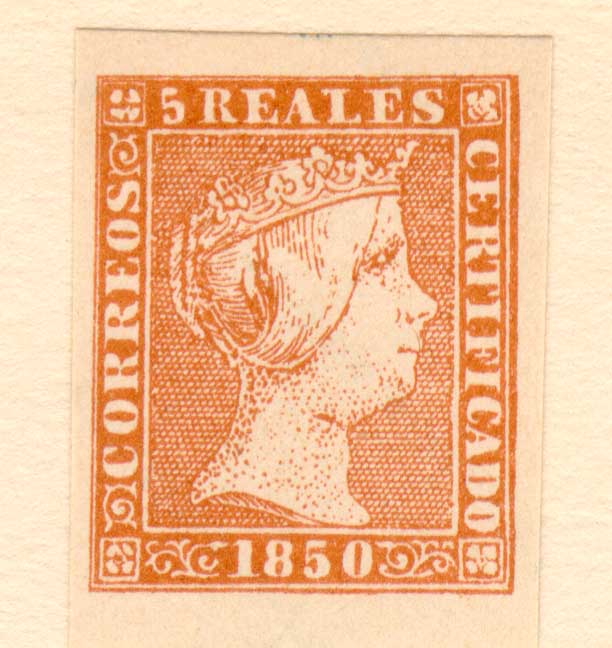
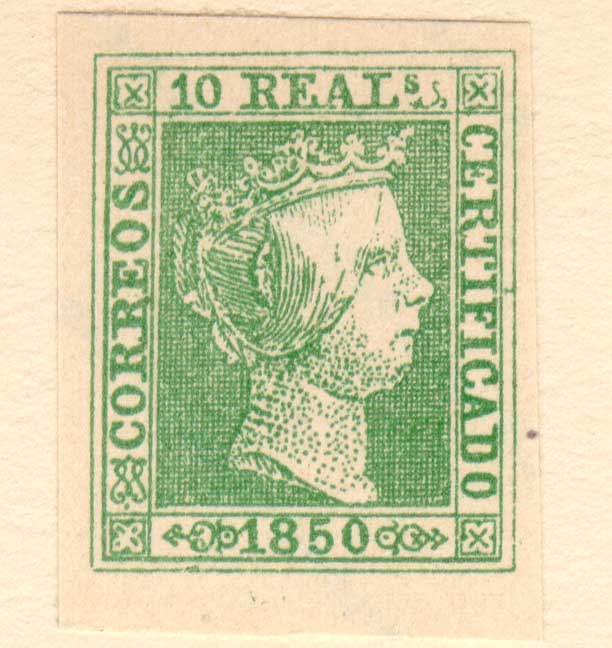
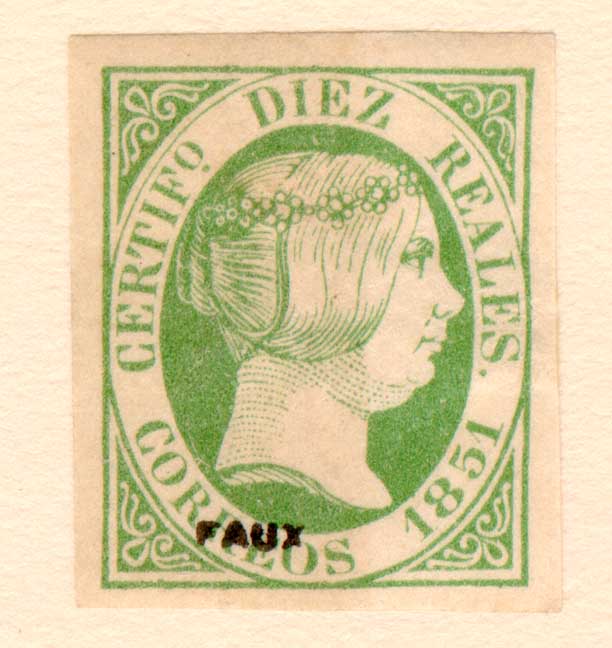
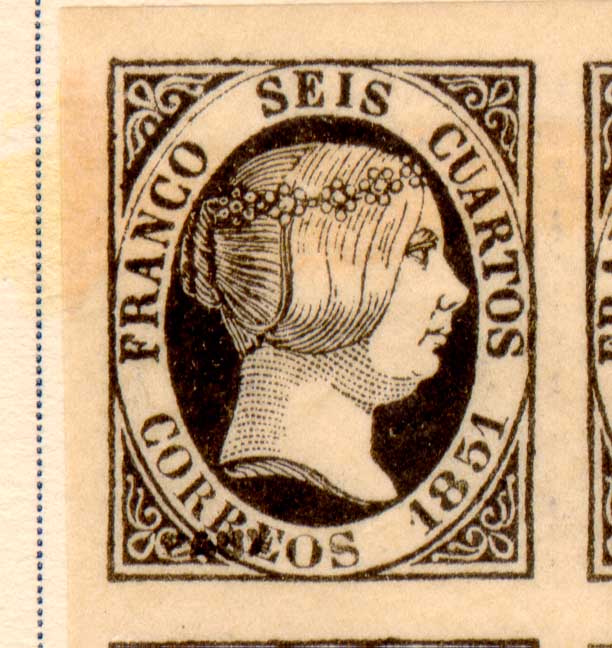
Robert - The good thing is that these 2 forgeries are about all you need to really worry about with the 6 cuartos. There are other forgeries around but they are so poorly done that they don't pose a threat. When you get into the higher values in the 1850 set however, there are many more forgeries to worry about, including Sperati forgeries.
The more copies of the 6cu that you can examine will make you more confident in identifying them I'm sure. It also helps to have a strong loupe as well. The one I use is 16x and is quite sufficient to make out the necessary details.
You can also scan them at high resolution and examine them on your monitor. If you do this I would suggest scans at least twice as large as your original scan here. |
|
Send note to Staff
|
|
|
Pillar Of The Community
United States
1121 Posts |
|
|
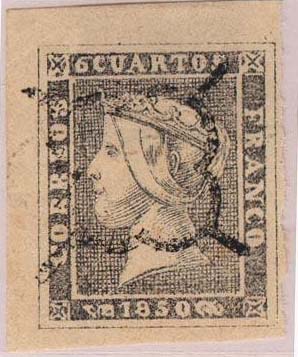 Here is one of my favorite forgeries for the 6cu. As you can tell it is really very crude, and the poor queen looks like she really got walloped in the chin. The paper looks like it might be an old album cutout of some sort. But still, this is the caliber of forgeries you can find other than the 2 I originally posted. |
|
Send note to Staff
|
|
|
Valued Member
United States
30 Posts |
|
|
Hi spain_1850,
Thanks for letting me know about the 2 main forgeries. My 'Manual de Sello' mentions that Fournier also made forgeries of the 6 cuartos; unfortunately, it doesn't give any photo images and the descriptions are very vague. This has made me very cautious of the 6 caurtos, but it sounds like I should just trust the Guia tort and not worry so much about the 6C.
My currently identification process involves a 10x loupe and examination of the images from my phone, which allows me to easily and quickly enlarge the image. That said, your method sounds more effective and I should give it a try.
Thanks again for the wisdom,
Robert |
|
Send note to Staff
|
|
|
Pillar Of The Community
United States
1121 Posts |
|
|
I have to admit I have not seen any of Fournier's Spanish forgeries. I would love to have some representative scans. It's my understanding that Fournier was not interested in trying to fool collectors, but rather make facsimiles available to those who could not afford genuine copies. Some of the Fourier forgeries I have seen of other countries had very generic looking cancellations on them. I just haven't seen any of his Spain products. |
|
Send note to Staff
|
|
|
Pillar Of The Community
United States
7104 Posts |
|
|
Pillar Of The Community
United States
1121 Posts |
|
|
Cjd - Thanks for that link. I totally forgot about that site. Looking at those pages, I might even have a few Fournier forgeries and didn't even know it.
|
|
Send note to Staff
|
|
|
Valued Member
United States
30 Posts |
|
|
spain_1850, I have been practicing my plating of this stamp and I definitely have been getting better. However, for this particular stamp below I cannot determine the plate position, but have limited it to two possible positions.  -Plate I, type 10 - stamps has the very distinctive two white marks on the O of FRANCO -Plate I, type 22 - stamps the black mark above the C in CUARTOS, and the rosette frame breaks Let me know what you think. Thanks, Robert |
|
Send note to Staff
|
|
|
Pillar Of The Community
United States
1121 Posts |
|
|
It looks like type 22 to me as well, for the same reasons you mention. Nice deduction, and nice 4 margin copy too! |
|
Send note to Staff
|
|
|
Valued Member
United States
30 Posts |
|
|
Valued Member
Denmark
445 Posts |
|
|
Valued Member
United States
30 Posts |
|
|
ClassicalStamps,
Sure - I would love to have a copy of the Fournier forgeries; it would be nice to have them as a reference. Please let me know where I can get them from.
Happy 4th!
Thanks,
Robert |
|
Send note to Staff
|
|
|
Valued Member
Denmark
445 Posts |
|
|
Replies: 21 / Views: 9,103 |
|




 Posted 05/25/2013 10:45 pm