Lamp: I hope you're still checking this thread.
I would agree with what everyone has said that these are pretty much common stamps, but, at least for the Japanese stamps, there are a couple of different types of cancellations that would make those particular stamps a little more special -- not necessarily valuable, but perhaps a little more sought-after, so don't just toss them into a packet with the others (in my opinion).
One type of cancellation is the "roller cancel". When you just have only the cancelled stamp in front of you, it'll look rectangular, rather than round. Here is an example from the pictures you posted:

Another type of cancellation that is a little more sought-after are the "English" cancels -- in other words, those showing the Roman alphabet, rather than Japanese characters, like this one:

The Scott catalogs are a great place to start, but they will hardly ever show cancels (maybe in the US specialized, for a few types). Cancels tend to be the province of specialized catalogs, sometimes in English, sometimes only in the home-country language. It really is quite an area of specialization, country by country.
However, you might find helpful the visual stamp identifier in the back of any volume of the Scott catalog. (At least those in recent memory.) There is a special section for non-Western alphabets, and they show examples that should help you distinguish Japanese stamps from Chinese.
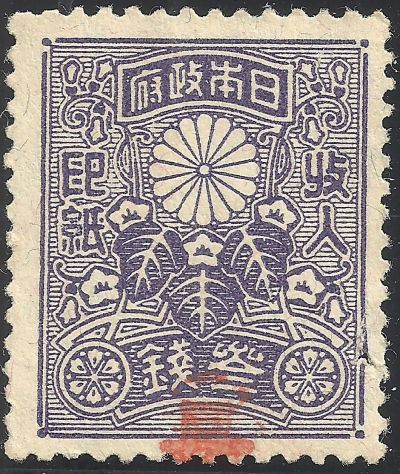
With that in mind, if you see a little sun with rays emanating from it, that's China. If you see a chrysanthemum blossom, that's Japan. I can see that some of the Japan ones that you show do not have that symbol (because that symbol represented the Japanese empire, and ended by about 1948), but you should usually be able to find a character that looks something like an "8", but with squared corners, and that's very likely Japan also, like the far lowest-left character in this stamp:

And to complicate things just a bit, the characters read right-to-left before about 1948 and left-to-right afterwards, like in the image above.
Good luck with all this, and please don't hesitate to ask more questions!
-- Dave
[edit: figured out what I did wrong the first time]





 Posted 12/29/2013 7:20 pm