| Author |
 Replies: 52 / Views: 9,241 Replies: 52 / Views: 9,241 |
|
Valued Member
Canada
26 Posts |
|
|
Does anyone know what type of variety of this two cents admiral stamp belongs to? There is a vertical line in the low left corner. Re-entry or retouch or other variety? Thank you, Wood 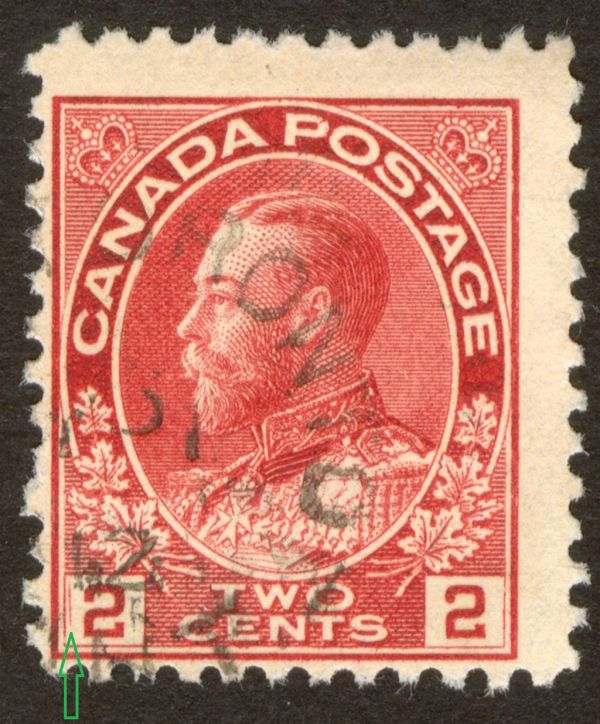 |
|
Send note to Staff
|
|
|
|
|
Rest in Peace
7742 Posts |
|
|
woodstamp...  ...to the forum...I see what you are talking about..sure looks like what you might see in a re-entry stamp...I am looking at the rest of the stamp and see no re-entry indicators to go along with it..But, if you take a high resolution picture and send it to Ralph at the website below, he will tell you if indeed it is a true re-entry. http://www.re-entries.com/ |
Send note to Staff 
|
|
|
Pillar Of The Community
Canada
1084 Posts |
|
|
Woodstamp: I can't help you with your King George V (kg5) stamp (Canada Scott#106) but I have to say you have mastered posting a scan on your first post. Great image! It took me two weeks of posting to get the hang of it. I look forward to seeing more. |
|
Send note to Staff
|
|
|
Valued Member
36 Posts |
|
|
Your stamp is 7LL7/2 - that is, it comes from plate 7, lower left pane, row 7, stamp 2. Plate 7 was made from the original die (note the almost non-existent upper right vertical line in the spandrel), not the retouched die, and it conforms to George Marler's Design Type O2 (you can see a break in the vertical line of the right numeral box opposite the top of the 2 and the small nick in the outer part of the right frame opposite TA in POSTAGE).
As to your question, (what type of variety is the strong vertical line in the left numeral box (LNB)), I agree with wert that it unlikely to be a re-entry because the strong extra line is the sole manifestation of possible doubling. It is also unlikely to be a retouch because the vertical line of the LNB is already quite strong and thus didn't need retouching (unlike, for example, the upper right vertical line) plus the extra line is some distance from the vertical line of the LNB. In my opinion, it is a constant plate flaw, caused by some mishap during the manufacture of the plate.
It is definitely constant. It exists on the plate proof at Library and Archives Canada , and I have seen two used examples besides this one. |
|
Send note to Staff
|
|
|
Pillar Of The Community
Canada
1084 Posts |
|
|
Valued Member
Canada
26 Posts |
|
|
AdmCol: Thank you for your detail explanation. It definitely answered my question.
Woodstamp |
|
Send note to Staff
|
|
|
Pillar Of The Community
United States
7103 Posts |
|
|
Valued Member
410 Posts |
|
|
Valued Member
Canada
242 Posts |
|
|
Nice post AdmCol, always impressive to see the kind of knowledge on here. |
|
Send note to Staff
|
|
|
|
Pillar Of The Community
New Zealand
731 Posts |
|
|
Welcome new guys. I joined last fall, and its a good group.
Very impressive first posting image--how did you get that arrow?
And can someone explain to me how to supersize the image? |
|
Send note to Staff
|
|
|
Valued Member
Canada
26 Posts |
|
|
tommy: What I did was using the free software IrfanView to resize the original image and re-save it as .jpg format file. If the file size is larger than 100KB, please down scale a little more till the file size is less than 100KB. Here is the IrfanView website, you can download the latest version, it's free. http://www.irfanview.com/ |
|
Send note to Staff
|
|
|
Rest in Peace
Canada
6750 Posts |
|
|
Would the openings on the left numeral box, left side lower, and the open space on the right numeral box, lower line, left corner, be considered to be in the same category as the previously mentioned, by AdmCol ( Welcome!  ), observances? 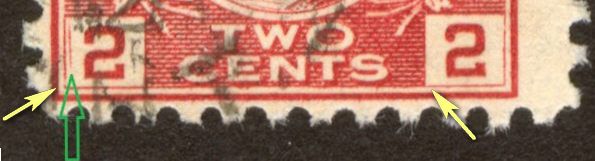 Also a Welcome to woodstamp! |
|
Send note to Staff
|
|
|
Valued Member
36 Posts |
|
|
The characteristics I mentioned in my previous post (break in the vertical line of the right numeral box (RNB) opposite the top of the 2 and the small nick in the outer part of the right frame opposite TA in POSTAGE) are those used by Marler in his 1982 book, The Admiral Issue of Canada, to identify Design Type O2.
There may be other characteristics such as the ones you point out, Puzzler, that are not listed by Marler but that are also unique to Type O2. On the other hand, the break in the bottom line of the RNB and the bottom of the vertical line in the left numeral box (LNB) may occur on many other plates, or they may be additional constant plate flaws specific to this stamp, or they be just transient varieties.
On an image I have of another example of woodstamp's variety, there is no break at the bottom of the vertical line of the LNB so I believe this break is a transient inking variety. I suspect the break in the bottom line of the RNB occurs on many 2c carmine plates. Thus, I don't think either variety is significant.
Here's another example of a flaw on woodstamp's stamp that does hold some interest. There is a very small dot in the top margin above the P in POSTAGE. This dot occurs on 2c carmine stamps throughout the many printings of this stamp and also on the 2c green stamp that replaced it. So, why is it interesting? The dot was on the master die prepared for the Admiral stamp design. It was reproduced on the secondary dies for most values and thus can be found on most Admiral stamp denominations, not just the 2c.
|
|
Send note to Staff
|
|
|
Valued Member
Canada
26 Posts |
|
|
To Puzzler:very good capture. I saw at least two other places have the same break. One is at the outer arc close to the letter C of CANADA. Another place is at the inner arc close to the letter N of CANADA. To AdmCol: Thanks a lot. Your expertise will help me and the others as well. I found another very interesting stamp. It has a big dot. Could you help me to figure out why this dot is so big and obvious? 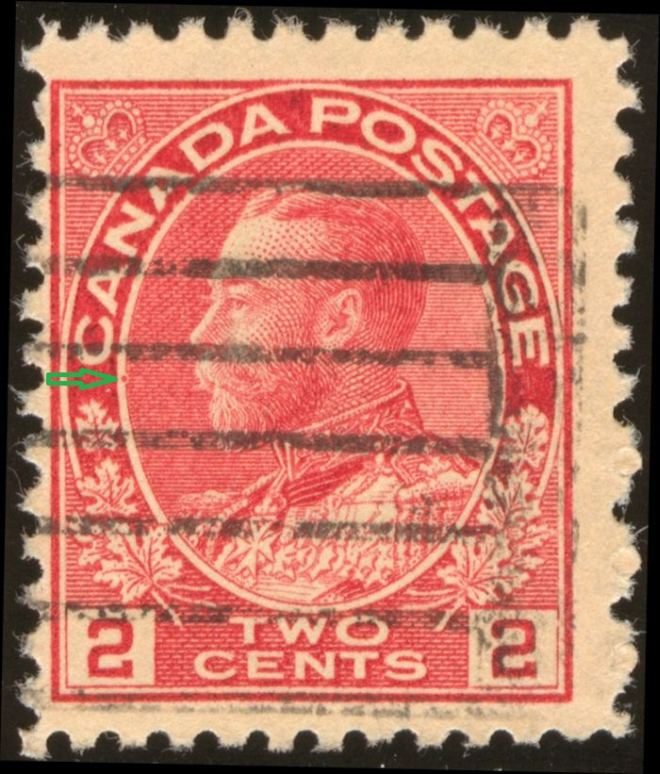 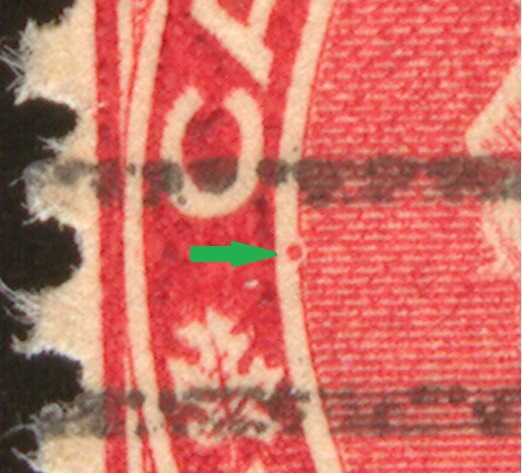 |
|
Send note to Staff
|
|
|
Rest in Peace
Canada
6750 Posts |
|
|
AdmCol,
Thank you, interesting to know about the top dot above C in CANADA also. |
|
Send note to Staff
|
|
|
Valued Member
410 Posts |
|
|
Replies: 52 / Views: 9,241 |
|



 Posted 01/18/2014 11:44 pm


