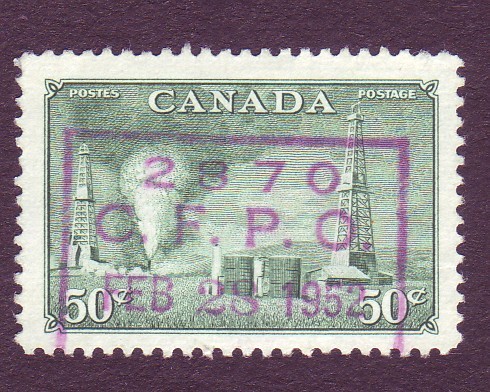
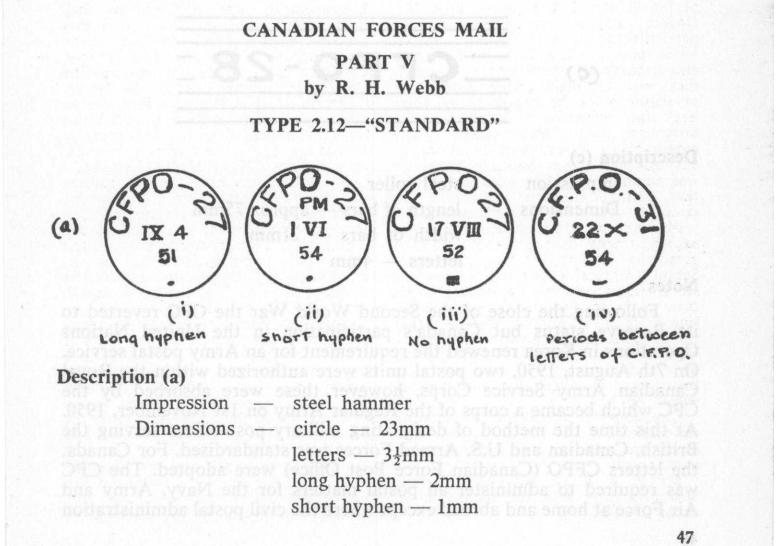
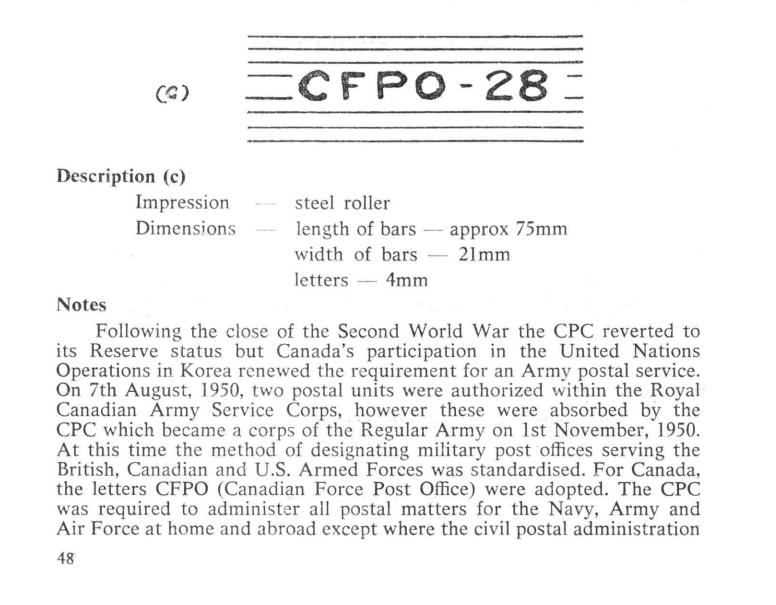
Gilles le timbre would be correct for usage after the mid-1960s when the branches were merged into the Canadian Forces. However, in 1952 the abbreviation stood for Canadian Field Post Office which would have been assigned to a CAPO (Canadian Army Post Office).
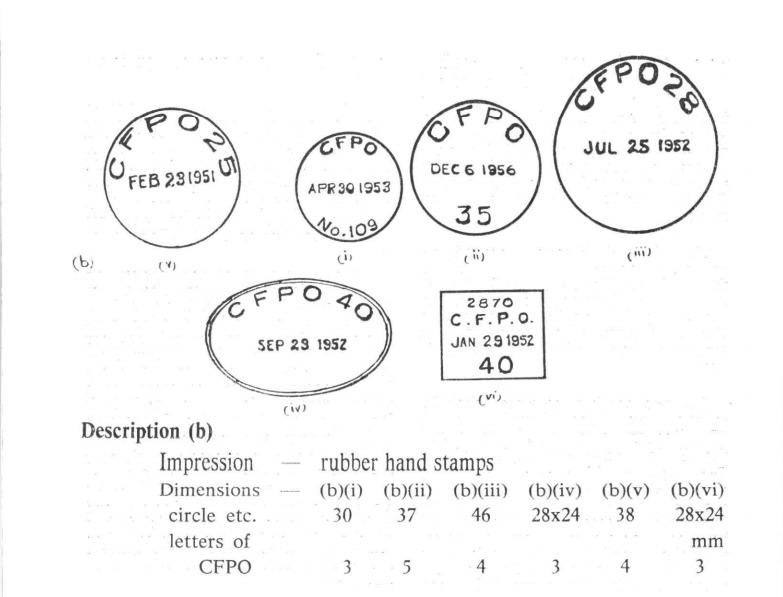
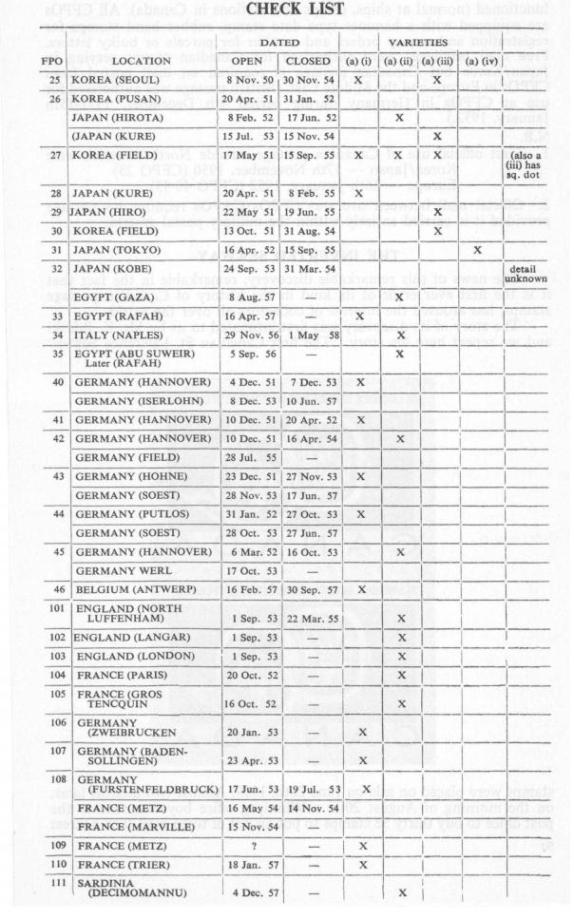
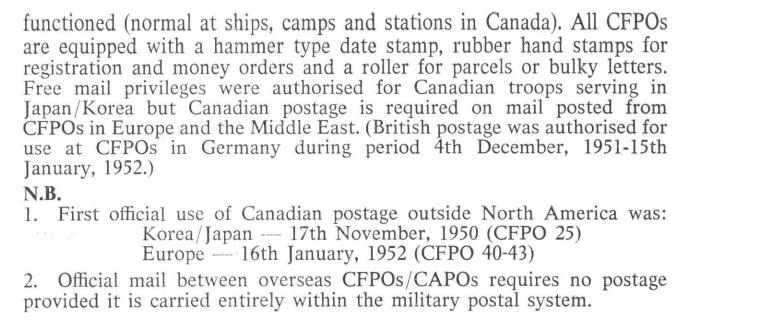
The following article is excerpted from the December 1959 issue of "The Maple Leaves: Journal of the Canadian Philatelic Society of Great Britain". explaining these CFPO markings, suggesting that the abbreviation is for "Canadian Force Post Office". In any event, it appears that your stamp is missing the number at the bottom which would have identified the location where the postmark was used:
Quote: In any event, it appears that your stamp is missing the number at the bottom which would have identified the location where the postmark was used:
Shucks! Thanks to all never-the-less.
I notice in the checklist example, the box handstamp also includes the 2870. What does the 2870 represent?
That is the number of the post office. The cancel is what we call a M.O.O.N. - for "money order office number" I think. That cancel was normally used on money orders and such, not usually for cancelling stamps on covers.
Disclaimer: While a tremendous amount of effort goes into ensuring the accuracy of the information contained in this site, Stamp Community assumes no liability for errors. Copyright 2005 - 2026 Stamp Community Family - All rights reserved worldwide. Use of any images or content on this website without prior written permission of Stamp Community or the original lender is strictly prohibited. Privacy Policy / Terms of UseAdvertise Here





 Posted 12/06/2014 4:11 pm