Quote:
WT1: What is the address of the recipient of the letter? The station was probable in the general neighborhood of the address.
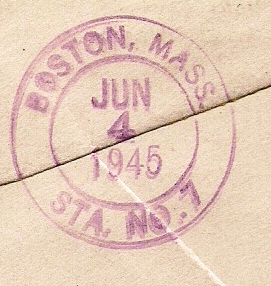
Both addresses (sender and receiver) were located in Boston. The postmark shown in the above example was dated the day before the other (which reads "Boston, Mass., Postal Station A") so I assume "Postal Station A" refers to the location where the cover was sent to.
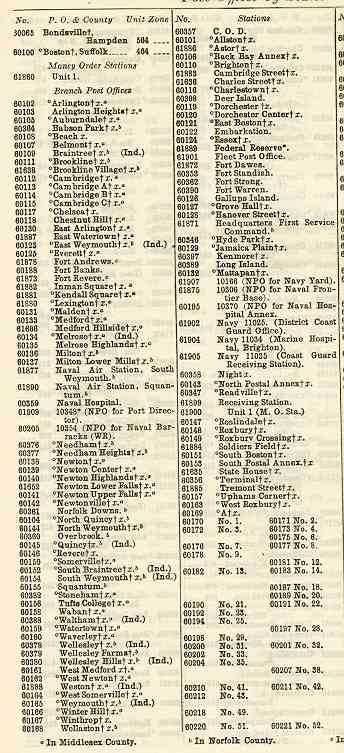
On the other hand, the "Boston, Mass. Sta. No. 7" postmark was probably from the post office where the sender entered the item into the mail. The return address of the sender was a law office that had been located at "Cornhill, Boston". An internet check reveals that Cornhill no longer exists but is now part of Government Center, so I suspect the postmark may have involved a Post Office station once located in the old Scollay Square area:
Quote:
Cornhill, along with Scollay Square, was destroyed during the construction of Boston's Government Center during the city's 1960s-era Urban Renewal Scheme. Initially, Government Center was lauded as "a model of how urban renewal, when imaginatively conceived and carried out, can bring new vitality and beauty to a city". Government Center even captured a special commendation from the American Institute of Architects in 1972. Today, the aesthetic merit of the area is assigned, at best, mixed values. Many view the area as a brutalist 'brick desert' in the heart of what was once one of Boston's most picturesque Victorian neighborhoods.
http://forgottennewengland.com/2012...ment-center/Incidentally, I did pickup a couple of references in the Postal Bulletin (dated 1905 and 1906) suggesting that the Postmaster General ordered that post offices establish "numbered stations" for the transaction of money order and registry business. Since the postmark shown was on a registered mail cover, I suspect that perhaps Station No. 7 may have been the post office where the item was received for mailing.
That's the most I've come up with to date.





 Posted 01/25/2015 4:18 pm