| Author |
 Replies: 19 / Views: 8,452 Replies: 19 / Views: 8,452 |
|
Bedrock Of The Community
United States
12128 Posts |
|
|
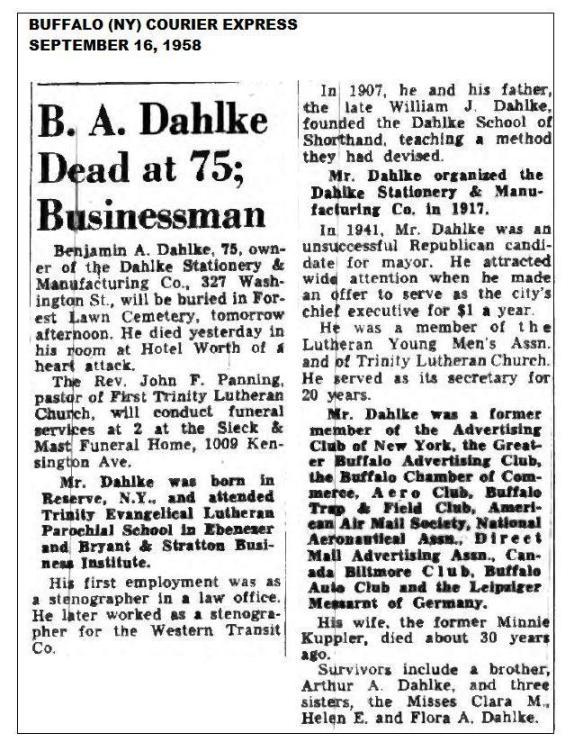
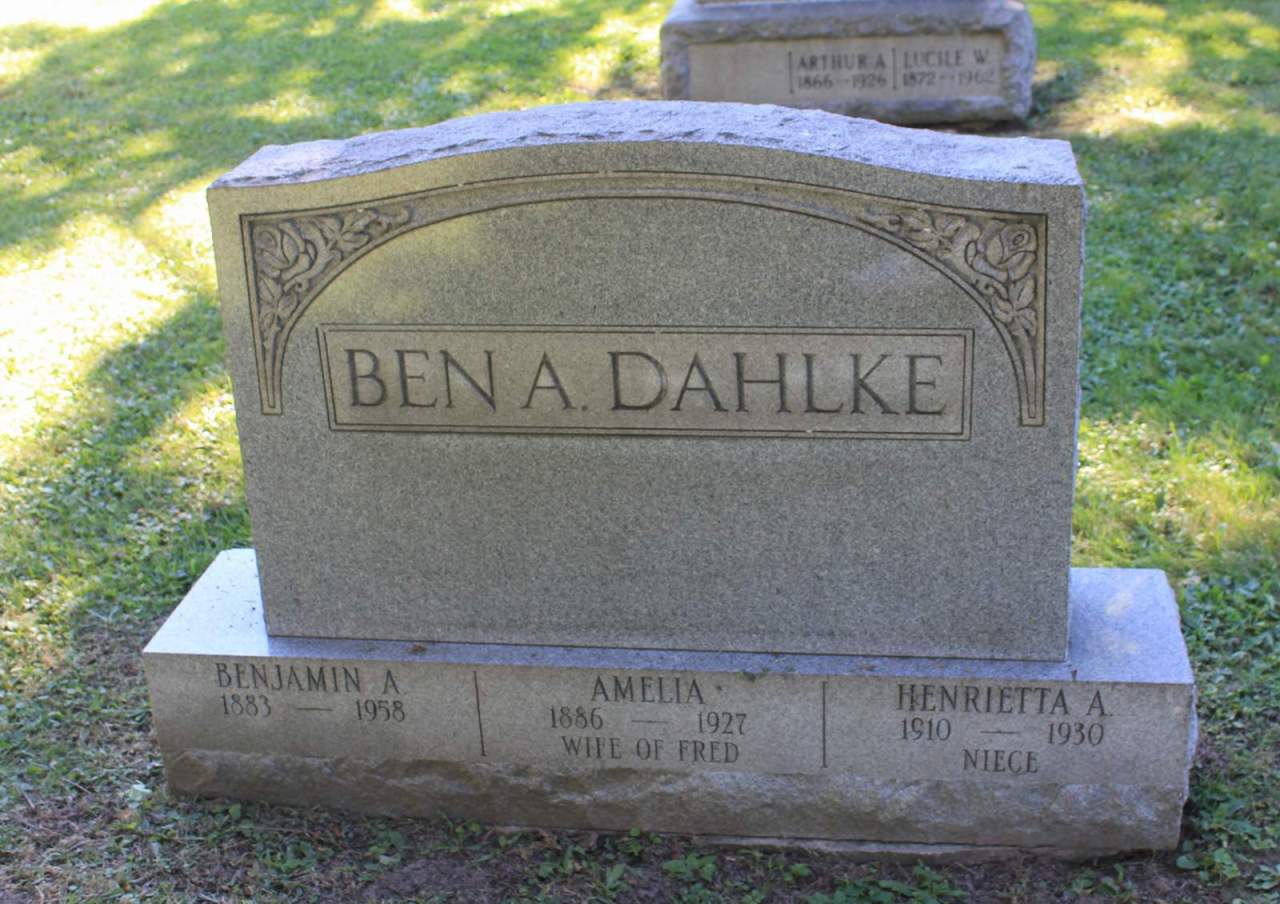
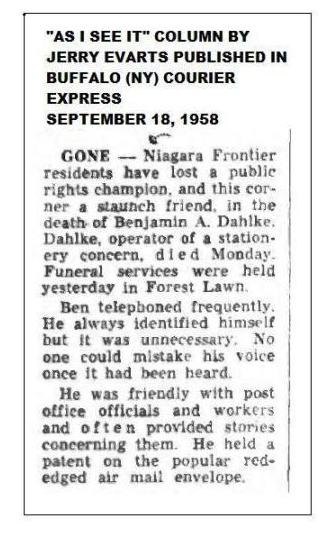
As I promised the other day, I'm creating this specific thread covering some online research I did on Benjamin A. Dahlke (a/k/a Ben A. Dahlke or B.A. Dahlke), the first individual to have obtained a patent on the air mail envelope we are most familiar with today (i.e. red and blue lozenges or parallelograms surrounding the envelope.) If you're bored with such history, you can move on to other threads; if not feel free to read on. What I am going to share is what I have been able to find on the internet when reviewing period publications and newspaper articles on Mr. Dahlke. Granted, there are a lot of loose ends to the story which requires more research than I am able to give to the subject. Nonetheless, I share what I do know and hopefully others can help fill in some of the blanks. Mr. Benjamin A Dahlke (1883-1958) was born in Reserve, NY and made his home in Buffalo for most of his adult life, eventually becoming proprietor of the Dahlke Stationery and Manufacturing Company. Mr. Dahlke's early career involved much salesmanship within his stationery business which naturally led into a keen interest in how the business community could take better advantage of the US Mail to advance their profit margin. (The internet has several articles he wrote on these themes for trade journals during the 1910s through the 1920s.) A biographical sketch of Mr. Dahlke may be found in this 1929 newspaper article. Note in particular the highlighted paragraph where he did not consider himself a "collector of stamps" but was nevertheless a member of the American and International Philatelic Associations and contributed a number of air mail stamps and covers to them.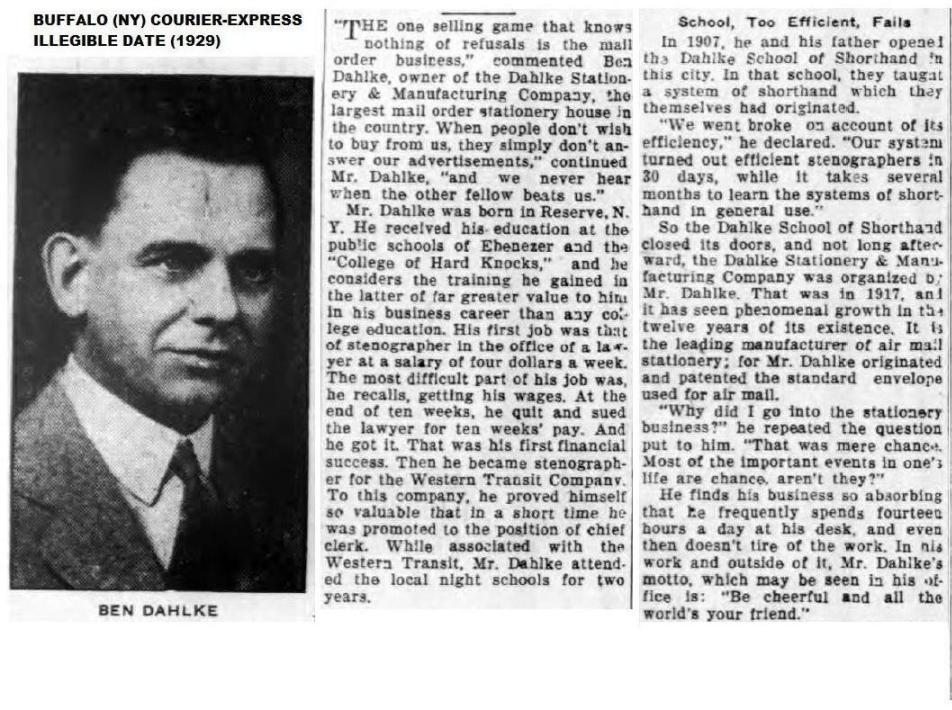 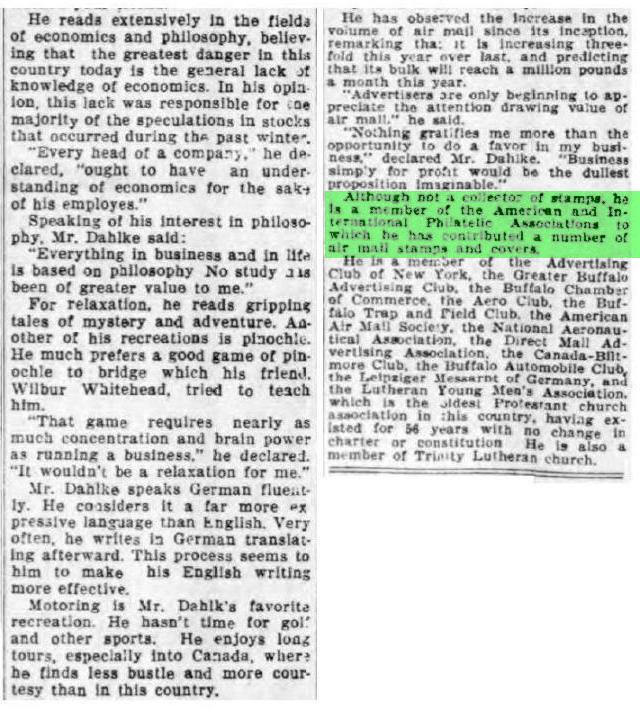 More to the point of this article, Mr. Dahlke apparently took out the first patent on the style of airmail envelopes we are most familiar with (i.e. red and blue lozenges or parallelograms surrounding the envelope). It is noteworthy that his patent was filed on October 24, 1927 but was not granted until a year and a half later on May 29, 1929 as US Patent No. 1714349:  Some of Mr. Dahlke's early air mail envelope examples are shown below. The reverse side of this 1928 air mail envelope includes the caption "Designed by Ben Dahlke, Buffalo, NY" and was apparently in use before his patent was granted:  Subsequent variations of his envelopes include this "odd" example of a side-opening air mail envelope used in 1935 (note the tab on the left side) and the change to include the caption "Designed by Dahlke Co., Buffalo, NY":  In this 1929 example, the caption is again changed to "Manufactured by Dahlke Stationery & Mfg. Co., Buffalo, NY: 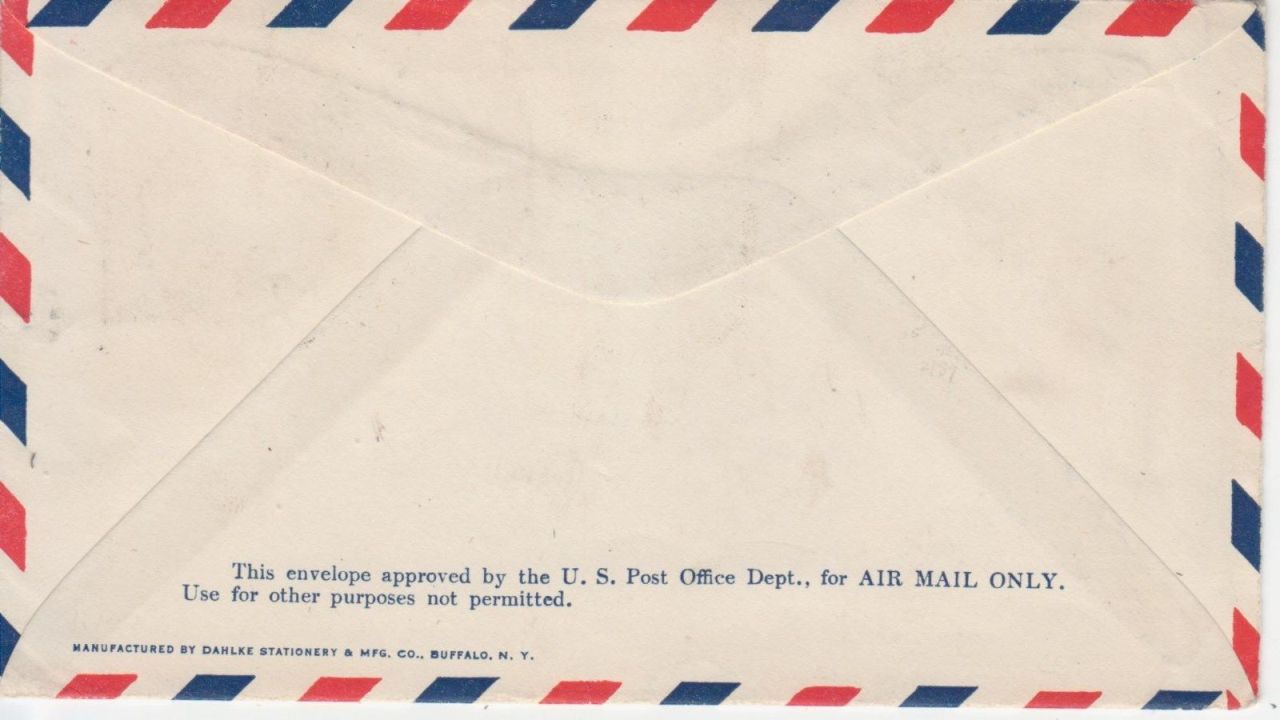 And most interesting is this 1928 example on either a #9 or #10 airmail envelope where the same caption is used: 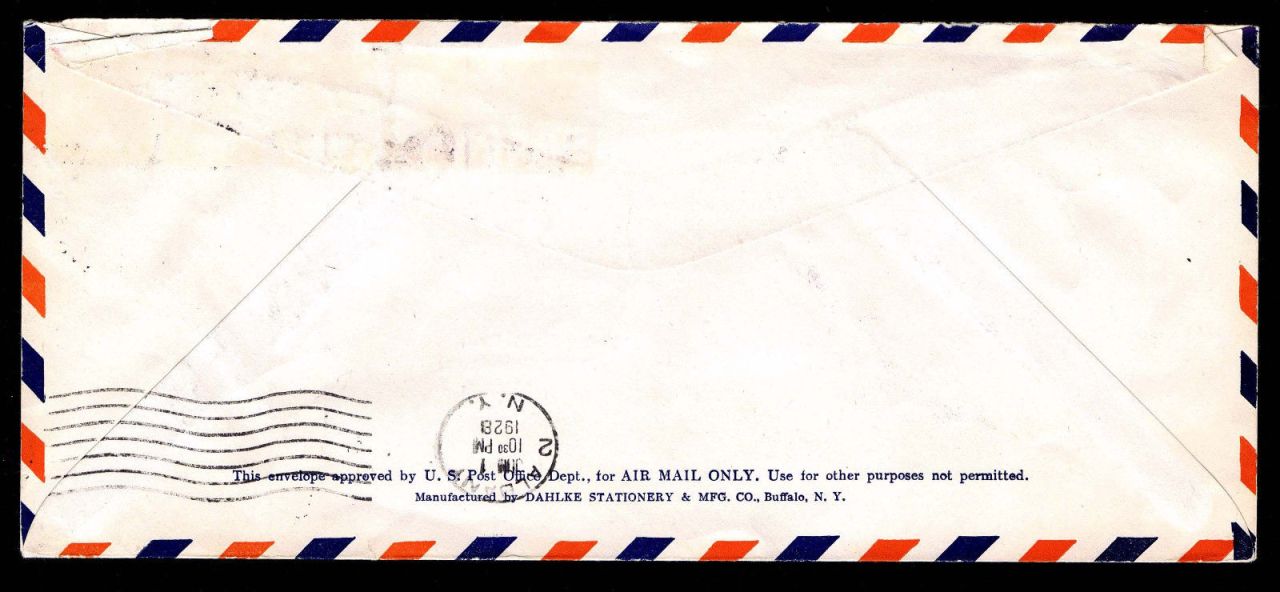 What makes this example particularly interesting is the front, where Mr. Dahlke has autographed it while making mention that he was the "originator and designer" of the envelope:  As alluded to in some of the previously posted designs, the US Post Office Department approved the use of this type of Airmail Envelope in their Postal Manual of 1928, excerpted below:  |
|
Send note to Staff
|
| Edited by wt1 - 03/25/2015 4:59 pm |
|
|
|
|
Pillar Of The Community
United States
1868 Posts |
|
|
Quote:
his patent was filed on October 24, 1927 but was not granted until a year and a half later on May 29, 1929 That was moderately slow by 1920s Patent Office standards, but rapid for today's USPTO in which many cases take 4+ years from filing to grant, and 6-10 years is not unusual for some technology. It's possible that there was concern about subject matter eligibility. Today, the USPTO generally will not grant a patent when the only improvement is the form of printed indicia, as here. Dahlke's application would have been DOA if filed any time in the past two decades and may have been invalid even if his time. They probably dithered over it and finally decided that since the effect of the invention is to improve other technology, namely processes of sorting of classes of mail, it should go through. |
Send note to Staff 
|
|
|
Bedrock Of The Community
United States
12128 Posts |
|
|
When the newly designed (and USPOD approved) envelope was announced in period newspaper articles, Mr. Dahlke is quoted as being the "designer" but the article went on to indicate that Mr. Dahlke is "not permitted to patent his design.": 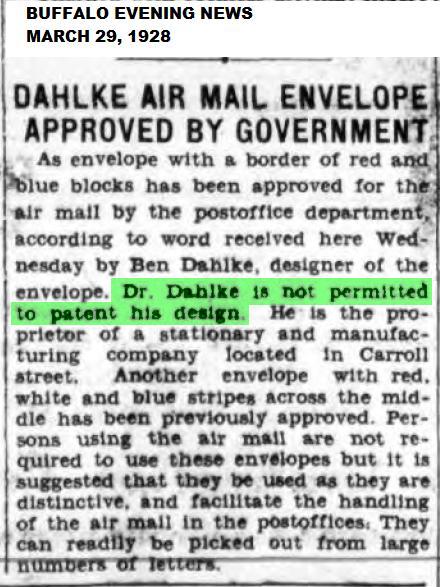 It is again mentioned in this subsequent newspaper article: 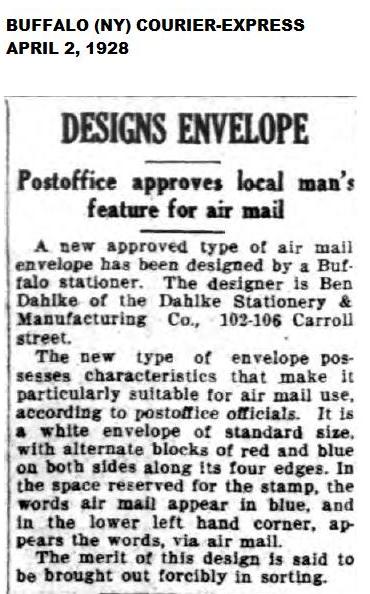 Although other news outlets apparently dropped any reference to Mr. Dahlke's design: 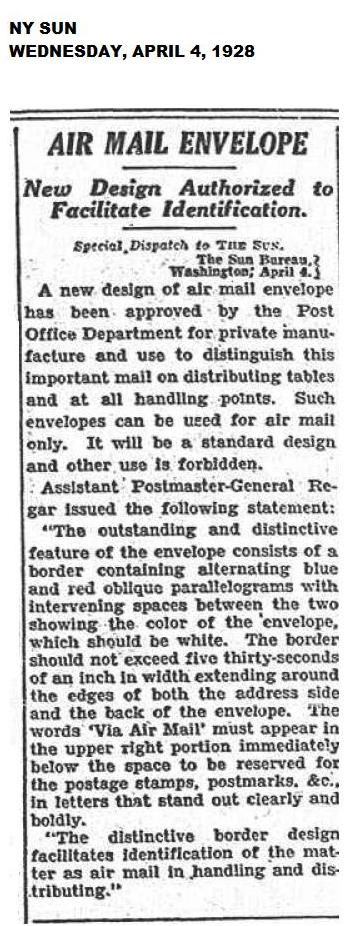 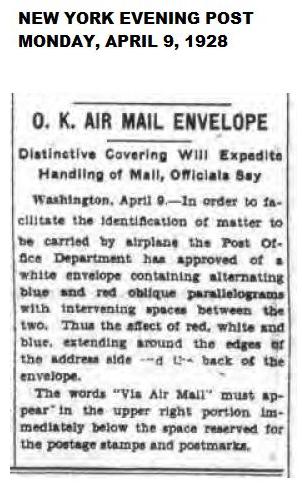 Some years later, in 1943, Mr. Dahlke apparently gave a Lions Club speech in which he mentioned the "difficulty he ran into when securing his 'Airmail Envelope Patent' which is now used today by Uncle Sam." 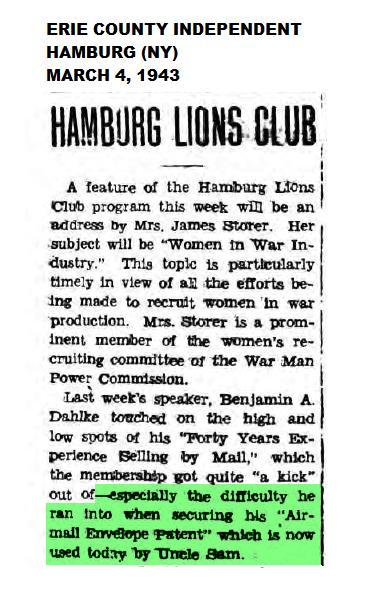 Later still, in 1958, when the Buffalo, NY area was promoting the 40th Anniversary of Airmail Service in the United States, a related article included the comment that Mr. Dahlke said he was offered $1 million for the patent of his airmail envelope by a New York City brokerage firm but he had to refuse the offer and turn the patent over to the US Government citing that ownership of such a patent by a stationery manufacturer would have violated Federal anti-monopoly laws: 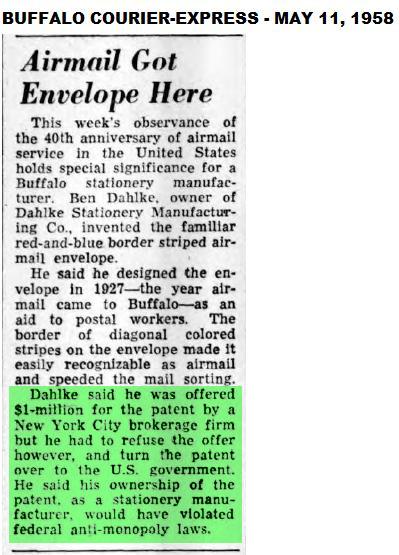 Through the years, Mr. Dahlke gave the post office other suggestions, too, including this failed attempt at a "preferred class of mail service". Although the proposal never got off the ground in 1932, it seems as though it was an early vision of things to come: 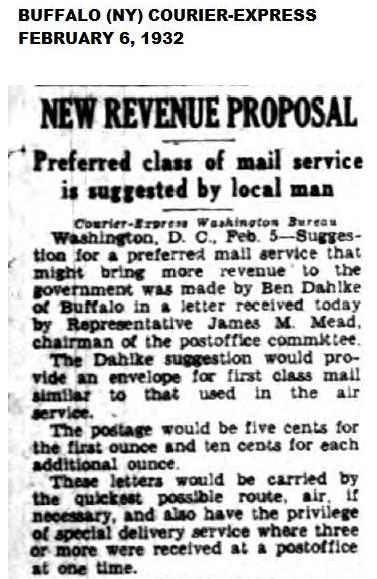 He was even given mention in a Life Magazine article in 1937 because of his "arrest' for jay-walking! 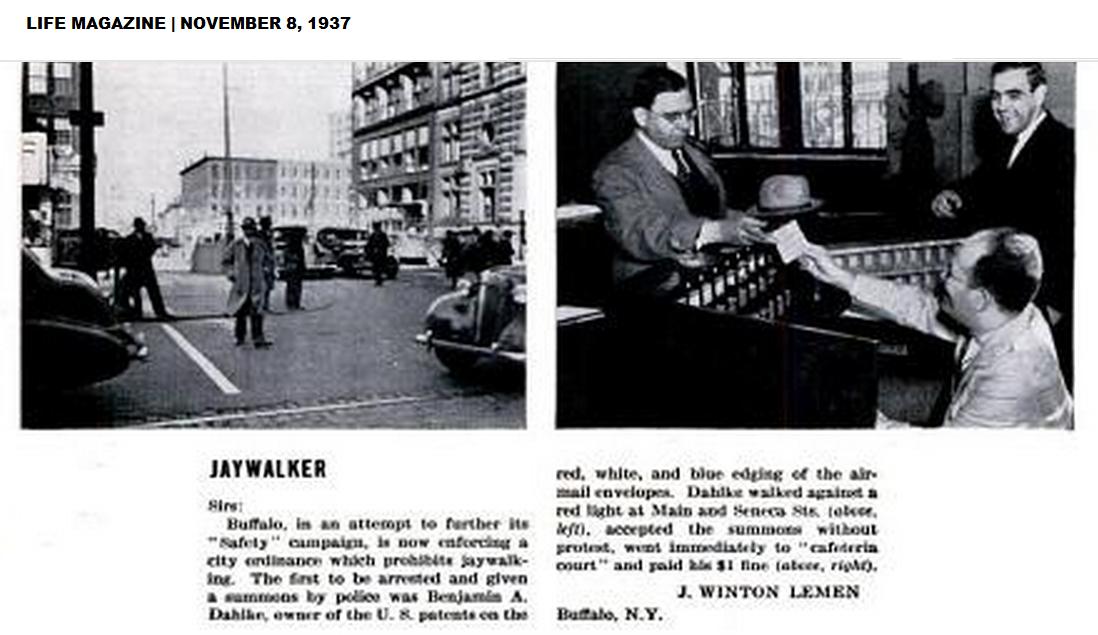 Mr. Dahlke also ran a failed effort at seeking the office of Mayor of Buffalo, NY on the platform that he and the department heads he would appoint would be willing to work at a salary of $1 per year: 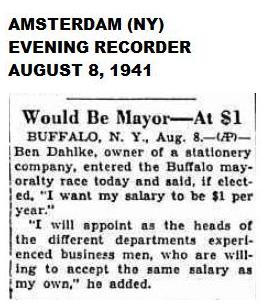 |
|
Send note to Staff
|
|
|
Bedrock Of The Community
United States
12128 Posts |
|
|
Bedrock Of The Community
United States
12128 Posts |
|
|
As a collateral piece of information, I share the link below which appears to be an attempt to document all of the various styles of early airmail envelopes put into use during the early days of airmail service. I must admit that I never realized the enormous number of different airmail envelopes that were created and found this reference to be a most interesting study: http://www.rhcourtneycollector.com/...elopes2.html |
|
Send note to Staff
|
|
|
Moderator
1589 Posts |
|
|
wt1, Fascinating. Thanks for taking the time to do this. I'm a little confused, though, but the POD "accepting" his design, and saying he couldn't patent it, yet he did anyway? Also, I have quite a few of these types of bordered covers, and none of them were produced by Dahlke. Many are blank, and then there is this one, the earliest I've found so far after a quick look through my collection: 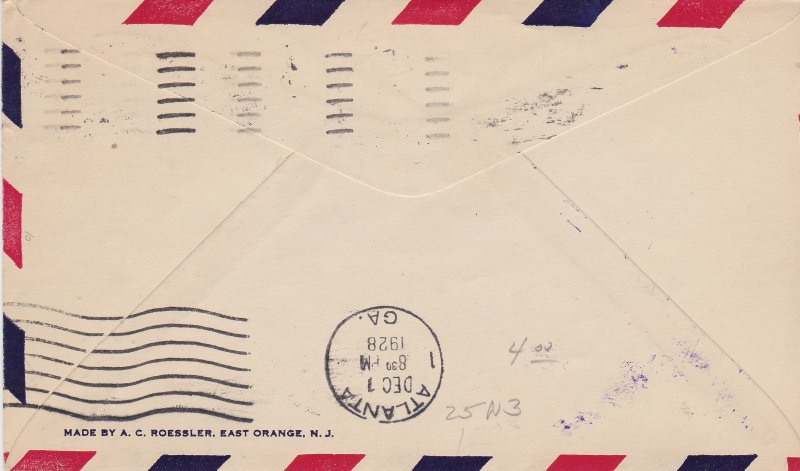 Scanner cut off the right edge. Note that this was "made" (not "designed") by Roessler, and is dated December 1, 1928, a few months after the design was "accepted." Most of the covers I have with this border have no attributions, just the border. Did he ever profit from the patent? Basil |
|
Send note to Staff
|
|
|
Bedrock Of The Community
United States
12128 Posts |
|
|
As I said at the outset, there are quite a few loose ends in my research that I haven't been able to document.
As to the matter of the air mail envelope patent, note that Dahlke submitted his patent in 1927 but was not "awarded" the patent until 1929. The USPOD apparently accepted his airmail envelope design in 1928 at which time they apparently stated that he couldn't patent it, yet he received a patent in 1929. A bit puzzling and an issue that requires more research.
It also opens up the nagging question as to "why" the USPOD would not allow the patent, yet the patent was issued AFTER the USPOD accepted the design. If you were to read into some of the newspaper articles, it suggests to me that Dahlke was not happy with that outcome, but as a businessman in the stationery business, he did not want to be tied up into years of litigation about it.
What I find especially interesting is the article suggesting that Dahlke was once offered $1 million for the patent, but instead had to turn it over to the US Government because of anti-monopoly laws of the day. It would be most interesting to find some further information about Dahlke's surrendering his Patent to the US Government but the USPOD seems completely silent on the issue and nothing appears to be easily found on the internet, so that would require some work to uncover.
In any case, it seems to me there certainly has to be a "paper trail" about the matter that must be documented in some old legal files on the subject.
One final note: Most of the Dahlke references to his design of the airmail envelope are localized to the Upstate New York area (i.e. Buffalo) and it could be that Mr. Dahlke himself made an issue of it to local media, whereas national media had little if any care to be concerned with reporting on such details.
|
|
Send note to Staff
|
| Edited by wt1 - 03/25/2015 7:13 pm |
|
|
Pillar Of The Community
United States
1868 Posts |
|
|
Part of the answer is that the Post Office Department and the Patent Office are independent agencies. Once the patent application was filed, the PO has to grant it unless it could find prior art or declare the subject matter ineligible. The POD did not have power to order the PO to reject the app. However, it is likely that the POD told Dahlke that he must voluntarily abandon the app in the PO as a condition of approval of the design for national use. The PO did not want to have approved a design of one vendor with patent monopoly rights. But apparently Dahlke refused and the POD wanted the design in use so they dropped the abandonment requirement. Meanwhile the patent app had advanced in examination and was granted.
The Patent Office file is not likely to exist, but might. |
|
Send note to Staff
|
|
|
Valued Member
United States
225 Posts |
|
|
Pillar Of The Community
United States
1047 Posts |
|
|
wt1:
Many thanks for posting the information about Ben Dalke. It adds a great deal to my collection of airmail covers with differing airmail border designs.
I am especially grateful for the link to R. Howard Courtney's web page and his inventory of airmail borders. Some time back I had seen some of his work and emailed him but never received a response. Until I learned of his interest, I though that I and a woman who exhibited her collection of these covers at the Wichita Stamp Show were the only collectors of this genre. I expect there are others as well and some may identify themselves as a result of this thread.
Mr. Courtney' inventory includes several covers I don't have and I think that I have some he does not display. I have not counted my covers recently, but at last count the number was just short of 300 obviously different border designs. I have since found many more examples from foreign countries.
My collection is grouped under twenty different headings or topics, the largest of which is "One-of-a-Kind" or covers with designs that I have not found repeated.
If there are other collectors of these covers I would be pleased to correspond and exchange notes and scans with them. Just send me a private email.
Again, wt1, many thanks for initiating this topic.
Don |
|
Send note to Staff
|
|
|
Bedrock Of The Community
United States
12128 Posts |
|
|
Here's a relatively dated Linn's Stamp News article on the subject: http://www.linns.com/news/us-stamps...blue-bordersI find it especially interesting to note that at one point a green and orange circle border was a failed attempt to create a distinct envelope for Special Delivery mail. I have never seen one of these envelopes in actual use, so I expect they are quite scarce and, as suggested in the Linn's article, perhaps a bit undignified for use by those who would have the most interest in sending Special Delivery mail (i.e. legal firms, banks and the business community):  Going back to the subject of airmail envelopes, one little point I never thought about before was covered in the 1928 Postal Guide about airmail envelope designs and the statement that airmail designated envelopes must be white, as no other colors are permissible although I think that requirement later changed in deference to all of the light blue colored envelopes that subsequently came into use. |
|
Send note to Staff
|
| Edited by wt1 - 03/26/2015 1:10 pm |
|
|
Pillar Of The Community
United States
2947 Posts |
|
|
Pillar Of The Community
United States
1047 Posts |
|
|
Here are two Special Delivery covers in my collection with the distinctive border, one philatelic and the other non-philatelic. I never thought much about non-philatelic use being scarce. I have seen both for sale at stamp shows, but neither one in abundance. There may have been some confusion with the public as to whether or not the envelopes were airmail specific and required extra postage. It is my understanding they were not, as evidenced by the non-philatelic cover here. Conversely, the first day cover was for the airmail stamp and the special delivery stamp had to be added because of the cover border. Don 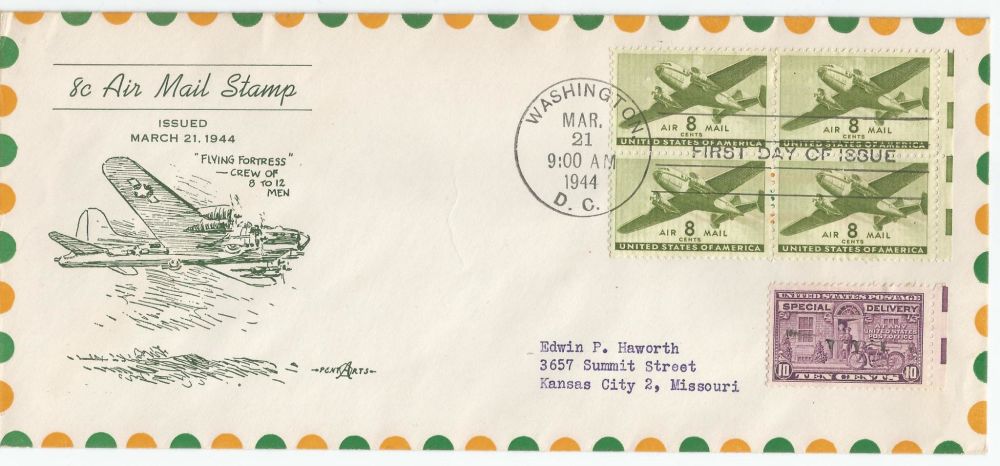  |
|
Send note to Staff
|
| Edited by DonSellos - 03/27/2015 7:02 pm |
|
|
Valued Member
United States
27 Posts |
|
|
Great thread, Neat history.
I was unaware of the Special Delivery envelopes until now. I can see how they would attract the attention of the postal workers to treat them "special".
wt1 Thanks for the education. I really like the "Indian Cycle Agency" rubber back-stamp on the one cover. |
|
Send note to Staff
|
|
|
Bedrock Of The Community
United States
12128 Posts |
|
|
Quote:
I really like the "Indian Cycle Agency" rubber back-stamp on the one cover. Actually, I pulled that "Indian Cycle Agency" cover from this old thread ... I probably should post a link to it here, too, as some fascinating Indian "Motocycle" covers were shown at that time: https://goscf.com/t/16454 |
|
Send note to Staff
|
|
|
Pillar Of The Community
United States
1179 Posts |
|
|
Replies: 19 / Views: 8,452 |
|




 Posted 03/25/2015 4:37 pm