| Author |
 Replies: 49 / Views: 9,506 Replies: 49 / Views: 9,506 |
|
|
|
Pillar Of The Community
Canada
644 Posts |
|
|
BeeSee, I agree that the colour is difficult online, hence I added the perforations as a deciding factor in this case.
The 12.2x12.2 is a later perf (1888 time period - also confirmed by the cancel) which makes this a 41. |
Send note to Staff 
|
|
|
Rest in Peace
7742 Posts |
|
|
Pillar Of The Community
Canada
644 Posts |
|
|
Valued Member
Canada
382 Posts |
|
|
My research indicates that there is an 1886 or 1887 printing of the 3 cent SQ that features a lower left position dot. In all probability, that means that one of the Ottawa plates was used after being retired for around 12 or so years. I have been trying to find one on cover for a while just to prove my theory.
I do not believe that colour is the most accurate method of determining the sequence of printings. Referring to the book by Ted Nixon & John Hillson, there are 13 distinctly different perforations on the 3 cent SQ. I have more than 200 dated covers and stamps and have a record of 100% accuracy sorting by perforation. I have also sorted 100's of 3 cent undated SQ's by perforation and find that, lo and behold, the colours within each perforation grouping are pretty consistent.
GJP |
|
Send note to Staff
|
|
|
Rest in Peace
7742 Posts |
|
|
Garfield, I have 3 or 4 more cover of the SQ 3cent to look at..how knows, your probably on to something.
I have about 200 stand alone SQ 3cents, now I will have to check perfs.
Robert |
|
Send note to Staff
|
| Edited by wert - 02/25/2016 9:03 pm |
|
|
Valued Member
Canada
382 Posts |
|
|
Since my last posting on this subject about 5 hours ago, I have examined 200+ 3 cent SQ covers and finally discovered my missing link. Here is a cover dated April 23, 1886 bearing a 3 cent Small Queen perf 12 x 12 with a lower left position dot. It cannot be an early Ottawa printing as none of them was perf 12 (exactly). This perforation is identified by Nixon & Hillson as a Montreal printing between 1880 and 1886. 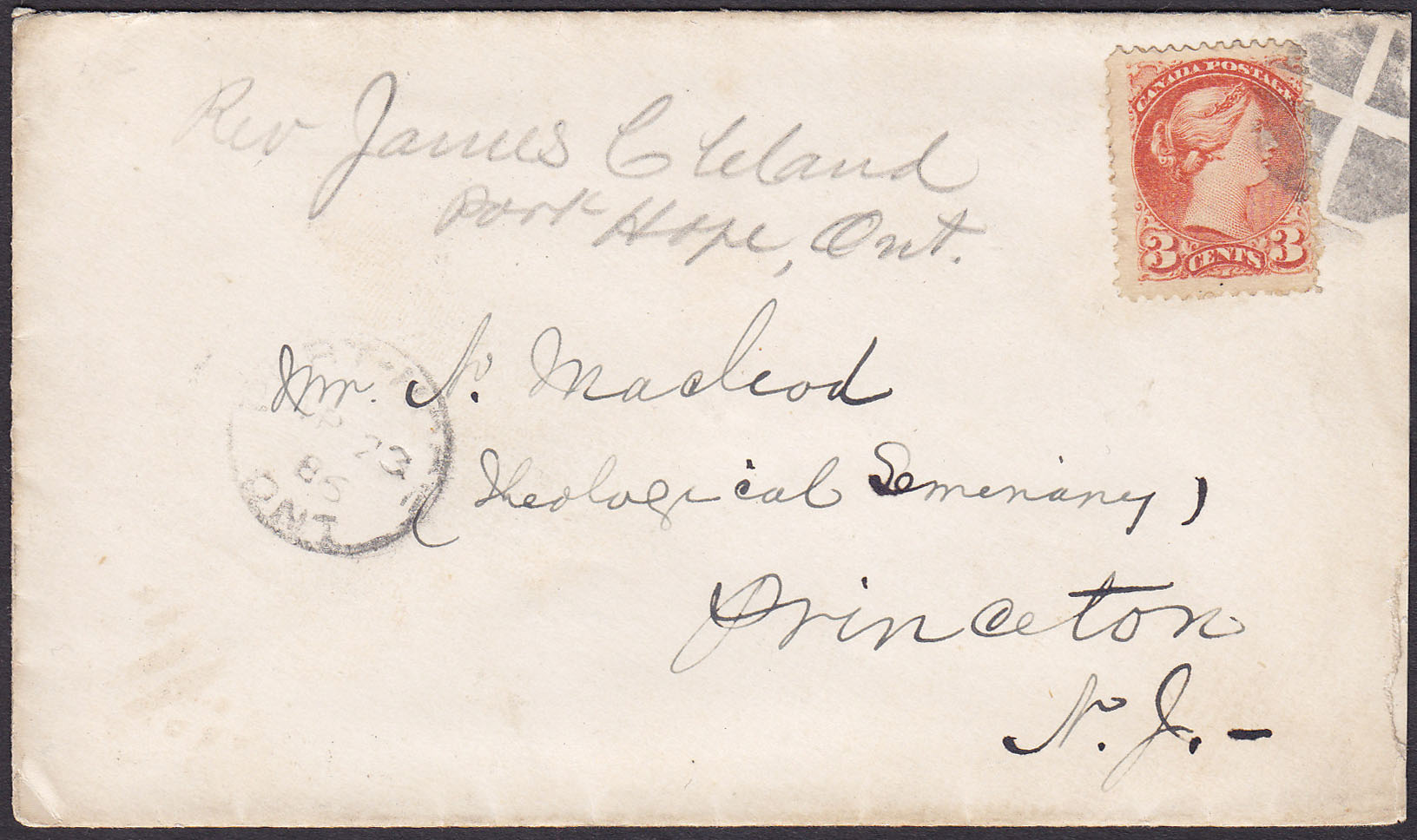 The stamp definitely has a position dot as can be seen below, 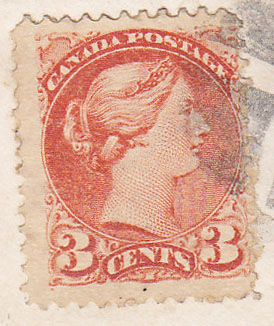 Since the Unitrade catalogue does not recognize this printing, I fall back on my own definition and call it a #41. For all practical purposes, however, I don't care what the catalogue number is and, frankly, it doesn't matter. GJP |
|
Send note to Staff
|
|
|
Pillar Of The Community
Canada
644 Posts |
|
|
gportch, that is an important finding. I admit that the reason I responded to this thread is because I have been wondering the same thing for quite some time. When I first started studying the SQ in any depth, this issue of lower left position dot really confused me. The Unitrade chart that you provide in the catalogue, and other literature stated quite unequivocally that the lower left position dot ONLY appeared on the early printings. I more-or-less came to my own conclusion that this issue was not yet resolved and left it at that (even though I couldn't understand why no one had brought this up before - kudos to wert for that  ). Yet, I had 3c SQ with the lower left position dot that in all other ways were NOT early printings (mainly due to the perf measurement, but also paper, colour). The fact that an early Ottawa plate may have been brought back (however temporarily) into service is an important finding. It would help many starting out to have that noted in Unitrade. When you finish your new chart, you should include a note to the effect that the position dot may appear in later (1886 - 87) printings (and include what we have been discussing here as the reasoning). I agree that the catalogue # is not as important as the information, however, I also think that this printing should have its own sub-letter (eg. 41x or whatever). |
|
Send note to Staff
|
| Edited by 3Dadeo - 02/26/2016 08:17 am |
|
|
Valued Member
39 Posts |
|
|
I think that this subject is fascinating! Boggs wrote, in The Postage Stamps and Postal History of Canada, that during the Montreal printings (and continued from the first Ottawa) a position dot is found at the lower left on every stamps except those from the extreme vertical row of the sheet. However, he goes on saying that "On plates made after 1885 the position dot is not discernable in most instances" (p.282). Hillson and Nixon in Canada's Postage Stamps of the Small Queen Era, 1870-1897 concur and provide further details. They say about the LL position dot that "This method of entering the plate was used certainly up to the late 1870s" and also that "by the 1880s, the method of locating the entries had changed". Positions dots on the new 1880s plates and until the end of the Small Queen era were thus located at nine o'clock or three o'clock of the vignette but didn't show up on the stamp very often (p.11-12). I've looked up my collection and found a couple dated 3 cents stamps with LL position dot from the 1880s. Three in '80, one in '81, two in '83, two in '84 and one in September '88 measured at 12.15 all around, very similar to the one wert has show : 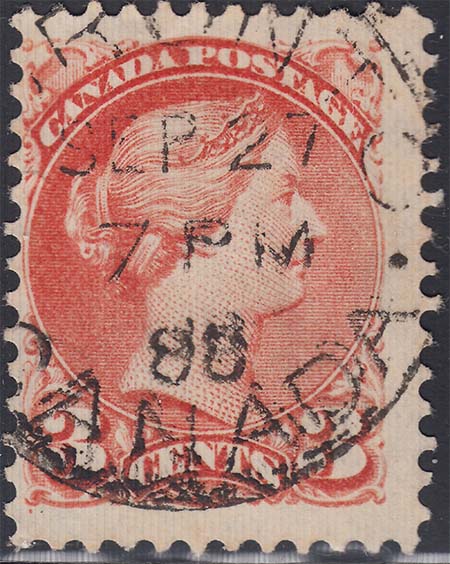 Unfortunately my collection isn't deep enough to draw conclusions. But then I've found an amazingly interesting article in the Small Queen Study Circle of BNAPS, Volume 16 Number 3, March 1992 entitled "Lower Left Position Dots on the 3 Cent Small Queen" by Leonard Kruczynski. http://bnatopics.org/hhlibrary/news...-v016n03.pdfI don't know if there were follow ups to that article. But after reading this and in the light of the previous sources, I think it is plausible that the new 3 cents plates that were laid down beginning in 1880-1881 (the one with the position dot at nine and three o'clock) were used simultaneously with late 1870s plates. When they moved printing operations in the Gazette building in late September of 1888, they discontinued the use of the older plates as can be deduced by the complete lack of LL position dot on the Rose Carmine stamps from that period. The position dot on those are at three o'clock when they are found according to Hillson and Nixon (p.12), and here is a scan of one I own from February 1888. 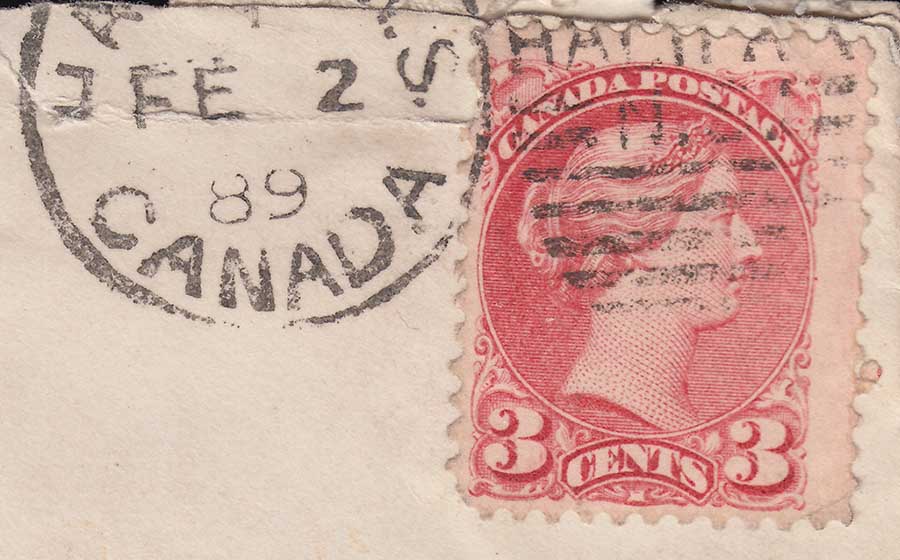 Anyway, that's just my theory but I hope it helps!  |
|
Send note to Staff
|
|
|
Valued Member
Canada
382 Posts |
|
|
Hi Cjusz, welcome to this discussion. I am intrigued by your comment "I've looked up my collection and found a couple dated 3 cents stamps with LL position dot from the 1880s. Three in '80, one in '81, two in '83, two in '84 and one in September '88 measured at 12.15 all around, very similar to the one wert has show" How are you measuring your perfs? There is no record of 12.15 in the 3 cent issue. Could you please recheck those stamps as there should be nothing over "12" between 1870 and 1888 To help the general discussion, I am attaching a scan of my table of 3 cent SQ perforations that is in agreement with Nixon & Hillson 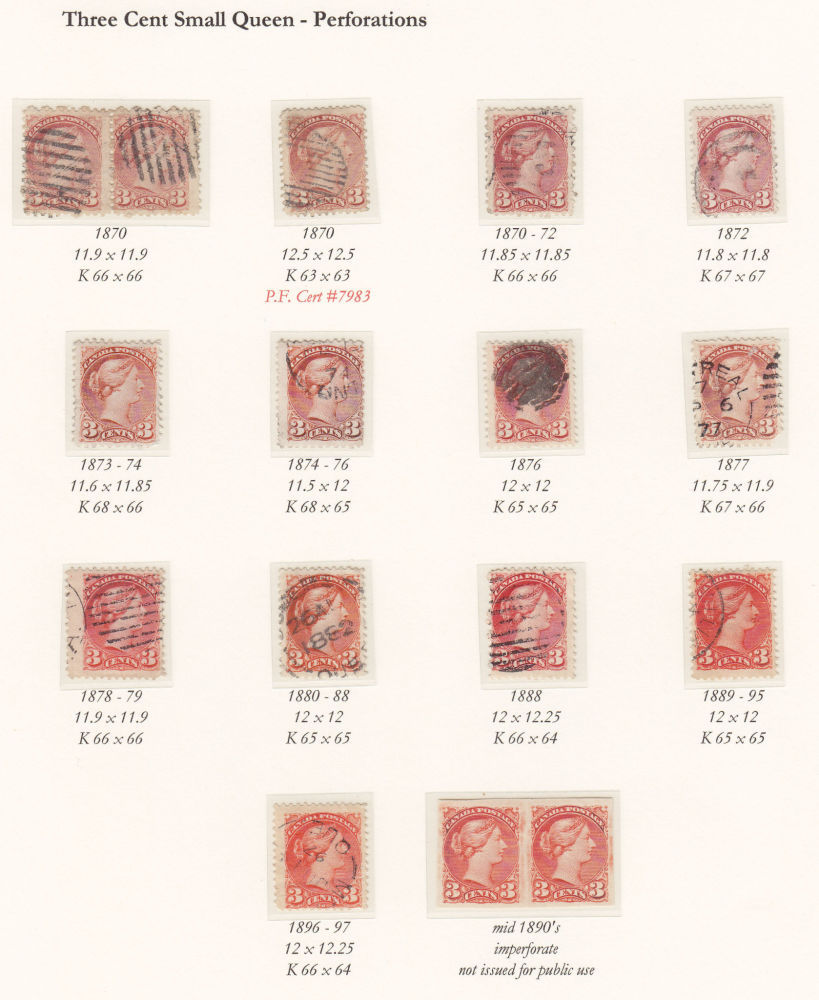 NOTE: K refers to the Kiusalas gauge GJP |
|
Send note to Staff
|
|
|
Pillar Of The Community
Canada
644 Posts |
|
|
gportch - a question about perf guages...
I use the "Perfect Guage".
I have heard that many will only use the "yellow Instanta".
Since we are talking such fine gradations of perf, do you think I should get an Instanta (they are still sold by Stanley Gibbons, though I don't know if the new Instanta is the same as the "Yellow Instanta")?
Also, I note that you don't have any 12.25x12.25 (of which I have several). |
|
Send note to Staff
|
| Edited by 3Dadeo - 02/27/2016 07:47 am |
|
|
Valued Member
39 Posts |
|
|
Perforations are so hard to measure on the Small Queens! I will elaborate on my method a bit later today when I have the time, but let's say I use a similar method as BeeSee explained in another post (I can't find it right now, I'll edit and post link when I do) :
I scan my stamps at 2400 DPI and measure them using a digital ruler in Photoshop.
The results I get are not always in accordance with Hillson and Nixon, who are my prefered reference on the subject. On page 128 of their book, there is a table listing the three cents perforations and they list 1888 perfs at 12x12.15, which I guess is close to the one I have. But then it could be my measurements that are wrong here!
My mistake on my last post as I meant that it is the 1888 I measured at 12.15, I haven't measured the others.
I will redo my measurements and post other infos a bit later today |
|
Send note to Staff
|
|
|
Valued Member
Canada
382 Posts |
|
|
Richard, the "yellow" Instanta has been considered as the best gauge to use. I have, over the last year, checked (using the VSC6000) a number of the new versions of this gauge sold by Unitrade and find that they are now very accurate and are within a fraction of one percent of my old yellow Instanta. If you can find an old Instanta that is great but the new Unitrade appears to be sufficiently accurate for all practical purposes.
For readers not familiar with the VSC6000 at the Greene Foundation, one of the many functions allows me to measure perforations (and gauges) to the nearest 0.01 millimetres.
Cjusz, thanks for re-measuring. I am net too concerned about the 12.15 on the 1888 because that is close to the 12.25. It is the earlier dated copies that really interest me.
GJP
|
|
Send note to Staff
|
|
|
Pillar Of The Community
Canada
644 Posts |
|
|
I found and purchased a Yellow Instanta online for $15US
It won't hurt to be able to compare results with my Unitrade perf guage. |
|
Send note to Staff
|
|
|
Valued Member
39 Posts |
|
|
Both my Old Yellow Instanta and my New "clear" Instanta are off by a significant margin that makes them inappropriate to measure Small Queens. I believe the plastic they are printed on is not entirely stable and may shrink (or expand) over time. Here are examples scanned at 2400 DPI of both gauges and a steel ruler for comparison. Measurements are made in pixels in Photoshop using the ruler tool, and at that scale, equivalence is 1 pixel = 0.0105833333 periodic millimeter. My scanner is not as precise (of course!) as the VSC6000, but enough to demonstrate that both of my gauges are inaccurate. Photoshop Old Yellow Instanta measurements over 20 millimeters : 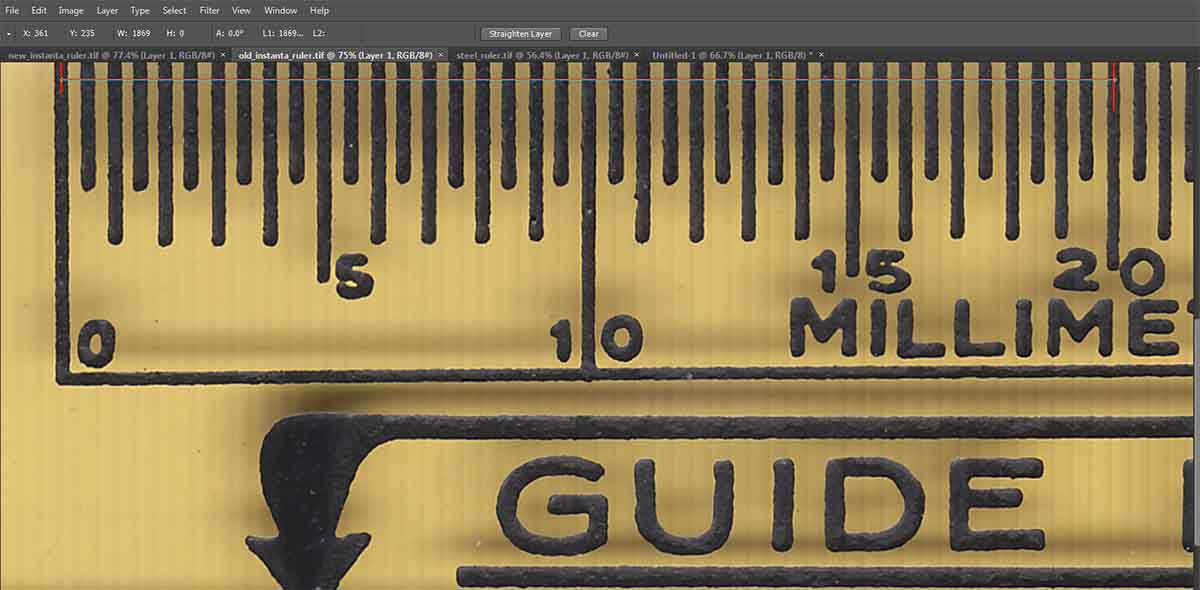 w: 1869 pixels, thus 1869 * 0.0105833333 = 19.78 millimeters, short by 0.22 --- Photoshop New Clear Instanta measurements over 20 millimeters : 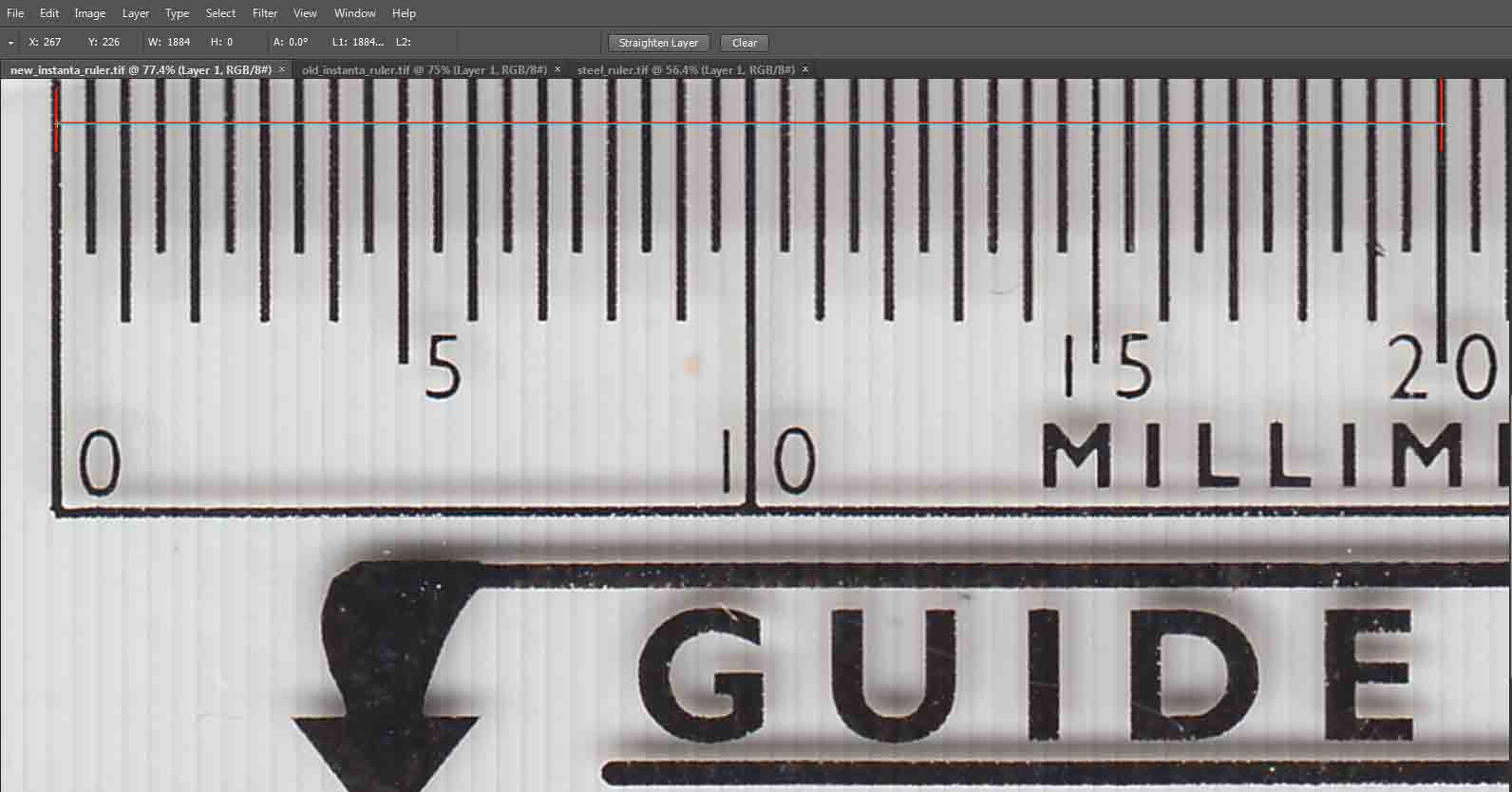 w: 1884 pixels, thus 1884 * 0.0105833333 = 19.94 millimeters, short by 0.06 --- Photoshop Steel Ruler measurements over 20 millimeters : 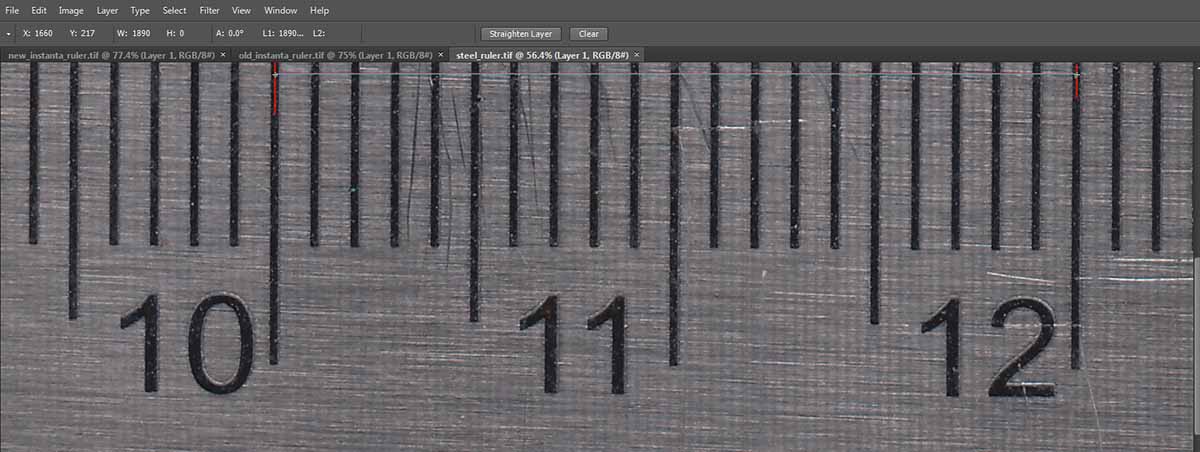 w: 1890 pixels, thus 1890 * 0.0105833333 = 20.00 millimeters My conclusion is that my steel ruler is more precise than the Instantas rulers and the combination of my scanner and Photoshop can produce precise measurements. Here's an exemple from the Old Yellow Instanta :  The 12th hole at 12.0 on the gauge is measured at 1869 pixels, that's 19.78 millimeters, again short by 0.22. Hence the real measurement the gauges give is not 12.0, but 12 holes every 19.78 mm, or 12.13 per 2cm. That kind of also indicate that my yellow has shrink by 0.22 millimeters in width since it was made (if it ever was precise) That's basically why I stick with Photoshop when I measure Small Queens! gportch, I'll have the measurements during the evening as well as a little reflexion on the subject! |
|
Send note to Staff
|
|
|
Rest in Peace
7742 Posts |
|
|
I use the same type of gauge on my computer using GIMP...If any one cant afford to buy photoshop, I will place a link for GIMP ( Graphical Image Manipulation Program) ..It is FREE to download. Robert 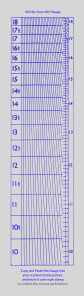 |
|
Send note to Staff
|
| Edited by wert - 02/27/2016 4:10 pm |
|
|
Replies: 49 / Views: 9,506 |
|




 Posted 02/24/2016 5:12 pm


