| Author |
 Replies: 19 / Views: 3,132 Replies: 19 / Views: 3,132 |
|
Rest in Peace
7742 Posts |
|
|
Hi guys...I was at the local stamp club last night and picked up a few things at the auction...I was looking at a lot I bought of Postage Due stamps...I noticed some thing about the 10 cent (scott J35a) stamp...It is a part of the "Fourth Issue" which is a perforation of 12.5 x 12.0 as standard perforation.. I put it up to my own stamp which is 12.5 x 12.0..But this new stamp was surprisingly a definite perforation of 12.75 x 12.0...Take a look at the pictures below. 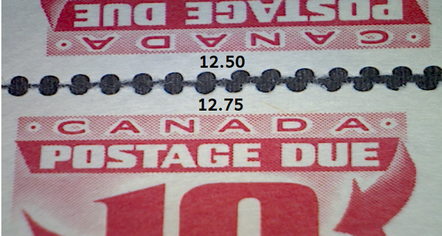 12.5 x 12.0 - regular perforation 12.5 x 12.0 - regular perforation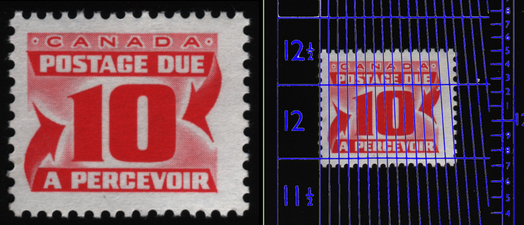 12.75 x 12.0 - New perforation 12.75 x 12.0 - New perforation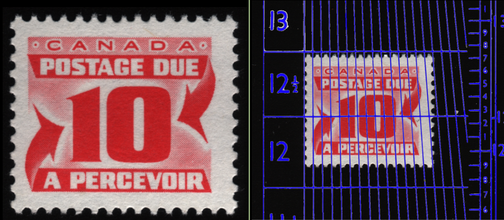 I have gone through the Unitrade catalogue all the way back to Scott 1 and there was NO combination of 12.75 x 12.0 or even 12.0 x 12.75...I am going to forward this on to BNAPS to see what they think..In the mean time I will ask any one who has these stamps to kindly check theirs and get back to me..Thanks. Robert |
|
Send note to Staff
|
| Edited by wert - 01/31/2017 5:11 pm |
|
|
|
|
Valued Member
36 Posts |
|
|
Looking at the top illustration, the teeth on the left side of the two stamps line up whereas the teeth on the right side are offset by a consistent amount. On the bottom stamp, the tooth in the centre is slightly narrower than the corresponding tooth on the top stamp. I believe the gauge of the perforations on both stamps is the same; however, the narrower width of the centre tooth is throwing off the measurement.
I believe the stamps are from the "Fourth Issue", which was perforated by a one-row H-comb (the same type of comb Canadian Bank Note Co. used to perforate the 1973 Caricature definitives and the first printing of the 1977 Floral definitives). On the Postage Due stamps, the comb traveled horizontally over the sheet so a misalignment between strikes would show up as a misalignment in the horizontal perforations. Because of the way the pins are laid out on a H-comb, a strike misalignment will produce a perforation discontinuity at the midpoint of the stamp, not at the corner. I believe that is what happened here - the slightly narrower centre tooth on the bottom stamp in the top illustration was caused by a slight misalignment between strikes of the H-comb perforator. |
Send note to Staff 
|
|
|
Rest in Peace
7742 Posts |
|
|
Dont let the distortion on the first picture you see throw you off..It was taken with a USB microscope and of course you knew that..right. Now here is a picture with my phone and perforation gauge.....Dont know how much more information needed to show the difference. Robert 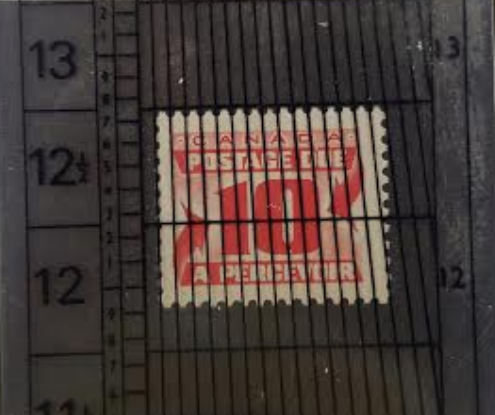 |
|
Send note to Staff
|
|
|
Pillar Of The Community
3865 Posts |
|
|
Check if both of the stamp's horizontal sides are the exact same gauge.
Check if the design size horizontally across is the same for both stamps.
There is a tendency for catalogues to group them all to the nearest 1/2
as the perforation gauge does with the perforation 12 1/4 to 12 3/4 range
as 12 1/2 eventhough specialists use 1/10 as on the other side of the gauge. |
|
Send note to Staff
|
| Edited by jogil - 02/01/2017 12:30 pm |
|
|
Pillar Of The Community
6366 Posts |
|
|
AdmCol's explanation makes perfect sense in comparison with your first photo. You would do well to re-read it and fully understand it. The lower stamp in the first photo which you have labeled as 12.75, is in reality, perf 12.5 along the left half AND perf 12.5 along the right half. The narrow tooth in the center condenses the overall "apparent rate" to 12.75.
Comparing the perforation alignments in your first illustration: The perfs align nicely on the left half of the stamps. They are all off by the same 1/4 perf on the right half. If the lower stamp were truly a 12.75, then the misalignment would be a gradually increasing amount between the stamps. |
|
Send note to Staff
|
|
|
Pillar Of The Community
3865 Posts |
|
|
Is there gum on the back of both mint stamps? |
|
Send note to Staff
|
| Edited by jogil - 02/01/2017 12:47 pm |
|
|
Rest in Peace
7742 Posts |
|
|
Yes..gum on both.
John..Then you are suggesting that ANY Canadian stamp perf could be wrong if we use AdmCol theory..????
Robert
|
|
Send note to Staff
|
|
|
Pillar Of The Community
6366 Posts |
|
|
No. It is a matter of understanding what the H-comb looks like. I don't have an illustration handy. Hopefully someone does. |
|
Send note to Staff
|
|
|
Valued Member
36 Posts |
|
|
There is an illustration of the T-comb and H-comb perforators on the Elizabethan II Study Group website: http://www.adminware.ca/esg/esg-glo...htm#CombPerfAlso illustrated is a block of the 45c QE II definitive with a major misalignment of the perforator, which happens to be a H-comb perforator. Note the short columns of vertical holes above and below the long row of horizontal holes. In this case, the perforator traveled vertically over the sheet of stamps. There is another illustration of perforators and their pin arrangements and the varieties strike misalignments can produce in an exhibit "My Favourite Elizabethan Varieties" on the BNAPS website. Go to this link: http://www.bnaps.org/ore/Beaudet-Fa...arieties.htmand navigate to page 10 of frame 1. See also page 16 of frame 1. |
|
Send note to Staff
|
| Edited by AdmCol - 02/01/2017 1:55 pm |
|
|
Rest in Peace
Canada
5701 Posts |
|
|
Also, those linear gauges play tricks with the eyes and are very difficult to line up with perforations, especially 1/4 or less.
I find the gauges with the hole patterns are much easier to get an accurate reading. |
|
Send note to Staff
|
|
|
|
Rest in Peace
7742 Posts |
|
|
Quote:
I believe the gauge of the perforations on both stamps is the same; however, the narrower width of the centre tooth is throwing off the measurement. AdmCol....So what you are saying, it is not variety, just an oddity...and nothing to get excited about. Robert |
|
Send note to Staff
|
|
|
Valued Member
36 Posts |
|
|
Your stamp is not a perforation gauge variety. However, the variety - a smaller than normal tooth at the centre of the stamp - does demonstrate the effect caused by a strike misalignment of the H-comb perforator. As such, it does hold some interest. Obviously a larger strike misalignment, such as the ones illustrated in the links I provided in an earlier posting, would be of greater interest. |
|
Send note to Staff
|
|
|
Rest in Peace
7742 Posts |
|
|
Thanks AdmCol..I will mark it as an H-comb perforation along side of my normal stamp.
Robert |
|
Send note to Staff
|
|
|
Pillar Of The Community
3865 Posts |
|
|
There appears to be a variation in the horizontal design length between the two stamps in the picture below. Is it a distortion? Probably not since the perforation differences are shown in it. 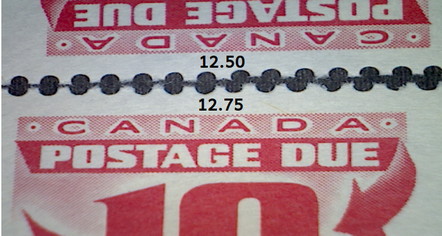 |
|
Send note to Staff
|
| Edited by jogil - 02/02/2017 07:51 am |
|
|
Moderator

United States
12330 Posts |
|
|
The key to using images in any type of dimensional comparison is to use a flat bed scanner at 100% with no post processing of the image. It is very, very difficult to use a camera image since the camera angle has to be at exactly 90 degrees above the stamp. And if you do manage to get close to 90 degrees over the top, you also have to hold the camera level (no tilt) as you snap the image.
When using a scanner, the stamps should be scanned together in the same scan and at a 1:1 scale. With flat bed scanner you should also locate the CCD camera on the scan bar and position the stamps over the top of it. The CCD uses a lens (like a fish eye) to scan the entire width of the glass (platen) and can introduce distortion around the sides of the scanning bed. Interestingly, the CCD is often not centered on the scanner bar but rather set off center. You simply have to look through the scanner glass and see where your scanner has it mounted.
Avoiding camera images will limit questions of distortion.
Don |
|
Send note to Staff
|
|
|
Pillar Of The Community
923 Posts |
|
|
I think AdmCol nailed it with the "H" comb. Just shifted the right half a bit 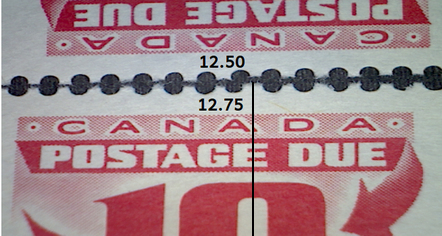 |
|
Send note to Staff
|
| Edited by sak - 02/02/2017 08:20 am |
|
|
Replies: 19 / Views: 3,132 |
|




 Posted 01/31/2017 5:11 pm


