| Author |
 Replies: 49 / Views: 17,287 Replies: 49 / Views: 17,287 |
|
|
|
Pillar Of The Community
1375 Posts |
|
|
Thank you both again, and thank you very much for the article, sinclair. That was interesting reading although not a long science article :). I myself think that 0.001 inch would be really very thin for those 3c stamps, and I doubt if they are still somewhere and measured with tools of today. While it was really a pleasure to read the 3c banknote paper thickness article, some research on the 1851 3c and 12c would also be very interesting. For sure I will have a look at all 1851 stamps I have and especially those who will be new in my hands. I really learned a lot about them here in this thread. What would be fitting nice here: There is also the "very thin paper" of the 1861 stamps (grilled stamps, some of the E grills and most of the F grills). I got an answer of cfrphoto here: https://goscf.com/t/56026#489980But I still didn't understand it really. So is the "very thin paper" also appearing at some early grilled banknote stamps? And to stay at the topic as well: has anyone already done measurements of the paper thickness of the 1861 very thin paper, I would assume it's similar mm/inch as the 1851 thin paper (although it's not India of course)? |
Send note to Staff 
|
|
|
Pillar Of The Community
1375 Posts |
|
|
Here another interesting article: http://www.nystamp.org/postal-histo...ic-is-paper/Nothing new about the 1851 thin / India paper, but some information about the 1861 paper: 1861 premiere gravure essays: very thin, transparent paper about .65-.75 mils
1861 regular issue paper initially a thin translucent hard paper measuring .70-.75mils
from January 1862: shifted to medium thickness paper measuring .80-.85 milsAbout the "thin paper" of that time (1868), Hahn says that it was used - Brookman's theory not proven but probable - to improve grill impressions. There is no thickness given, but the thin paper is: - extra sizing - brittle - sharp snap at flick test - paper darker or gray, translucent - the back like 'waxed paper' and: "this paper was never observed on earlier stamps and is not found used later" this would answer my question about the usage of the thin paper at the grilled banknote stamps (see my link above), and I would read it like it was not used for the banknote stamps. The known banknote stamps with very thin paper would rather come from soaked double paper stamps or result of a bad batch of paper. so, what questions are there left... :). - anybody some more information about the thickness of the 1861 "thin paper"? - I didn't find any mention of a thick paper like the 10c banknote I showed at the beginning, so what paper is this? |
|
Send note to Staff
|
|
|
Valued Member
213 Posts |
|
|
I'll elaborate a bit more on my prior post.
The only materials transferred between National and Continental were those owned by the government. The ink, the paper, transfer rollers, and even unsold sheets of stamps, remained behind because the government declined to pay for them.
Thus, when you find the same paper used (i.e. ribbed) by both National and Continential, the assumption is it all came from the same paper mill.
|
|
Send note to Staff
|
|
|
Valued Member
213 Posts |
|
|
Trigger alert.
The early papers of the 1851 issue were the same as that used for the 1850 printings of the prior issue.
I wish I could post pictures here, but if you have a 3c on thin paper, place it side-by-side with a 5c 1847 from the 2nd printing of 1850. Flip the two over on their backs, and viola, the papers are the same color and thickness.
If you think about it, it's only natural that the 1851 issue would start out using the same paper as the 1847s. :-) |
|
Send note to Staff
|
|
|
Pillar Of The Community
United States
2555 Posts |
|
|
That theory conforms well with some of my opinions about the early printings on thin paper and have pretty much thought the same thing but never really put my eyes on what I thought was an exact match. Do you believe that there is actually any India paper in them? I have always had my doubts. I have also said many times that I don't believe there is more than one type of thin paper. I reviewed my material the other night and can not budge from that opinion. In fact, if I chose to do so, I could post images of my own stamps and challenge anybody to sort out the part India stamps from the thin but not part India stamps.
AJ, I encourage you to email the images to me and I will post them for you. I promise to clearly state who's images they are. |
|
Send note to Staff
|
|
|
Moderator

United States
12330 Posts |
|
|
Hi Winston,
I already sent AJ an email offering image posting help and my email address. :P
Don |
|
Send note to Staff
|
|
|
Pillar Of The Community
United States
2555 Posts |
|
|
Well Don, before I read your message I also sent him a direct email to his address in the USPCS directory. |
|
Send note to Staff
|
|
|
Pillar Of The Community
United States
2555 Posts |
|
|
Just to be clear, I don't necessarily agree that the thin paper is the same as what the late printings of the 1947's were printed on. I am willing to contradict anybody and everybody if I believe it, but this would sort of go against what has been espoused by a long list of the biggest names in philately. And again, I haven't seen one (an 1847) that I thought was a dead ringer either.
|
|
Send note to Staff
|
|
|
Pillar Of The Community
1375 Posts |
|
|
thank you again, that's all interesting, also the other threads about paper that were answered the last days. Here in my thread I still search information about the 1861 thin paper, so not the 1847 or 1851.
Can I assume that there is no more research done in this direction, so that there are for example no thickness measurements in comparison to "normal" 1861 paper?
and AJ: thanks again, but still I ask myself then in the case of ribbed paper as your example: did the National also use ribbed paper? I thought this was exclusive to the Continental? Weiss and Payton mention 1870 2 cents stamps (National) to be known on ribbed paper, but I didn't find any other information on that. so is this still seen as correct and did you refer to those 2c stamps?
(about my other 10c banknote stamp (1882) I will do some research on my own and come back later with another thread possibly.) |
|
Send note to Staff
|
|
|
Moderator
United States
12330 Posts |
|
|
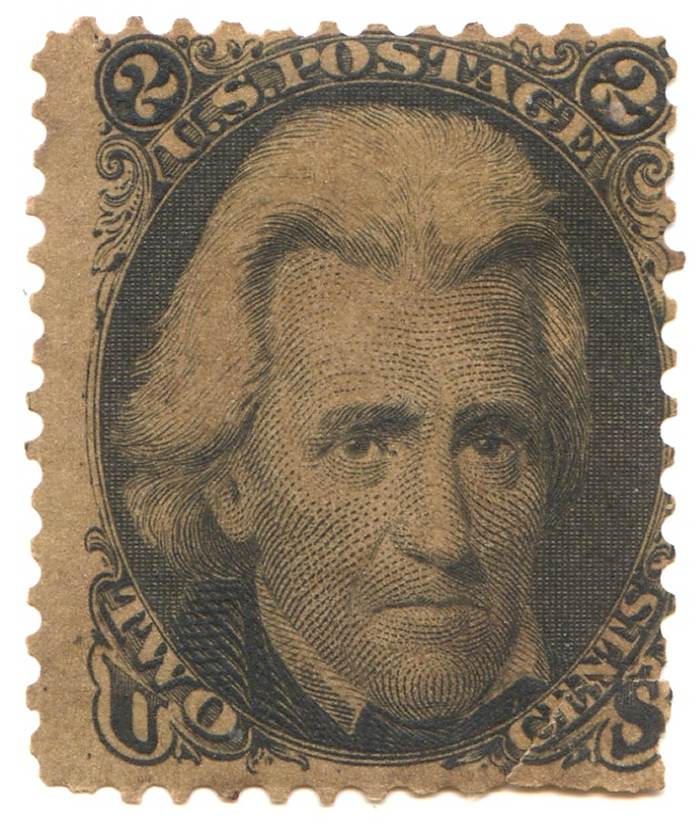 High resolution image links of same stamp http://www.stampsmarter.com/webimages/straw1.jpghttp://www.stampsmarter.com/webimages/straw2.jpgI'll toss this badly damaged and unusual 'thin' paper stamp into the discussion. It came from a collection a got a few years back from Europe if I translated correctly the stamp was marked as 'straw' or 'wheat' paper. The paper is indeed very strange; it is very thin, very hard, and very brittle. It also has an odd color and inclusions. At first I thought this was the worse toned stamp ever, but frankly I am not sure. Does anyone have any feedback on 'straw' or 'wheat' think paper? I am reposting an a 1942 paper articvle that Hal previously posted back in 2015. 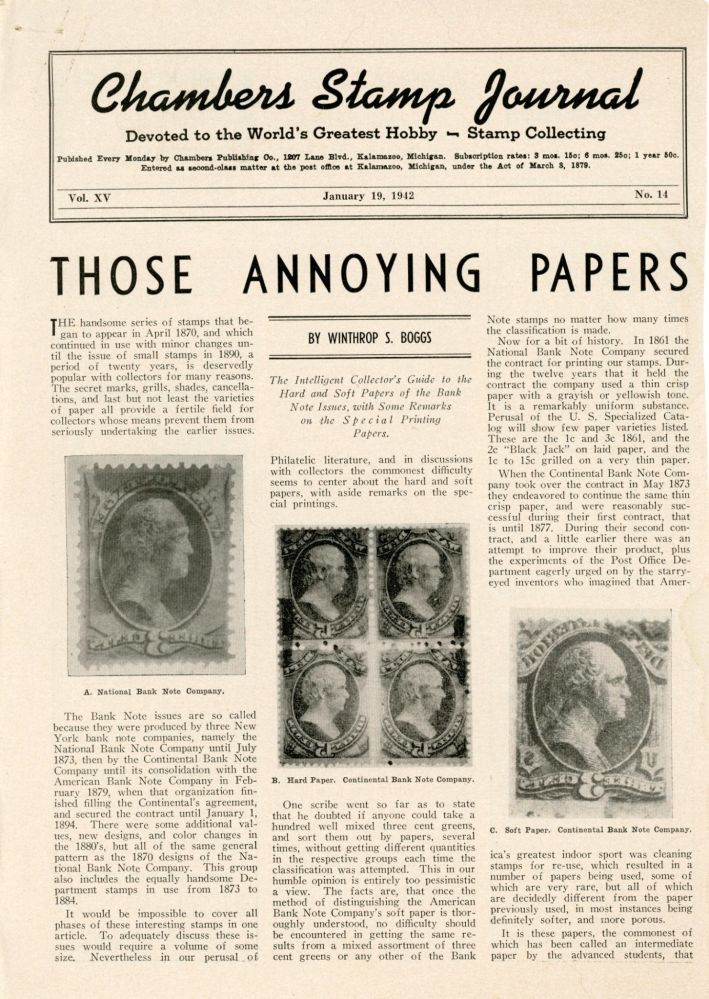 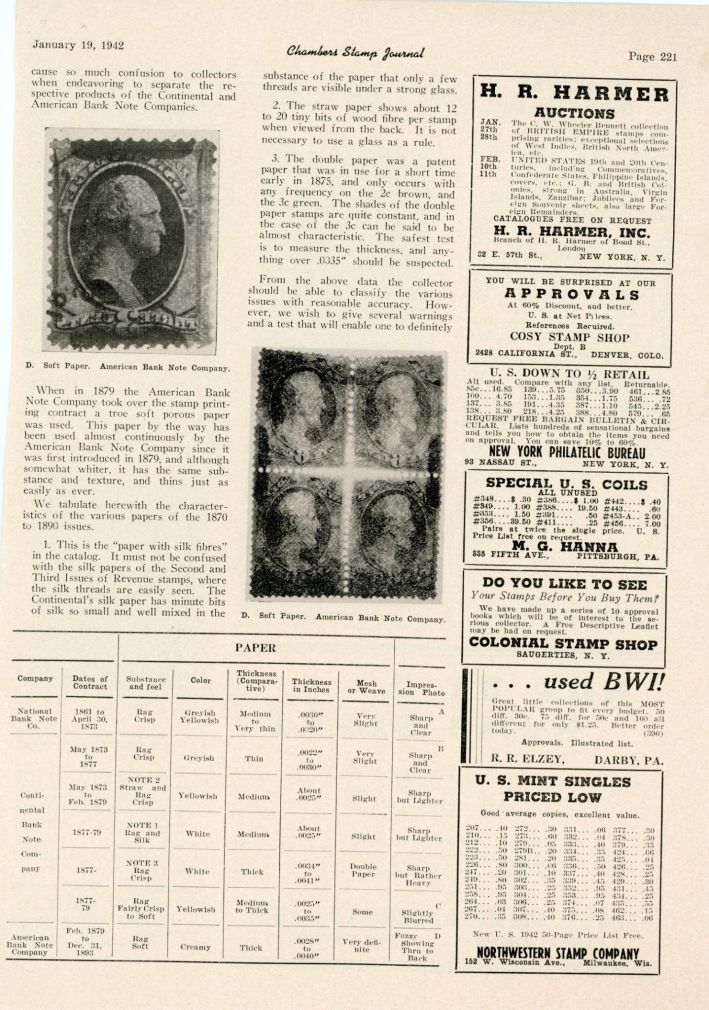 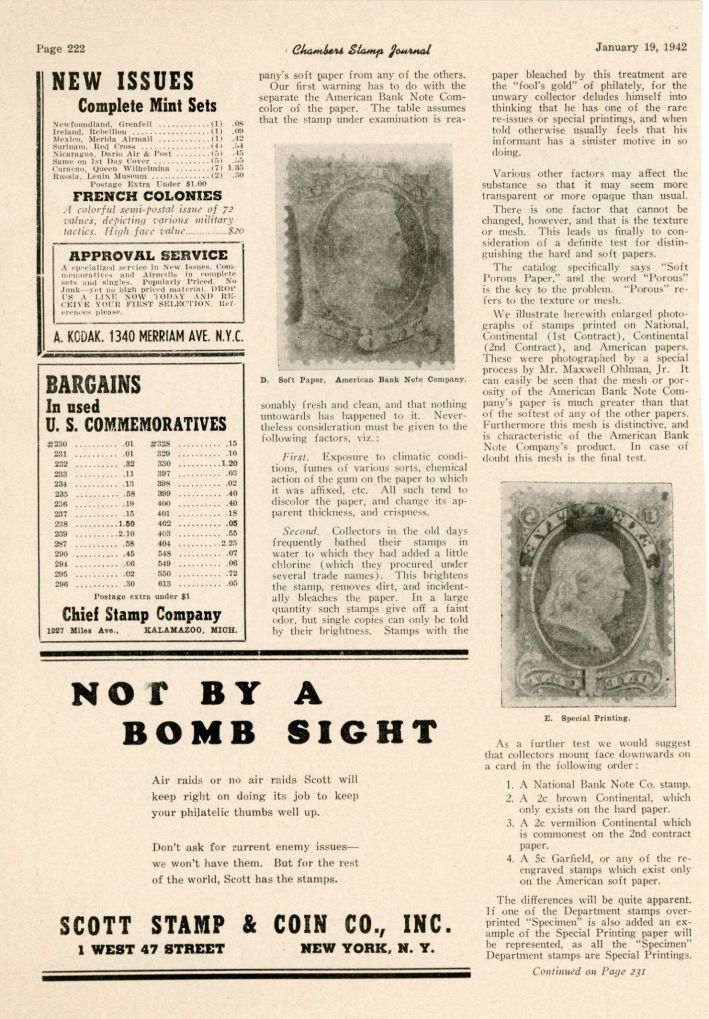 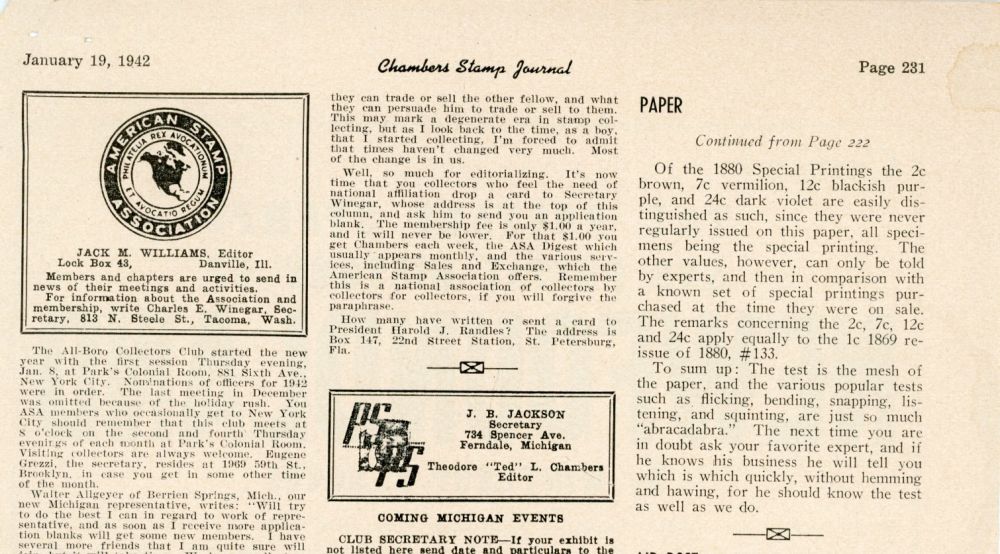 Don |
|
Send note to Staff
|
|
|
Pillar Of The Community
1375 Posts |
|
|
Thank you, Don, that was interesting to read. It's also about the bank note stamps, not the very thin paper of 1861, as you also show your 2 cents stamp. So now we are two, who would like to know more about the 1861 thin paper :). did you ever measure your stamp? but as long as no measurement research of the 1861 thin paper is known (as it seems), my list I gave above is all I can give as indications for very thin paper of 1861. I will also have a second look at all my 1861 stamps. |
|
Send note to Staff
|
|
|
Valued Member
213 Posts |
|
|
stamperix said "did the National also use ribbed paper? I thought this was exclusive to the Continental? Weiss and Payton mention 1870 2 cents stamps (National) to be known on ribbed paper, but I didn't find any other information on that. so is this still seen as correct and did you refer to those 2c stamps"
I'm not sure if you saw my earlier post referencing "Some Data on Continental Bank Note Company Ribbed Paper Stamps," by William E. Mooz. Chronicle of USPCS, August 2000 (No.187).
The so-called ribbed paper was thought to be exclusive to National until Mr. Mooz was able to identify a certain few Continental printings on the same paper.
|
|
Send note to Staff
|
|
|
Pillar Of The Community
United States
1337 Posts |
|
|
Here is one that seems odd. It feels real thick and the paper is brownish in color. The only other paper talked about was thin paper. Maybe it is my imagination but it sure seems thick and strange. AJ, what do you think of this paper? Just dirty? Normal? 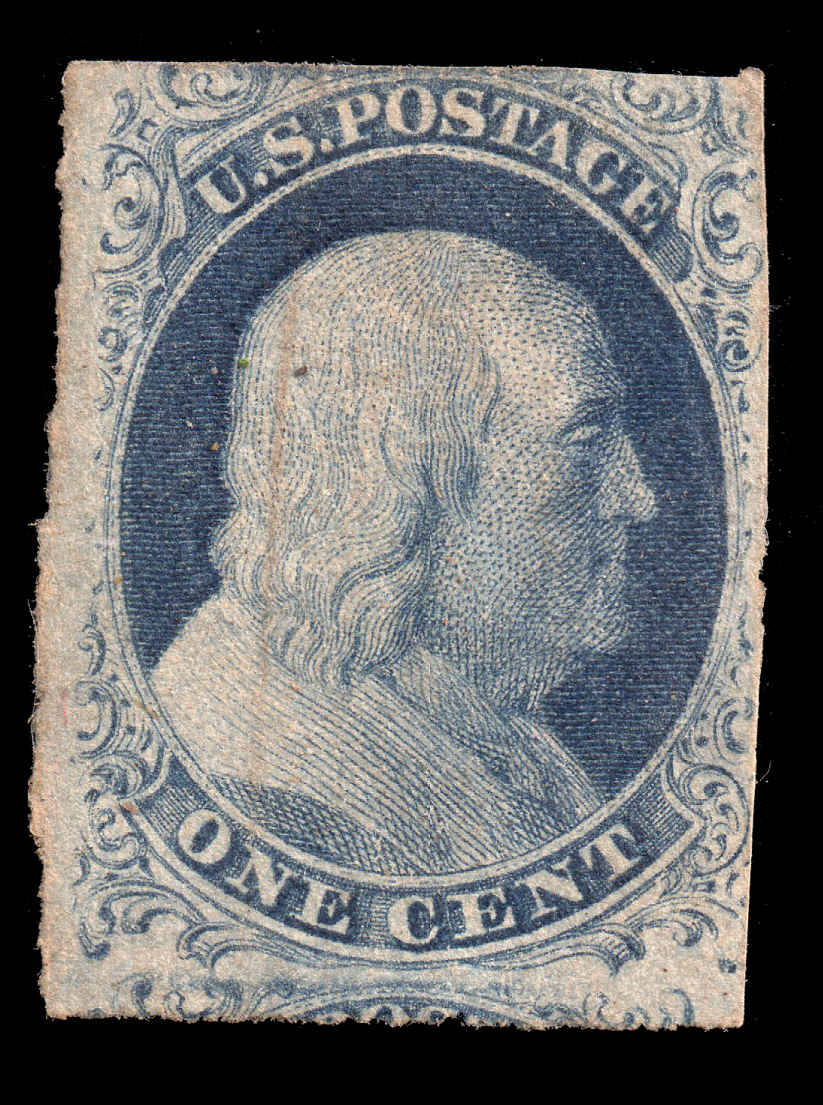 |
|
Send note to Staff
|
| Edited by jaxom100 - 01/04/2018 11:39 am |
|
|
Valued Member
213 Posts |
|
|
How very kind of you to post the Boggs article on Banknote papers! I was librarian of the Seattle Collectors Club during the early 1990s and read everything I could get my hands on. I don't remember ever seeing this article, so I thank you very much. Winthrup Boggs was the first U.S. paper expert, and he is the one who inspired me to continue the research into US stamp papers. Boggs uncovered the Rawdon, Hatch, Wright & Edison correspondence that discussed the making of the N.Y. City Delivery issues of 1842-50, the 1845 New York Provisional Issue, and the U.S. 1847 Issue. He is credited with identifying the Willcox Paper Co. of Philadelphia (yes, two 'l's' See: http://thomaswillcox.blogspot.com/) as the principal supplier of paper for the latter of these issues. Another accomplishment of his was "The Postage Stamps of Canada," in which he made a great study of the early watermarked paper, which according to Government records was also made by Willcox. (see Appendix P) Boggs contacted the legendary Dr. Dard Hunter, author of "Papermaking, The History and Technique of an Ancient Craft." He encouraged Dr. Hunter to write an article on stamp paper for the Philatelic Congress Books. Boggs also sent Dr. Hunter a few of the U.S. and Canadian stamps with stitch watermarks, to which the latter said (quoting from memory), "Stamps are such small bits of paper, making them difficult to identify. . . . The stitches may be the result of repairs to the paper mold." Dr. Hunter referred Boggs to the Crane Library for further information. Unfortunately, the library records were so disorganized that no new leads could be found. This is where Mr. Boggs's research ended. Despite his many successes Boggs was unable to generate significant interest in American stamp papers. He was most disappointing that dealers and collectors of his time didn't appreciate the high quality of the papers used for the 1847 issue. Following in Boggs's footsteps, I revisited the Crane Library in 1997 and there obtained transcripts of nearly three dozen letters written during the 1850s by Toppan, Carpenter, the stamp manufacturer. These transcripts later became the basis of my article in the AP ("The Problem Papers" Nov. 2000) and my more recent book "Paper History of Classical American Stamps and Stationery." So, the Boggs legacy lives on. |
|
Send note to Staff
|
|
|
Valued Member
213 Posts |
|
|
I doubt if this will be a very satisfactory answer to many of you, but with regards to the Blackjack above posted by 51Studebaker, I must say that it appears to have been chemically washed back in the 1860s or thereabouts. I say this because there doesn't appear to be any cancellation, and that's the main clue.
Immediately following the Civil War money was tight, and although it wasn't commonly known, cancellation ink could easily be removed by dipping in lemon or orange juice. This became the basis for the Government approval of grills. It seems various types of gum and mucilage were used to re-affix the stamp to the envelope. One hundred years later the same stamps appear toned and somewhat brittle depending on the length of exposure, type of gum, and/or rough handling over the years.
After about 50 years cancellation ink becomes color-fast, so most collectors today are unaware of certain public activities to defraud the Post Office.
Case in point, there's an interesting story about the 3-cent 1869 that I'm sure many people are aware of--I even think this became the basis for a catalog listing! The author found a couple of stamps from the same correspondence on so-called "grey" paper. He claimed they were genuine because he had soaked the stamps off-cover himself. Unfortunately, no unused 3-cent stamps on 'grey' paper ever surfaced. Grey paper is the classic sign of a chemically washed stamp no matter what it's origins.
BTW, There was another article in the Chronicle about 10-15 years ago regarding a 3-cent 1861 on "grey" paper, which was soaked off original cover. So, it seems the author was just another victim of contemporary chemically washed stamps.
Fakes and forgeries happen to the best of us at times. |
|
Send note to Staff
|
|
|
Replies: 49 / Views: 17,287 |
|



 Posted 12/20/2017 11:35 am


