| Author |
 Replies: 49 / Views: 17,288 Replies: 49 / Views: 17,288 |
|
|
|
Valued Member
213 Posts |
|
|
Wow. jaxom100, it certainly appears this 1-cent 1851 was chemically washed back in the day. I can see traces of the cancellation, that is, pen cancellation running down the face. The earlier rag papers were more difficult to remove the cancellations. Their removal was less than complete, and the paper generally toned or turned grey as a result.
In 1859 U.S. stamp paper changed from all-rag content to what is called textured-rag. Textured rag paper has starch, usually in the form of gluten, a colorless, odorless additive used in many products today (excepting gluten-free--of course). When mixed with rag pulp it reduces the amount of rag content by roughly half, making the paper cheaper to produce.
Among the Travers Papers is found a clipping from a Washington news paper dated 1859. Here it is said that the new stamp papers were tested and found to be more susceptible to chemical washing of cancellation inks. The reason for this is that gluten in the matrix acts as a blocker, it doesn't absorb cancellation inks as much as the old rag papers did. Chemical washing was discussed in Government circles as early as 1849 or 1850, according to letters in the Travers Papers. But, chemical washing didn't become a major concern with the Government until the introduction of textured-rag papers. However, the year-over-year savings on postage stamps printed on cheaper paper easily off-set any losses due to fraud. |
Send note to Staff 
|
|
|
Moderator

United States
12330 Posts |
|
|
AJ,
Thank you very much for the feedback back. I had considered a chemically altered used stamp but the original looking gum on the back had me fooled.
Don |
|
Send note to Staff
|
|
|
Pillar Of The Community
United States
3528 Posts |
|
|
No question that 1c stamp has been chemically washed/altered, in order to try and remove the pen cancel.
Paper aside, that is not a normally occurring color/appearance for this stamp. |
|
Send note to Staff
|
|
|
Pillar Of The Community
1375 Posts |
|
|
thank you AJ, it's a pleasure to read when you share your knowledge. just two more thoughts:
- I said this about Continental and ribbed paper, as this is what I always read about the 24c banknote (164), in Scott / Micarelli there is written that it was "printed on vertical ribbed paper and it is believed that only Continental used this type of paper". I say this not to contradict you but to explain why I thought this way, so I came from the direction "ribbed = Continental". Also, I didn't find any information about the National + ribbed in the article you mentioned, that's why I didn't get this point.
- maybe you have some information about the thin paper of 1861: I read the article of Hahn (2002) "The topic is paper" and got this information where I made a list some posts ago here. Are my assumptions correct that:
- there are no measurement research results for this paper thickness of the "very thin paper type"?
- bank note stamps (1870 and later) didn't have this same "very thin paper type"?
- only the grilled stamps had this "very thin paper type"?
as mentioned I don't ask about the 1851 where we got good information here in this thread already, but the 1861. |
|
Send note to Staff
|
|
|
Pillar Of The Community
United States
1337 Posts |
|
|
Here is a copy of the last three 1c Franklins that I got in. The one on the left looks like thick paper. The one in the middle appears much thinner paper. You can see some of the design from the back. The last one is the brown stamp with thicker paper. 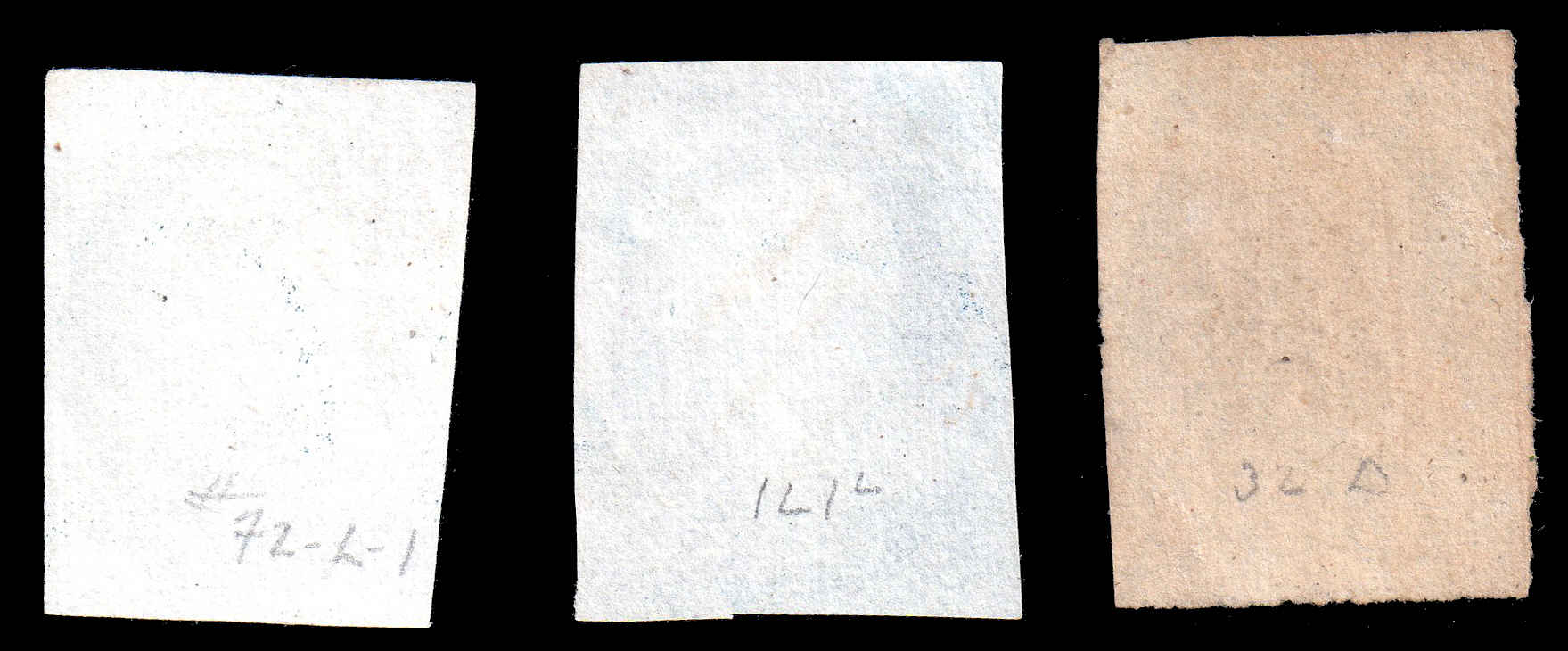 |
|
Send note to Staff
|
|
|
Pillar Of The Community
United States
1946 Posts |
|
|
Quote:
The so-called ribbed paper was thought to be exclusive to National until Mr. Mooz was able to identify a certain few Continental printings on the same paper.
With all due respect, I think you got this turned around. Wiley and Stevenson, early in the 20th century associated ribbed paper primarily if not exclusively, with the Continental Bank Note Co. By end of (XXth) century the exclusive use of this paper by CBNC was the basis for determining the 24c on ribbed to be a bona fide Continental printing. The article by Mooz correlates and contrasts the paper used for the Cont special printings and their subsequent use of ribbed paper. What did you actually have in mind regarding something used by National that appear(s) on a few examples from Continental? |
|
Send note to Staff
|
| Edited by essayk - 01/06/2018 01:03 am |
|
|
Pillar Of The Community
1375 Posts |
|
|
hello essayk,
yes, these were just my thoughts about this in my last post. Also in my last post, some questions about 1861 thin paper - do you perhaps have information on these questions? |
|
Send note to Staff
|
|
|
Valued Member
213 Posts |
|
|
stamperix. Re: 24c banknote.
If I misled you in any way I apologize. I just work on the fundamentals. I have no association with the catalog or catalog editors. Nothing that I say or write about has any connection to the catalog, nor do I make any catalog recommendations. In this case Mr. Mooz has sorted this issue out with the catalog (See "The Continental Bank Note Company Printing of the 1873 24c, Scott #164." by William E. Mooz).
There's a problem with the concept of ribbed paper, mainly that it's a manufacturing defect and therefore unpredictable. For instance, I have found ribbing on the U.S. 1861 issue and 1873 issue. I have also found ribbing on the U.S. postal cards issue of 1872. Taken together, these items form the basis of my theory on the subject.
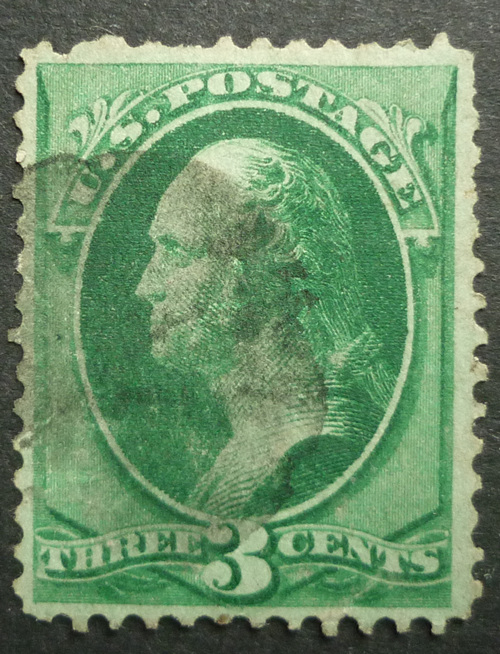
To get back to your question; There is a condition of weak horizontal ribbing that is fairly common on U.S. Departmental issues. This is the variety that is associated with the Continental Banknote Company (CBCo.). This kind of ribbing is also found on the regular stamp issue of 1873.
Now, there's a second variety of ribbing. This is a strong vertical ribbing, a rather scarce condition, and it may be found on regular stamp issues printed around 1872-3. This is the variety I alluded to in prior posts. I have found this condition on a 3c CBCo. stamp.
There has been a long-running discussion concerning the so-called "Lost Continental," which was a ribbed 24c banknote. By paying close attention it is learned that the 24-cent stamp has strong vertical ribbing (the latter variety above). Catalog editors deduced therefore that since this stamp does not have the "signature" horizontal ribbing, it cannot be used as the basis of a CBCo. listing.
So then, this is were my research comes in. If a NBCo. stamp is found with strong vertical ribbing, then it may be said that the same paper manufacturer was used by both NBCo. and CBCo. QED.
|
|
Send note to Staff
|
| Edited by AJ Valente - 01/06/2018 12:19 pm |
|
|
Pillar Of The Community
United States
1414 Posts |
|
|
Quote:
So then, this is were my research comes in. If a NBCo. stamp is found with strong vertical ribbing, then it may be said that the same paper manufacturer was used by both NBCo. and CBCo. QED. Al, In front of me as I type this is a 2 cent unused no gum Continental Bank Note Company stamp (Scott 146 ribbed paper variety with thin spots and a horizontal crease) with four certificates: PF 0418822 11/29/2004: 146 red brown unused no gum PF 0424766 05/24/2005: It is not Scott 146, rather it is a unused Scott 157, brown shade, on vertically ribbed paper APEX 171053 11/30/2006: Scott No. 146 on vertically ribbed paper PF 449274 05/07/2007: It is not Scott 146, rather it is a unused Scott 157, brown shade, on vertically ribbed paper This stamp may be part of the reason that some philatelists believed that National Bank Note Company used ribbed paper. The stamp is clearly brown. It is not the red brown National Bank Note Company shade and the lines appear to be joined at the location where the "secret mark" is said to be. The lines are not joined on National printings. While it may be that a ribbed pattern can occur on the surface of the paper as a result of manufacturing difficulties, it is also possible that Continental Bank Note Company ordered the paper in an attempt to improve printing quality. Unlike the National Bank Note printed 15 cent Scott 152, some fine lines in the corner triangles are missing in Continental Bank Note printings, except for examples on ribbed paper. I once saw a 163 with vertically ribbed paper certified by PSE as a 152, possibly because the printing quality was so much better. However, the stamp had the Continental yellow orange shade instead of bright orange. Information from the paper study by Ron Burns suggests that Continental ribbed paper in use for only a few months. I don't have the dates handy. For what it is worth, Continental silk paper also had a short period of use starting after the rate supporting the need for the 24 cent denomination had ended. This does not explain the 24 cent examples on silk paper, because there are no other National Bank Note printed denominations on paper with hundreds of tiny black fibers. |
|
Send note to Staff
|
| Edited by cfrphoto - 01/06/2018 4:13 pm |
|
|
Pillar Of The Community
United States
1946 Posts |
|
|
Quote:
There has been a long-running discussion concerning the so-called "Lost Continental," which was a ribbed 24c banknote. By paying close attention it is learned that the 24-cent stamp has strong vertical ribbing (the latter variety above). Catalog editors deduced therefore that since this stamp does not have the "signature" horizontal ribbing, it cannot be used as the basis of a CBCo. listing.
The 2018 US Specialized still lists with a note the entry of a stamp on vertically ribbed paper as the only certified Continental 24c able to be identified as US #164. In characterizing vertically ribbed paper as seldom seen and something less than a Continental fingerprint, substituting the horizontal ribbing seen on Departmental special printings as the characteristic Continental signature, you flip flop the work of some great philatelists over the 20th century. Would I be wrong to suspect that you have been strongly influenced by the opinions of Bill Mooz who would try to see vertical ribbing as a National signature, and whose works on the topic as published in the USPCS Chronicle make no mention whatsoever of the works of Wylie, Stevenson, and more recently Ron Burns writing for the PF? Given my own unpublished studies of the subject going back into the 1980s I really wonder if Mooz is using the same notion and imagery for "ribbing" as these other students. I am aware that there have been more than a few students who have mistaken mesh varieties for vertically ribbed paper. Perhaps Mr. Mooz was misled by the reconstructive speculations of Roy White in supposing how ribbing was actually achieved. Be that as it may, it is certain that the present dominant understanding of what constitutes vertically ribbed paper holds to a form which predominates among the issued postage stamps far more often than anything like the horizontal ribbing of the departmental stamps. True vertical ribbing is far more abundant than horizontal ribbing among the regular postage issues. It appears exactly as Wiley and Stevenson described it (40 lines to the inch), and is easily encountered on the 15c and the 2c, but is not rare on several other denominations as well. This will give you a sense of the distribution: 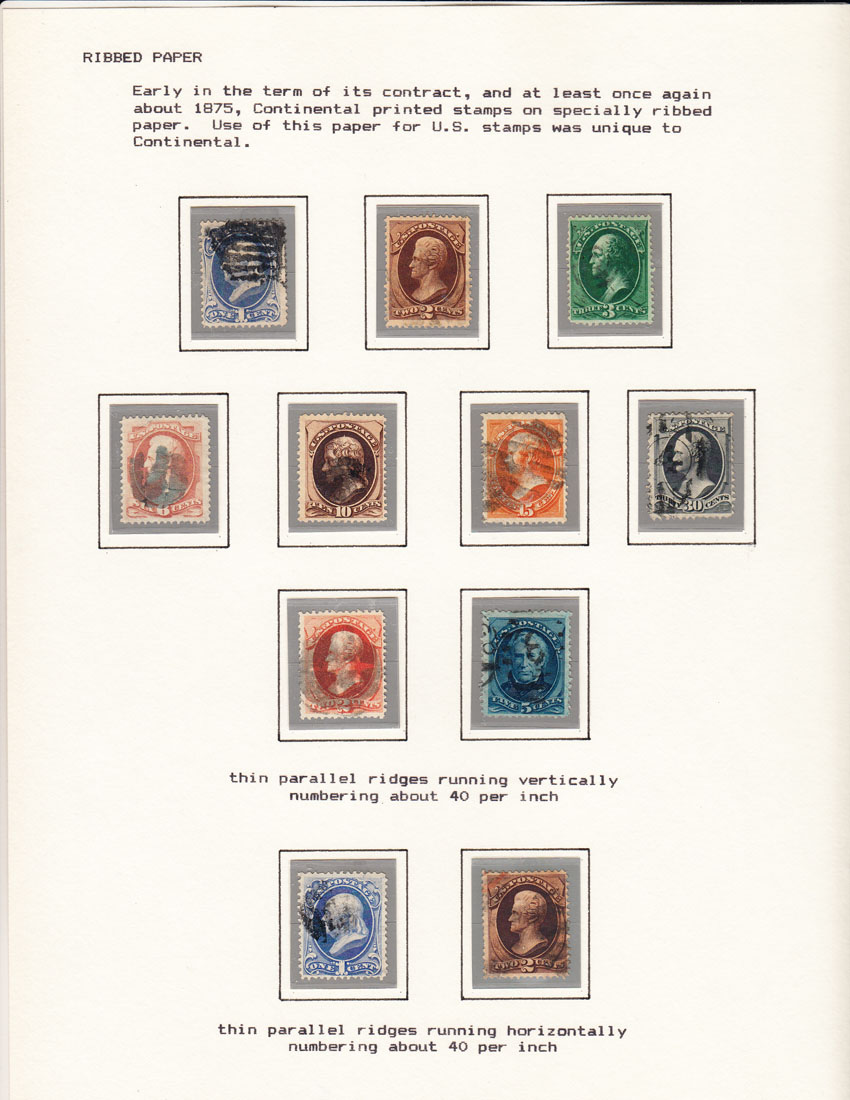 (That page was prepared for an exhibit in 1992.) I look forward to learning more from you about your own investigations into these matters. What do you understand ribbing to be? |
|
Send note to Staff
|
| Edited by essayk - 01/06/2018 11:19 pm |
|
|
Valued Member
213 Posts |
|
|
jaxom100: The variations in thickness of the 1851 issue are consistent with handmade paper. Its just the nature of the product. I have it at 31 thousandths with deviation of 5 thousandths (e.g. .0031" +/- .0005"). The thinner varieties are .0027", while the thicker varieties are sometimes as thick as .0036".
|
|
Send note to Staff
|
|
|
Valued Member
213 Posts |
|
|
cfrphoto wrote: "it is also possible that Continental Bank Note Company ordered the paper in an attempt to improve printing quality"
With regard to the 2-cent stamp. Again, I work on the fundamentals of paper and have no basis to comment on stamp color. I do know from research in the Travers papers that the color was changed from brown to vermilion following chemical testing of cancellation inks by the Government.
Your statement above goes back to the Barwis report in which it is shown that certain changes occurred to the paper with regard to beating time and sizing. Such changes would result in noticeable differences in opacity and thickness, however the latter could also be regulated to a certain extent on the paper machine.
Barwis suggests the changes were done for cost efficiency. In my upcoming article it is said (in the footnotes) that "No record of conversations about the stamp paper exist from this time, so the purpose of the changes made by Continental BNCo. remain a mystery."
|
|
Send note to Staff
|
| Edited by AJ Valente - 01/07/2018 08:54 am |
|
|
Valued Member
213 Posts |
|
|
essayk:
The vertical ribbed variety is somewhat rare. I think Wiley stated (from memory here) he found 6 copies among 10,000 3-cent stamps. The variety is also somewhat exclusive, being centered around the year 1873. To me the aspects of rarity and exclusivity are some of the great things about American stamp paper and the study thereof. I thoroughly enjoy seeing an entire set of them, thank you.
Mooz's work builds upon a theory that the 24-cent variety is exclusively a National printing. My research supports that notion, although I find it difficult to envision how that process might work. If the mill supervisor were standing here today we could ask him, but even then I don't think a satisfactory answer would result. If pressed on the matter, I suppose that I don't agree or disagree, this is but a minor point that has little bearing on the overall picture. Still, I would be remis not to mention it, albet in the footnotes.
I have little doubt about the theory of what created the strong ribbing. The most important breakthrough came from press reports regarding problems with the 1872 Postal Card issue. The papermaker admitted his calendars had gone bad, and, sure enough, strong ribbing is found in the paper. There is also the very early ribbed variety seen on the 1861 issue. Here the lines are not straight but rather wavy, indicating weakness in the belt. These were some of the first belts made in America, and although the textile maker had successfully stolen the pattern from England, they had still not perfected the manufacturing process at this early date.
There is almost no evidence to support a theory on the weak horizontal ribbing. One thing for certain is the paper was fairly dry when the marking occurred. I think it has something to do with the cutter and stacker mechanism, but admittedly the marks might even have been made by an automated ruling machine (dry pens without any ink in the reservoir). Needless to say, some problems defy any effort to explain them, and without some concrete evidence this variety will remain unexplained for the foreseeable future. |
|
Send note to Staff
|
|
|
Pillar Of The Community
1375 Posts |
|
|
Valued Member
213 Posts |
|
|
stamperix wrote "maybe you have some information about the thin paper of 1861"
Hann has made some good observations. There is indeed some rational behind these varieties, but more study is needed.
There has been some recent progress in the area of mid-to-late 1860s papers. Many people have suspected this for quite some time, but it may now be confirmed that there was a paper change in 1867. We have all been conditioned to ignore the question of paper and think of the 1867 issue as exclusively grilled, but that picture is now changing.
A different paper mill began supplying stamp paper in 1867, and this stock is noticeably softer. Much is known about the equipment at this particular mill, and so the qualitative change in the character of the 1867 papers may be explained in those terms.
A collector contacted me recently about an article he is writing on a mid-60s paper variety, so I won't comment further except to say that this variety was confirmed to be an 1867 printing. |
|
Send note to Staff
|
|
|
Replies: 49 / Views: 17,288 |
|




 Posted 01/04/2018 12:59 pm