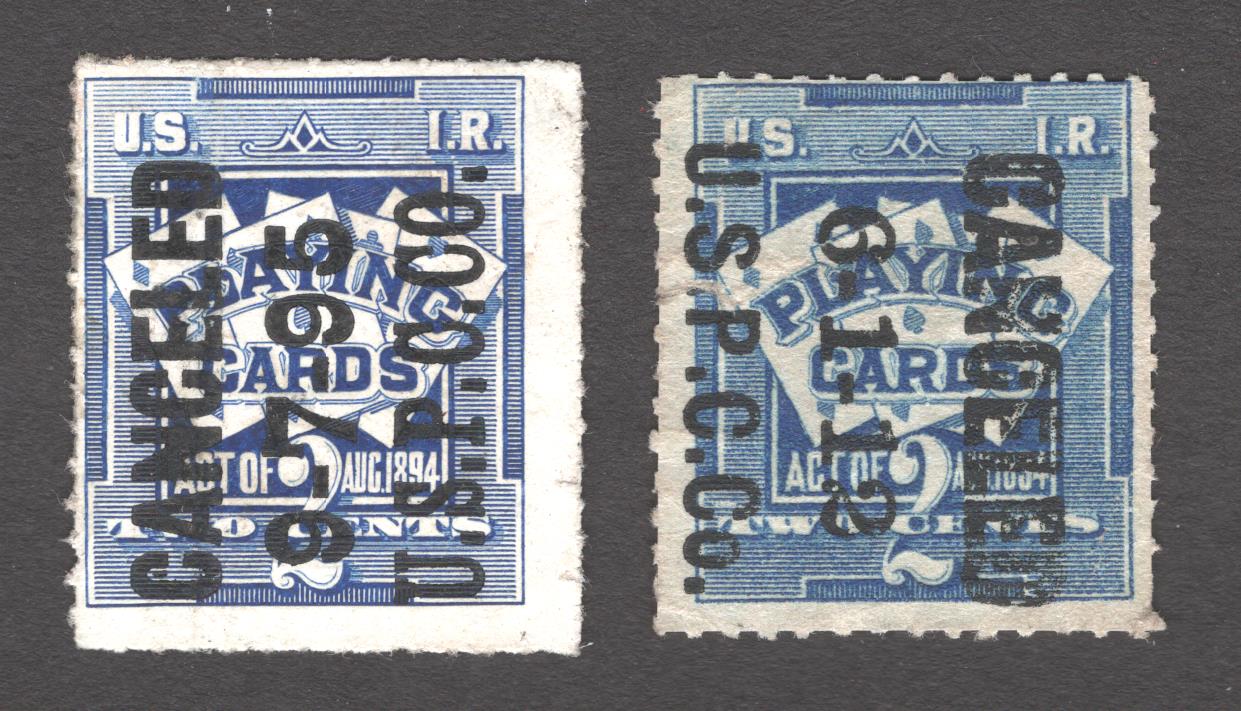
I'm not sure why Scott doesn't list this information, but, as far as I am aware, RF2d and RF2e were only used by the United States Playing Card Company.
The RF2d variety is known on thick (left) and thin (right) paper.
Jim - I am most skeptical of the rouletted stamp on the right, the one with 1912 cancel. The margins seem very small to my eye. The U.S. Playing Card experiment with rouletting of imperforate playing card stamps lasted less than a year, and no later than March, 1896. The experiment started with complete rouletting for a month (?) and then they only rouletted vertically in October, 1895 through March, 1896.
Jim - Your 1912 use almost certainly is on watermarked paper and therefore would be RF3.
I think the more interesting study of RF3 would be to track at what period of time the change from roulette 5 ½ to hyphen hole (or the classic term slot perforated) 7 was made. But there is one more change back to rouletting - roulette 7. In my experience pairs are almost necessary to differentiate the difference between hyphen hole versus rouletting that gauge the same. This latter change takes place quite late in the long period of use of RF3. As I recall it takes place some time in 1914.
Disclaimer: While a tremendous amount of effort goes into ensuring the accuracy of the information contained in this site, Stamp Community assumes no liability for errors. Copyright 2005 - 2026 Stamp Community Family - All rights reserved worldwide. Use of any images or content on this website without prior written permission of Stamp Community or the original lender is strictly prohibited. Privacy Policy / Terms of UseAdvertise Here





 Posted 01/06/2018 9:28 pm