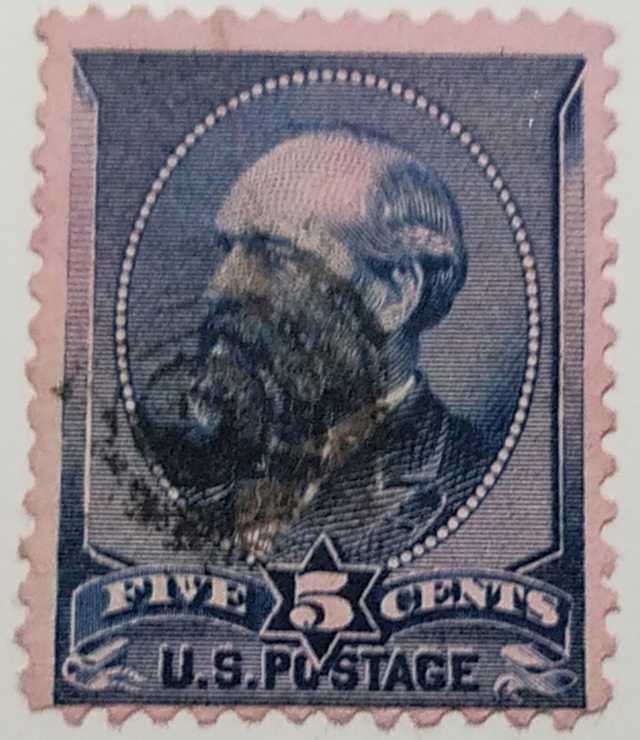
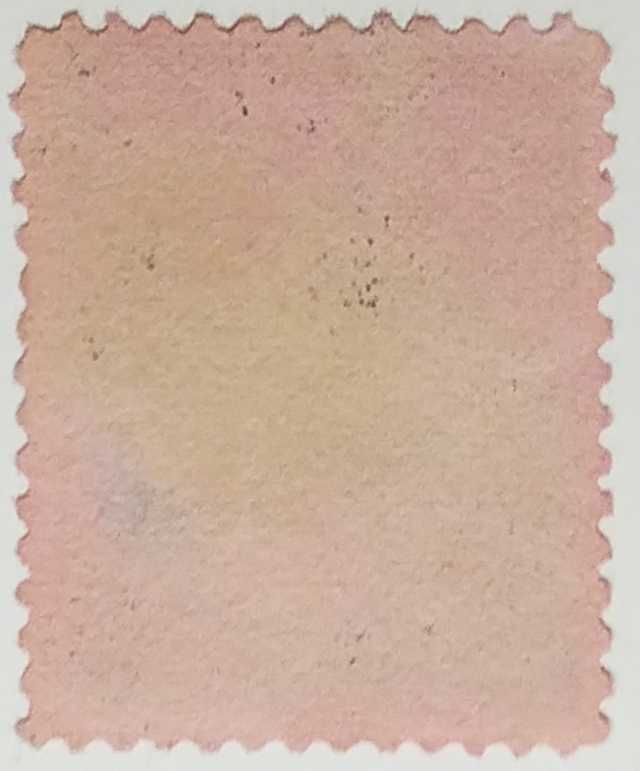
You are correct to infer that the discussion about "pink backs" has nothing to do with the "pink paper" variety of the 5c Garfield.
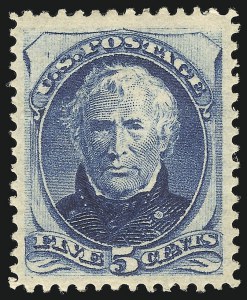
Your reference to the 5c Taylor on pinkish paper threw me off for a bit until I checked the Hahn article and a writeup of the Eagle auction. Hahn cleared it up: "Later we find the 5¢ Taylor of 1875 is known on a pinkish
laid paper." (emphasis mine.) This is a reference to one of the paper shades of what Brazier referred to as the Campbell, Hall, and Co safety paper experimentals.
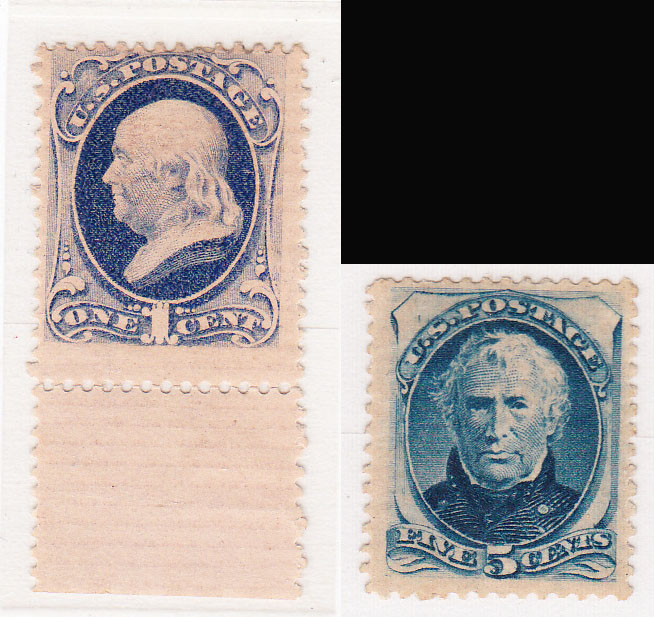
That paper is rather thick and stiff, with strongly pronounced lines that until recently were thought to be laid lines, though today are understood to have been impressed by the dandy roll in the manufacture of machine made paper. It was produced in three color toned papers, one of which has pinkish overtones. These were never issued and need not concern us further.
The 5c Garfield is a different matter. In his magisterial work of 1902, John Luff reported that a single unused example of the 5c on paper with a decidedly pink tone was shown to him by a Mr. F. O. Conant of Portland, Maine. Conant reported that a local collector had purchased a lot of ten or fifteen such at the Portland Post Office in 1889. Among the group was a top margin plate number pair, in which the color ran evenly all the way through the margin to the edge. The evenness of the coloring precluded that it was some kind of accidental stain. Luff says no more about it, but the variety is listed in the first U.S. Specialized in 1926, and continues to be listed as an "a" or "b" subvariety until 1973, when it disappears. It was not moved to the proof section, nor does it resurface in 1992 with the essay section.
Brookman, in his discussion of 216 in volume three of his magnum opus, includes a letter from J.M. Bartels to a client in which he enclosed a pair of a similar pink paper he had sold to a client but could not get agreement on its authenticity, despite testimony from John Luff himself. He also relates that Luff had purchased the copy earlier shown him by Conant, but that it had been stuck down on a page and was ruined as evidence in the attempt to remove it. Here I would note that this damaged example is what you should expect to find in the Luff reference collection at the PF. Brookman adds the note that although the pink paper type was never listed used, at the time of his writing (1967) unnamed specialists advised him that genuine used examples were known to exist (most probably still on cover).
Hereafter, so far as I know, the trail goes cold. I have read no further discussions of it, and in 1973 it was removed from the Specialized, though on what evidence or authority I cannot say. I have never seen one, and cannot quite imagine what it looks like. However, there is a precedent for something like it from about ten years earlier than it would have been issued. Here is an example of an experimental modeling the varnish coated paper of Joseph Schnoble, having all the characteristics of such a stamp variety:
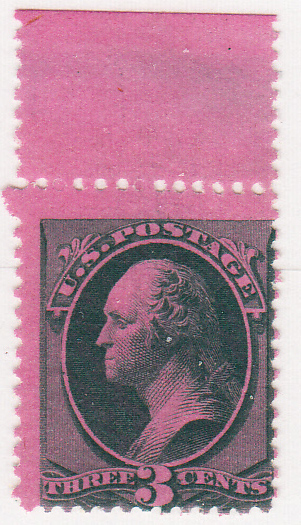
I do not think that the 5c Garfield indigo on pink paper was a resurrection of the Schnoble patent since the days of that quest were long past by 1888. But the patent item is certainly a precedent. Until I see contrary conclusive evidence debunking the existence of such a thing I leave the door open for it to surface. One further note: numerous US essays of the late 19th century, several of them unknown prior to recovery, have surfaced among old collections in Europe. Since you are in Germany it would pay to keep your mind and your eyes open for something that has apparently not been seen in the United States for a very long time.





 Posted 02/06/2018 03:50 am