Quote:
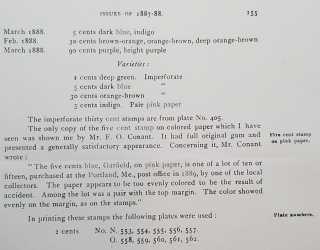
One last piece of information to add to the puzzle. Scotts 1902 edition specifically ID's the pink varient and details about its production and a (then) current owner of a number of the stamps. So regardless of the authenticity of my stamp, there is strong evidence that several existed in 1902.
So the mystery deepens.
Brad
You do not understand correctly what that work is from 1902. I understand that you are eager to establish your stamp as an undiscovered rarity. I get it. But let me caution you that speculation is no substitute for good research, though I do admire and applaud your effort in turning up Luff. But we've been there before.
The mystery is not deepening. You just failed to read one of the paragraphs I wrote and posted earlier in this thread. Now, if you want to understand, you need to carefully read all of what I have written here, starting with the earlier paragraph.
Quote:
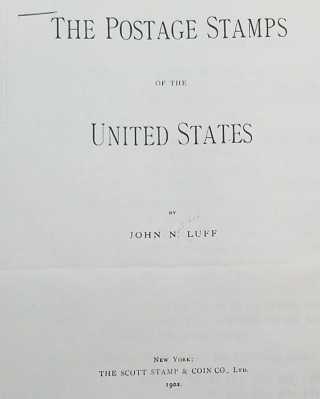
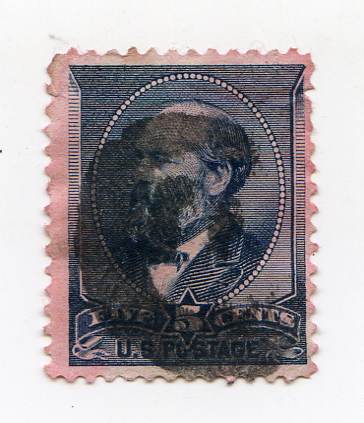
The 5c Garfield is a different matter. In his magisterial work of 1902, John Luff reported that a single unused example of the 5c on paper with a decidedly pink tone was shown to him by a Mr. F. O. Conant of Portland, Maine. Conant reported that a local collector had purchased a lot of ten or fifteen such at the Portland Post Office in 1889. Among the group was a top margin plate number pair, in which the color ran evenly all the way through the margin to the edge. The evenness of the coloring precluded that it was some kind of accidental stain. Luff says no more about it, but the variety is listed in the first U.S. Specialized in 1926, and continues to be listed as an "a" or "b" subvariety until 1973, when it disappears. It was not moved to the proof section, nor does it resurface in 1992 with the essay section.
Permit me to direct your attention to vol 3, page 20 of the 1967 work by Lester Brookman on the
United States Postage Stamps of the 19th Century. There Brookman quotes a 1946 letter from J. Murray Bartels to a customer who had won an auction lot consisting of another 5c blue on pinkish paper. The house wanted to confirm that the example to be sent was indeed what was at the time listed in the Scott catalog as a variety, so they submitted it to two of the most prominent authorities of the day, one of whom was John Luff himself. The authorities could not agree, so the house gave the man the lot at no charge, convinced for their part that it was indeed the correct variety.
But in that letter they go into some detail about how, in the discovery of the original examples which gave rise to the listing, Conant had procured one of the originals for his collection. Unfortunately, by the time his collection was sold to Luff, that stamp had become stuck down to an album page, and subsequently soaked off. Its value as a comparison copy was completely compromised. Nonetheless, in Luff's recollection of that original stamp, it was a deeper shade of pink than the copy Bartels was offering, and even in its soaked condition it was a deeper pink. Hence the generosity of the house in releasing what must be called a "might have been."
Today, the PF owns and is caretaker for the Luff reference collection, and that stamp, sans gum, may still be there. But without gum its value as a comparison reference is nil. As for the absence of gum, Brookman reported that a couple of used stamps were supposedly accepted by some as authentic originals of this variety, but how that was done and by what authorities is today unknown to the PF. Usually something that connects the used examples to an authenticated original find is noted in an affidavit and submitted as corroboration. But even that is not known to exist today. So, without a good basis for re-establishing the existence of the variety the PF considers the matter closed, as you have seen for yourself.
As for your stamp, the pink color is not uniformly distributed over the entire range of paper, and would be disqualified by any competent authority familiar with the case. Today the burden of finding authenticated corroborating copies will be upon anyone making the kind of claim you would like to make about your stamp.





 Posted 05/15/2018 07:20 am